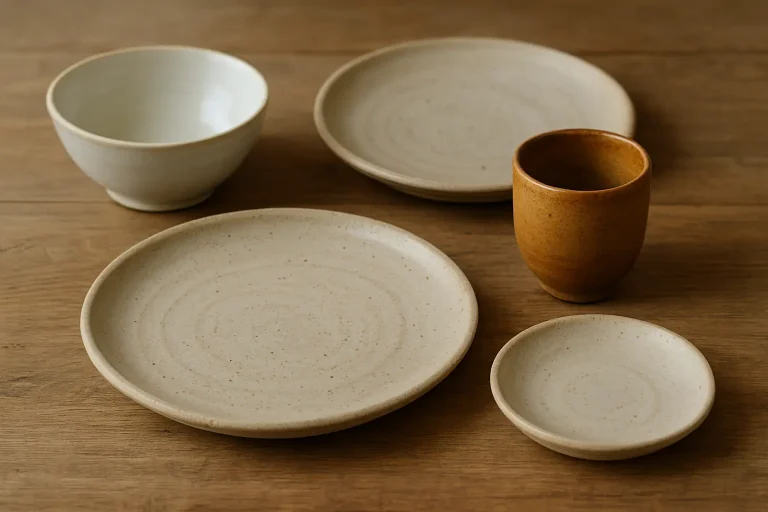
History of Ceramics From Ancient Pottery to Modern Materials

Humans have been shaping clay into useful and beautiful objects for more than 20,000 years, making ceramics the oldest known synthetic material on Earth. This guide covers the complete arc of ceramic history, from the earliest fired clay figurines of the Upper Paleolithic through ancient earthenware traditions, the invention of stoneware and porcelain, Islamic and European tin-glazed traditions, the Industrial Revolution’s transformation of pottery production, the 20th-century studio pottery movement, and the advanced technical ceramics now used in aerospace, medicine, and electronics.
Understanding this history is not just an academic exercise. Every technique, material choice, and firing method used in studios today has roots in decisions made by potters thousands of years ago, and knowing why those decisions were made helps modern ceramicists understand why the materials behave the way they do.
What Are the Oldest Known Ceramics and When Did Humans First Fire Clay?
The oldest known fired ceramic objects are the Dolni Vestonice figurines from the Czech Republic, dated to approximately 26,000 BCE, making ceramic technology older than agriculture, metalworking, and writing. These were not pots but small animal and human figures fired at low temperatures, around 500 to 800°C (932 to 1472°F), in open hearths or simple pit fires.
The oldest known ceramic vessels come from Xianrendong Cave in Jiangxi Province, China. Research published in the journal Science in 2012 by Wu Xiaohong and colleagues dated pottery fragments from that site to approximately 20,000 to 19,000 years ago, pushing the origin of pottery-making deep into the Last Glacial Maximum.
This dating overturned a long-held assumption that pottery emerged only after the Neolithic transition to settled farming communities. Ceramic vessels clearly appeared among mobile hunter-gatherer populations first.
Why Did Early Humans Fire Clay, and What Did They Make?
The earliest ceramic figurines at Dolni Vestonice were not utilitarian objects. Archaeologists including Nicholas Conard, writing in the journal Nature, have argued that these objects served ritual or symbolic functions, representing an early human capacity for abstract thinking and material transformation.
Pottery vessels emerged independently in multiple regions. After the earliest Chinese examples, pottery appeared in the Japanese Jomon culture around 14,000 BCE, in the Levant and Near East around 8,000 to 7,000 BCE, in sub-Saharan Africa around 9,000 BCE, and in the Americas independently around 5,000 to 4,000 BCE.
Each of these traditions developed distinct forming methods, surface treatments, and firing technologies suited to their local clay sources and social needs.
How Did Early Firing Temperatures Shape What Ancient Potters Could Make?
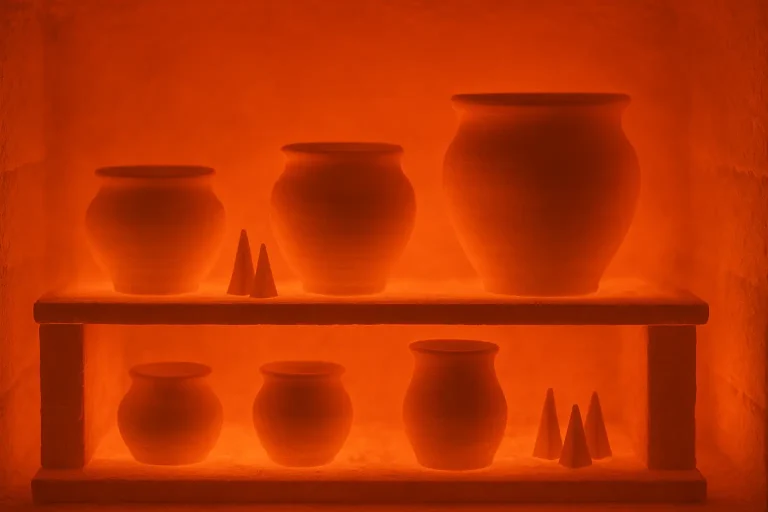
Early open-fire and pit-fire kilns reached temperatures between 600 and 900°C (1112 and 1652°F). At these temperatures, clay undergoes a permanent chemical transformation called sintering, where clay particles bond together but the material remains porous with absorption rates typically above 10%.
This porosity had practical consequences. Unglazed earthenware at these temperatures absorbs liquids, making it unsuitable for storing oils or fermented beverages without organic liners like pitch or resin. Early potters compensated by burnishing the surface before firing, collapsing surface pores and reducing but not eliminating absorption.
The mechanism at work is straightforward: silica in the clay begins to fuse with alumina and flux minerals only above approximately 950°C (1742°F). Below that threshold, the ceramic matrix stays open and permeable. Raising kiln temperature was therefore not just a refinement but a chemical threshold that unlocked new functional possibilities.
How Did Ancient Near Eastern and Egyptian Pottery Establish the First Ceramic Traditions?
The Neolithic cultures of the Near East, including the Hassuna, Samarra, and Halaf peoples of present-day Iraq and Syria between roughly 7,000 and 5,000 BCE, developed the first decorated pottery traditions using geometric painted designs applied before firing with iron-rich slips that fired to red, brown, and black.
Egyptian pottery from the Predynastic period (around 4,400 to 3,100 BCE) is notable for its Naqada I red-polished black-top ware, where potters created two-tone effects by inverting pots in ash during the final phase of firing. The oxygen-starved zone produced black coloration through carbon deposition, while the exposed red body fired in normal oxidation conditions.
This deliberate manipulation of firing atmosphere is one of the earliest documented examples of potters controlling kiln conditions to achieve a specific surface effect.
What Was Egyptian Faience and How Was It Made?
Egyptian faience is not technically a ceramic made from clay. It is a quartz-core material coated with an alkali-silica glaze, typically colored turquoise or blue with copper compounds. Fired at temperatures between 870 and 1000°C (1598 and 1832°F), faience was used for amulets, tiles, and vessels from at least 3,500 BCE through the Roman period.
The blue-green color comes from copper oxide (CuO) dissolved in an alkali glaze. Copper produces turquoise in alkaline flux systems and green in lead flux systems, which is why Egyptian faience looks different from later lead-glazed Roman and medieval wares despite using the same colorant.
Faience production required a quartz body ground to specific particle sizes, a copper-containing glaze material, and precise firing to achieve vitrification of the glaze without collapsing the quartz core. According to materials scientist Pamela Vandiver, whose research on ancient ceramic technology has been widely cited, three distinct manufacturing methods were used: surface application, efflorescence of soluble salts to the surface, and cementation in glaze powder.
What Made Chinese Ceramics the Foundation of Global Pottery Technology?
Chinese potters made the single most consequential leap in ceramic history when they developed high-fire stoneware and, eventually, true porcelain. Stoneware firing at temperatures above 1200°C (2192°F) produces a vitrified body with absorption rates below 1%, creating vessels that are liquid-tight without any glaze.
The earliest Chinese stoneware dates to the Shang Dynasty, around 1600 to 1046 BCE, fired in cross-draft kilns capable of reaching 1200°C (2192°F) or higher. These kilns used the combustion gases more efficiently than earlier updraft designs, channeling heat horizontally through the ware before exhausting it through a chimney at the back.
Chinese ceramic technology influenced every major pottery tradition that followed, and Chinese porcelain in particular drove centuries of European attempts to replicate it.
How Was True Porcelain Invented and What Makes It Different from Stoneware?
True porcelain is a high-fire ceramic body made from kaolin clay (a pure, white-firing aluminosilicate), feldspar (the flux), and quartz (the glass former). Fired to cone 10 to 14 (2381 to 2530°F / 1305 to 1388°C), the feldspar melts and fills the spaces between kaolin particles, creating a dense, translucent, vitrified matrix with absorption rates below 0.5%.
Chinese porcelain production is traditionally dated to the Eastern Han Dynasty (25 to 220 CE), though proto-porcelain wares appear earlier in the Shang period. The Tang Dynasty (618 to 907 CE) saw the development of two foundational porcelain traditions: white ware from northern kilns at Xing and blue-green celadon ware from southern kilns at Yue.
The Song Dynasty (960 to 1279 CE) is widely regarded as the classical peak of Chinese ceramics. Song court wares including Ru, Guan, Ge, Ding, and Jun represent five of the most technically and aesthetically refined ceramic traditions in history.
What Produced the Blue and White Porcelain That Dominated Global Trade?
Blue and white porcelain, the most widely traded and imitated ceramic ware in history, was developed during the Yuan Dynasty (1271 to 1368 CE) at the Jingdezhen kilns in Jiangxi Province. The cobalt blue decoration is applied as an underglaze, painted onto the unfired or bisque-fired porcelain body and then covered with a transparent glaze before the final high-fire reduction firing.
The cobalt ore used in early Yuan and Ming Dynasty blue and white porcelain was imported from Persia, containing manganese impurities that produced the characteristic heaped and piled effect visible in the brushwork of early pieces. Later, domestic Chinese cobalt sources with lower manganese content produced a more even, lighter blue.
Cobalt oxide (CoO) is one of the most reliable ceramic colorants. It produces blue across all firing atmospheres and across a wide temperature range from low-fire earthenware (cone 06 to 04, approximately 999 to 1060°C / 1830 to 1940°F) to high-fire stoneware and porcelain (cone 10, 1305°C / 2381°F). No other oxide matches its color stability across conditions.
For anyone working with underglaze cobalt decoration today, cobalt carbonate powder at 0.5 to 2% addition produces reliable blue in most glaze systems.
How Did Islamic Potters Transform Ceramic Technology Between 700 and 1400 CE?
Islamic potters working across Persia, Mesopotamia, Egypt, and Spain between the 8th and 14th centuries made contributions to ceramic technology that permanently changed the materials and aesthetic vocabulary of world pottery. Their most significant technical achievement was the development of tin-opacified lead glazes, which produced a brilliant white surface on low-fire earthenware bodies that could be decorated with colored oxides.
The tin glaze works because tin oxide (SnO2) is chemically insoluble in a lead silicate glaze melt. The tin particles remain suspended as fine crystals throughout the glaze layer, scattering light at all wavelengths and producing an opaque white surface that functions as a ground for painted decoration. A typical tin glaze formula contains 8 to 12% tin oxide by weight added to a lead silicate base glaze.
This technology spread westward from Persia through North Africa and into Spain, eventually producing the Hispano-Moresque lustrewares of Valencia and the tin-glazed maiolica tradition of Italy. For a detailed technical history of this tradition, our guide to tin-glaze application methods and historical maiolica production covers the full chemistry and studio replication techniques.
What Was Lusterware and How Did Islamic Potters Achieve Its Metallic Surface?
Lusterware is a ceramic decoration technique in which metallic oxides (typically silver, copper, or gold compounds) are applied over an already-fired glaze and refired at a lower temperature (around 500 to 700°C / 932 to 1292°F) in a reducing atmosphere. The metal ions in the overglaze decoration are reduced back to their metallic state, depositing a thin metallic film on the glaze surface.
The mechanism requires precise atmosphere control. Too much reduction collapses the metallic film into a dark, matte deposit. Too little reduction leaves the metallic compounds as dull colored oxides rather than reflective metal. The correct reducing atmosphere produces a thin, adherent metallic film one to two atoms thick that reflects light with an iridescent, shifting quality impossible to achieve by any other means.
Abbasid Baghdad potters developed this technique in the 9th century CE, and it spread to Fatimid Egypt, Seljuk Persia, and Moorish Spain. The Alhambra Vase, produced in Granada around 1300 CE and now in the Museo Nacional de Arte Hispanomusulmán, represents the technical and artistic peak of Islamic lusterware.
How Did Ancient Greek and Roman Potters Shape Western Ceramic Traditions?
Ancient Greek pottery between roughly 900 and 300 BCE represents one of the most documented and technically analyzed ceramic traditions in history. Greek potters developed three major decorative styles in sequence: Geometric (900 to 700 BCE), Black-Figure (700 to 480 BCE), and Red-Figure (530 to 300 BCE), each representing a distinct approach to the relationship between clay body color, slip decoration, and firing atmosphere.
The black slip used on Attic Greek pottery is not a glaze. It is an extremely fine particle-size iron-rich slip that vitrifies at a lower temperature than the coarser clay body, producing a hard, dense, slightly shiny black surface when fired in a three-phase kiln firing: oxidizing (turning both body and slip red), reducing (turning both black through carbon deposition and FeO formation), and re-oxidizing (re-burning the coarser body red while the denser slip retains its black surface because it has already vitrified and cannot re-absorb oxygen).
Our detailed examination of Greek pottery’s black-figure and red-figure firing techniques covers the three-phase kiln process and the slip chemistry in full technical detail.
What Did Roman Sigillata Ware Contribute to Ceramic Technology?
Roman terra sigillata (literally “sealed earth”), produced from approximately 100 BCE to 400 CE, was the first mass-produced standardized ceramic ware in history. Made primarily at workshops in Arezzo (Arretine ware) and later in Gaul (Gaulish samian ware), terra sigillata used press molds for relief decoration and a fine iron-rich slip fired to a uniform coral-red at temperatures around 1000 to 1050°C (1832 to 1922°F) in an oxidizing atmosphere.
The production scale was industrial by ancient standards. The Arezzo workshops of Publius Cornelius, documented in ancient sources, employed dozens of workers and produced standardized mold-made vessels distributed across the Roman Empire from Britain to Egypt. This industrialization of pottery production is the first documented example of what the Industrial Revolution would repeat 1,700 years later at much greater scale.
Roman potters also developed lead glazes for low-fire wares, primarily in the provinces of Gaul and Britain. Lead oxide (PbO) as a glaze flux dramatically lowered the melting temperature of silica, producing a glassy, transparent glaze at kiln temperatures between 900 and 1000°C (1652 and 1832°F) well within the reach of simple updraft kilns.
Here is a comparison table to help you understand how the major ancient ceramic traditions differed across the dimensions that matter most for understanding the history and technology:
Use the table below to compare the major ancient ceramic traditions by their key technical and cultural characteristics.
| Tradition | Period (Approx.) | Firing Temp. | Clay Body Type | Key Innovation | Glaze / Surface |
|---|---|---|---|---|---|
| Jomon (Japan) | 14,000 BCE | 600-800°C (1112-1472°F) | Low-fire earthenware | Cord-impressed surface decoration | Unglazed |
| Egyptian Faience | 3,500 BCE onward | 870-1000°C (1598-1832°F) | Quartz core (non-clay) | First glazed ceramic objects | Alkali-copper glaze (turquoise) |
| Chinese Stoneware | 1600 BCE onward | 1200°C+ (2192°F+) | Vitrified stoneware | First vitrified high-fire ware | Ash glaze, celadon |
| Greek Attic | 900-300 BCE | 950-1050°C (1742-1922°F) | Low-fire earthenware | Three-phase oxidation/reduction | Iron-rich black slip |
| Islamic Lusterware | 800-1400 CE | 900-1050°C (1652-1922°F) + 500-700°C refire | Low-fire earthenware | Metallic reduction luster | Tin-opacified lead glaze with luster |
| Chinese Porcelain | 200 CE onward | 1280-1400°C (2336-2552°F) | True porcelain (kaolin/feldspar/quartz) | First translucent vitrified ceramic | Transparent glaze, cobalt blue underglaze |
| Roman Sigillata | 100 BCE to 400 CE | 1000-1050°C (1832-1922°F) | Low-fire earthenware | First mass-produced standardized ware | Iron-rich red slip (unglazed) |
How Did European Potters Attempt to Replicate Chinese Porcelain Between 1400 and 1800?
Chinese blue and white porcelain arrived in Europe in significant quantities through Portuguese trade routes from the late 15th century onward, and European potters spent the next two centuries attempting to understand and replicate its translucency, whiteness, and hardness. The challenge was fundamental: European potters had no kaolin deposits they recognized as such and no kilns capable of sustained high-fire temperatures above 1300°C (2372°F).
The first European response was the development of faience and maiolica traditions in Italy, France, the Netherlands, and Germany from the 15th century onward. These wares used tin-opacified lead glazes on low-fire earthenware bodies to produce a white surface that could be painted with cobalt, manganese, copper, and iron oxides. They looked superficially similar to Chinese porcelain but were fundamentally different: porous, relatively soft (around 4 Mohs hardness versus 7 for true porcelain), and fired at temperatures below 1100°C (2012°F).
The Dutch Delftware tradition, which flourished particularly from roughly 1620 to 1800, produced some of the finest European tin-glazed earthenware specifically in response to Chinese blue and white porcelain imports. Our detailed examination of Delftware’s materials, firing methods, and historical context explains how Dutch potters adapted Islamic tin-glaze technology to compete with Asian porcelain imports.
What Was Soft-Paste Porcelain and Why Did It Fall Short of True Porcelain?
Soft-paste porcelain (also called artificial porcelain or pate tendre) was the first European attempt to create a porcelain-like body without kaolin. Developed at the Saint-Cloud factory near Paris around 1700 and at Vincennes and Sevres from the 1740s onward, soft-paste used glassy frit materials mixed with clay and chalk to create a translucent body firable at temperatures between 1100 and 1250°C (2012 and 2282°F).
The problem was structural. Soft-paste porcelain lacks the interlocked mullite crystals that form in true hard-paste porcelain during high-fire vitrification. Mullite (3Al2O3.2SiO2) forms from the reaction of alumina and silica above approximately 1200°C (2192°F) and provides the mechanical strength and thermal shock resistance that makes true porcelain durable. Soft-paste without mullite is significantly weaker, chips more easily, and cannot withstand sudden temperature changes.
Sevres soft-paste porcelain from the mid-18th century is nonetheless among the most technically accomplished and artistically refined European ceramics ever produced, achieving color effects and painted decoration that hard-paste porcelain could not replicate due to the more fluid, absorbent nature of the glaze on the soft-paste body.
How Was European Hard-Paste Porcelain Discovered at Meissen?
True hard-paste porcelain was first produced in Europe at the Meissen factory in Saxony around 1710, through the work of Johann Friedrich Bottger, a young alchemist working under the patronage of Augustus the Strong of Saxony. The critical discovery was kaolin. Bottger identified a deposit of white kaolinite clay at Colditz and recognized that when combined with feldspar and fired above 1300°C (2372°F), it produced a translucent, vitrified body equivalent to Chinese porcelain.
The discovery was kept as a state secret for decades. The Meissen factory, established at Albrechtsburg Castle in 1710, was the only European source of true hard-paste porcelain for approximately 50 years until the knowledge spread to Vienna, other German states, and eventually the rest of Europe.
Johann Joachim Kandler, the chief modeler at Meissen from 1733, developed the European porcelain figure as a distinct art form. Meissen figures used the white body as a canvas for enamel overglaze colors applied in a third firing at around 700 to 800°C (1292 to 1472°F), well below the glaze maturation temperature but hot enough to fuse the enamel oxides onto the glaze surface.
What Role Did the Industrial Revolution Play in Transforming Ceramic Production?
The Industrial Revolution transformed ceramics from a craft practice into a mass-production industry between approximately 1760 and 1850, driven primarily by developments in Staffordshire, England, and the entrepreneurial innovations of Josiah Wedgwood. Wedgwood’s contribution was not just mechanical efficiency but systematic materials science applied to ceramic production decades before the field was formally named.
Wedgwood developed several new ceramic bodies through systematic experimentation documented in his personal notebooks. Creamware (1762) was a refined lead-glazed earthenware with a cream-colored body from Cornish clay and calcined flint, fired at around 1100°C (2012°F), that was light, durable, and cheap enough to replace pewter tableware across the British population. Black basalt (1768) was an unglazed fine stoneware body colored with iron oxide and manganese that fired to a dense, smooth, matte black. Jasperware (1774) was a dense, unglazed stoneware body colored with metal oxides throughout its mass (not just on the surface), capable of taking extremely fine molded relief decoration.
How Did Wedgwood Apply Scientific Methods to Ceramics?
Josiah Wedgwood invented the pyrometer, a device for measuring kiln temperatures by measuring the contraction of clay test pieces fired to different temperatures, in 1782. Before this, potters estimated kiln temperature by eye, observing the color of incandescent heat through a spy hole. Wedgwood presented his pyrometer to the Royal Society in 1782 and was elected a Fellow the same year, the first potter to receive that honor.
Wedgwood’s pyrometer was eventually superseded by the Orton pyrometric cone system developed by Edward Orton Jr. in 1896. The Orton cone system measures heat work (the combined effect of temperature and time) rather than temperature alone, making it a more accurate predictor of ceramic body and glaze maturation. The Orton Foundation, based in Westerville, Ohio, still produces and calibrates pyrometric witness cones that are the global industry standard today.
Industrial ceramic production required standardization of clay bodies, glaze formulas, firing schedules, and quality control methods. The techniques developed in Staffordshire between 1760 and 1850, including jiggering (automated forming of flatware), jolleying (automated forming of hollowware), and slip casting in plaster molds, remain the production methods used by industrial ceramic manufacturers today.
How Did Transfer Printing Change Ceramic Decoration?
Transfer printing was developed in England around 1750 to 1760 and transformed the economics of ceramic decoration. Before transfer printing, every decorated piece required a skilled painter working by hand. Transfer printing used engraved copper plates to print designs onto tissue paper with ceramic oxide inks, which were then transferred onto the biscuit-fired ceramic surface and fired into the glaze.
The Blue Willow pattern, developed around 1790 and attributed to various Staffordshire factories, became the most widely produced transfer-printed ceramic design in history. The cobalt blue pigment used in underglaze transfer printing (applying the print before the glaze firing) required firing above 1200°C (2192°F) to fuse properly, which is why cobalt blue is the dominant color in traditional transfer-printed ware: it is the most stable oxide at high fire temperatures.
For those interested in replicating historical ceramic forms and understanding how materials science underpins ceramic production from ancient times to the present, our complete reference on ceramic materials science, clay body chemistry, and vitrification thresholds provides the foundational scientific context.
How Did Japanese Ceramic Traditions Develop Their Distinctive Aesthetic and Technical Identity?
Japanese ceramics represent one of the most philosophically distinctive ceramic traditions in history, in which aesthetic values developed from technical constraints rather than being imposed on them. The wabi aesthetic of the Muromachi and Edo periods (roughly 1336 to 1868) specifically valued irregularity, asymmetry, and surface accident produced by wood-firing atmospheres, ash glaze deposits, and the natural movement of clay.
The Jomon tradition, the world’s oldest known pottery tradition (approximately 14,000 to 300 BCE), produced low-fire earthenware with elaborate cord-impressed surface textures. Jomon pottery was not primarily utilitarian. Its elaborate surface decoration suggests ceremonial and social functions from the earliest period of Japanese ceramic history.
Raku ware, developed in Kyoto by the potter Chojiro in the late 16th century under the patronage of tea master Sen no Rikyu, represents the most influential specifically Japanese ceramic invention in terms of global studio pottery practice. Traditional Japanese raku uses a hand-built (not wheel-thrown) lead-glazed earthenware body fired slowly to approximately 800 to 1000°C (1472 to 1832°F) in a small kiln, then removed while still glowing and allowed to cool in the open air.
What Were the Major Japanese High-Fire Ceramic Traditions?
Japanese high-fire ceramic traditions centered on six original kiln sites, known collectively as the “Six Ancient Kilns” (Rokkoyo): Seto, Tokoname, Echizen, Tamba, Bizen, and Shigaraki. These kilns, active from roughly 1200 CE onward, produced unglazed or natural ash-glazed stoneware fired in anagama (single-chamber) or noborigama (climbing multi-chamber) kilns at temperatures between 1200 and 1300°C (2192 and 2372°F) using wood fuel.
The natural ash glaze that forms on Bizen and Shigaraki wares is not applied: it is the result of wood ash from the kiln’s fuel settling on the pottery surfaces during multi-day firings and melting into the clay surface at high temperatures. The glaze composition and color vary with the position of the pot in the kiln, the type of wood burned, and the length of the firing. No two wood-fired pieces are identical, and this irreducible variability is central to the aesthetic value placed on these wares.
Arita porcelain, developed in northern Kyushu around 1616 after Korean potters brought kaolin knowledge to Japan, was the foundation of Japanese export porcelain. Imari and Kakiemon wares from Arita were major Japanese exports to Europe from the 1650s onward and directly influenced European porcelain decoration, including Meissen’s early polychrome enamel decoration.
How Did the Arts and Crafts Movement and Studio Pottery Transform Ceramics in the Modern Era?
The Arts and Crafts movement in Britain and America from roughly 1880 to 1920 was a direct reaction against industrial ceramic production. Its founding argument, articulated by John Ruskin and William Morris, was that machine production separated the maker from the made object, producing work that was technically competent but spiritually empty. Pottery was central to the Arts and Crafts program because it combined all the values the movement prized: direct material engagement, hand forming, natural materials, and surfaces shaped by fire rather than applied decoration.
The studio pottery movement that grew from Arts and Crafts principles in the 20th century established the model of the individual artist-potter working alone or in a small studio, controlling every stage of production from clay preparation through firing. This model, which dominates contemporary ceramics practice today, is historically unusual. In every major pre-modern ceramic tradition, different specialists handled clay preparation, forming, decoration, and firing as separate skilled trades.
What Was Bernard Leach’s Contribution to Modern Studio Pottery?
Bernard Leach (1887 to 1979) is the single most influential figure in the history of Western studio pottery. His book A Potter’s Book, first published in 1940, remained the dominant technical and philosophical reference for studio potters for the next 40 years. Leach synthesized Japanese mingei (folk craft) aesthetics, the functional stoneware tradition of East Asia, and the English slipware tradition into a coherent studio practice that he established at the Leach Pottery in St. Ives, Cornwall, in 1920.
Leach’s technical contributions were as important as his philosophical ones. He introduced the anagama and noborigama wood kiln to Britain, established systematic glaze testing methods adapted from East Asian traditions, and developed stoneware glazes using locally sourced wood ash, feldspar, and iron oxide that produced surface qualities no Western potter had achieved before.
Key Specifications for Leach-tradition stoneware practice:
- Firing range: Cone 9 to 10 (2300 to 2381°F / 1260 to 1305°C), reduction atmosphere
- Clay body: Grogged stoneware, typically 10 to 15% absorption before firing, under 1% after
- Glaze system: Ash glazes, tenmoku, celadon, iron-saturate glazes in reduction
- Kiln type: Downdraft gas or wood kiln for reduction
- Shrinkage: Approximately 12 to 14% total from wet to fired
How Did the American Studio Pottery Movement Develop Its Own Identity?
American studio ceramics developed somewhat differently from the Leach-influenced British tradition, partly because American potters had access to both the Leach model (transmitted through figures like Warren MacKenzie, who worked at St. Ives) and to Abstract Expressionist painting, which influenced a generation of ceramicists toward more gestural, sculptural, and conceptually ambitious work.
Peter Voulkos (1924 to 2002) is the pivotal figure in American ceramics. Working at the Otis Art Institute in Los Angeles from 1954 and at the University of California, Berkeley, from 1959, Voulkos deliberately broke with functional pottery conventions by creating large-scale, slashed, punched, and deformed stoneware works that used ceramics as a sculptural medium equivalent to painting or sculpture. His influence established the legitimacy of ceramics as a fine art medium in American universities.
The contrast between the Leach-MacKenzie tradition (functional, modest, East Asian-influenced) and the Voulkos tradition (sculptural, expressionist, American) defined the central tension in American ceramics education through the 1980s and still shapes how ceramics is taught in art schools today.
What Is Raku Firing and How Did the Western Adaptation Differ from the Japanese Original?
Traditional Japanese raku, as described above, is a hand-built lead-glazed earthenware tradition with specific ritual associations to the Japanese tea ceremony. Western raku, developed primarily by Paul Soldner in California in the 1960s, uses the same basic principle of removing hot ware from the kiln but adds a post-firing reduction phase that does not exist in traditional Japanese practice.
In Western raku, pottery is loaded into a small gas kiln and fired rapidly to approximately cone 06 (999°C / 1830°F). The ware is then removed from the kiln while glowing and placed into a metal container filled with combustible material (newspaper, sawdust, or dry leaves). The combustible material ignites from the heat of the pottery, and the container is covered with a lid, creating a heavy reduction atmosphere inside.
The reduction atmosphere performs two distinct effects simultaneously. Carbon from incomplete combustion penetrates unglazed areas of the clay body, turning them black. Metallic oxides in the glaze (particularly copper compounds) are reduced to their metallic state, producing the iridescent copper and rainbow luster effects characteristic of Western raku. The glaze also crazes (develops a network of fine cracks) as the rapid thermal shock causes the glaze to contract faster than the clay body. This crazing, normally a defect to be avoided, is aesthetically central to Western raku.
A portable raku kiln with a propane burner is the standard equipment for Western raku firing, and raku-specific clay bodies with high thermal shock resistance (typically containing 30 to 40% grog or sand) are essential for surviving the rapid thermal cycling. Standard raku clay bodies are formulated to withstand thermal shock that would destroy regular stoneware.
How Did 20th-Century Ceramics Research Produce Advanced Technical Ceramics?
The 20th century produced a category of ceramic materials that would have been unrecognizable to any pre-industrial potter: advanced technical ceramics engineered for mechanical, thermal, electrical, or optical performance rather than for aesthetic or utilitarian vessel-making purposes. These materials share the same fundamental chemistry as traditional ceramics (they are inorganic, non-metallic, heat-processed solids) but are produced through radically different manufacturing processes to achieve properties traditional ceramics cannot approach.
The materials science understanding that made advanced technical ceramics possible developed through the 19th and early 20th centuries as chemists and physicists characterized the crystal structures and phase relationships of ceramic compounds. The phase diagram for the alumina-silica system, fundamental to understanding all clay and glaze behavior, was established by Bowen and Greig in research published in the American Journal of Science in 1924. This single piece of research underpins every modern understanding of what happens to clay and glaze minerals at high temperatures.
What Are Alumina, Silicon Carbide, and Silicon Nitride, and Where Are They Used?
Alumina (Al2O3) ceramics are the most widely used advanced technical ceramic. High-purity alumina (greater than 99.5% Al2O3) is processed by pressing and sintering fine alumina powder at temperatures between 1600 and 1800°C (2912 and 3272°F). The resulting material has a hardness of 9 Mohs (approaching diamond at 10), flexural strength of 300 to 400 MPa, and excellent chemical resistance. Alumina is used for cutting tool inserts, wear-resistant liners, electrical insulators, and biomedical implants including hip replacement ball heads.
Silicon carbide (SiC) is a non-oxide ceramic with a combination of properties no oxide ceramic can match: extreme hardness (9.5 Mohs), thermal conductivity higher than most metals, and exceptional resistance to thermal shock. Silicon carbide kiln shelves, familiar to studio potters, exploit the thermal conductivity and shock resistance of this material to survive rapid temperature changes in kiln loading and firing. The silicon carbide kiln shelves available to contemporary studio potters are direct descendants of the industrial technical ceramic research of the mid-20th century.
Silicon nitride (Si3N4) ceramics, developed from the 1960s onward, combine high strength (flexural strength up to 1000 MPa), low density, and excellent thermal shock resistance. They are used for automotive engine components, cutting tools, and gas turbine parts where the combination of low weight and high-temperature performance is critical.
How Did Piezoelectric Ceramics and Electronic Ceramics Change Technology?
Barium titanate (BaTiO3) was identified as a piezoelectric ceramic (a material that generates an electric charge when mechanically stressed) in 1944 by researchers at MIT and independently by scientists in Japan and the Soviet Union. This discovery opened an entirely new category of functional ceramic materials used not for thermal or mechanical performance but for electrical and electronic functions.
Piezoelectric ceramics are used in ultrasound transducers, sonar equipment, pressure sensors, actuators, and the piezoelectric igniters found in gas lighters and stoves. Lead zirconate titanate (PZT), developed in the early 1950s, became the dominant piezoelectric ceramic material because its piezoelectric response can be tuned by adjusting the zirconium-to-titanium ratio, and it remains the most widely used piezoelectric material today despite ongoing research into lead-free alternatives due to lead toxicity concerns.
Ceramic capacitors, using barium titanate formulations with very high dielectric constants, are present in virtually every electronic circuit manufactured today. A modern smartphone contains hundreds of ceramic capacitors. The global market for electronic ceramics reflects this ubiquity, driven by consumer electronics, automotive electronics, and telecommunications infrastructure.
What Are the Key Developments in Contemporary Studio Ceramics and Modern Ceramic Materials?
Contemporary studio ceramics after approximately 1980 has moved beyond the functional-versus-sculptural debate of the Voulkos era into a broader engagement with ceramics as a medium for conceptual art, installation, and material exploration. Potters like Lucie Rie (1902 to 1995), whose work bridged modernist design and studio craft, established an aesthetic of refined formal precision that influenced generations of studio potters. Hans Coper (1920 to 1981), Rie’s studio partner in London for much of the 1950s and 1960s, developed sculptural vessel forms of extraordinary geometric complexity that remain among the most influential studio ceramics works of the 20th century.
The development of electric kilns with digital controllers and the widespread availability of commercial cone 6 glaze systems from the 1980s onward democratized studio ceramics practice. An electric kiln capable of reaching cone 6 (2232°F / 1222°C) with a programmable controller costs between $800 and $3,500 for studio sizes, compared to the gas kilns that required specialized installation, ventilation, and significantly higher operating costs. Electric kilns with digital controllers made cone 6 stoneware production accessible to home studio potters for the first time.
How Have Digital Technologies Changed Contemporary Ceramics Practice?
3D printing (additive manufacturing) using ceramic materials has developed rapidly from research applications in the 1990s to commercial and studio applications in the present. Ceramic 3D printing uses either paste extrusion (direct ink writing), binder jetting, or stereolithography processes to build ceramic forms layer by layer, which are then sintered in a kiln. The technology enables forms that are geometrically impossible by throwing or hand-building but still produces work that must be fired to achieve ceramic properties.
Glaze chemistry software, particularly Tony Hansen’s DIGITALFIRE Insight software and the associated Digitalfire Reference Database, has transformed how studio potters develop and troubleshoot glazes. Where pre-computer glaze development relied on empirical testing of recipes, modern glaze software calculates the unity molecular formula (UMF) of a glaze from its recipe, allowing potters to predict firing behavior, identify flux imbalances, and adjust thermal expansion before a test tile is ever fired.
The UMF (unity molecular formula) expresses a glaze recipe as a ratio of flux oxides to alumina to silica in molar proportions. In plain terms, it shows whether a glaze has enough glass-forming silica, enough stabilizing alumina, and the right balance of fluxes to melt smoothly at the target temperature. The industry reference range for a stable cone 6 glaze is 0.2 to 0.5 Al2O3 and 2.0 to 4.0 SiO2 per unity of fluxes, according to the Digitalfire Reference Library published by Tony Hansen.
What Are Zirconia Ceramics and Why Are They Used in Dental Crowns?
Yttria-stabilized zirconia (YSZ) is arguably the toughest structural ceramic known. Zirconia (ZrO2) undergoes a phase transformation from tetragonal to monoclinic crystal structure during cooling from high temperatures. This transformation involves a volume expansion of approximately 3 to 5%. Without stabilization, this expansion causes zirconia objects to crack during cooling every time they are fired.
Adding 3 to 8 mol% yttria (Y2O3) stabilizes zirconia in the tetragonal phase at room temperature. When a crack begins to propagate through stabilized zirconia under stress, the stress field at the crack tip triggers the tetragonal-to-monoclinic transformation locally. The volume expansion at the crack tip puts the surrounding material in compression, arresting the crack. This mechanism, called transformation toughening, gives YSZ a fracture toughness (6 to 10 MPa.m^0.5) far above any other structural ceramic and approaching some metals.
Dental zirconia crowns use CAD/CAM milling of pre-sintered zirconia blanks followed by final sintering at approximately 1500°C (2732°F) to produce tooth-colored restorations with the strength and toughness to survive normal biting forces. The translucency of newer cubic-phase zirconia formulations, which sacrifice some toughness for better optical properties, has made full-contour zirconia crowns the most widely used ceramic dental material globally.
For a broader understanding of how ceramic materials span everything from ancient earthenware to aerospace components, our guide covering ceramic material types across cookware, tile, and structural applications bridges the gap between historical pottery and modern technical ceramics.
What Was the Origin and Development of Majolica and Faience Traditions in Europe?
Majolica and faience are the same basic technology (tin-opacified lead-glazed earthenware) with different names reflecting different European regional traditions. The name “majolica” derives from Majorca, the Spanish island through which Islamic tin-glazed ware was imported to Italy in the late medieval period. “Faience” derives from Faenza, the Italian city whose export majolica wares were so widely known in France and Germany that the French called all similar wares “faience.”
Italian majolica production centered on Faenza, Deruta, Gubbio, Urbino, and Castel Durante from the late 15th century onward. The istoriato style (narrative painted decoration covering the entire surface of the vessel) developed in Urbino workshops, particularly those of Nicola da Urbino and Francesco Xanto Avelli, represents the technical and artistic peak of Italian Renaissance majolica. These painters treated the white tin-glaze surface as a canvas for complex figurative compositions derived from prints after Raphael and other major Renaissance artists.
For those interested in replicating traditional tin-glaze techniques or understanding the full chemistry and application method, our complete technical guide to tin-glaze formulation, application, and historical firing methods covers everything from base glaze chemistry to surface decoration with metallic oxides.
How Did French Faience Develop Its Own Technical and Aesthetic Identity?
French faience production developed at centers including Rouen, Moustiers, Nevers, and Strasbourg from the late 17th century onward. Rouen faience is particularly notable for its lambrequin style, featuring elaborate symmetrical borders of hanging drapery-like ornament derived from Baroque metalwork and textile patterns, painted in cobalt blue and manganese purple on white tin glaze.
Strasbourg faience from the Hannong factory (established 1721) was technically innovative in developing high-fire muffle kiln enamels that could be applied over the tin glaze and fired at lower temperatures to achieve a range of red, green, yellow, and purple colors impossible in the single-fire tin glaze tradition. The pink and crimson colors achieved using colloidal gold (the so-called Purple of Cassius) were a particular Strasbourg specialty that influenced ceramic decoration across Europe.
The discovery of European hard-paste porcelain at Meissen around 1710 eventually undermined the French faience industry, as porcelain offered superior whiteness, hardness, and translucency. Most French faience factories had closed by the early 19th century, though the tradition was revived as a studio craft in the late 19th century during the Arts and Crafts movement.
How Has the History of Ceramics Shaped Current Studio and Industrial Practice?
Every major development in ceramic history survives in some form in contemporary practice. The wood-firing traditions of Bizen and Shigaraki are practiced by studio potters worldwide who build anagama kilns specifically to achieve the atmospheric effects that only multi-day wood firings produce. Tin-glaze decoration is practiced both as a historical reconstruction and as a contemporary studio technique. The Meissen porcelain formula (kaolin, feldspar, quartz in high-fire reduction) is the starting point for contemporary studio porcelain. The industrial transfer-printing and jiggering techniques developed in Staffordshire remain the production methods of industrial ceramic manufacturers.
The continuity between ancient and modern ceramic practice is made visible by the materials themselves. The high-fire stoneware clay used in a contemporary studio kiln fires to vitrification by the same mechanism discovered by Chinese potters during the Shang Dynasty 3,600 years ago: high-silica clay minerals reacting with feldspar flux at temperatures above 1200°C (2192°F) to form a glass-bonded, impermeable matrix. The chemistry has been characterized; the materials have been refined and standardized; the kilns are electric and digitally controlled. But the fundamental transformation from soft clay to hard, permanent ceramic is the same.
Understanding how early potters learned to identify and exploit this transformation, and how each generation built on the accumulated technical knowledge of previous ones, is essential context for anyone working with ceramic materials today. For a comprehensive starting point in understanding how ceramic materials behave from the molecular level through to firing and use, our materials science reference covering ceramic composition, sintering behavior, and material classification provides the scientific foundation that underpins every ceramic tradition covered in this history.
The history of ceramics is also the history of technological diffusion. Tin-glaze technology traveled from Islamic Persia to North Africa to Spain to Italy to the Netherlands to England over roughly 600 years. Porcelain technology traveled from China to Japan, then independently from Europe (Meissen) outward across the continent over roughly 50 years. Advanced technical ceramics developed in research labs in the mid-20th century have now reached studio potters through silicon carbide kiln shelves, high-duty kiln furniture sets, and digital glaze chemistry software.
The next phase of this diffusion is already underway: ceramic 3D printing, computational glaze design, and bio-ceramic implant technology are the current frontier, and they will become accessible to studio practice within the same historical timeframe that every previous ceramic technology has taken to travel from specialist knowledge to general use.
Here is a quiz to help you test your understanding of ceramic history, from the earliest fired objects through to modern technical ceramics.
INTERACTIVE QUIZ
How Much Do You Know About the History of Ceramics?
8 questions. Takes about 2 minutes. See your result at the end.
Frequently Asked Questions About the History of Ceramics
What is the difference between earthenware, stoneware, and porcelain in terms of firing temperature and absorption rate?
Earthenware fires between cone 06 and cone 1 (approximately 999 to 1137°C / 1830 to 2079°F) and retains an absorption rate above 3% after firing, making it porous without glaze. Stoneware fires between cone 6 and cone 10 (1222 to 1305°C / 2232 to 2381°F) and achieves an absorption rate below 1% at full vitrification. Porcelain, made from kaolin, feldspar, and quartz, fires to cone 10 and above and achieves absorption rates below 0.5% with translucency that stoneware cannot match.
The practical consequence: unglazed earthenware is not food-safe for liquid storage because bacteria colonize the porous body. Fully vitrified stoneware and porcelain are liquid-tight without glaze. This is why ancient cultures used organic liners (pitch, resin, beeswax) inside low-fire earthenware storage vessels.
Can I replicate Chinese celadon glaze in an electric kiln?
No. Traditional celadon green requires reduction firing. Iron oxide (Fe2O3) in the glaze must be converted to ferrous oxide (FeO) in a carbon-rich atmosphere between cone 012 and cone 8 to produce the characteristic blue-green color. Electric kilns fire in full oxidation and cannot produce this chemical conversion regardless of glaze chemistry. An iron-bearing glaze fired in an electric kiln produces amber, tan, or brown surfaces, not celadon green.
Some commercial glaze manufacturers produce electric-kiln “celadon-look” glazes using titanium dioxide and small amounts of iron or cobalt to approximate the color. These are not chemically equivalent to reduction celadon but can produce visually similar results in an oxidation atmosphere. For authentic celadon, a gas kiln with reduction capability is required.
Is lead-glazed historical pottery food-safe to use for eating and drinking?
Lead-glazed historical pottery is not food-safe and should not be used for eating or drinking. Lead oxide (PbO), used as a flux in low-fire glazes from Roman times through the 19th century, is soluble in acidic foods and beverages including vinegar, tomatoes, wine, and citrus juices. Leaching rates increase with acidic content, temperature, and mechanical wear of the glaze surface.
This applies to antique earthenware from any period that used lead-based glazes, including Roman Samian ware, medieval English slipware, European faience, and many types of historical American pottery. Modern ceramic glazes produced since the mid-20th century by reputable manufacturers are formulated to be lead-free and food-safe. If you are uncertain about a piece, do not use it for food or liquid contact.
Who invented the pottery wheel and when was it first used?
The earliest evidence for the pottery wheel comes from Mesopotamia (modern Iraq) around 3500 BCE, in the late Uruk period of Sumerian civilization. The earliest form was likely a slow wheel or tournette, a heavy rotating disk turned by hand or foot used to rotate the pot during building and finishing rather than for continuous throwing. Our detailed examination of the origins of pottery making and early ceramic technology covers the archaeological evidence for the wheel’s invention in full.
The fast kick wheel capable of continuous throwing appeared somewhat later. By approximately 2700 BCE, evidence from Mesopotamian and Egyptian sites indicates potter’s wheels spinning fast enough for throwing. China developed the fast wheel independently around 3000 BCE, and the technology spread through trade and population movement to neighboring cultures over the following millennia.
What is the difference between a bisque firing and a glaze firing, and do I need both?
A bisque firing takes raw dry clay to approximately cone 06 to 04 (999 to 1060°C / 1830 to 1940°F), permanently converting it from fragile dry clay to a hard, porous ceramic that can be handled without breaking and will absorb glaze evenly. A glaze firing then takes the bisqued and glazed ware to the maturation temperature of the glaze (cone 6 at 1222°C / 2232°F for mid-fire work), melting the glaze into a glass layer and completing vitrification of the clay body.
Single-fire (also called once-fire or raw glazing) is an alternative where glaze is applied to leather-hard or dry greenware and the entire sequence is completed in one firing. Single-fire is used in production settings to save fuel costs but requires more careful glaze application and kiln loading because the unfired clay is fragile. For most studio potters and beginners, the two-fire bisque-then-glaze sequence is more reliable and forgiving.
Why did Islamic potters develop tin glaze instead of trying to make true porcelain?
Islamic potters lacked access to kaolin deposits and kilns capable of sustained temperatures above 1300°C (2372°F) required for true porcelain. Their solution was technically elegant: instead of raising the clay body to porcelain whiteness by increasing temperature, they covered a low-fire earthenware body with an opaque white tin-oxide glaze that provided the white surface required for painted decoration. The tin glaze achieves visual whiteness at temperatures of 900 to 1050°C (1652 to 1922°F), well within the capability of simple wood-fired kilns.
This technological constraint produced an aesthetic tradition that turned out to be more flexible for painted decoration than true porcelain. The soft, absorbent tin glaze surface accepts painted oxide colors that fuse into the glaze during firing without running, allowing detailed painterly work impossible on the hard, non-absorbent surface of high-fire porcelain. The Islamic tin-glaze tradition, transmitted through Spain and Italy, eventually produced the European maiolica painting tradition that is still practiced today.
What is the silicon dust risk when working with historical ceramic materials and how do you manage it?
Free crystalline silica (quartz, cristobalite, and tridymite) in dry clay, dry glaze materials, and kiln dust causes silicosis, an incurable and potentially fatal lung disease, when silica particles smaller than 10 microns are inhaled over time. Silicosis risk is highest when mixing dry glaze materials, sanding dry greenware, cleaning a dry studio, or working in dusty kiln rooms. The risk was completely unmanaged in historical ceramic workshops, and silicosis was a recognized occupational disease among pottery workers from at least the 19th century onward.
Current studio safety practice requires wearing a properly fitted N95 or half-face respirator with P100 filters whenever handling dry glaze materials or clay dust, wet-mopping rather than dry-sweeping the studio floor, and using a HEPA vacuum rather than a standard vacuum for kiln room cleaning. These precautions eliminate the silicosis risk that was endemic in historical pottery workshops.
Can I use a cone 10 glaze in a cone 6 kiln?
Firing a cone 10 glaze in a cone 6 kiln (approximately 400°F / 220°C below the glaze’s maturation temperature) produces a dry, matte, under-melted surface that is porous, rough to the touch, and potentially hazardous if the glaze contains metallic colorants that leach more readily from under-melted surfaces. The glaze flux system does not fully activate, the silica does not fully dissolve into the melt, and the resulting surface is a partially sintered powder rather than a glass.
The reverse (a cone 6 glaze in a cone 10 kiln) is equally problematic: the glaze over-melts, running off the pot and fusing to the kiln shelf. Always match the glaze cone rating to the kiln’s actual firing temperature. If you have a cone 10 glaze you want to use in a cone 6 kiln, it requires reformulation by a glaze chemist or the addition of additional flux materials to lower the maturation temperature.
How do I know if an ancient ceramic piece I own contains lead glaze?
Visual inspection provides useful clues. Lead-glazed historical earthenware typically has a warm, yellowish or amber-tinted transparent glaze (because lead oxide itself imparts warmth to the glaze color), often with a soft, slightly cloudy depth rather than the hard bright gloss of modern high-fire glazes. Majolica and faience pieces have an opaque white glaze (tin oxide opacifier) and were lead-free in their colorants but used lead as the base flux.
The only definitive test is XRF (X-ray fluorescence) analysis, available through museum conservation departments and some commercial testing services. For practical purposes, assume that any low-fire earthenware produced before approximately 1950 that was not made by a manufacturer who documented their glaze chemistry may contain lead. Do not use it for food or beverage contact, and wash hands after handling.
What technical ceramics are used in spacecraft and jet engines?
Thermal barrier coatings (TBCs) on jet engine turbine blades use yttria-stabilized zirconia (YSZ) at 7 wt% yttria, applied by plasma spray or electron beam physical vapor deposition to thicknesses of 100 to 300 microns. The YSZ coating insulates the superalloy blade from combustion gas temperatures of 1400 to 1600°C (2552 to 2912°F), temperatures that would melt the underlying metal without the ceramic barrier. The blade metal itself operates at approximately 1000 to 1100°C (1832 to 2012°F) beneath the coating.
Silicon carbide (SiC) fiber-reinforced SiC ceramic matrix composites (CMCs) are replacing some nickel superalloy components in the hot sections of modern jet engines. CMCs are approximately one-third the density of nickel superalloys while operating at higher temperatures, reducing engine weight and improving fuel efficiency. GE Aviation introduced SiC/SiC CMC components in the LEAP engine, which entered commercial service in 2016.
What is the connection between historical Japanese tea ceremony ceramics and modern studio pottery aesthetics?
The Japanese tea ceremony (chado) aesthetic established by Sen no Rikyu in the 16th century created the most coherent and historically influential framework for evaluating ceramic quality in terms of wabi principles: asymmetry, roughness, austerity, and the visible evidence of making. Raku tea bowls, Shino tea bowls from Mino kilns, and the Korean-influenced Ido tea bowls brought to Japan as rice bowls and elevated to tea ceremony use all embody qualities that Western studio pottery largely adopted through Bernard Leach’s mediation in the 20th century.
The direct lineage runs from Sen no Rikyu’s aesthetic framework through Soetsu Yanagi’s mingei philosophy to Bernard Leach’s A Potter’s Book (1940) and into Western art school ceramics education from the 1950s onward. The preference for subtle surface variation, natural ash deposits, and evidence of the hand that remains central to studio pottery aesthetics today is traceable to 16th-century Japanese tea ceremony values, transmitted across four centuries and two cultural systems.
Why did Chinese porcelain remain technically superior to European porcelain for so long?
Chinese potters had access to superior raw materials, particularly the combination of pure kaolin from Gaoling Mountain in Jiangxi Province and petuntse (a feldspathic rock known as China stone) that together form the ideal porcelain body formula. They also had centuries of accumulated knowledge about kiln design, firing schedules, and glaze chemistry that European potters had to reconstruct from scratch without access to the Chinese technical tradition.
Chinese kiln technology, particularly the dragon kiln (longyao) and the round Jingdezhen kiln, could fire large quantities of ware to uniform temperatures above 1300°C (2372°F) in ways that European updraft kilns could not reliably achieve until the late 18th century. European hard-paste porcelain from Meissen onward achieved equivalent fired properties to Chinese porcelain within decades of the initial discovery, but reaching that technical level required both material discovery (kaolin) and kiln engineering advances happening simultaneously.
Conclusion
The history of ceramics spans 26,000 years of human ingenuity, from the pit-fired figurines of Dolni Vestonice to the transformation-toughened zirconia of contemporary dental and aerospace applications, and every development in that arc built directly on the technical knowledge of the generation before it.
The most important lesson for anyone working with ceramic materials today is that the behavior of clay and glaze in a kiln is not arbitrary or mysterious. It follows chemical and physical laws that potters from the Shang Dynasty to the present have been learning to read and exploit. Understanding why the materials behave as they do, whether you are a studio potter choosing between cone 6 stoneware clay and porcelain or an engineer specifying silicon nitride for a cutting tool insert, is the direct continuation of the oldest technical tradition in human history.