Ceramic vs Glass: How These Two Inorganic Materials Differ
Ceramic and glass look nothing alike, yet they share the same fundamental identity: both are inorganic, non-metallic solids shaped by heat. The differences between them, however, run all the way down to their atomic structure, and those differences determine everything from how a coffee mug survives a dishwasher to how a fiber optic cable carries light across continents.
This guide covers the full property-by-property comparison of ceramics and glass, including atomic structure, mechanical strength, thermal behavior, optical properties, electrical characteristics, chemical resistance, manufacturing methods, and real-world applications across industries.
What Are Ceramics and Glass? Defining Two Inorganic Material Families
Ceramics are inorganic, non-metallic solids produced by shaping and firing raw materials at high temperatures, typically above 1,000°F (538°C), resulting in a crystalline or partially crystalline microstructure. Glass is an inorganic, non-metallic solid produced by melting raw materials and cooling them rapidly enough to prevent crystal formation, creating an amorphous (non-crystalline) solid with no long-range atomic order.
The distinction matters immediately at the atomic level. According to Daniel Rhodes in Clay and Glazes for the Potter, the crystalline structure of fired ceramics gives them directional strength, anisotropic thermal behavior, and defined melting points. Glass, by contrast, has no melting point in the strict thermodynamic sense.
Glass softens gradually over a temperature range because its atoms never organized into a crystal lattice in the first place. This is the single most important structural difference between the two material families, and it drives every performance difference that follows.
Both materials belong to the broader category of advanced inorganic materials, but ceramics and glass diverge sharply in processing, microstructure, and end-use properties. For a deeper foundation on what ceramics are at the materials science level, the complete materials science guide to ceramics covers crystal systems, bonding types, and phase diagrams in detail.
Atomic Structure: Crystalline vs Amorphous and Why It Changes Everything
The defining structural difference between ceramics and glass is crystallinity. Ceramics have a repeating, ordered atomic lattice. Glass has a random, disordered atomic network with no repeating unit cell.
In a crystalline ceramic such as alumina (Al2O3), aluminum and oxygen atoms arrange themselves in a precise corundum crystal structure. Each atom occupies a defined position relative to its neighbors, and this pattern repeats uniformly throughout the material.
In soda-lime glass (the most common glass type), silicon and oxygen atoms form a continuous random network. Sodium and calcium ions sit in the gaps of this network rather than at fixed lattice sites. The result is a material that has short-range order (each silicon atom is still bonded to four oxygen atoms) but no long-range order.
This structural distinction produces a measurable consequence: ceramics have sharp melting points, while glass has a glass transition temperature (Tg). The glass transition temperature for standard soda-lime glass is approximately 1,076°F (580°C). Below Tg, glass behaves as a rigid solid. Above Tg, it softens progressively into a viscous liquid with no abrupt phase change.
Ceramics such as silicon carbide (SiC) melt at 4,892°F (2,700°C) with a sharp transition from solid to liquid, exactly as a crystalline material should behave. This difference in thermal transition behavior is the reason ceramics are used for kiln furniture and furnace linings while glass is used for lenses, windows, and optical fibers.
The Journal of the American Ceramic Society defines glass as a special subset of the ceramic family in some classification systems, specifically as an amorphous ceramic. For the purposes of engineering and materials selection, however, the crystalline-versus-amorphous distinction separates their performance profiles so completely that treating them as a single category would be misleading.
How Do Ceramics and Glass Differ in Mechanical Properties?
Ceramics are harder than glass. Alumina ceramics reach 9 on the Mohs scale. Silicon carbide reaches 9.5. Standard soda-lime glass measures 5.5 to 6.5 on the Mohs scale, and borosilicate glass (Pyrex) measures approximately 7.
Hardness, however, tells only part of the mechanical story. Both ceramics and glass are brittle, meaning they fracture without significant plastic deformation under tensile stress. Neither material yields, bends, or absorbs energy the way metals do before failure.
The mechanism behind brittleness is the same in both cases: ionic and covalent bonds resist dislocation motion, the atomic-scale slip mechanism that gives metals their ductility. When stress exceeds the bond strength, crack propagation is rapid and catastrophic rather than gradual.
Compressive strength is where ceramics dominate. Alumina has compressive strength of 250,000 to 300,000 psi (1,724 to 2,069 MPa). Dense silicon nitride reaches 500,000 psi (3,447 MPa) in compression. Soda-lime glass has compressive strength of approximately 50,000 to 100,000 psi (345 to 690 MPa), and borosilicate glass reaches approximately 160,000 psi (1,103 MPa).
Tensile strength is where both materials are weakest, but glass is more vulnerable than dense ceramics. Surface flaws in glass act as stress concentrators that propagate rapidly under tension. Tempered glass addresses this by introducing compressive stress at the surface through controlled rapid cooling, raising tensile strength to approximately 20,000 to 24,000 psi (138 to 165 MPa) versus 6,000 to 9,000 psi (41 to 62 MPa) for annealed glass.
Fracture toughness, measured as KIc, quantifies resistance to crack propagation. Alumina has KIc of 3 to 5 MPa·m^0.5. Silicon carbide reaches 3 to 6 MPa·m^0.5. Soda-lime glass has KIc of 0.7 to 0.8 MPa·m^0.5. Borosilicate glass reaches 0.75 to 1.0 MPa·m^0.5. The ceramic advantage in fracture toughness is three to seven times, which explains why ceramic armor, cutting tools, and structural components outperform glass in high-stress applications.
Use the table below to compare the key mechanical properties of common ceramics and glass types at a glance.
| Material | Mohs Hardness | Compressive Strength (MPa) | Tensile Strength (MPa) | Fracture Toughness KIc (MPa·m^0.5) | Failure Mode |
|---|---|---|---|---|---|
| Alumina (Al2O3) | 9 | 1,724 to 2,069 | 200 to 310 | 3 to 5 | Brittle fracture |
| Silicon Carbide (SiC) | 9.5 | 2,500 to 3,447 | 250 to 400 | 3 to 6 | Brittle fracture |
| Zirconia (ZrO2) | 8.5 | 2,000 to 2,500 | 400 to 700 | 6 to 10 | Brittle (toughened grades) |
| Soda-Lime Glass | 5.5 to 6.5 | 345 to 690 | 40 to 60 | 0.7 to 0.8 | Brittle fracture |
| Borosilicate Glass (Pyrex) | 7 | 690 to 1,103 | 60 to 100 | 0.75 to 1.0 | Brittle fracture |
| Tempered Soda-Lime Glass | 5.5 to 6.5 | 690 to 900 | 138 to 165 | 0.9 to 1.1 | Granular fracture |
The mechanical advantage of ceramics over glass is largest in hardness, fracture toughness, and compressive strength. For applications requiring impact resistance over cutting resistance, however, glass and ceramics perform similarly poorly, and metal or polymer composites become the preferred choice.
Thermal Properties: How Heat Affects Ceramics and Glass Differently
Ceramics generally outperform glass in thermal applications because crystalline materials have lower thermal expansion coefficients, higher service temperatures, and more predictable thermal behavior than amorphous solids. The exception is borosilicate glass, which was engineered specifically to close part of this performance gap.
The coefficient of thermal expansion (CTE) measures how much a material expands per degree of temperature rise. A lower CTE means less dimensional change and less thermal stress during heating and cooling cycles.
Alumina has a CTE of 6 to 8 ppm/°C. Silicon carbide has a CTE of 2.5 to 4 ppm/°C. Cordierite, used in kiln furniture and catalytic converters, has a CTE as low as 1.5 to 2 ppm/°C, making it one of the most thermally stable ceramics available. Soda-lime glass has a CTE of 8 to 9 ppm/°C. Borosilicate glass (Pyrex) has a CTE of 3.3 ppm/°C, which is why it replaced soda-lime glass in laboratory equipment and cookware.
The maximum use temperature separates the two material families decisively. Dense alumina ceramics retain structural integrity up to 3,272°F (1,800°C). Silicon carbide components function at 2,732°F (1,500°C) in oxidizing atmospheres and higher in inert atmospheres. Soda-lime glass begins to deform at temperatures above 1,202°F (650°C). Borosilicate glass has a working temperature limit of approximately 1,472°F (800°C) under low stress.
Thermal shock resistance is where the comparison becomes more nuanced. Thermal shock occurs when rapid temperature change creates differential expansion stress that exceeds the material’s tensile strength. Both ceramics and glass are vulnerable to thermal shock, but for different reasons.
In ceramics, thermal shock resistance depends on the combination of CTE and fracture toughness. Low-CTE materials like cordierite and silicon carbide resist thermal shock well. High-CTE ceramics like zirconia are more vulnerable unless toughened. In glass, thermal shock resistance depends almost entirely on CTE, which is why borosilicate glass survives stovetop cooking while soda-lime glass shatters under the same temperature gradient.
Thermal conductivity also differs. Alumina has thermal conductivity of 20 to 35 W/m·K. Silicon carbide reaches 80 to 150 W/m·K, comparable to some metals. Soda-lime glass has thermal conductivity of 0.96 to 1.05 W/m·K. Borosilicate glass reaches 1.1 to 1.2 W/m·K. The ceramics’ superior thermal conductivity means heat moves through ceramic components faster, which matters for heat exchangers, kiln furniture, and electronic substrates where rapid heat dissipation is needed.
In plain terms: ceramics handle higher temperatures and dissipate heat faster. Glass handles thermal cycling better than its reputation suggests, as long as the glass type was engineered for it, but it cannot approach the upper service temperatures of advanced ceramics.
Optical Properties: Transparency, Opacity, and Light Transmission
Glass transmits light. Most ceramics do not. This single optical difference is responsible for the most obvious visible distinction between the two material families and for their divergent roles in optics, architecture, and electronics.
Standard soda-lime glass transmits 85 to 90% of visible light (wavelengths 380 to 700 nm). Borosilicate glass transmits 90 to 92%. Fused silica (pure SiO2 glass) transmits from deep ultraviolet (below 200 nm) through the near-infrared, making it the preferred material for UV optics, laser components, and semiconductor lithography.
The reason glass is transparent while most ceramics are opaque comes down to the amorphous structure. In glass, the absence of grain boundaries and crystal lattice defects means photons pass through with minimal scattering. In polycrystalline ceramics, photons scatter at grain boundaries where refractive index changes abruptly. The result is opacity in even nominally pure ceramic materials.
Translucent and transparent ceramics do exist, but they require specific processing conditions. Translucent porcelain achieves light transmission because its glass phase content (from feldspar melting during firing) fills the pore spaces that would otherwise scatter light. High-firing cone 10 porcelain (2,381°F / 1,305°C) in a gas kiln can reach 15 to 25% translucency. Purpose-engineered transparent alumina (Lucalox, developed by General Electric) achieves transparency by sintering ultra-pure alumina to near-zero porosity under carefully controlled conditions, allowing it to transmit 90% of light. This material is used in high-pressure sodium lamp envelopes where glass would not survive the operating temperature.
Color behavior also differs. Glass achieves color through dissolved metal ions in the melt. Cobalt produces blue. Manganese produces purple. Iron produces green or amber depending on oxidation state and concentration. Color is uniform throughout the material because the amorphous structure allows complete dissolution of colorants. Ceramics achieve color through colorant oxides in glazes, stains, or body colorants that interact with the crystalline matrix during firing. The same iron oxide that produces amber in glass produces red, orange, brown, or black in ceramic bodies and glazes depending on atmosphere, temperature, and flux chemistry.
Refractive index, the measure of how much a material bends light, ranges from 1.5 to 1.9 for most glasses and 1.7 to 2.4 for most ceramics. High-refractive-index ceramics such as zirconia (2.15 to 2.20) are used in dental prosthetics specifically because the optical properties approximate tooth enamel.
Electrical Properties: Insulators, Conductors, and Semiconductors
Both ceramics and glass are excellent electrical insulators in their standard forms, but advanced ceramics span a far wider range of electrical behavior than glass. This range is one of the most important reasons ceramics have become essential to electronics, power systems, and sensor technology.
Alumina has electrical resistivity of 10^13 to 10^15 ohm-cm at room temperature. Soda-lime glass has resistivity of 10^11 to 10^13 ohm-cm. Both are effective insulators. The difference becomes critical at elevated temperatures, where glass conductivity increases sharply because sodium and other mobile ions in the random network begin to move under an electric field. Alumina retains its insulating behavior to much higher temperatures because the aluminum and oxygen ions are locked in the crystal lattice and cannot migrate.
The ceramic family, however, includes materials that glass simply cannot match in electrical diversity. Barium titanate (BaTiO3) is a ferroelectric ceramic with a dielectric constant of 1,000 to 10,000, used in multilayer capacitors found in virtually every electronic device. Silicon carbide is a wide-bandgap semiconductor used in power electronics for electric vehicles and grid-scale inverters. Yttria-stabilized zirconia conducts oxygen ions at temperatures above 1,112°F (600°C), making it the material of choice for oxygen sensors and solid oxide fuel cells. Lead zirconate titanate (PZT) is a piezoelectric ceramic that converts mechanical stress to electrical voltage, used in ultrasound transducers, actuators, and sensors.
Glass has no equivalent to this electrical diversity. Standard glasses are insulators, and while specialized glasses such as conductive indium tin oxide (ITO) coatings exist, the electrical functionality comes from thin film coatings rather than from the glass material itself.
Dielectric loss is another relevant metric. At microwave frequencies, alumina has a loss tangent (tan delta) of 0.0001 to 0.0003. Soda-lime glass has a loss tangent of 0.01 to 0.02 at the same frequencies. The ceramic’s lower loss makes it the preferred substrate for microwave circuit boards, radar systems, and satellite communications hardware.
In plain terms: if the application needs an insulator, both materials work. If the application needs precise electrical behavior at high temperatures or specific electrical functions (piezoelectric, ferroelectric, ionic conducting), ceramics are the only option.
Chemical Resistance: Which Material Handles Acids, Alkalis, and Corrosive Environments Better?
Ceramics and glass both resist chemical attack better than metals and most polymers, but their vulnerability profiles differ in ways that matter for industrial, laboratory, and food-contact applications. Glass resists acids better than most ceramics. Ceramics resist alkalis and high-temperature chemical environments better than glass.
Soda-lime glass is attacked by hydrofluoric acid (HF), which dissolves silica by forming volatile silicon tetrafluoride. It is also gradually etched by strong alkalis (pH above 12) because hydroxide ions break Si-O-Si bonds in the network. The “frosted” appearance of glass left in strong caustic solutions is the visible result of this network dissolution.
Borosilicate glass resists most acids at room temperature. It resists hydrochloric acid, sulfuric acid, and nitric acid up to moderate concentrations. It is still vulnerable to HF and to hot concentrated phosphoric acid. Its acid resistance is better than alumina ceramics, which are attacked by concentrated sulfuric acid and hydrofluoric acid at elevated temperatures.
Alumina ceramics resist alkalis (sodium hydroxide, potassium hydroxide) better than glass does. This is the reason alumina crucibles are used for fusing samples in analytical chemistry with sodium carbonate flux at temperatures above 1,800°F (982°C), a process that would destroy a glass vessel. Silicon carbide ceramics resist oxidizing acids, reducing acids, and alkalis across a wide temperature range. Silicon nitride resists most mineral acids and has excellent resistance to molten metals, which is why it is used for metal processing equipment and thermocouple protection tubes in steel production.
For food-contact applications, both materials are chemically inert under normal use conditions. Fired and glazed ceramics are food-safe when the glaze is lead-free and fully matured to its rated cone temperature. Glass is inherently food-safe. The Ceramic Arts Network notes that underfired glazes or glazes containing lead, barium, or lithium colorants can leach into acidic foods (citrus juices, vinegars, tomato-based sauces) even if the surface appears intact.
Water permeability is a distinction specific to ceramics. Porous ceramics (earthenware fired at cone 06 to cone 04, approximately 1,823°F to 1,940°F / 995°C to 1,060°C) have absorption rates of 5 to 15%. Glass has zero water absorption. Vitrified stoneware fired to cone 6 (2,232°F / 1,222°C) or cone 10 (2,381°F / 1,305°C) achieves absorption rates below 1% and is functionally equivalent to glass for moisture resistance. The distinction between porous and vitrified ceramics is critical for anyone selecting functional pottery for food or liquid contact.
A ceramic absorption test kit lets studio potters verify that their fired ware meets the under-1% absorption threshold before use as functional tableware.
Manufacturing Processes: How Ceramics and Glass Are Made Differently
Ceramics and glass diverge at the very first step of manufacturing. Ceramics are shaped before they achieve their final properties. Glass is shaped while it is in a fluid or semi-fluid state.
Ceramic manufacturing begins with raw materials in powder or plastic form. Clay-based ceramics start as wet plastic clay that can be wheel-thrown, hand-built, slip-cast, or press-molded. Advanced technical ceramics such as alumina and silicon carbide start as fine powders that are compacted by die pressing, cold isostatic pressing (CIP), or injection molding. In all cases, the shaped body is then fired at high temperature to sinter the particles together, driving off water and organics, and developing the crystalline microstructure that gives the material its final properties.
Glass manufacturing begins by melting the raw batch (silica sand, soda ash, limestone, and other oxides) at temperatures of 2,552°F to 2,912°F (1,400°C to 1,600°C) until fully molten. The melt is then shaped while fluid or semi-fluid using processes including float forming (flat glass), blowing (bottles and containers), drawing (fiber optics and flat glass sheet), pressing (lenses and optical components), and casting (art glass and thick optical elements). The shaped glass is then annealed by controlled slow cooling to relieve thermal stresses before the material can be safely used or processed further.
The key process distinction is this: ceramic green bodies can be machined, drilled, and modified before firing because the unfired material is relatively soft. Glass must be shaped while hot because once cooled it is rigid and can only be cut or ground with abrasive tools. Post-firing ceramic machining is possible but expensive because fired ceramic is extremely hard. Glass grinding and polishing is routine and is how precision optical lenses are made.
Shrinkage is a uniquely ceramic challenge. Clay bodies shrink 8 to 15% total from wet to fired state, which means all dimensions must be scaled up in the forming stage to achieve the intended final size. Glass does not shrink in this way because it is shaped after melting, not before. A ceramic shrinkage ruler helps studio potters calculate the correct forming size for a target fired dimension across different clay bodies.
Additive manufacturing (3D printing) applies to both materials but at different maturity levels. Ceramic 3D printing using extrusion-based or stereolithography methods is commercially established for dental zirconia, bone scaffolds, and complex industrial components. Glass 3D printing remains at an earlier development stage, though MIT Media Lab demonstrated silica glass printing in research published in 2015 using a custom heated nozzle system.
Surface finishing options also differ. Ceramics can be glazed, a process unique to the ceramic family in which a glass layer is fused to the ceramic surface during firing to provide impermeability, color, and texture. Glass can be coated with metallic or oxide thin films (anti-reflection coatings, ITO conductive coatings, low-emissivity coatings) but cannot be glazed in the ceramic sense because the surface is already vitreous.
Where Ceramics and Glass Overlap: Glass-Ceramics and Glaze Chemistry
The boundary between ceramics and glass is not always sharp. Glass-ceramics are a hybrid category that begin as glass and are then converted to a predominantly crystalline material through controlled nucleation and crystallization heat treatment. The result is a material with the workability of glass (shaped while molten) and the microstructure of a ceramic (crystalline phases).
Corning’s Pyroceram, developed in 1957, was the first commercial glass-ceramic. Its successor materials include Corelle dinnerware, Zerodur (used in telescope mirrors for its near-zero CTE of 0 ± 0.007 ppm/°C), and Macor (a free-machining glass-ceramic used in vacuum systems and high-voltage applications). These materials achieve thermal expansion coefficients close to zero and hardness values of 6 to 7 on the Mohs scale, outperforming standard glass while retaining the dimensional precision of glass forming methods.
Ceramic glazes represent the other point of overlap. A fired ceramic glaze is chemically and structurally a glass layer bonded to a ceramic substrate. Glazes are formulated from the same basic oxides as glass: silica (SiO2) as the glass former, alumina (Al2O3) as a stabilizer, and flux oxides (calcium, potassium, sodium, magnesium, zinc) as melting agents. The Mastering Cone 6 Glazes textbook by Hesselberth and Roy explains glaze formulation using the unity molecular formula (UMF), the same tool glaze chemists and glass formulators use to balance oxide ratios.
The glaze must match the thermal expansion of the underlying clay body. If the glaze CTE is higher than the clay CTE, the glaze contracts more than the clay during cooling and goes into tension. The result is crazing: a network of fine cracks in the glaze surface. If the glaze CTE is lower than the clay CTE, the glaze goes into compression and may shiver (flake off in sharp chips). This glaze-fit problem is the ceramics equivalent of thermal stress failure in glass-to-metal seals, and the chemistry required to solve it is identical in both fields.
Understanding glaze chemistry at this level also clarifies how ceramic tile performs in architectural applications versus glass tile. The ceramic tile versus slate tile durability comparison covers how the ceramic glaze layer affects scratch resistance, slip coefficient, and water absorption in flooring applications specifically.
Real-World Applications: Where Each Material Is Used and Why
The property differences between ceramics and glass translate directly into distinct application territories. Where applications overlap, material selection depends on temperature range, optical requirements, electrical function, or cost.
Glass dominates optical applications where transparency is non-negotiable: flat glass for architecture and automotive, container glass for food and beverage packaging, optical fiber for telecommunications, and precision optics for cameras, microscopes, and telescopes. The global flat glass market is estimated at over $100 billion annually, with soda-lime glass accounting for approximately 90% of total glass production by volume (according to the International Glass Association’s current market data).
Ceramics dominate high-temperature structural applications: kiln furniture (cordierite shelves and alumina posts rated to 2,372°F / 1,300°C), furnace linings (refractory bricks and castables), cutting tools (ceramic inserts that machine hardened steel at speeds no carbide tool can match), and aerospace thermal protection (the Space Shuttle’s reinforced carbon-carbon nose cap and alumina tile underbelly system).
Electronics applications favor ceramics specifically because glass cannot replicate the functional electrical properties. Multilayer ceramic capacitors (MLCCs) use barium titanate dielectric layers thinner than 1 micron. Piezoelectric sensors in automotive airbag systems use PZT ceramics. Alumina substrates carry microwave circuits in radar and satellite systems. These are not applications where glass could substitute with design changes. The physics of the amorphous structure simply does not support the required electrical behavior.
Biomedical applications use both materials. Bioactive glass (developed by Larry Hench at the University of Florida and first reported in 1971) bonds chemically to bone tissue and is used in bone void fillers and dental coatings. Alumina and zirconia ceramics are used in hip and knee joint replacements, dental crowns, and implant abutments. The biocompatibility of both materials comes from their chemical inertness and resistance to body fluid corrosion.
Cookware is a territory where both materials appear but in different forms. Enamel cookware uses a glass glaze fused to a steel or cast iron body. All-ceramic cookware is typically made from high-fired stoneware or porcelain. The GreenPan vs T-fal ceramic cookware comparison examines how the ceramic coating on non-stick pans differs from traditional fired ceramic ware in composition, durability, and heat tolerance.
A cordierite kiln shelf rated to cone 10 illustrates the ceramic thermal advantage directly: it survives repeated firing cycles to 2,381°F (1,305°C) and thermal shock during kiln opening because its CTE of 1.5 to 2 ppm/°C keeps dimensional change to a minimum. No glass product could survive the same service conditions.
Ceramic vs Glass in Everyday Products: A Practical Side-by-Side
The abstract property differences between ceramics and glass show up in everyday products in ways most people have observed without recognizing the underlying material science. Understanding the distinction helps both consumers and designers make better material choices.
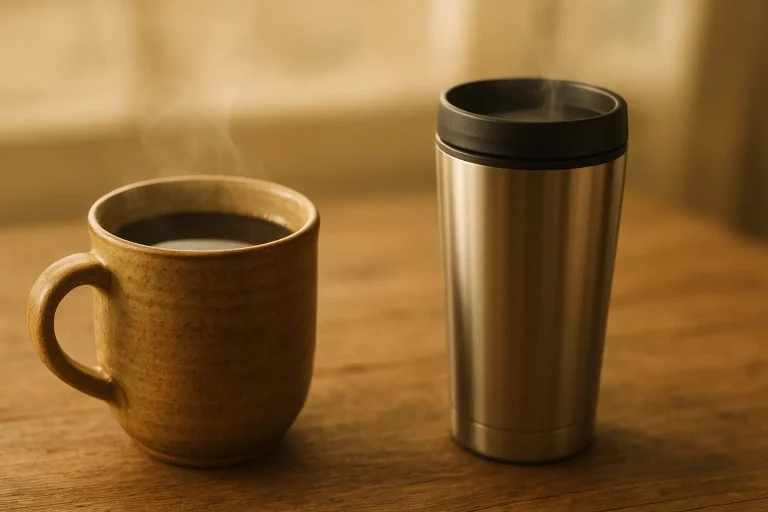
A fired stoneware mug and a glass tumbler hold the same volume of coffee, but their behavior differs in every dimension. The stoneware mug has lower thermal conductivity (1 to 3 W/m·K versus glass’s 0.96 to 1.05 W/m·K), which means it feels less cold to the touch when filled with a hot beverage. The mug’s glaze layer is chemically a glass, but the underlying ceramic body provides the structural support. The glass tumbler is transparent, dimensionally stable, and lighter. Neither is better. They optimize for different priorities.
Smartphone screens illustrate the glass advantage in precision manufacturing. Corning Gorilla Glass, an alkali-aluminosilicate glass, is chemically strengthened by an ion-exchange process that replaces small sodium ions near the surface with larger potassium ions, putting the surface in compression without changing dimensions. The resulting compressive stress layer of 40 to 50 microns depth provides scratch resistance (6 to 7 Mohs) and drop resistance in a sheet 0.4 to 0.7 mm thick. No ceramic manufacturing process can produce a flat, transparent, dimensionally precise panel at this scale and cost.
Bathroom tile and floor tile are ceramics, not glass, because impact resistance under foot traffic, ability to be cut and laid, and resistance to moisture penetration over decades favor the crystalline ceramic structure. The glaze on the tile surface is glass, which provides the smooth, impermeable, color-stable working surface. The combination of ceramic substrate and glass glaze achieves what neither material alone could deliver as efficiently.
For potters and ceramics students deciding between glass and ceramic materials for a studio application, the material choice usually reduces to temperature. Orton pyrometric witness cones placed in every kiln firing confirm that the ceramic body and glaze reached their target temperature, which is the single most important quality control step for functional ware.
This side-by-side comparison of ceramics versus glass in common product categories ties directly to the broader question of how ceramics compare to other inorganic material families. The ceramic versus metal property-by-property comparison extends the same analytical framework to hardness, conductivity, density, and cost differences between ceramics and the metallic material family.
Key Property Comparison Table: Ceramics vs Glass at a Glance
Use the table below to select the correct material family for a specific set of performance requirements across the most commonly evaluated engineering and design properties.
| Property | Ceramics (typical range) | Glass (typical range) | Winner | Why It Matters | Application Example |
|---|---|---|---|---|---|
| Hardness (Mohs) | 7 to 9.5 | 5.5 to 7 | Ceramics | Scratch resistance, cutting tools | Alumina cutting inserts |
| Max Use Temp (°F) | 2,732 to 4,892 | 1,202 to 1,472 | Ceramics | Kiln furniture, furnace linings | SiC furnace elements |
| Light Transmission | 0 to 25% (most opaque) | 85 to 92% | Glass | Windows, optics, displays | Fiber optic cable |
| Fracture Toughness (MPa·m^0.5) | 3 to 10 | 0.7 to 1.1 | Ceramics | Structural reliability, armor | Zirconia dental crowns |
| CTE (ppm/°C) | 1.5 to 8 | 3.3 to 9 | Ceramics (low-CTE types) | Thermal cycling stability | Cordierite kiln shelves |
| Electrical Diversity | Insulator to semiconductor | Insulator only (standard) | Ceramics | Electronics, sensors, power | BaTiO3 capacitors |
| Acid Resistance | Good (most), poor (HF, H2SO4 hot) | Excellent (most acids), poor (HF) | Glass (for most acids) | Lab vessels, chemical storage | Borosilicate lab glassware |
| Alkali Resistance | Excellent (alumina, SiC) | Poor at high pH | Ceramics | Caustic processing equipment | Alumina crucibles for fusion |
The table confirms that neither ceramics nor glass is universally superior. The correct choice depends on the specific combination of properties required for the application, with temperature, transparency, and electrical function being the three most decisive factors in most material selection decisions.
The following widget gives you a structured way to find the right material for your specific use case based on the properties that matter most to your application.
INTERACTIVE TOOL
Find the Right Inorganic Material for Your Application
Answer 2 questions to get a ceramics or glass recommendation tailored to your use case.
Frequently Asked Questions About Ceramic vs Glass Material Differences
Is glass technically a type of ceramic?
In some materials science classification systems, glass is categorized as an amorphous ceramic because it shares the same defining characteristics: inorganic, non-metallic, and formed by high-temperature processing. The American Ceramic Society uses this broad definition, which is why ceramic engineering programs cover glass science. For practical engineering and design purposes, however, ceramics and glass are treated as distinct material families because their crystalline versus amorphous microstructures produce fundamentally different mechanical, thermal, and optical properties.
The distinction matters most in application. A crystalline alumina ceramic and a soda-lime glass may both be inorganic non-metallic solids, but their hardness, transparency, melting behavior, and manufacturing methods have almost nothing in common.
Why does ceramic crack from thermal shock but glass does not always?
Both ceramics and glass can crack from thermal shock, but their vulnerability depends on different factors. In ceramics, the combination of thermal expansion coefficient (CTE) and fracture toughness determines thermal shock resistance. Low-CTE ceramics like cordierite (CTE 1.5 to 2 ppm/°C) resist thermal shock because the material expands and contracts very little with temperature change. High-CTE ceramics crack under rapid temperature change because differential expansion creates tensile stress that exceeds fracture toughness.
In glass, CTE is the dominant factor. Soda-lime glass (CTE 8 to 9 ppm/°C) shatters under rapid temperature changes. Borosilicate glass (CTE 3.3 ppm/°C) survives stovetop cooking and laboratory use because its lower CTE reduces thermal stress. A borosilicate glass baking dish can go from refrigerator to oven because the low CTE keeps thermal stresses below the fracture threshold. A soda-lime drinking glass cannot.
Can ceramic and glass be used together in the same product?
Yes, and this combination is extremely common. Ceramic tile uses a glaze that is chemically glass fused onto a ceramic substrate. Enamel cookware fuses a glass coating onto steel or cast iron. Electronic circuit boards use alumina ceramic substrates with glass-sealed vias. The key requirement for any ceramic-glass composite is that the CTE values of the two materials must be matched closely enough that the bond survives thermal cycling without delamination or cracking. Glass-to-metal seals and ceramic-to-glass seals are a specialist engineering field precisely because CTE matching across materials is technically demanding.
Is ceramic or glass safer for food and drink contact?
Both materials are food-safe when properly manufactured. Glass is inherently inert and non-porous, with zero risk of leaching under normal food and beverage conditions. Fully vitrified ceramic (cone 6 stoneware or above, with absorption below 1%) covered with a lead-free, fully matured glaze is equally food-safe. The risk in ceramics comes from underfired glazes (where the glaze did not fully melt and bond to the clay body), lead-containing glazes fired at incorrect temperatures, and porous unglazed earthenware that can harbor bacteria. A certified lead-free cone 6 glaze eliminates the leaching risk for functional pottery.
Why do kilns use ceramic components rather than glass components?
Kiln shelves, posts, and furniture use ceramic materials because the service temperatures in a kiln (1,800°F to 2,381°F / 982°C to 1,305°C for cone 6 to cone 10 firing) exceed the working temperature of all standard glass types by a factor of two or more. Cordierite ceramic shelves (rated to 2,372°F / 1,300°C) and mullite shelves (rated to 2,642°F / 1,450°C) survive repeated thermal cycling because their low CTE values prevent accumulation of thermal stress damage. Soda-lime glass deforms at 1,202°F (650°C) and borosilicate glass at approximately 1,472°F (800°C). Neither approaches the kiln service temperature range.
What is the difference between a glass glaze on a ceramic and a glass coating on metal?
A glass glaze on a ceramic and a glass-enamel coating on metal are chemically similar but serve different structural purposes. Both are glass layers fused to a substrate at high temperature, and both use silica, flux oxides, and optional colorants as their raw materials. The critical difference is CTE matching. A ceramic glaze must match the CTE of the underlying clay body (typically 5 to 7 ppm/°C for stoneware) to prevent crazing or shivering. An enamel on steel must match the CTE of steel (11 to 13 ppm/°C), which requires a completely different oxide formula with higher flux content to achieve compatibility with the metallic substrate’s much higher expansion coefficient.
Does glass absorb water like porous ceramics do?
Glass has zero water absorption regardless of composition or thickness. Its amorphous, fully dense structure has no open porosity for water to enter. Ceramics range from highly porous (earthenware at cone 06 with 5 to 15% absorption) to fully vitrified (high-fire stoneware at cone 10 with below 0.5% absorption). The water absorption of a ceramic is controlled by firing temperature: higher firing drives more glass-phase formation between particles, closing porosity progressively. A potter testing a new clay body should always measure absorption after firing by weighing a dry fired tile, soaking it in water for 24 hours, and dividing the weight gain by the dry weight. Any value above 3% indicates the body is not fully vitrified and should not be used for functional ware without glaze coverage over all food-contact surfaces.
Can you scratch glass with a ceramic tool?
Yes. Because most ceramics have Mohs hardness values of 7 to 9.5 and standard glass measures 5.5 to 6.5 on the Mohs scale, any ceramic harder than 6.5 will scratch glass. Alumina (9 Mohs), silicon carbide (9.5 Mohs), and even fired stoneware (6 to 7 Mohs at the glaze surface) can leave visible scratches on soda-lime glass. This is why ceramic tiles, stone countertops, and unglazed pottery bottoms must never be slid across glass surfaces. Diamond (10 Mohs) scratches both ceramics and glass, and is used as the abrasive in grinding wheels for machining both material families. A diamond blade for ceramic and glass cutting works on both materials for exactly this reason.
What happens to glass at the temperatures used to fire ceramics?
Glass softens and deforms well below the temperatures used in standard ceramic firing. Soda-lime glass begins to deform at approximately 1,202°F (650°C) and flows visibly at 1,562°F (850°C). Borosilicate glass deforms above 1,472°F (800°C). Cone 6 ceramic firing reaches 2,232°F (1,222°C). Cone 10 reaches 2,381°F (1,305°C). At these temperatures, glass would collapse, pool, and fuse to any surface it contacts. This is the physical reason kiln furniture, thermocouple sheaths, and firing supports are made from high-fire ceramics and not from glass. The only glass-type materials that survive kiln temperatures are fused silica (working limit 2,012°F / 1,100°C) and, for structural use, transparent alumina.
Are ceramic coatings on non-stick pans the same as fired ceramic?
No. The ceramic coating on non-stick cookware (used in brands such as GreenPan, Cuisinart Ceramic, and T-fal Ceramic) is a sol-gel derived silicon-oxygen coating applied at temperatures well below 1,000°F (538°C) and cured rather than fired. It is amorphous, not crystalline, and bears no structural relationship to kiln-fired stoneware or porcelain. The term “ceramic” in non-stick cookware marketing refers to the silicon-oxygen chemical structure, not to the manufacturing process or material properties of traditional fired ceramics. Fired stoneware cannot be coated to a pan thickness of 0.05 to 0.2 mm, and non-stick sol-gel coatings cannot survive the thermal cycling of kiln firing. They are different material systems that share only a chemical family name.
Which lasts longer in outdoor use: ceramic tile or glass tile?
Vitrified ceramic tile (absorption below 0.5%, fired to cone 6 or above) generally outlasts glass tile in freeze-thaw cycling climates because its lower water absorption reduces the expansion damage when absorbed water freezes. Glass tile is non-porous and does not absorb water, but glass-to-grout joint stress and the brittleness of glass under thermal cycling can cause edge chipping and cracking over decades of outdoor exposure. Both materials are highly UV-stable and chemically inert to rain and atmospheric pollutants. For frost-prone climates, porcelain tile (absorption below 0.5%, Mohs hardness 7 to 8) is the most durable option. For mild climates, glass mosaic tile provides color saturation and optical effects that ceramic glazes cannot match because glass is transparent through its full depth while ceramic glaze is only a surface layer.
Why is zirconia used for dental crowns instead of glass?
Zirconia (ZrO2) ceramic is used for dental crowns because it combines fracture toughness of 6 to 10 MPa·m^0.5 (versus glass’s 0.7 to 1.0 MPa·m^0.5) with a refractive index of 2.15 to 2.20 that approximates tooth enamel optically. Teeth undergo compressive loads of 160 to 180 pounds per square inch (1.1 to 1.24 MPa) during normal chewing. Glass crowns would fracture under this cyclic loading within months. Zirconia’s transformation toughening mechanism (where stress at a crack tip triggers a martensitic phase transformation that closes the crack) gives it crack resistance that glass and most other ceramics cannot match. A dental zirconia ceramic blank for CAD/CAM milling illustrates how precisely engineered ceramic composition is for biomedical applications.
The Clearest Way to Think About Ceramics vs Glass
Ceramics are defined by crystalline order. Glass is defined by the absence of it. That single structural difference cascades into every other property contrast covered in this guide: ceramics run hotter, resist wear better, and support a wider range of electrical functions. Glass transmits light, accepts precise optical shaping, and resists most acids better than ceramics do.
The two material families are not competitors in most applications. They occupy distinct performance territories, and the best products often use both together, with ceramic structure providing the thermal and mechanical foundation and glass providing the surface, optical, or sealing function. For anyone selecting materials for a ceramics studio, an engineering application, or a product design, the decision starts with temperature range and whether transparency is required. Those two factors alone resolve most ceramic-versus-glass material selections.
For a broader understanding of how ceramics fit within the full family of inorganic materials, including comparisons with metals across hardness, conductivity, density, and cost, the complete guide to ceramic materials science provides the foundational framework that connects every property discussed in this article back to atomic bonding and crystal structure.