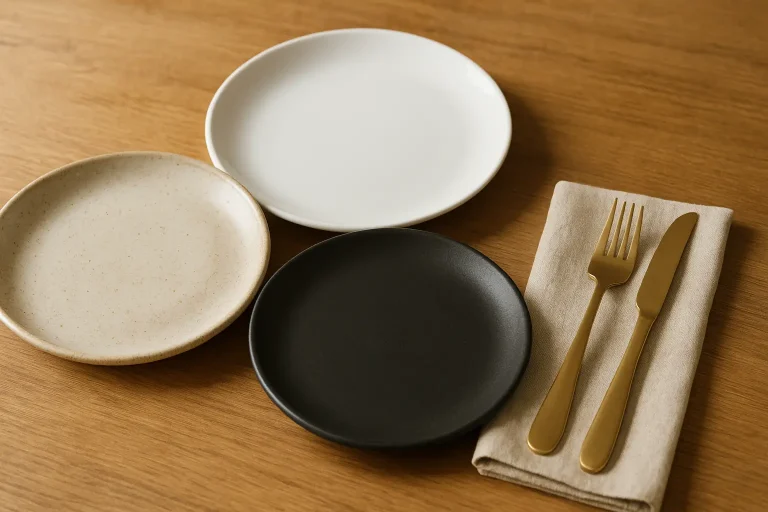
Ceramic Dinnerware: Complete Guide to Sets Plates Bowls and Servingware

Ceramic dinnerware is not just a table setting choice. The clay body, firing temperature, and glaze chemistry determine whether your plates are food-safe, dishwasher-proof, chip-resistant, and built to last decades or crack after a season.
This guide covers every category of ceramic dinnerware you will encounter: stoneware sets, porcelain sets, earthenware sets, bone china, handmade studio pottery, individual plates, bowls, mugs, platters, and full servingware collections. For each type, you will find firing temperatures, glaze safety standards, durability comparisons, price ranges, and specific buying recommendations.
What Is Ceramic Dinnerware and How Is It Different from Other Tableware?
Ceramic dinnerware is tableware formed from clay, fired in a kiln at temperatures between cone 06 (1828°F / 998°C) for earthenware and cone 10 (2381°F / 1305°C) for high-fire stoneware, and coated with a glaze that seals the surface. The fired glaze fuses chemically with the clay body, creating a single integrated material rather than a coating applied on top.
This is what separates ceramic dinnerware from melamine, plastic, or metal tableware. The glaze is not paint. It is a glass layer that bonds at the molecular level during firing, making it scratch-resistant, non-porous when properly fired, and inert in contact with food acids.
According to Daniel Rhodes in Clay and Glazes for the Potter, vitrified ceramic materials achieve under 1% water absorption after firing, making them structurally equivalent to glass in terms of liquid impermeability. Non-vitrified earthenware, by contrast, absorbs 3-15% water and requires an intact glaze to remain food-safe.
Ceramic dinnerware falls into five main material categories: stoneware, porcelain, earthenware, bone china, and vitrified hotel china. Each has a distinct clay body composition, firing range, and performance profile.
The Five Types of Ceramic Dinnerware: Materials, Firing Ranges, and What Each Means for Daily Use
The material category of a ceramic dinnerware set determines its weight, translucency, chip resistance, thermal shock tolerance, and long-term durability more than any other single factor. Choosing the wrong material category for your household’s use pattern is the most common buying mistake.
Tony Hansen of the Digitalfire Reference Library documents that stoneware clay bodies fired to cone 6 (2232°F / 1222°C) achieve shrinkage rates of 10-13% and absorption rates under 2%, giving them the combination of weight, density, and durability that makes them the most popular choice for everyday home use. Porcelain fired to cone 10 (2381°F / 1305°C) achieves under 0.5% absorption and translucency, but its lower silica content relative to alumina makes it more brittle than stoneware under impact.
Use the table below to match your household use pattern to the right ceramic dinnerware material before purchasing a set.
| Material | Firing Range | Shrinkage Rate | Absorption After Firing | Weight per Dinner Plate | Chip Resistance | Dishwasher Safe | Best Use Case |
|---|---|---|---|---|---|---|---|
| Stoneware | Cone 6-10 (2232-2381°F / 1222-1305°C) | 10-13% | Under 2% | 18-26 oz | High | Yes (most) | Everyday family use, casual dining |
| Porcelain | Cone 6-10 (2232-2381°F / 1222-1305°C) | 12-15% | Under 0.5% | 12-18 oz | Moderate | Yes (most) | Formal dining, gift sets, minimalist aesthetics |
| Earthenware | Cone 06-02 (1828-2048°F / 998-1120°C) | 8-10% | 3-15% | 16-24 oz | Low to moderate | Sometimes | Decorative use, low-impact casual dining |
| Bone China | Cone 6-8 (2232-2305°F / 1222-1263°C) | 10-12% | Under 0.5% | 10-14 oz | High (flexural strength) | Yes (most) | Formal dining, fine tableware, gift sets |
| Vitrified Hotel China | Cone 8-10 (2305-2381°F / 1263-1305°C) | 12-14% | Under 0.3% | 20-30 oz | Very high | Yes (commercial rated) | Restaurant use, high-frequency dishwashing |
| Studio Handmade (Stoneware) | Cone 6-10 (2232-2381°F / 1222-1305°C) | 10-13% | Under 2% (variable) | 16-28 oz | High (variable by maker) | Usually yes | Artisan gift sets, individual pieces, unique collections |
Stoneware Dinnerware: The Everyday Standard
Stoneware is the most practical ceramic dinnerware material for households that use their dishes daily. A stoneware dinnerware set fired to cone 6 (2232°F / 1222°C) produces plates and bowls with under 2% water absorption, making them fully food-safe, non-porous, and resistant to bacterial infiltration without any surface sealant.
The fired glaze on stoneware bonds directly to the clay body during firing, creating a surface hardness of 5-7 on the Mohs scale. This hardness means metal utensils leave minimal marks compared to softer earthenware finishes.
Key Specifications (Stoneware Dinnerware):
- Firing range: cone 6-10 (2232-2381°F / 1222-1305°C)
- Absorption rate: under 2% (vitrified at cone 6, under 0.5% at cone 10)
- Shrinkage from wet to fired: 10-13%
- Glaze hardness: 5-7 Mohs
- Thermal shock tolerance: moderate to high (suitable for oven use up to 350°F / 177°C in most commercial sets)
The mechanism behind stoneware’s durability is vitrification: silica and alumina in the clay body fuse into a dense glass-ceramic matrix as kiln temperatures exceed 2200°F (1204°C). This vitrification only occurs fully when both time and temperature targets are met. If the kiln fires too quickly past critical temperature windows, the clay surface can vitrify while the interior remains porous, a defect called case hardening that causes cracking under thermal stress.
Porcelain Dinnerware: Elegant but Fragile Under Impact
Porcelain dinnerware is made from a refined clay body containing at least 50% kaolin (pure white clay), along with feldspar and silica, fired to cone 6-10 (2232-2381°F / 1222-1305°C). The high kaolin content creates the characteristic white translucent surface that distinguishes porcelain from stoneware.
A porcelain dinnerware set achieves under 0.5% water absorption after firing, making it the most non-porous of all ceramic dinnerware types. The trade-off is brittleness: porcelain has high compressive strength but lower impact resistance than stoneware because its lower grog content provides less structural reinforcement against point-impact fracture.
Key Specifications (Porcelain Dinnerware):
- Firing range: cone 6-10 (2232-2381°F / 1222-1305°C)
- Absorption rate: under 0.5%
- Shrinkage: 12-15%
- Translucency: present in thin-walled pieces (under 3mm)
- Glaze hardness: 6-8 Mohs
Porcelain dinnerware is the right choice for formal dining settings where aesthetic refinement matters more than chip resistance. For households with children or high-frequency casual use, stoneware provides better long-term durability per dollar spent.
Earthenware Dinnerware: Colorful but Porous Without Its Glaze
Earthenware is fired at the lowest temperature range of all ceramic dinnerware types: cone 06-02 (1828-2048°F / 998-1120°C). At these temperatures, the clay body does not vitrify. It retains a water absorption rate of 3-15%, meaning the clay itself remains porous and relies entirely on the surface glaze for food safety.
This creates a critical vulnerability: if the glaze cracks, chips, or crazes (develops a fine network of surface cracks), the porous clay beneath becomes exposed to food acids, moisture, and bacteria. Earthenware with crazed glaze should not be used for food storage or acidic foods.
The mechanism is straightforward. At cone 06 (1828°F / 998°C), silica and alumina in the clay body have not reached the temperature required to fuse into a continuous glass matrix. The clay particles sinter together but do not flow. The result is a rigid but permeable structure that absorbs liquids through capillary action unless sealed by an intact glaze layer.
Earthenware’s advantage is its vivid color range. Low-fire glazes can use colorants that burn away at higher temperatures, including bright oranges, turquoise blues, and opaque whites that are impossible to achieve on stoneware fired to cone 10. Brands like Fiesta, manufactured by Homer Laughlin China Company, use a vitreous china body fired at high temperatures but with a low-fire-style decorative glaze aesthetic.
Bone China: Lightweight Strength Through Calcium Phosphate
Bone china is a specific type of porcelain that contains 30-50% calcined bone ash (calcium phosphate) along with kaolin and feldspar. The calcium phosphate content, derived from cattle bone, creates a glass phase during firing that gives bone china its characteristic translucency, whiteness, and unexpected flexural strength despite its light weight.
A bone china dinnerware set weighs 25-40% less than an equivalent stoneware set while matching or exceeding its flexural strength. According to the British Ceramic Confederation, bone china is required by UK standards to contain a minimum of 30% calcium phosphate to carry the bone china designation.
Key Specifications (Bone China):
- Bone ash content: 30-50% calcium phosphate
- Firing range: cone 6-8 (2232-2305°F / 1222-1263°C)
- Absorption rate: under 0.5%
- Weight: 25-40% lighter than stoneware equivalent
- Flexural strength: 65-90 MPa (higher than standard porcelain)
Bone china’s calcium phosphate creates a translucent glass phase during firing because phosphate ions disrupt the regular silica-alumina network, scattering light differently than standard porcelain. This effect requires exact temperature control: fire too low and the bone ash does not integrate, fire too high and the piece bloats. Most bone china is fired in two stages: a bisque at cone 10 (2381°F / 1305°C) to vitrify the body, then a glaze fire at cone 6 (2232°F / 1222°C) to mature the decorative glaze.
Vitrified Hotel China: The Commercial Durability Standard
Vitrified hotel china (also called vitrified porcelain or institutional china) is engineered specifically for commercial foodservice environments where pieces go through industrial dishwashers 200-400 times per year. It is fired to cone 8-10 (2305-2381°F / 1263-1305°C) with a clay body formulated for under 0.3% absorption and maximum edge-chip resistance.
Brands like commercial vitrified dinnerware sets from Tuxton, World Tableware, and Hall China achieve this durability through a combination of high alumina content in the clay body and a thickened rolled rim design that distributes impact energy across a wider surface area rather than concentrating it at a single fracture point.
For home use, vitrified hotel china is overkill in most cases. Its weight (20-30 oz per dinner plate) and utilitarian appearance make it practical only for households that genuinely need near-indestructible tableware.
Complete Ceramic Dinnerware Sets: What Pieces Are Included and What You Actually Need
A standard ceramic dinnerware set sold as a “service for four” contains 16 pieces: four dinner plates, four salad/side plates, four bowls, and four mugs. Sets described as “service for eight” contain 32 pieces across the same four categories. Open stock sets allow you to buy pieces individually, which matters when replacing broken items from a discontinued pattern.
The piece count in a dinnerware set does not tell you anything about the set’s quality or durability. Two 16-piece sets at the same price point can have radically different clay bodies, glaze chemistries, and firing temperatures. The description matters more than the count.
Dinner Plates: Size, Weight, and Rim Design
Standard ceramic dinner plates measure 10-11 inches (25-28 cm) in diameter for the eating surface, with a total plate diameter of 10.5-12 inches (27-30 cm) including the rim. Coupe plates (rimless or minimal rim designs) maximize the eating surface for a given plate diameter. Traditional plates with a wide rim reduce the usable food area but provide better stacking stability and a more formal aesthetic.
A stoneware dinner plate set of four in the 10.5-inch range typically weighs 18-26 oz per plate. Heavier plates feel more substantial and resist sliding on smooth table surfaces. Lighter porcelain plates in the same diameter range weigh 12-18 oz and feel more refined but show edge chips more visibly against their white body.
The foot ring (the raised base ring on the underside of the plate) determines how the plate sits and stacks. A wider foot ring provides more stable stacking. A glazed foot ring slides on other plates during stacking. An unglazed foot ring (common on stoneware) grips other plates but requires checking that the bare clay is fully vitrified and not absorbent before using the piece for food service.
Ceramic Bowls: Volume, Shape, and Thermal Performance
Ceramic dinner sets include soup/cereal bowls as the standard bowl piece, typically 18-22 oz (530-650 ml) in capacity and 6-7 inches (15-18 cm) in diameter. Coupe-style bowls with straight or gently curved sides maximize volume for a given diameter. Traditional rounded bowls with a pronounced lip feel better to hold.
Ceramic soup bowls in stoneware retain heat significantly better than glass or thin porcelain because the dense clay body stores thermal energy and releases it slowly. A stoneware bowl at cone 6 has a thermal mass that keeps soup at serving temperature for 5-8 minutes longer than an equivalent glass bowl of the same volume.
The condition that determines thermal performance is wall thickness. Stoneware bowls with 6-8mm walls hold heat longer than bowls with 4mm walls. Production porcelain bowls often have 3-4mm walls, which look elegant but release heat faster than heavier stoneware. For hot soups and ramen, stoneware bowl thickness is the right specification to check before buying.
Ceramic Mugs: Handle Attachment and Volume Standards
Standard ceramic mugs in dinnerware sets hold 10-14 oz (295-415 ml). Oversized mugs hold 16-20 oz (475-590 ml). The handle attachment method matters more than most buyers realize: handles attached to wet clay with slip (liquid clay suspension) before bisque firing are structurally stronger than handles attached to already-dry bisqueware with commercial adhesive.
A stoneware mug set with pulled handles (formed directly on the wheel from the same clay as the body) represents the highest structural integrity. Extruded handles (formed through a die) are consistent but may have thinner attachment joints. Press-molded handles are the most uniform but vary by manufacturer in attachment strength.
The failure mode for mug handles is detachment at the lower attachment point, where the handle joins the mug body. This occurs when the handle and body have different drying rates during production, creating stress at the joint before firing. High-quality production stoneware mugs score and slip the attachment area during production to create a mechanical and chemical bond that fires as a single unit.
Servingware: Platters, Serving Bowls, and Covered Dishes
Complete ceramic dinnerware sets for larger households include servingware: oval platters (12-16 inches / 30-40 cm), large serving bowls (2-4 quart / 1.9-3.8 L capacity), and covered casserole or serving dishes. Not all serving pieces in a set match the dinner pieces in clay body or firing temperature.
Some manufacturers produce dinnerware bodies at one factory and servingware at another, then sell them together as a set. Minor glaze color variation between serving pieces and individual place settings is normal in these cases. If exact color matching matters, check whether the brand produces all pieces in the same production run.
Stoneware serving platters fired to cone 6 are oven-safe up to 350°F (177°C) in most cases, making them suitable for bringing baked dishes directly from oven to table. Always verify the manufacturer’s specific temperature rating: some decorative glazes containing metallic lusters or on-glaze decals are not oven-safe even when the underlying clay body is.
How to Read a Ceramic Dinnerware Label: Glaze Safety, Food Safety, and Oven Safety Claims
Ceramic dinnerware labels use several terms that have specific technical meanings and legal standards behind them. Understanding these terms prevents buying dinnerware that is decorative-only when you need functional food-safe pieces, or buying expensive oven-safe sets when you will never put a plate in the oven.
The U.S. Food and Drug Administration (FDA) regulates ceramic dinnerware under 21 CFR Part 109, which sets maximum allowable leaching levels for lead and cadmium from ceramic food-contact surfaces. As of the most recent FDA guidelines, ceramic ware must not leach more than 3 ppm lead or 0.5 ppm cadmium when tested with 4% acetic acid solution at 68°F (20°C) for 24 hours.
Food-Safe vs Decorative-Only: What the Label Must Tell You
A ceramic piece is food-safe when three conditions are met: the glaze is fully melted and sealed without pinholes or crawling, the colorants used are lead-free and cadmium-free at levels below FDA thresholds, and the clay body is either fully vitrified (under 2% absorption) or fully sealed by an intact glaze. If any of these conditions is not met, the piece is decorative-only.
Decorative-only ceramic pieces exist in large quantities in the retail market, particularly imported earthenware with bright overglaze decorations. These pieces often carry no food-safety certification and should not be used for serving, eating, or storing food. Look for explicit “food safe” or “FDA compliant” labeling, not just “suitable for everyday use,” which is a marketing phrase with no regulatory meaning.
Lead-Free and Cadmium-Free Glazes: What the Certification Means
Glaze colorants that produce certain colors at low-fire temperatures (cone 06-02 / 1828-2048°F / 998-1120°C) traditionally required lead or cadmium compounds as flux materials to achieve full glaze melt and color saturation. Modern commercial lead-free glaze systems use lithium, zinc, and boron-based flux systems instead, achieving equivalent color range without the health risk.
The Ceramic Arts Network and the American Ceramics Society both recommend verifying lead-free status through the manufacturer’s material safety data sheet (MSDS), not just the product label. Certification from SGS, Bureau Veritas, or equivalent third-party testing organizations provides independent verification that the piece meets current FDA or EU Ceramic Directive (84/500/EEC) standards.
Microwave-Safe, Dishwasher-Safe, and Oven-Safe: The Technical Differences
Microwave-safe ceramic dinnerware contains no metallic content in its glaze or decoration. Metallic lusters, platinum or gold rim bands, and iron-oxide-heavy dark glazes that approach metallic saturation can arc in a microwave and damage both the piece and the appliance. Any ceramic piece with visible metallic sheen should be treated as not microwave-safe unless explicitly labeled otherwise.
Dishwasher-safe certification means the glaze does not absorb water, does not etch under alkaline detergent chemistry, and does not fade under repeated thermal cycling between wash (140-160°F / 60-71°C) and dry (180°F / 82°C) cycles. Fully vitrified stoneware and porcelain at cone 6+ pass this standard. Low-fire earthenware with soft glazes does not always pass extended dishwasher testing.
Oven-safe ceramic dinnerware tolerates temperatures up to 350-450°F (177-232°C) for pieces explicitly rated by the manufacturer. The critical condition is thermal shock: placing a cold ceramic piece directly into a hot oven, or placing a hot piece directly onto a cold surface, creates rapid differential expansion between the glaze and clay body that can cause cracking. Always place ceramic dinnerware in a cold oven and allow it to heat gradually for best results.
Top Ceramic Dinnerware Sets by Category: Specific Recommendations with Specifications
The best ceramic dinnerware set depends on whether you prioritize daily durability, formal aesthetics, handmade character, or commercial-grade resistance. Each category has clear leaders based on clay body quality, glaze food-safety standards, and long-term availability of replacement pieces.
This is the area where buyers consistently overspend on features they do not need or underspend in ways that produce short-term satisfaction and long-term frustration. A set that looks beautiful in a store display but uses a soft earthenware body and overglaze decoration will show wear, crazing, and fading within 2-3 years of daily dishwasher use.
Here is a searchable comparison of the most-purchased ceramic dinnerware sets across categories, with key specifications for each.
INTERACTIVE TABLE
Find Your Ceramic Dinnerware Set: Searchable Comparison
Type a keyword or filter by material to narrow the list instantly.
| Set Name | Material | Price (16-pc) | Dishwasher | Microwave | Best For |
|---|---|---|---|---|---|
| Corelle Livingware | Vitrelle Glass-Ceramic | $40-60 | Yes | Yes | Budget everyday use, lightweight |
| Gibson Home Soho Lounge | Stoneware | $55-80 | Yes | Yes | Everyday family dining |
| Denby Halo | High-fired Stoneware | $200-350 | Yes | Yes | Premium everyday, heirloom quality |
| Villeroy & Boch New Wave | Premium Porcelain | $150-250 | Yes | Yes | Modern formal dining |
| Apilco Tradition Porcelain | French Porcelain | $120-200 | Yes | Yes | Classic bistro style, restaurant quality |
| Fiesta Dinnerware | Vitreous China | $90-160 | Yes | Yes | Color collectors, casual dining |
| Royal Doulton Gordon Ramsay | Bone China | $100-180 | Yes | Yes | Formal dining, lightweight premium |
| Wedgwood Jasper Conran | Fine Bone China | $200-400 | Yes | Yes | Heirloom formal sets, gift giving |
Best Budget Ceramic Dinnerware Sets: Under $80 for 16 Pieces
The most reliable budget ceramic dinnerware sets in the $40-80 range use either vitrelle glass-ceramic (Corelle) or mid-fire stoneware produced in high-volume factories in China, Portugal, or Eastern Europe. At this price point, the key variables are glaze quality and whether the set carries explicit lead-free, cadmium-free certification.
Corelle Livingware uses a three-layer glass-ceramic material called Vitrelle, which is not traditional clay-based stoneware but performs similarly for food safety and dishwasher durability. Corelle 16-piece sets weigh significantly less than stoneware equivalents (dinner plate: 8-10 oz vs 18-26 oz) and resist chipping better than earthenware at equivalent price points.
For traditional clay-based stoneware under $80, Gibson Home, Mikasa, and American Atelier produce sets using mid-fire stoneware bodies with lead-free reactive glaze finishes. Color variation in reactive glazes (where the glaze produces slightly different tones based on iron content and firing position in the kiln) is a feature, not a defect, in these sets.
Best Mid-Range Ceramic Dinnerware Sets: $80-250 for 16 Pieces
The mid-range category from $80-250 is where material quality differences become most significant. Sets in this range from Denby (UK), Villeroy & Boch (Germany), and Le Creuset (France) use higher-density stoneware bodies fired at higher temperatures than budget sets, producing better chip resistance, more consistent glaze surfaces, and longer service life.
Denby, in particular, fires its stoneware at temperatures approaching cone 10 (2381°F / 1305°C), producing a clay body so dense it requires no glaze on the exterior to remain non-porous. A Denby stoneware dinner plate has an absorption rate documented by the company at under 0.3%, placing it in the same density category as commercial vitrified hotel china.
Le Creuset’s ceramic dinnerware uses a stoneware body with their proprietary colorful enameled glaze system. The glaze is formulated to the same thermal shock resistance specifications as their cast iron enamel, making Le Creuset ceramic plates and bowls genuinely oven-safe to 500°F (260°C), significantly higher than most consumer ceramic dinnerware.
Best Premium Ceramic Dinnerware Sets: Over $250 for 16 Pieces
Premium ceramic dinnerware above $250 separates into two distinct categories: fine bone china and porcelain sets from European heritage manufacturers (Wedgwood, Meissen, Limoges, Royal Copenhagen), and handmade studio stoneware from individual potters or small production studios.
Heritage manufacturer sets like Wedgwood bone china dinnerware carry open stock availability that can extend for decades, meaning individual broken pieces can be replaced without replacing the entire set. This matters more than it sounds: a dinnerware set is a long-term investment, and the inability to replace a broken dinner plate is the most common reason sets get retired early.
Studio stoneware sets from individual potters represent a different value proposition. Each piece is unique, fired in small batches in a single studio kiln, and often available directly from the maker. Prices for studio sets typically run $300-800 for service for four, with higher prices for established potters with documented exhibition histories.
Ceramic Dinnerware Glaze Types: Matte, Satin, Reactive, and Speckled Finishes
The glaze finish on ceramic dinnerware is not just aesthetic. Glaze chemistry determines hardness, food-safety profile, stain resistance, utensil marking visibility, and how the piece ages over years of dishwasher use. Understanding the four main glaze finish categories helps you predict how a set will look after 500 dishwasher cycles, not just on the shelf in the store.
According to Robin Hopper’s The Ceramic Spectrum, glaze surface character is determined primarily by the silica-to-alumina ratio (the Seger unity molecular formula) and the flux system used. High-silica glazes produce glossy surfaces. High-alumina glazes produce matte surfaces. The ratio determines the surface quality; the flux system determines the temperature at which the glaze matures.
Gloss Glazes: The Dishwasher-Resistant Standard
Gloss glazes on stoneware dinnerware contain a high silica content that melts into a continuous glass layer during firing. This glass surface has a hardness of 5-7 Mohs, resists etching from alkaline dishwasher detergents, and shows utensil marks (metal transfer from silverware) less than matte surfaces because the smooth surface does not grip metal particles the way a micro-rough matte finish does.
Gloss glazes are the most practical choice for everyday dinnerware. They are easier to clean, more resistant to staining from coffee, tea, and acidic sauces, and more forgiving of the abrasive chemistry in commercial dishwasher detergents.
Matte and Satin Glazes: Beautiful but Requiring More Care
Matte glazes achieve their non-reflective surface through one of two mechanisms: either a high alumina content that prevents full glaze flow and creates a micro-crystalline surface, or a calcium/barium flux system that promotes the formation of anorthite or celsian crystals during cooling. Both mechanisms create a surface that diffuses light rather than reflecting it.
The practical trade-off is that matte-glazed dinnerware scratches more visibly from metal utensils, stains more easily from acidic foods, and requires more careful dishwasher practices. Harsh alkaline detergents can etch matte glaze surfaces over time, gradually dulling the finish. Matte-glazed ceramic dinnerware looks best when hand-washed or used with a gentle dishwasher detergent at lower temperature settings.
Satin glazes sit between gloss and matte in terms of silica-alumina ratio. They have better stain resistance than true matte glazes while maintaining a softer visual quality than full gloss. For households that want a contemporary matte aesthetic but use their dishes daily, satin-finish stoneware is the practical middle ground.
Reactive Glazes: Unique Character at the Cost of Consistency
Reactive glazes (also called “live glazes” or “variegated glazes”) contain iron oxide, titanium dioxide, or other transition metal colorants that produce different visual results depending on kiln atmosphere, firing temperature, and the specific position of each piece in the kiln. No two pieces in a reactive-glaze set look exactly the same.
This is intentional. Reactive glaze stoneware sets from brands like Gibson Home and American Atelier use this variability as a design feature that mimics handmade studio pottery aesthetics at production price points. The glaze chemistry is food-safe and fully vitrified at cone 6.
The failure mode specific to reactive glazes is inconsistency across replacement pieces. If you buy a reactive-glaze set and later need to replace a broken bowl, the replacement piece from a new production batch will likely have a slightly different color and pattern than the original set. Buyers who want long-term visual consistency should choose a standard color glaze with a documented production run from an open-stock manufacturer.
Speckled Glazes: Iron Oxide Particles in a White or Cream Base
Speckled stoneware dinnerware gets its characteristic dark flecks from iron-bearing particles in the clay body or glaze that create localized reduction spots during firing. Manganese dioxide (MnO2) added to the clay body at 1-3% produces a warm brown speckle. Iron oxide (Fe2O3) at 2-5% in the clay body produces darker brown-black speckles through a similar mechanism.
Speckled stoneware has experienced sustained popularity because its appearance closely resembles hand-thrown studio pottery while being produced at commercial scale. Speckled stoneware dinnerware sets from brands like Mikasa Farmhouse, Threshold (Target house brand), and Stone Lain are all vitrified stoneware bodies with manganese-speckle or iron-speckle formulations that are food-safe and dishwasher-compatible.
One safety note: manganese dioxide at concentrations above 5% in a clay body has been associated with potential manganese vapor release during high-temperature firing. This is a studio potter concern during the kiln-loading and firing process, not a food-safety concern for the consumer using a fired and glazed piece. All commercial speckled stoneware dinnerware sold in the U.S. and EU uses manganese levels well within safe limits for fired, food-contact use.
Handmade vs. Production Ceramic Dinnerware: What You Are Actually Paying For
The price gap between a 16-piece production stoneware set at $60 and a handmade studio stoneware set for four at $400 is not primarily a material cost difference. It is a time and process difference. Both sets may use nearly identical clay bodies and glaze chemistries. The difference is in how each piece is formed, finished, and fired.
Production dinnerware is formed by slip casting (pouring liquid clay into plaster molds) or by ram-pressing (mechanically pressing clay into matching dies). Both methods produce consistent wall thickness, weight, and diameter with tolerances under 1mm. A dinner plate from a production run of 10,000 is functionally identical to every other plate in that run.
What Handmade Ceramic Dinnerware Actually Means
Handmade ceramic dinnerware is formed by one of three methods: wheel throwing, hand-building (slab or coil construction), or press molding by hand in a studio environment. Each method produces inherent variation in wall thickness, foot ring height, and diameter that distinguishes handmade from production pieces even when the final forms look similar.
Wheel-thrown stoneware dinnerware, made by an experienced potter, represents the most time-intensive production method. A production studio potter making dinner plates on a kick wheel or electric pottery wheel can produce approximately 20-30 consistent plates per day. At that production rate, even a modest hourly rate of $30/hour produces a per-plate labor cost of $10-15 before material and firing costs are added.
The practical implication is that a handmade stoneware dinner plate at $50-80 from a studio potter is correctly priced for the labor involved. A handmade plate at $15 from a mass-market brand claiming “handcrafted” is typically hand-finished or hand-glazed from a machine-formed body, not wheel-thrown.
How to Identify Genuinely Handmade Ceramic Dinnerware
Genuinely wheel-thrown ceramic dinnerware shows specific physical evidence of its making: concentric throwing lines on the interior of bowls and the undersides of plates (left by the potter’s fingers during pulling), slight asymmetry in the rim profile visible when looking across the plate edge, and variation in foot ring height between pieces in the same set (typically within 1-2mm).
Slip-cast or press-molded production pieces that are labeled “handmade” often have a smooth interior with no throwing lines, perfectly uniform rim profiles, and foot rings that are machine-consistent. These are not genuinely wheel-thrown pieces. They may be hand-finished or hand-glazed in the studio, which adds some human element, but the forming method is mechanical.
For buyers interested in supporting individual potters, platforms like Etsy, local ceramic arts markets, and direct-from-studio websites provide access to genuinely handmade stoneware sets. Many studio potters offer service sets in limited runs of 20-50 identical pieces, maintaining enough production consistency for a matching set while preserving the handmade character.
Ceramic Dinnerware and Thermal Shock: What Causes Cracking and How to Prevent It
Thermal shock cracking in ceramic dinnerware occurs when one part of a piece expands or contracts faster than an adjacent part, creating stress at the boundary that exceeds the material’s tensile strength. The result is a visible crack, often running from the base of a bowl to the rim in a nearly straight line, or from the edge of a plate inward along a radius.
The mechanism is a mismatch in thermal expansion coefficients (CTE) between the glaze and clay body, or between two zones of the same piece that experienced different temperature change rates. The glaze’s CTE must closely match the clay body’s CTE or stress accumulates at the glaze-clay interface during every heating and cooling cycle. Over hundreds of thermal cycles, this accumulated stress eventually causes cracking or crazing.
Crazing: Why Your Glaze Develops a Network of Fine Cracks
Crazing is a network of fine cracks through the glaze layer that do not penetrate the clay body beneath. It develops when the glaze has a higher CTE than the clay body. During cooling after firing, the glaze tries to contract more than the clay body allows. The clay body constrains the glaze, putting it under tension. When the tensile stress exceeds the glaze’s modulus of rupture, the glaze fractures into the characteristic craze pattern.
On fully vitrified stoneware (under 2% absorption), crazing is primarily a visual and hygiene concern: the crazed glaze surface traps food particles and bacteria in its cracks and cannot be fully cleaned. On low-fire earthenware (above 3% absorption), crazed glaze also exposes the porous clay body to liquids, making the piece potentially unsafe for food use over time.
Crazing is not reversible in a fired piece. It is also not caused by dishwasher use, although repeated thermal cycling can accelerate existing crazing. The root cause is always a glaze chemistry mismatch that was present from the initial firing. If a piece crazes within the first few months of use, the glaze-clay fit was incorrect from manufacture.
Shivering: The Opposite of Crazing
Shivering is the opposite failure mode: the glaze has a lower CTE than the clay body. During cooling, the clay body tries to contract more than the glaze allows. The glaze ends up under compression. If compression stress is too high, small flakes or shards of glaze literally pop off the surface of the piece, often at the rim where compression stress concentrates.
Shivering in production ceramic dinnerware is rare because it requires a significant CTE mismatch in the direction opposite to crazing. When it does occur, it creates a food safety hazard: sharp glaze fragments in food. Any ceramic piece that shows flaking glaze should be removed from food service immediately.
Preventing Thermal Shock in Daily Use
Most thermal shock damage to ceramic dinnerware in home use occurs from one of four actions: placing a refrigerator-cold ceramic piece directly into a hot oven, pouring boiling liquid into a cold bowl, placing a hot piece directly onto a cold wet surface, or putting a hot piece directly into cold water for washing.
The prevention is straightforward. Allow ceramic dinnerware to reach room temperature before placing it in a hot oven. Preheat ceramic serving bowls for hot foods by filling them with hot tap water for 1-2 minutes before adding the food. Do not place hot ceramics on cold stone countertops: use a trivet or cloth between the hot piece and the cold surface.
How to Care for Ceramic Dinnerware: Washing, Storage, and Long-Term Maintenance
Ceramic dinnerware with fully vitrified stoneware or porcelain bodies and lead-free glaze surfaces is dishwasher-safe under normal household conditions. The conditions that accelerate dishwasher wear are: chlorine bleach additives in the detergent, sanitize cycle temperatures above 160°F (71°C) repeated daily, and stacking pieces directly against each other without cushioning during the wash cycle.
For premium sets, hand washing extends glaze life by eliminating the cumulative abrasive and chemical stress of dishwasher detergent over hundreds of cycles. Hand wash with warm water and a non-abrasive sponge. Avoid steel wool, abrasive scrubbing pads, and bleach-based cleaners on glazed ceramic surfaces.
Removing Utensil Marks from Ceramic Dinnerware
Gray marks on white or light-colored ceramic dinner plates from metal utensils are not scratches in the glaze. They are metal deposits left on the glaze surface when the metal of a fork or knife is softer than the glaze hardness (which, at 5-7 Mohs for fired stoneware glaze, it often is). The gray color is metallic residue, not damaged glaze.
Metal marks on ceramic dinnerware remove with a mild abrasive cream cleanser like Bar Keepers Friend, applied with a damp cloth and gentle circular motion. The abrasive breaks down and lifts the metal deposit without scratching the glaze surface below. Bar Keepers Friend contains oxalic acid and a fine feldspar abrasive that is softer than fired glaze. Rinse thoroughly after treatment.
Storing Ceramic Dinnerware: Preventing Chips and Stacking Damage
The majority of chips in everyday ceramic dinnerware occur during storage and removal, not during eating. Plates stacked directly on each other allow the unglazed or rough-textured foot ring of one plate to score the glaze surface of the plate below during removal. Over time, this creates micro-abrasion that weakens the glaze edge and increases susceptibility to chipping.
Felt or rubber plate separators placed between stacked ceramic dinnerware pieces eliminate contact abrasion entirely. Ceramic plate storage separators cost $8-15 for a set of 12 and extend the visual life of any dinnerware set. For premium sets above $200, they are worth using from the first day.
Ceramic Dinnerware for Specific Use Cases: Oven-to-Table, Outdoor, and High-Use Households
Not all ceramic dinnerware performs equally across all use scenarios. A set designed for formal dining will fail quickly in a household that bakes casseroles, puts plates in the microwave daily, and runs three dishwasher loads per week. Matching the dinnerware specification to the actual use pattern prevents early replacement.
For oven-to-table use, stoneware with thermal shock resistance ratings above 350°F (177°C) and no metallic glaze decoration is the correct specification. Le Creuset stoneware is rated to 500°F (260°C). Denby stoneware carries a similar high-temperature rating. Most mid-range stoneware sets carry a 350°F (177°C) rating. Below that threshold, the piece may crack or the glaze may craze from oven heat.
Ceramic Dinnerware for Outdoor and Casual High-Use Settings
For outdoor dining, poolside use, or households with young children, the relevant specifications shift from aesthetics to impact resistance. Fully vitrified stoneware at cone 6-10 has the best combination of chip resistance and food safety. Melamine and outdoor-rated plastics have better impact resistance but cannot match ceramic’s food safety credentials for long-term acidic food contact.
If ceramic dinnerware is required for outdoor settings, select sets with reinforced rim designs (rolled rims rather than sharp coupe edges), heavier wall thickness (6-8mm rather than 3-4mm), and a matte or satin glaze finish that hides surface scratches better than a high-gloss finish.
Commercial-grade vitrified hotel china, while heavy and utilitarian in appearance, offers the best combination of durability and food safety for high-frequency use. Brands like commercial ceramic dinnerware from Tuxton or Oneida are available for home purchase and carry specifications designed for the hardest use conditions imaginable.
Price Guide: What Ceramic Dinnerware Costs at Every Budget Level
Ceramic dinnerware pricing follows a clear cost-quality relationship up to approximately $200 for a 16-piece set. Above that threshold, price increasingly reflects brand heritage, designer collaborations, and collector appeal rather than material performance improvements.
Use the table below to match your budget to the realistic performance level you can expect at each price point.
| Price Range (16-piece set) | Clay Body Type | Absorption Rate | Glaze Quality | Typical Manufacturer Origin | Expected Service Life (daily use) |
|---|---|---|---|---|---|
| $20-50 | Low-fire earthenware or thin stoneware | 3-15% | Basic food-safe, limited dishwasher longevity | China (mass market) | 2-5 years with care |
| $50-100 | Mid-fire stoneware (cone 4-6) | 1-3% | Lead-free, reactive or speckled finishes | China, Portugal, Eastern Europe | 5-10 years with care |
| $100-180 | High-fire stoneware or bone china (cone 6-8) | Under 1% | Durable, branded lead-free certification | UK, Germany, France, USA | 10-20+ years |
| $180-350 | Premium stoneware or fine porcelain (cone 6-10) | Under 0.5% | High-density, branded with thermal ratings | UK (Denby), Germany (Villeroy & Boch), France | 20+ years, open stock available |
| $350-600 | Fine bone china or studio stoneware | Under 0.5% | Premium, hand-decorated or studio-fired | UK, Japan, individual studio potters | Decades to heirloom with care |
| Above $600 | Fine porcelain, bone china, or luxury studio ware | Under 0.5% | Heritage, designer, or collector quality | Meissen (Germany), Limoges (France), Royal Copenhagen | Heirloom quality, multi-generational |
The sharpest performance upgrade for money occurs in the $50-100 to $100-180 transition. Moving from the first band to the second produces a meaningfully denser clay body, better glaze durability, and manufacturer support for open-stock replacement. Moving from $180 to $350 produces diminishing performance returns with increasing aesthetic and heritage returns.
Ceramic Dinnerware vs. Other Tableware Materials: The Full Comparison
Ceramic dinnerware competes with glass, melamine, plastic, enamelware, and stainless steel for household tabletop use. Each material category has specific performance advantages that make it the right choice for particular use patterns. Ceramic’s advantages are thermal retention, food safety over the full pH range of foods, aesthetic range, and long-term cost per use when a quality set is maintained properly.
Use the table below to compare ceramic against the four most common alternative tableware materials across the dimensions that matter most for daily household use.
| Material | Food Safety (full pH range) | Thermal Retention | Impact Resistance | Dishwasher Durability | Cost per Piece (dinner plate) | Best For |
|---|---|---|---|---|---|---|
| Stoneware Ceramic | Excellent (fully vitrified, inert) | High (dense clay body holds heat) | Moderate (chips at rim under impact) | High (cone 6+ glaze resists etching) | $8-60 | Everyday family dining, hot food service |
| Tempered Glass | Excellent | Low (releases heat quickly) | Moderate (shatters under point impact) | High | $5-20 | Lightweight everyday use, visual food presentation |
| Melamine | Limited (not for hot foods above 160°F / 71°C, not microwave safe) | Very low | Very high (near-unbreakable) | Moderate (scratches over time) | $3-12 | Outdoor dining, children, poolside |
| Enamelware | Good (intact enamel is food-safe; chipped enamel exposes metal) | Moderate | High (dents rather than chips) | Good | $8-25 | Camping, outdoor cooking, rustic aesthetic |
| Bone China | Excellent | Moderate (thinner walls lose heat faster than stoneware) | Moderate (high flexural strength, lower impact resistance) | High (most modern bone china) | $15-80 | Formal dining, lightweight premium tableware |
| Stainless Steel | Excellent | Low (conducts heat away quickly) | Very high | Excellent | $5-30 | Institutional, camping, children, hygiene-priority settings |
Ceramic stoneware wins on thermal retention and aesthetic range. Melamine wins on impact resistance for outdoor or child-focused settings. Tempered glass wins on transparency and food presentation where visual appearance of the plate itself matters. For most household dining scenarios, stoneware ceramic is the highest-value material across the combination of food safety, aesthetics, thermal performance, and long-term cost per use.
If you are also evaluating ceramic cookware and bakeware alongside your dinnerware purchase, our complete guide to ceramic bakeware dishes and pans covers oven-safe ceramic options in detail, including casserole dishes and baking pans that coordinate with dinnerware sets from the same manufacturers.
Choosing the Right Ceramic Dinnerware Set: A Decision Framework by Household Type
The right ceramic dinnerware set for a given household is determined by five factors in order of priority: use frequency, presence of children or outdoor use, oven and microwave requirements, aesthetic preference, and budget. Running through these in order produces a clear recommendation for most buyers.
Use frequency determines the minimum clay body density required. Daily use by a household of four or more requires cone 6+ stoneware or bone china. Occasional formal dining can use earthenware or lower-fired porcelain without experiencing accelerated wear. This single factor eliminates a large portion of decorative sets from consideration for household dinnerware.
Here is an interactive tool to help you find the right ceramic dinnerware type based on your specific household needs and priorities.
INTERACTIVE TOOL
Find the Right Ceramic Dinnerware for Your Household
Answer 2 questions to get a personalized dinnerware recommendation.
Households with Children: The Non-Negotiable Specifications
Households with children under 12 using ceramic dinnerware daily have two non-negotiable specifications: explicit lead-free and cadmium-free certification (not just “food safe” labeling), and sufficient clay body density to tolerate the impact of being knocked off a countertop or dropped from a child’s hand height (approximately 2-3 feet / 60-90 cm).
High-fire stoneware at cone 6-10 with a wall thickness of 6-8mm provides the best combination of these requirements at a practical price point. At $60-120 for a 16-piece set, brands like Gibson Home and Mikasa produce sets that meet FDA lead standards and have enough mass to absorb minor impacts without shattering.
Households That Cook: Oven Safety as a Baseline Requirement
If your household regularly uses the oven and brings dishes directly to the table, oven safety is not an optional feature: it is a baseline specification that eliminates a large portion of ceramic dinnerware from consideration. Many sets marketed as “ceramic” at budget price points use thin earthenware bodies with on-glaze decorations that are not oven-safe above 200°F (93°C).
The simplest filter: look for manufacturer-stated oven ratings above 350°F (177°C), confirmed in the product specification sheet, not the marketing description. Le Creuset, Denby, and Emile Henry all publish specific temperature ratings with warranty coverage. Most budget stoneware sets list oven safety but do not specify a temperature or exclude “rapid temperature changes” in the fine print, which is an admission that the piece is not genuinely thermal-shock-resistant.
For households building a ceramic kitchen from the ground up, you may find our overview of ceramic cookware, pottery, tile, and materials useful for understanding how dinnerware fits within the broader ceramic kitchen ecosystem.
Where to Buy Ceramic Dinnerware: Department Stores, Specialty Retailers, and Direct from Potters
Ceramic dinnerware is available through four main channels: department stores and big-box retail, kitchen specialty stores, online marketplaces, and direct-from-maker sources including pottery studios and ceramics markets. Each channel has advantages and trade-offs in terms of price, physical examination before purchase, and return policy.
Department stores (Williams-Sonoma, Crate & Barrel, Pottery Barn) carry a curated selection of mid-range to premium sets in the $80-400 range, with in-store display pieces you can examine for weight, surface finish, and rim thickness before buying. Their return policies are generally the most consumer-friendly in the category.
Online Marketplace Purchasing: What You Cannot Evaluate in Photos
Online marketplace purchasing (Amazon, Wayfair) offers the widest selection and lowest prices but removes the ability to physically evaluate three critical characteristics before purchase: the actual weight of a dinner plate (which photographs never convey accurately), the true color of a reactive or speckled glaze (which varies significantly between monitor calibrations), and the surface feel of a matte glaze (which cannot be assessed from images).
When buying ceramic dinnerware online, request the following information in the product description or from the seller before purchasing: specific gravity of the clay body after firing (if available), oven-safe temperature rating in °F or °C, lead-free certification standard (FDA, EU Ceramic Directive, or equivalent), and whether the set is open stock with individual replacement pieces available.
For budget sets in the $40-80 range, Amazon reviews filtered to “verified purchase” with photos provide the most useful real-world evidence of actual color accuracy and surface finish quality.
Buying Direct from Studio Potters: What to Ask Before Purchasing
Buying ceramic dinnerware directly from a studio potter gives you access to genuinely handmade pieces not available through any retail channel, the ability to commission custom sizes or colors, and a direct relationship with the maker for future replacement pieces. It also requires more due diligence before purchase.
Ask any studio potter the following before commissioning a dinnerware set: What clay body do you use and what cone do you fire to? What is the absorption rate of your fired clay body? Are your glazes lead-free and cadmium-free, and do you have MSDS documentation for the materials? Are all pieces dishwasher-safe and microwave-safe? Can you provide replacement pieces if a piece breaks?
A professional studio potter with experience making functional ware should answer all of these questions without hesitation. A potter who cannot state their firing cone or absorption rate is either working without testing their own materials or does not have the technical background for production functional ware. Both situations represent risk for the buyer.
If you are interested in building a collection around white ceramic dinnerware specifically, our dedicated comparison of white ceramic dinnerware sets across brands and price points covers the specific glaze chemistry differences between bright white, off-white, and warm white finishes across the major manufacturers.
Frequently Asked Questions About Ceramic Dinnerware
Is all ceramic dinnerware food-safe, or do I need to check before using it?
Not all ceramic dinnerware is food-safe, and you should check before using any unmarked or import ceramic pieces for food service. The FDA requires ceramic dinnerware sold in the U.S. for food contact to meet lead leaching limits of 3 ppm and cadmium limits of 0.5 ppm under 21 CFR Part 109. Pieces without explicit food-safe labeling or third-party certification (SGS, Bureau Veritas) should be treated as decorative-only.
Handmade ceramic pieces, imported earthenware, and older vintage ceramic dinnerware produced before the mid-1990s carry the highest risk. Lead was widely used in ceramic glazes before modern regulations. If you cannot verify the glaze formulation or firing temperature of a piece, use it for decorative display only.
What is the difference between stoneware and porcelain for everyday use?
Stoneware is denser, heavier, more chip-resistant, and more forgiving under impact than porcelain for everyday use. Porcelain is lighter, more translucent, and more elegant in appearance but more prone to chipping and fracturing under point impact. For households using dinnerware daily with minimal care, stoneware fired to cone 6 (2232°F / 1222°C) is the more practical choice. Porcelain is the better choice for formal dining where aesthetic refinement matters more than chip tolerance.
Both are fully food-safe when fired to cone 6+. The material difference is structural, not chemical. From a food safety standpoint, a properly fired cone 6 stoneware piece and a cone 6 porcelain piece with equivalent lead-free glazes are equivalent.
Can I put ceramic dinnerware in the oven, and what temperature is safe?
Most stoneware and porcelain dinnerware is oven-safe to 350°F (177°C), but the specific temperature limit varies by manufacturer and clay body. Le Creuset stoneware is rated to 500°F (260°C). Denby stoneware carries a similar high-temperature rating. Budget earthenware sets may not be oven-safe above 200°F (93°C). Always check the manufacturer’s published oven rating, not just a generic “oven-safe” claim on the package.
The thermal shock risk is the real danger in oven use. Place ceramic dinnerware in a cold oven and allow it to heat gradually. Never place a cold ceramic piece directly into a preheated oven above 300°F (149°C). The rapid temperature differential creates stress at the glaze-clay interface that can cause cracking even in otherwise oven-safe pieces.
Why does my ceramic dinnerware show gray marks, and can I remove them?
Gray marks on ceramic dinnerware from metal utensils are not scratches in the glaze. They are metal deposits left on the glaze surface when the softer metal of a fork or knife rubs against the harder fired glaze (5-7 Mohs hardness). The mark is metallic residue on top of the glaze, not damage to the glaze itself.
Remove metal marks with Bar Keepers Friend cream cleanser applied with a damp cloth in gentle circular motions. The oxalic acid and fine feldspar abrasive in Bar Keepers Friend break down and lift the metal deposit without scratching the glaze below. Rinse thoroughly after treatment and repeat if necessary for stubborn marks.
Is earthenware ceramic dinnerware safe for daily use with food and hot liquids?
Earthenware dinnerware is safe for food contact when the glaze is intact, lead-free, and fully melted without pinholes or crazing. The issue with earthenware for daily use is the porous clay body: earthenware fired at cone 06-02 (1828-2048°F / 998-1120°C) does not vitrify and retains 3-15% absorption. If the glaze cracks, chips, or crazes, the exposed porous clay absorbs liquids, food acids, and bacteria that cannot be fully cleaned out.
For hot liquids specifically, the thermal mass of earthenware is lower than stoneware, meaning cups and mugs lose heat faster. More importantly, repeated exposure to hot liquids accelerates any existing glaze crazing by stressing the glaze-clay interface through thermal expansion cycles. For daily hot beverage use, stoneware or bone china at cone 6+ is the safer long-term choice.
How do I know if my handmade ceramic bowl is safe to use for food?
Ask the potter four specific questions: What clay body and firing cone did you use? What is the absorption rate of the fired clay body? Are your glazes lead-free, and do you have MSDS sheets for the glaze materials? Is this piece safe for the dishwasher and microwave? A potter producing functional ware for food use should answer all four without hesitation and be able to provide glaze material documentation on request.
If the potter cannot state their firing cone or does not know the absorption rate of their clay body, treat the piece as decorative. Glazed surfaces that appear milky, crazed, or incompletely melted (with a rough texture rather than a smooth glass-like surface) may have unfused glaze that can leach colorants. When in doubt, use the piece for dry food display only.
What does “microwave-safe” actually mean on a ceramic label, and what voids it?
Microwave-safe on ceramic dinnerware means the piece contains no metallic content that could arc or overheat in a microwave field. A ceramic piece is microwave-safe when its glaze and decoration contain no metallic lusters, no platinum or gold rim bands, no iron-saturate glazes approaching metallic saturation, and no metallic oxide decorations applied on top of the fired glaze. The ceramic body itself does not interact with microwave energy and is inherently safe.
What voids microwave-safe status: any visible metallic sheen, gold or silver rim banding, luster overglaze decoration, or the manufacturer’s instruction to avoid microwave use. If any of these conditions apply, do not use the piece in a microwave regardless of what the general product label says. When in doubt, hold the piece under incandescent light at an angle: any metallic reflection indicates metallic content that is not microwave-safe.
Can I use ceramic dinnerware for serving acidic foods like tomato sauce, citrus, or vinegar dressings?
Fully vitrified stoneware and porcelain at cone 6+ with lead-free glaze is safe for all food acids including tomato sauce, citrus juice, and vinegar dressings. The vitrified glaze surface is chemically inert at normal food contact temperatures and pH ranges. FDA testing of lead leaching uses 4% acetic acid solution (vinegar-equivalent strength), so certified food-safe ceramic has already been validated against acidic food contact.
The risk is in non-vitrified earthenware with soft or crazed glazes. Acetic acid and citric acid dissolve colorant compounds in soft glazes over time, particularly lead, cadmium, and copper. Never use earthenware with crazed or chipped glazes for acidic food storage or long-contact service (marinating, salad dressing storage, overnight tomato sauce storage in the bowl). Stoneware fired to cone 6+ has no such restriction.
Do I need to season or seal new ceramic dinnerware before using it?
No. Fully vitrified stoneware and porcelain dinnerware at cone 6+ requires no seasoning or sealing before use. The vitrified clay body and fused glaze surface are already sealed by the firing process. The fired glaze hardness (5-7 Mohs) and under 2% absorption rate mean the piece is immediately ready for food contact, dishwasher use, and microwave use according to the manufacturer’s ratings.
Unglazed clay pieces (terracotta, unglazed stoneware serving pieces, pizza stones) are different: these require seasoning with water or oil before first use to condition the porous surface. This rule does not apply to glazed dinnerware. If a retailer or seller tells you to seal a glazed ceramic dinnerware piece before food use, that is a signal that the glaze is not fully vitrified and the piece may not be food-safe without sealant, which itself raises food-safety concerns about what is in the glaze.
What is the difference between a 16-piece and a 32-piece dinnerware set, and which do I need?
A 16-piece dinnerware set includes four dinner plates, four salad or side plates, four bowls, and four mugs (service for four people). A 32-piece set doubles each category for service for eight. The distinction matters primarily for household size: a household of two or three people using one set of dishes needs only 16 pieces. A household that regularly hosts six or eight guests for meals needs 32 pieces or two separate 16-piece sets.
Consider also whether open stock is available for the set you choose. A 16-piece set where individual pieces can be reordered is more practical over time than a 32-piece set at a lower price where the pattern is discontinued after the first production run. For formal entertaining sets that will be used infrequently, buying a 16-piece set with open stock availability is the more cost-effective long-term approach than buying 32 pieces at a lower per-piece price from a pattern with no replacement stock.
Can ceramic dinnerware go from the freezer directly to the oven?
No ceramic dinnerware should go directly from a freezer (temperatures at or below 0°F / -18°C) to a hot oven. The temperature differential of 350°F (194°C) or more applied across the space of minutes exceeds the thermal shock tolerance of almost all consumer ceramic dinnerware, including premium stoneware. The rapid expansion creates stress at the glaze-clay interface that can cause cracking or catastrophic fracture.
The correct procedure is to move the piece from freezer to refrigerator for several hours, then to room temperature for 30-60 minutes, then into a cold oven that heats gradually with the piece inside. Emile Henry’s HR Ceramic and some high-fire Denby pieces are rated for more aggressive thermal transitions, but even these should not go directly from freezer to preheated oven. Check the manufacturer’s specific instructions for your set.
What causes ceramic dinnerware to chip, and is a chipped piece still safe to use?
Ceramic dinnerware chips when point impact stress at the rim exceeds the tensile strength of the clay body at that location. The most common cause is rim-to-rim impact: plates knocked together during stacking or dishwasher loading, or pieces dropped onto a hard surface with the rim making first contact. Coupe plates (rimless) chip more visibly at the edge than plates with a raised rim that distributes impact energy across a wider area.
A chipped ceramic piece with a sharp exposed clay edge is not safe for continued food use. The sharp edge can cut lips or fingers. More critically, a chip that breaks through the glaze into the clay body on a non-vitrified earthenware piece exposes porous clay to food contact. On fully vitrified stoneware (under 2% absorption), a small chip is primarily a hygiene and safety concern for the sharp edge rather than a food contamination risk, but the piece should be retired from table use regardless.
Building a Complete Ceramic Dinnerware Collection: Plates, Bowls, Servingware, and Specialty Pieces
A complete ceramic dinnerware collection extends beyond the four standard pieces in a basic set. Households that cook and entertain benefit from adding large dinner plates (12-inch / 30 cm for main courses on larger tables), individual pasta bowls (wide and shallow, 9-10 inches / 23-25 cm), soup mugs with handles, and serving pieces that coordinate with the place settings.
The investment logic for building beyond the basic set is the same as for the initial purchase: buy the clay body and glaze quality first, then fill in pieces over time. A high-quality stoneware collection built over several years from a consistent manufacturer with open stock availability will outlast multiple complete budget sets purchased at once.
Specialty Ceramic Pieces Worth Adding: Ramekins, Bakers, and Serving Bowls
Ceramic ramekins (4-6 oz / 120-180 ml individual baking dishes) are among the most versatile additions to a ceramic dinnerware collection. They go from oven to table for individual soufflés, crème brûlée, small gratins, and side dishes. The oven-safe specification for ramekins should be verified the same way as for any oven-use ceramic: manufacturer-stated temperature rating above 350°F (177°C).
Large ceramic serving bowls in the 3-4 quart (2.8-3.8 L) range are the workhorses of a complete collection. A single large stoneware serving bowl that coordinates with the dinner set reduces the number of serving vessels needed and creates visual cohesion across the table. Look for a bowl with a wide, stable foot ring that does not tip under the weight of a full salad or pasta portion.
For households with a full white ceramic dinnerware aesthetic, a white ceramic dinnerware complete set from Apilco, Pillivuyt, or similar restaurant-grade porcelain manufacturers allows mixing individual pieces freely across their entire catalog, since all pieces share the same clay body and glaze system. This interchangeability is a significant advantage for household-scale collection building.
Glaze chemistry is what ultimately determines both the food safety and the long-term appearance of any ceramic dinnerware collection. If you want to understand how glaze formulation differences between manufacturers translate into visual and functional differences in fired ware, our detailed guide on ceramic glaze chemistry, raw materials, and colorant systems explains the silica-alumina-flux triangle and how it determines surface character across the full range of cone temperatures.
Coordinating Dinnerware with Bakeware: The Case for System Buying
The most practical approach to ceramic kitchen assembly is system buying: selecting a manufacturer that produces both dinnerware and bakeware in the same clay body and glaze system, then building across both categories. Le Creuset, Emile Henry, and Denby all produce coordinated dinnerware-bakeware systems where casserole dishes, pie plates, loaf pans, and dinner plates share the same glaze colorways and clay bodies.
The functional advantage of system buying is thermal consistency: a casserole dish and a dinner plate from the same manufacturer fired at the same cone share identical CTE characteristics, meaning the same temperature management rules apply to both. You learn one set of handling rules and apply it across the entire collection.
For households building out a ceramic bakeware and dinnerware collection simultaneously, our detailed examination of ceramic bakeware dishes, pans, and oven-safe ratings covers the specific specifications needed for bakeware pieces that will work alongside dinnerware from the same system.
The Long-Term Value of Quality Ceramic Dinnerware: Cost Per Use Over Time
A Denby stoneware set at $250 for 16 pieces that lasts 20 years of daily use has a cost per use of approximately $0.003 per meal (assuming three meals per day for a household of four, or roughly 87,000 uses over 20 years). A budget earthenware set at $45 that requires replacement every three years has a cost per use over the same 20-year period of approximately $0.005 per meal, plus the environmental cost of five replacement purchases.
This cost-per-use calculation is not an argument for always buying the most expensive set. It is an argument for buying the minimum quality level that matches your actual use pattern. A household that eats out most nights and uses ceramic dinnerware three times per week is a candidate for a quality budget set. A household that uses ceramic dinnerware three times daily, puts everything through the dishwasher, and occasionally uses the oven needs cone 6+ stoneware with thermal shock resistance: the $45 set will not survive that use pattern for more than two years.
For readers making decisions across a broader ceramic cookware budget, including both dinnerware and functional cookware, our resource on the best budget ceramic cookware sets under $100 covers the performance floor at the lowest price point with the same material specifications applied to pots and pans.
Ceramic dinnerware at cone 6+ stoneware or bone china is not a premium luxury for most households. It is the minimum specification for daily functional use that will not require replacement within five years, maintain food safety throughout its life, and tolerate the thermal and chemical demands of dishwashers, microwaves, and occasional oven use. Choose the material category that matches your use pattern first, then select within that category based on aesthetics and budget.