How Does Automotive Ceramic Coating Work? The Science Behind It

Automotive ceramic coating is not a wax or a sealant. It is a liquid polymer that bonds to your car’s paint at the molecular level, forming a permanent glass-like shell that conventional detailing products cannot replicate.
The chemistry behind that bond is what separates ceramic coating from every other paint protection product on the market. Understanding how silicon dioxide (SiO2) crosslinks with the clear coat explains why a properly applied ceramic coating can resist UV degradation, chemical etching, and water contamination for years rather than weeks.
This guide covers the full science of automotive ceramic coating: how SiO2 bonds to paint surfaces, how hydrophobic layers form, how hardness ratings translate to real-world scratch resistance, how heat curing accelerates the chemical reaction, and how professional-grade coatings differ from consumer products at the molecular level. It also covers the limits of ceramic coating so you can make an informed decision before investing in an application.
What Is Automotive Ceramic Coating? The Chemistry in Plain Terms
Automotive ceramic coating is a liquid solution containing silicon dioxide (SiO2) or titanium dioxide (TiO2) suspended in a carrier solvent. When applied to a painted surface and allowed to cure, the SiO2 molecules form covalent bonds with the hydroxyl groups on the clear coat, creating a hard, transparent, semi-permanent layer that becomes part of the paint surface rather than sitting on top of it.
The key distinction is chemical adhesion versus mechanical adhesion. Traditional car waxes sit in microscopic pores on the paint surface and are held by weak Van der Waals forces. Ceramic coatings form actual chemical bonds with the substrate, which is why they cannot be removed by washing or by contact with rain, bird droppings, or road chemicals.
Silicon dioxide is the same compound found in glass and quartz. Its extreme hardness (7 Mohs on the mineral hardness scale) and chemical inertness are why manufacturers chose it as the primary active ingredient in automotive ceramic formulations. When SiO2 crosslinks into a dense network on the paint surface, it transfers those properties to the coating layer.
Titanium dioxide (TiO2) appears in some premium formulations as a secondary active compound. TiO2 adds photocatalytic self-cleaning properties, breaking down organic contaminants when exposed to UV light, and increases the hardness of the cured layer above what SiO2 alone achieves.
The Difference Between SiO2 Content and Coating Performance
Consumer-grade ceramic coatings typically contain 50-70% SiO2 by volume in their active formulation. Professional-grade coatings used by certified detailers contain 80-95% SiO2, with some manufacturers such as Gtechniq Crystal Serum Ultra and IGL Kenzo reporting concentrations above 90% in their professional product lines.
Higher SiO2 concentration does not simply mean a thicker coating. It means a denser molecular network after curing, which directly affects hardness rating, chemical resistance, and hydrophobic durability. A coating with 90% SiO2 concentration cures harder than one with 60%, all other variables equal.
The carrier solvent matters as much as the SiO2 percentage. The solvent controls how quickly the active compound spreads across the surface, how long the installer has to work before flash-off begins, and how deeply the SiO2 molecules can migrate into the microscopic valleys of the clear coat before the crosslinking reaction locks them in place.
How Does the Bonding Mechanism Work at the Molecular Level?
The bonding process begins the moment liquid ceramic coating contacts the clear coat surface. The clear coat is a polyurethane or acrylic polymer with free hydroxyl groups (-OH) distributed across its surface. These hydroxyl groups are chemically reactive sites that form the attachment points for SiO2 molecules.
SiO2 molecules in the coating solution carry silanol groups (-Si-OH). When a silanol group contacts a hydroxyl group on the clear coat, a condensation reaction occurs. The two groups bond covalently, releasing a water molecule as a byproduct. This Si-O-Si or Si-O-C bond is significantly stronger than the Van der Waals forces holding wax to paint.
As the carrier solvent evaporates and more SiO2 molecules settle onto the surface, the condensation reaction continues across millions of contact points simultaneously. The result is a three-dimensional SiO2 network chemically anchored to the clear coat from below and crosslinked within itself from above. This network is what chemists describe as a sol-gel glass matrix.
The depth of this matrix on a fully cured professional coating is approximately 1-5 micrometers (0.001-0.005 mm). To put that in context, a human hair is approximately 70 micrometers in diameter. The coating adds no measurable thickness to the appearance of the vehicle but fundamentally changes the surface chemistry of the paint.
Why the Clear Coat Must Be Polished Before Coating
Contamination on the clear coat surface blocks silanol-hydroxyl bonding sites. Iron particles, tar, water spots, silicone residue from previous waxes, and paint oxidation all occupy the surface chemistry that ceramic coating needs to form its bond. This is why professional installers require paint correction before ceramic coating application.
A contaminated or oxidized surface produces a coating that bonds only to the contamination layer, not to the actual clear coat. When that contamination layer eventually degrades or lifts, the ceramic coating lifts with it. The coating is only as permanent as the substrate it bonds to.
Surface preparation using a clay bar removes embedded contamination from paint pores. A clay bar kit for paint decontamination is a non-negotiable step before any ceramic coating application, whether consumer or professional grade. Polishing with a dual-action polisher removes oxidation and micro-marring that would otherwise sit between the coating and the clean clear coat.
How Does the Hydrophobic Effect Form and Why Does It Matter?
The hydrophobic (water-repelling) effect of ceramic coating is a direct result of the SiO2 network’s surface energy. When the sol-gel matrix fully crosslinks, the outermost surface of the cured coating presents an extremely low surface energy profile. Water molecules cannot spread across a low surface energy surface because the cohesive forces within the water droplet are stronger than the adhesive forces between water and the coating.
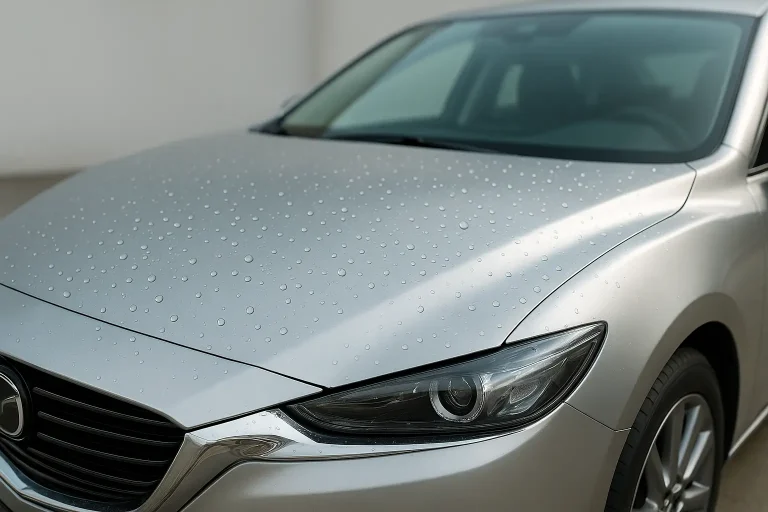
The practical result is a water contact angle above 100 degrees on a properly cured ceramic coating. Contact angle is the angle measured at the edge of a water droplet sitting on a surface. On unprotected paint, water contact angle is typically 40-60 degrees, meaning water spreads flat. On a cured ceramic coating, the droplet beads sharply, rolls with minimal friction, and carries surface contamination with it as it moves.
This self-cleaning behavior is not cosmetic. Dirt, road grime, and bird dropping acids require surface adhesion to begin their corrosive work on paint. A surface where water and contaminants cannot achieve adhesion significantly slows the rate at which environmental damage accumulates between washing cycles.
How Hydrophobic Durability Degrades Over Time
The hydrophobic effect weakens before the coating itself fails. As the outermost molecular layer of the SiO2 network is gradually abraded by washing, UV exposure, and contact with atmospheric pollutants, the surface energy of the coating slowly increases. Water contact angle decreases from above 100 degrees toward 80-90 degrees as this abrasion progresses.
This is why detailers recommend applying a maintenance spray (sometimes called a SiO2 booster or ceramic maintenance spray) every 3-6 months. The booster temporarily restores the low surface energy layer without requiring full reapplication of the base coating. The structural bond of the coating to the clear coat remains intact even when the hydrophobic surface layer has worn down.
A coating that no longer beads water is not a failed coating. It is a coating whose sacrificial hydrophobic layer has been depleted while the hardness protection and UV blocking properties remain functional. Understanding this distinction helps owners maintain their investment correctly rather than assuming the entire coating has failed.
What Does the Hardness Rating Mean and How Is It Measured?
Ceramic coating hardness is rated on the pencil hardness scale (ASTM D3363), which uses standardized graphite pencil grades from 6B (softest) to 9H (hardest) to measure scratch resistance. A coating rated 9H resists penetration by a 9H pencil pressed at 45 degrees with a defined load. Unprotected automotive clear coat tests at approximately 2H-4H depending on brand and age.
The hardness rating does not mean the coating is scratch-proof. It means the coating is harder than clear coat and therefore absorbs minor abrasions that would otherwise mark the paint. Swirl marks from improper washing, light contact with abrasive materials, and micro-marring from environmental debris are the damage types that hardness protection mitigates.
Sharp objects, keys, and significant impact forces exceed the hardness threshold of any current ceramic coating. A 9H-rated coating will scratch when a key is dragged across it with intent. The benefit is that the scratch is in the coating rather than the clear coat, and some coating manufacturers design their products as a sacrificial layer that can be removed and reapplied without touching the paint beneath.
The Mohs Scale vs the Pencil Hardness Scale
Ceramic coating marketing often references the Mohs hardness scale used for minerals (where diamond is 10 Mohs and talc is 1 Mohs). The comparison of SiO2 to quartz at 7 Mohs is technically accurate for the raw mineral compound but does not describe the cured coating layer on paint.
The cured sol-gel matrix on a car panel is a thin, flexible glass composite, not a solid quartz crystal. Its effective hardness when measured under ASTM D3363 pencil hardness testing is in the 7H-9H range for high-quality professional coatings. This is meaningfully harder than unprotected clear coat but is not equivalent to the 7 Mohs absolute hardness of crystalline quartz.
The pencil hardness rating is the correct metric for comparing coating products because it tests the coating as it exists in its application form, on a flexible substrate, under real-world test conditions. A product claiming “9H hardness” should be asked whether that rating was verified under ASTM D3363 testing or is simply a reference to the raw SiO2 mineral hardness.
How Does Heat Curing Accelerate the Ceramic Coating Reaction?
The condensation reaction that bonds SiO2 to the clear coat hydroxyl groups is temperature-dependent. At ambient temperature (65-75°F), the reaction proceeds slowly over 24-48 hours before the coating reaches initial cure, and continues crosslinking internally for 7-30 days before the final hardness is achieved. Heat accelerates the reaction rate by increasing molecular kinetic energy, allowing more silanol-hydroxyl contacts per unit time.
Professional detailing studios use infrared (IR) curing lamps that heat the panel surface to 140-160°F (60-71°C) for 30-45 minutes after coating application. This IR cure reduces the time to initial hardness from 24 hours to approximately 60-90 minutes. It also drives off residual carrier solvent more completely, which reduces the risk of high spots and coating streaks forming as the solvent evaporates unevenly at ambient temperature.
The crosslinking reaction also benefits from consistent temperature. Cold temperatures below 50°F (10°C) significantly slow the reaction and can prevent adequate bonding if the panel surface is too cold for silanol groups to achieve the activation energy needed for the condensation reaction. Professional coating manufacturers specify an application temperature window of 50-90°F (10-32°C) for reliable results.
Why Humidity Matters During Application and Curing
Relative humidity affects ceramic coating application in two opposing ways. Moderate humidity (40-60%) is beneficial because the condensation reaction that bonds SiO2 to the clear coat requires water molecules as a catalyst. Atmospheric moisture participates in the silanol formation chemistry and helps drive the bonding reaction at ambient temperatures.
High humidity (above 70%) is problematic because excess atmospheric moisture causes the carrier solvent to flash off too rapidly. When the solvent evaporates before the SiO2 network has time to level and settle into the surface micro-texture, the coating can cure with micro-streaks and an uneven hydrophobic response. High humidity also causes water spotting in the uncured coating if any moisture contacts the fresh surface.
Low humidity (below 30%) slows the condensation reaction by limiting the atmospheric moisture that catalyzes SiO2 crosslinking. In very dry conditions, coatings take longer to reach initial cure and may require IR heat assistance to compensate for insufficient ambient moisture. Professional installers use hygrometers to monitor humidity throughout the application process and adjust their technique or environment accordingly.
How Do Professional-Grade Coatings Differ from Consumer Products?
The fundamental chemical process is identical between professional and consumer ceramic coatings. Both use SiO2 sol-gel chemistry to bond to clear coat hydroxyl groups. The differences lie in SiO2 concentration, solvent formulation, layer thickness per application, and the addition of secondary active compounds in professional products.
Consumer ceramic coatings such as consumer-grade SiO2 ceramic spray coatings are formulated for ease of application by non-professionals. They use lower SiO2 concentrations (50-70%) and faster flash times so the product levels before the applicator can buff it. The tradeoff is a thinner cured layer (0.5-1 micrometer) and a shorter service life (12-24 months under normal conditions).
Professional coatings such as Gtechniq Crystal Serum Ultra, Nanolex SI3D, and Ceramic Pro 9H use SiO2 concentrations above 85% with slower solvent systems that require the trained technique of a professional applicator to work within the flash window correctly. The cured layer is thicker (2-5 micrometers), the hardness rating is higher (9H vs 7H-8H for most consumer products), and the service life extends to 3-5 years with proper maintenance.
Multi-Layer Coating Systems and Why They Are Used
Professional-grade ceramic coating systems often specify a base layer and one or more topcoats applied over 24-48 hours. The base layer is formulated for maximum SiO2 adhesion to the clear coat surface. It prioritizes bonding chemistry over surface slickness. The topcoat layers are formulated with different solvent profiles to maximize hydrophobicity and gloss at the outer surface.
Layering works because each SiO2 layer bonds to the hydroxyl groups generated on the surface of the previous cured SiO2 layer, building thickness and density progressively. A two-coat system produces a measurably harder final surface than a single coat of the same product because the second layer crosslinks with both the first layer and its own SiO2 network simultaneously, creating a denser final matrix.
Most consumer coating products cannot be layered effectively because their solvent systems dissolve partially cured previous layers rather than bonding to them. This is a deliberate formulation choice to prevent consumer application errors, but it limits consumer products to single-layer thickness regardless of how many coats are applied.
How Does UV Protection Work in Ceramic Coating?
Automotive ceramic coating provides UV protection through two mechanisms: physical barrier blocking and chemical inertness. The cured SiO2 layer is transparent to visible light but absorbs and reflects a portion of the UV spectrum, reducing the UV energy that reaches the clear coat and paint beneath. The degree of UV blocking is a function of coating thickness and SiO2 network density.
The chemical inertness mechanism is equally important. UV radiation degrades paint by exciting electrons in organic polymer chains, initiating free radical oxidation reactions that cause fading, chalking, and brittleness. The SiO2 matrix is an inorganic compound with no organic polymer chains to oxidize. UV energy that penetrates the coating encounters the inorganic SiO2 network rather than reactive organic clear coat molecules, significantly slowing the oxidation cascade.
Titanium dioxide (TiO2), used in premium ceramic coating formulations, adds a third mechanism: photocatalytic activity. Under UV exposure, TiO2 generates reactive oxygen species that break down organic contamination (bird droppings, tree sap, pollen) sitting on the coating surface. This self-cleaning reaction occurs continuously in sunlight and is the primary reason TiO2-containing coatings maintain their appearance better between wash cycles than SiO2-only formulations.
Why Ceramic Coating Does Not Replace Paint Protection Film
Ceramic coating and paint protection film (PPF) protect against fundamentally different damage types. Ceramic coating excels at chemical resistance, UV protection, and hydrophobic maintenance. PPF (thermoplastic polyurethane film) excels at impact resistance, rock chip absorption, and deep scratch protection. The two products address different threat categories rather than competing for the same function.
PPF has a thickness of 150-250 micrometers, compared to the 1-5 micrometer thickness of ceramic coating. That 50-100x thickness advantage gives PPF the physical mass to absorb rock chip impacts that penetrate any ceramic coating regardless of hardness rating. Ceramic coating’s 9H hardness is measured at micro-scale; a rock chip involves macro-scale impact forces that exceed any thin coating’s energy absorption capacity.
Many professional detailers apply ceramic coating over PPF to combine both products’ benefits. The PPF handles impact resistance while the ceramic coating on top provides hydrophobicity, UV protection, and gloss enhancement. PPF without a top coating degrades faster under UV exposure and is harder to maintain than PPF with a ceramic topcoat bonded to it.
What Are the Chemical Resistance Properties of Cured Ceramic Coating?
Cured ceramic coating resists a broad range of chemical attacks that damage unprotected paint. The SiO2 matrix is stable across a pH range of approximately 2-12, meaning it resists both strong acids (bird droppings contain uric acid at pH 3-4.5; acid rain is typically pH 4-5) and strong alkaline compounds (many road wash chemicals are pH 11-12). Unprotected clear coat begins etching at pH values below 4 or above 10 with prolonged contact.
The mechanism of chemical resistance is the same as the bonding mechanism in reverse. Because the SiO2 network is a fully crosslinked inorganic matrix with no free reactive sites after curing, corrosive compounds cannot form the chemical attachments needed to initiate surface degradation. Bird dropping acids that etch clear coat in as little as 2-3 hours under summer heat conditions take 24-48 hours to visibly affect a properly cured ceramic coating under the same conditions.
The temperature dependency of chemical etching is important to understand. Both bird dropping uric acid and iron contamination from brake dust etch paint faster at high temperatures because thermal energy accelerates the chemical reaction rate. Ceramic coating’s benefit at high surface temperatures (a dark-colored car in summer can reach surface temperatures of 150-180°F) is that the inorganic SiO2 matrix does not soften or become more reactive the way organic wax and sealant binders do under heat.
What Ceramic Coating Cannot Resist
Concentrated hydrofluoric acid (HF), used in some wheel cleaner formulations and certain industrial processes, attacks the SiO2 network directly. HF reacts with silicon dioxide to form silicon tetrafluoride, which is why HF-based cleaners are used to strip ceramic coatings during removal procedures. Any wheel cleaner product containing hydrofluoric acid should never contact a ceramic-coated surface.
Strong alkaline solutions above pH 13 degrade the SiO2 matrix over time. Some automatic car washes use concentrated alkaline pre-soaks that gradually strip the hydrophobic surface of ceramic coatings. Touchless car washes using pH-neutral or pH-adjusted chemistry are compatible with ceramic coating maintenance; brushed car washes and strong alkaline pre-soaks shorten coating service life significantly.
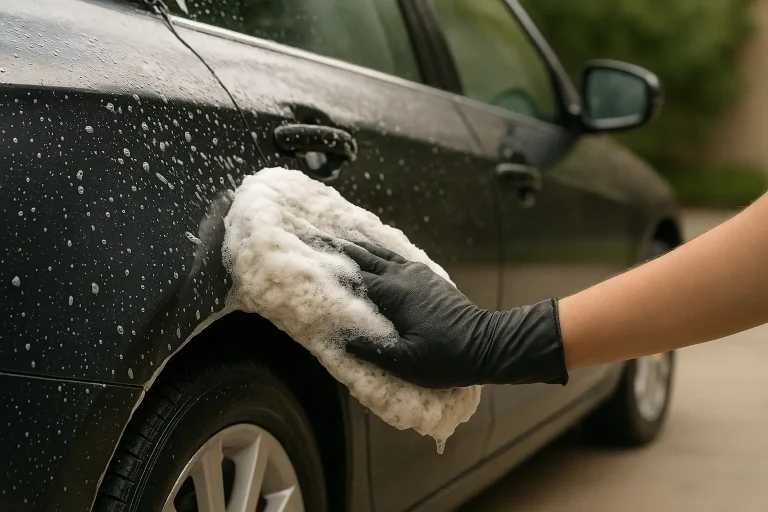
Physical abrasion from improper washing technique (using dirty microfiber, aggressive scrubbing, or automatic brushes) removes the outer hydrophobic layer faster than chemical exposure under normal conditions. Maintaining a ceramic-coated vehicle with a high-quality microfiber wash mitt and the two-bucket wash method preserves the coating surface far longer than the coating’s chemistry determines on its own.
How Does the Curing Process Work Step by Step?
The ceramic coating curing process begins at the molecular level the moment SiO2 contacts the hydroxyl sites on the clear coat surface. The process unfolds in three distinct phases: initial flash, primary crosslinking, and full cure. Each phase has different environmental sensitivities and defines a different set of handling restrictions for the coated vehicle.
Understanding each phase prevents the most common application and post-application errors that cause ceramic coatings to fail prematurely or cure with visible defects.
Here is a visual breakdown of how the curing chemistry progresses through each phase, from initial application to the fully hardened sol-gel matrix that defines long-term coating performance.
PROCESS GUIDE
Ceramic Coating Cure Phases: What Happens at Each Stage
Three distinct chemical phases from application to full cure, with handling restrictions and environmental sensitivities for each.
Initial Flash (0 to 2 minutes after application)
The carrier solvent begins evaporating the moment the liquid coating contacts the panel surface. SiO2 molecules begin migrating toward hydroxyl bonding sites on the clear coat. The installer must work the product level and buff off the residue before the solvent fully flashes or high spots form permanently. Flash time is typically 60-120 seconds at 68°F (20°C) and shortens significantly above 80°F (27°C).
Primary Crosslinking (2 minutes to 24 hours)
Condensation bonding between silanol groups (-Si-OH) and clear coat hydroxyl groups (-OH) accelerates as residual solvent evaporates. The SiO2 network begins forming its three-dimensional matrix. The coating achieves initial hardness within 2-4 hours at ambient temperature. During this phase, water contact must be avoided completely. Any water on the coating surface interferes with solvent evaporation and can cause water spotting in the curing matrix.
Full Cure and Final Hardness (24 hours to 30 days)
Internal crosslinking within the SiO2 matrix continues for up to 30 days after application. The coating reaches its rated pencil hardness (7H to 9H depending on product) at full cure, not at initial cure. Vehicles can be driven carefully after 24 hours, but the coating remains slightly softer than its final rated hardness during this period. Aggressive washing, chemical contact, and high-speed highway driving should be avoided for the first 7 days to allow the matrix to densify without mechanical disruption.
IR-Assisted Cure (Professional Studios Only)
Infrared curing lamps heat the coated panel to 140-160°F (60-71°C) for 30-45 minutes after the installer completes each section. IR cure compresses the primary crosslinking phase from 24 hours to 60-90 minutes by increasing molecular kinetic energy and driving off residual carrier solvent more completely. The vehicle can receive water contact within 2-4 hours of an IR-assisted cure rather than the 24-hour minimum for ambient-cure applications.
Post-Cure Maintenance Window (30 days onward)
Once the 30-day full-cure period is complete, the coating has reached its rated hardness and can withstand normal washing, rain exposure, and highway debris contact. The first maintenance wash at 30 days is the recommended window to inspect the coating surface for any high spots or application defects that were not caught at installation, and to apply a SiO2 maintenance booster spray that replenishes the hydrophobic surface layer to its maximum water contact angle.
Why Water Contact During Curing Causes Permanent Defects
Water reaching the coating surface during the primary crosslinking phase (the first 24 hours) causes a specific type of defect called water spotting in the matrix. This happens because water droplets displace the partially cured SiO2 molecules at the droplet boundary, creating a ring of denser SiO2 concentration where the water edge dried. The result is a circular pattern of different hardness and hydrophobicity that is visible as a matte ring on the gloss surface after full cure.
Rain during the curing window is the most common cause of this defect for consumer ceramic coating applications done outdoors. Professional installation occurs in enclosed, climate-controlled detailing bays precisely to control this variable. A portable IR curing lamp for detailing garages can accelerate cure time enough to close the water-contact vulnerability window for DIY applications.
How Does Ceramic Coating Compare to Other Paint Protection Products?
The three primary categories of automotive paint protection are carnauba wax, synthetic polymer sealant, and ceramic coating. Each category represents a different adhesion mechanism, hardness level, hydrophobic performance, and service life. Understanding how they differ at the chemistry level explains why ceramic coating commands a significant price premium over wax and sealant alternatives.
Use the table below to compare the key performance specifications across all three protection categories before deciding which product is appropriate for your vehicle and maintenance expectations.
| Specification | Carnauba Wax | Synthetic Sealant | Consumer Ceramic | Pro Ceramic |
|---|---|---|---|---|
| Adhesion Type | Van der Waals (physical) | Covalent partial | Covalent (full) | Covalent (full) |
| SiO2 Content | None | 0-15% (some blends) | 50-70% | 85-95% |
| Pencil Hardness | Below 2H | 2H to 4H | 7H to 8H | 9H |
| Water Contact Angle | 70-80 degrees | 80-90 degrees | 95-105 degrees | 105-115 degrees |
| pH Resistance Range | pH 5-9 | pH 4-10 | pH 3-11 | pH 2-12 |
| Heat Resistance | Softens above 160°F | Softens above 200°F | Stable to 1200°F | Stable to 1200°F |
| Service Life | 4-8 weeks | 6-12 months | 12-24 months | 3-5 years |
| Typical Cost | $15-40 (DIY) | $20-60 (DIY) | $30-100 (DIY) | $500-2,000 (installed) |
The SiO2 network is chemically inert at temperatures up to approximately 1,200°F (649°C), which is why ceramic coating performs identically in summer heat that reaches 180°F panel surface temperatures. Carnauba wax softens and loses adhesion above 160°F (71°C), making it effectively non-functional as a protective layer in direct summer sunlight on a dark-colored vehicle.
For most vehicle owners using their car daily under normal environmental exposure, a professional ceramic coating with a 3-5 year service life represents a better long-term value than repeated wax applications every 6-8 weeks, even accounting for the higher upfront installation cost.
What Are the Science-Based Limits of Ceramic Coating?
Ceramic coating cannot prevent all paint damage, and understanding its limits is as important as understanding its benefits. The most common misunderstanding, reinforced by marketing language, is that a 9H-rated coating provides scratch immunity. The hardness rating applies to micro-scale abrasion resistance under standardized test conditions. It does not apply to impact forces, deep scratches from sharp objects, or damage types that exceed the thin coating layer’s energy absorption capacity.
Rock chips are the clearest example of a damage type that ceramic coating cannot prevent. A 2-3 micrometer coating layer has negligible energy absorption capacity relative to a gravel chip traveling at highway speed. The chip penetrates the coating, the clear coat, and often the base coat regardless of the coating’s hardness rating. Paint protection film is the correct product for rock chip resistance.
Ceramic coating does not fill paint swirls or scratches. It seals and hardens the surface as it exists at application. Swirl marks present in the clear coat before coating application will be visible through the ceramic layer after curing because the coating is transparent and 1-5 micrometers thick. Paint correction before coating application is not optional; it is a prerequisite for the coating to enhance rather than preserve existing imperfections.
Why Coating Claims About “Self-Healing” Require Scrutiny
Some ceramic coating products marketed as “self-healing” or “flex-coat” formulations contain a small proportion of elastomeric polymer blended into the SiO2 matrix. The elastomeric component allows very light swirl marks (under 1 micrometer depth) to partially recover when heat is applied, typically from sunlight or warm water. The SiO2 matrix is not self-healing. Only the elastomeric component has this property, and it applies only to superficial contact marks above a threshold temperature of approximately 95-115°F (35-46°C).
True paint protection film (PPF) products with topcoat layers have more robust self-healing capability than ceramic coating blends because the thermoplastic polyurethane film itself can flow and recover over a wider range of scratch depths at lower temperatures. Marketing that conflates ceramic coating self-healing claims with PPF self-healing capability is misleading buyers about relative performance.
For vehicles where swirl resistance and minor scratch recovery are primary concerns, a hybrid approach of PPF on high-impact zones combined with a professional-grade SiO2 ceramic topcoat over the full vehicle addresses both categories with the appropriate product for each function.
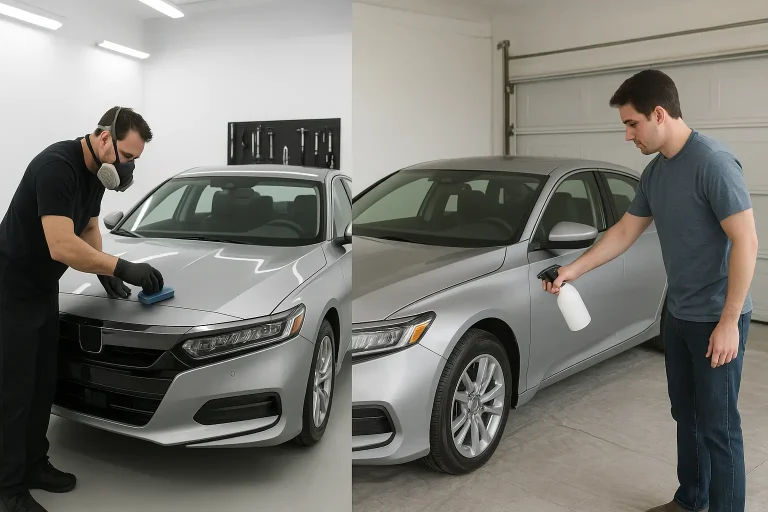
How to Prepare and Apply Ceramic Coating Correctly
Correct preparation accounts for approximately 80% of ceramic coating performance and longevity. A coating applied to a properly prepared surface will outlast and outperform the same coating applied to a contaminated or damaged surface by a factor of 2-3 in service life. The preparation steps are non-negotiable regardless of coating price or brand.
The following steps represent the professionally established preparation and application protocol. Skipping any step directly reduces the adhesion quality and longevity of the finished coating.
-
Wash with a pH-neutral car shampoo (1-2 hours).
Remove all loose surface contamination using a two-bucket wash method with a clean pH-neutral car wash soap. Dry completely with a clean microfiber drying towel. Any soap residue remaining on the paint will interfere with SiO2 adhesion. -
Decontaminate with iron remover and clay bar (1-2 hours).
Spray an iron and fallout remover across all painted surfaces. Allow 3-5 minutes of dwell time. Iron contamination turns purple as the product neutralizes embedded iron particles. Rinse thoroughly. Follow with a clay bar lubricated with detailing spray to remove tar, industrial fallout, and tree sap that the wash did not remove. The paint surface should feel completely smooth (no texture or drag) when you run a clean fingertip over it after claying. -
Polish with a dual-action machine polisher (2-6 hours depending on condition).
Use a dual-action random orbital polisher with a cutting compound to remove oxidation, water spots, and swirl marks from the clear coat. Finish with a finishing polish and soft pad to eliminate any haze from the cutting stage. Paint correction must be completed before coating application. Any remaining defects will be sealed permanently beneath the ceramic layer. -
Wipe down with isopropyl alcohol (IPA) solution (30-60 minutes).
Mix isopropyl alcohol to 70-80% concentration with distilled water. Wipe all polished surfaces with a clean microfiber to remove all polishing oils, dust, and silicone residue. This step ensures the clear coat hydroxyl bonding sites are fully exposed and free of any oil-based compound that would block SiO2 adhesion. Allow 10-15 minutes for the IPA to fully evaporate before coating application. -
Apply ceramic coating to a 2×2 foot section at a time (2-4 hours for full vehicle).
Apply 4-6 drops of ceramic coating liquid to a foam applicator wrapped in a suede microfiber cloth. Work the product into the panel surface using overlapping straight-line passes. Watch for the coating to flash (surface appears slightly hazy or develops a rainbow sheen) after 60-90 seconds at 68°F (20°C). Buff off with a clean, plush microfiber before the flash becomes complete. Working in a shaded or enclosed environment is essential. Direct sunlight accelerates flash time to under 30 seconds, which is too fast for proper leveling. -
Level the coating with a second clean microfiber immediately after buffing (continuous with step 5).
Use a second dry, clean microfiber to do a final leveling pass across each section immediately after the first buff. This catches any thin high spots the first buff missed and ensures a uniform, streak-free surface before the primary crosslinking phase begins. Inspect each section under a dedicated detailing LED light held at a low angle to catch any remaining residue. -
Allow initial cure undisturbed for 24 hours minimum.
Keep the vehicle in a clean, dry environment away from water contact for 24 hours. Ambient temperature should remain between 50-90°F (10-32°C) during this window. Do not touch the coated surface, cover the vehicle with a car cover, or allow any liquid contact during the initial cure phase.
Common Application Mistakes That Permanently Reduce Coating Performance
Applying ceramic coating in direct sunlight is the most common DIY error. Flash time drops below 30 seconds when panel surface temperature exceeds 90°F (32°C), which is faster than most applicators can work a 2×2 foot section. The result is high spots where the SiO2 network cured before leveling, visible as bright, hazy patches that require machine polishing to remove.
Using too much product is the second most common error. Ceramic coating is not paint. More product does not mean more protection. Each drop of coating contains enough SiO2 to cover approximately 1 square foot of surface at the correct application thickness (1-3 micrometers). Excess product produces thick, uneven layers that cure slowly, produce more high spots, and waste an expensive material.
Failing to inspect under proper lighting allows application defects to cure permanently. A standard garage light will not reveal high spots, streaks, or areas of uneven coverage. A dedicated LED swirl finder inspection lamp is essential for verifying each section immediately after application before the coating passes its flash window.
How Does Nano-Ceramic Technology Differ from Standard Ceramic Coating?
The term “nano-ceramic coating” refers to ceramic coating formulations where the SiO2 particles have been reduced to nanoparticle size, typically 1-100 nanometers in diameter, compared to the micrometer-scale particles in standard formulations. The nanoparticle size affects how the SiO2 distributes across the clear coat surface during application and how densely the cured network forms.
Smaller particles can penetrate more deeply into the microscopic valleys and texture of the clear coat before the crosslinking reaction locks them in place. A nanoparticle formulation on a polished clear coat with surface texture of 5-20 nanometer roughness can achieve more complete surface coverage than a standard particle formulation, because the nanoparticles are small enough to fill valleys that larger particles bridge over rather than contact.
The practical performance difference between nano and standard formulations is most visible in hydrophobic uniformity. A nano-ceramic coating on a highly polished surface produces a more consistent water contact angle across the entire panel because the SiO2 network is more uniform at the microscopic level. On a surface with visible scratches or significant texture, the difference between nano and standard formulations is less meaningful because the surface irregularities dominate the contact angle measurement.
Graphene Coating vs Ceramic Coating: Which Technology Is More Advanced?
Graphene-infused ceramic coatings represent the current frontier of consumer paint protection chemistry. Graphene is a single-atom-thick layer of carbon atoms arranged in a hexagonal lattice with an extraordinary combination of properties: higher tensile strength than steel, excellent thermal conductivity, and low surface energy (hydrophobicity) comparable to fluoropolymer coatings such as PTFE.
When graphene flakes are incorporated into a SiO2 sol-gel matrix, the hybrid coating shows measurably lower water contact angle hysteresis (the difference between advancing and receding contact angles) compared to SiO2-only formulations. Lower contact angle hysteresis means water droplets move off the surface more easily at lower tilt angles, which translates to better self-cleaning behavior in real conditions.
Graphene’s thermal conductivity also reduces water spot formation from heat-induced mineral deposition. A standard ceramic coating surface under direct summer sun can reach 150-180°F. At those temperatures, water droplets on the surface evaporate rapidly, leaving behind concentrated mineral deposits. Graphene’s thermal conductivity helps dissipate panel surface heat more quickly, slowing the evaporation rate and giving water droplets more time to roll off before they deposit minerals. For a deeper look at how this compares to the full spectrum of protective coating options, see our comprehensive breakdown of automotive coating types and their protection levels.
What Does Scientific Research Say About Long-Term Coating Performance?
Published research on automotive ceramic coating longevity is limited compared to industrial ceramic coating literature, but several relevant studies provide quantified performance data. A study published in the journal Progress in Organic Coatings examined SiO2 sol-gel coatings on automotive paint substrates and found that coatings with SiO2 concentrations above 80% maintained hydrophobic contact angles above 100 degrees for 36 months of outdoor Florida exposure testing, a condition that represents approximately 3x the UV and humidity stress of northern European or Pacific Northwest climates.
Research published in the Journal of Coatings Technology and Research found that SiO2 sol-gel coatings applied over polyurethane clear coat at film thicknesses of 2-4 micrometers produced a statistically significant reduction in UV-induced clear coat gloss loss over 24-month outdoor exposure compared to uncoated controls. The coated samples retained 85-90% of initial gloss values; uncoated controls retained 60-70% of initial gloss under the same exposure conditions.
These figures align with the manufacturer claims from professional coating brands, which typically specify 70-80% gloss retention at the end of their rated service life periods. The research supports the core mechanism claim that the inorganic SiO2 barrier reduces UV-initiated oxidation in the organic clear coat beneath it, though the research also confirms that coating thickness is a critical variable: coatings under 1 micrometer showed significantly reduced UV protection compared to 2-micrometer and 4-micrometer samples.
Independent Testing Standards for Ceramic Coating Claims
The ceramic coating industry currently lacks a single universal independent testing standard equivalent to what the automotive industry has for OEM clear coat performance (ISO 11341 for artificial weathering, ISO 2409 for adhesion). Most coating manufacturer hardness and durability claims are based on internal testing protocols that vary between brands.
ASTM D3363 (pencil hardness) and ASTM D1308 (chemical resistance to spot exposure) are the most commonly referenced independent standards in ceramic coating specifications. When evaluating a coating product’s claims, looking for ASTM-referenced test results rather than proprietary test results provides a more reliable basis for comparison. Independent coating review organizations such as Detailing World and ESOTERIC Car Care publish comparative hardness and longevity testing using consistent methodologies that the wider detailing community has validated over multiple product generations.
How Much Does Professional Ceramic Coating Cost and What Affects the Price?
Professional ceramic coating installation costs range from $500 to $2,000 or more for a full vehicle, with the price variance driven primarily by the scope of paint correction required, the vehicle size and panel complexity, the specific coating system specified, and the certified installer’s labor rate in the local market. The coating material itself typically represents only 15-25% of the total professional installation cost. Labor and surface preparation dominate the price structure.
A vehicle requiring heavy paint correction (multiple-stage polishing to address deep swirls, oxidation, and water etch marks) adds $200-600 to the base coating installation price. Paint correction labor is priced per hour at professional detailing rates of $75-150 per hour depending on the market. A full correction on a moderately worn daily driver takes 6-12 hours before the coating application begins.
Consumer ceramic coating kits for DIY application range from $30 to $200, with professional-supply single-coat kits available through detailing supply retailers at $100-400 for enough product to coat one full vehicle. The DIY cost savings are real, but they require investing 8-16 hours of preparation and application time and accepting the risk of application errors that can require professional correction to remove high spots from improperly cured sections.
Consumer Ceramic Coating Kits: What to Buy and What to Expect
For DIY ceramic coating, reputable consumer-grade products include Gtechniq C2v3 Liquid Crystal, Adam’s Polishes Ceramic Coating, and CarPro CQuartz UK 3.0. These products are formulated for application by non-professionals with longer flash windows, lower viscosity, and higher margin for error than professional installer-grade products.
Key Specifications for a quality consumer ceramic coating kit:
- SiO2 concentration: 50-70% active compound
- Flash time at 68°F (20°C): 90-180 seconds (longer is easier for DIY)
- Coverage per 30ml bottle: 1 full vehicle of a standard sedan
- Pencil hardness (cured): 7H to 8H
- Water contact angle: 95-105 degrees after full cure
- Rated service life: 12-24 months with proper maintenance
Consumer kits that include an IR-safe formula (some professional-only formulas become unstable if a consumer attempts IR cure without proper temperature control) and a detailed application guide specific to ambient temperature adjustment are the safest choices for first-time applicators. Avoid products that do not specify SiO2 concentration, flash time, or testing methodology in their technical documentation.
How to Maintain Ceramic Coating for Maximum Service Life
Ceramic coating maintenance is simpler than maintaining wax or sealant, but it requires avoiding specific products and practices that degrade the SiO2 network prematurely. The coating is the sacrificial outer layer protecting the clear coat. Maintaining the coating correctly means the paint beneath it never needs attention for the full service life period.
Washing technique is the single most impactful maintenance variable. The two-bucket wash method (one bucket of clean soapy water for the wash mitt, one bucket of clean water for rinsing the mitt between passes) prevents grit contamination in the wash media from being dragged across the coating surface. A single pass with a contaminated wash mitt creates swirl marks that reduce the hydrophobic performance of the coating surface. Using a foam cannon with a pressure washer for a pre-wash foam stage removes loose contamination before any contact wash media touches the coating surface, further reducing swirl-generating contact abrasion.
A pH-neutral car shampoo must be used for every wash. Alkaline shampoos (pH above 9) gradually strip the hydrophobic surface layer of the SiO2 network, reducing water contact angle and shortening the effective service life of the coating. Many popular “wash and wax” combination shampoos contain silicone polymers that build up on ceramic coating surfaces and create a dull, uneven surface energy profile over time. These products are incompatible with ceramic coating maintenance.
When to Apply a SiO2 Maintenance Booster
A SiO2 ceramic booster spray such as CarPro Reload SiO2 maintenance spray or Chemical Guys HydroCharge should be applied every 3-6 months to restore maximum hydrophobic performance. The booster contains a diluted SiO2 formulation that bonds to the existing coating surface, replenishing the outermost hydrophobic layer that washing has gradually depleted.
The indicator that a booster application is needed is a reduction in the water beading behavior on the coating surface. When water begins sheeting rather than beading sharply (contact angle dropping below approximately 90 degrees), the outer SiO2 layer has been depleted to the point where a booster will produce an immediately visible improvement. Applying a booster before this point is also acceptable as a scheduled maintenance practice.
Booster sprays do not add meaningful thickness to the coating or extend its rated service life beyond the base coating’s specifications. They maintain the hydrophobic surface in its optimal condition throughout the rated service life period. When the base coating finally reaches the end of its service life (typically indicated by no response to booster application and water contact angle that remains below 80 degrees), the vehicle requires professional removal and reapplication of a fresh base coating.
For vehicles where the coating needs to be removed, whether due to end of service life or incorrect application, the removal chemistry is the reverse of the application chemistry. If you need to address this situation, our guide on safely stripping ceramic coating without damaging the underlying clear coat covers the correct chemical and mechanical removal protocols.
How Does Ceramic Coating Science Apply to Other Ceramic Technologies?
The SiO2 sol-gel chemistry that makes automotive ceramic coating work is the same fundamental chemistry used in multiple other ceramic-based protective and functional technologies. Understanding the core bonding mechanism in automotive coating provides a basis for understanding why ceramic materials perform so differently from organic polymers across a wide range of applications.
In ceramic water filtration systems, SiO2 is used not for its low surface energy but for its controlled pore structure. Ceramic filters are manufactured from SiO2, alumina, and other refractory oxides sintered into a rigid porous matrix with pore sizes ranging from 0.1 to 5 micrometers. The same chemical inertness that protects car paint from acid rain is what makes ceramic filter media safe for drinking water contact across a wide pH range. For a detailed explanation of how the pore chemistry of ceramic filters removes biological and chemical contaminants, see our science of pore filtration in ceramic water purification systems.
Ceramic heaters use the thermal stability of ceramic compounds (typically positive temperature coefficient barium titanate ceramics) to self-regulate temperature without electronic controls. The same resistance to thermal degradation that keeps automotive ceramic coating stable at 1,200°F underlies the operating principle of ceramic heating elements. The connection between automotive and thermal applications of ceramic science is more direct than it might appear. If you are curious about how that thermal stability translates to heating technology, our article on how ceramic heating elements regulate temperature through PTC resistance covers the physics in depth.
Ceramic cookware coatings use a different subset of the same sol-gel chemistry. Non-stick ceramic pan coatings use SiO2 and titanium dioxide compounds to create a low-surface-energy cooking surface with chemical resistance to food acids and high heat. The application and maintenance principles share significant overlap with automotive ceramic coating. Avoiding abrasive cleaning tools and alkaline detergents preserves the SiO2 network in cookware coatings for the same fundamental chemical reason it preserves automotive coatings.
Frequently Asked Questions About Automotive Ceramic Coating Science
Can ceramic coating be applied over existing wax or sealant without removing it first?
Ceramic coating applied over wax or sealant will bond to the wax layer rather than to the clear coat. The wax or sealant layer will eventually degrade, and when it does, the ceramic coating above it will delaminate with it. Complete removal of all wax and sealant using an IPA (isopropyl alcohol) wipe-down at 70-80% concentration is mandatory before ceramic coating application. The IPA strip must be confirmed by checking that water sheets evenly across the paint surface rather than beading, which indicates complete wax removal.
What happens if ceramic coating is applied in direct sunlight?
Direct sunlight heats the panel surface above 90°F (32°C), which reduces the flash time of the carrier solvent from the normal 90-180 seconds to under 30 seconds. At that flash time, the coating cures before the installer can level it, producing permanent high spots that appear as bright, hazy patches on the finished surface. These high spots require machine polishing with a cutting compound to remove, which also removes the freshly applied coating. Application must occur in shade, indoors, or during cooler morning hours with ambient panel temperature confirmed below 85°F (29°C).
Is 9H ceramic coating harder than the car’s clear coat, and does that mean it cannot scratch?
A 9H-rated ceramic coating is harder than automotive clear coat, which tests at approximately 2H-4H on the ASTM D3363 pencil hardness scale. The hardness difference means minor abrasions (swirl marks, light contact) that would mark unprotected clear coat are absorbed by the coating layer instead. However, 9H is not scratch-proof. Sharp objects, rock chips at highway speed, and abrasive contact with grit under applied pressure all penetrate 9H ceramic coating. The coating is a harder sacrificial layer over the paint, not an impenetrable shield.
Can ceramic coating be applied to plastic trim, rubber seals, and glass?
SiO2 ceramic coating bonds to glass surfaces effectively because glass is also an amorphous SiO2 compound with abundant hydroxyl surface groups that react with the coating’s silanol groups. Applying ceramic coating to windshields and side windows produces a hydrophobic surface that improves rain sheeting and visibility. On unpainted plastic trim and rubber seals, ceramic coating provides temporary protection but adhesion longevity is significantly shorter (6-12 months versus 3-5 years on paint) because porous, flexible substrates do not provide the stable bonding surface that polyurethane clear coat does.
Why does bird dropping damage occur faster in summer on a ceramic-coated car?
Bird droppings contain uric acid at pH 3-4.5, which etches paint surfaces through chemical attack on clear coat polymers. At higher surface temperatures (150-180°F on dark cars in summer sun), the reaction rate of uric acid on any surface, including ceramic coating, increases significantly due to the Arrhenius relationship between temperature and chemical reaction rate. Ceramic coating’s pH 2-12 resistance means the etching process is slower than on unprotected paint, but the temperature effect still applies. Removing bird droppings within 2 hours rather than allowing prolonged contact eliminates the temperature-accelerated etching risk regardless of coating type.
Does a thicker ceramic coating layer always mean better protection?
Coating thickness above approximately 5 micrometers does not produce proportionally better protection because the SiO2 network’s UV blocking, chemical resistance, and hardness properties are determined by network density rather than absolute thickness. An overly thick layer cures more slowly, is more prone to high spots during leveling, and can develop internal stress cracks in the cured matrix if applied excessively. The optimal thickness for a professional single-coat application is 2-4 micrometers. Multi-coat systems achieve better performance through successive thin layers of 1-2 micrometers each rather than through a single thick application.
Can I use an automatic car wash on a ceramic-coated vehicle?
Touchless automatic car washes using pH-neutral or pH-adjusted detergent chemistry are compatible with ceramic coating maintenance and will not significantly shorten the coating’s service life. Brushed automatic car washes use spinning brushes or cloth media that introduce micro-abrasions across the coating surface with every wash cycle, progressively depleting the outer hydrophobic layer and creating swirl marks in the SiO2 network. A brushed car wash once will not destroy a ceramic coating, but regular use of brushed car washes shortens the coating’s effective hydrophobic service life by 30-50% compared to hand washing with proper technique.
Does ceramic coating on wheels hold up to brake dust and heat?
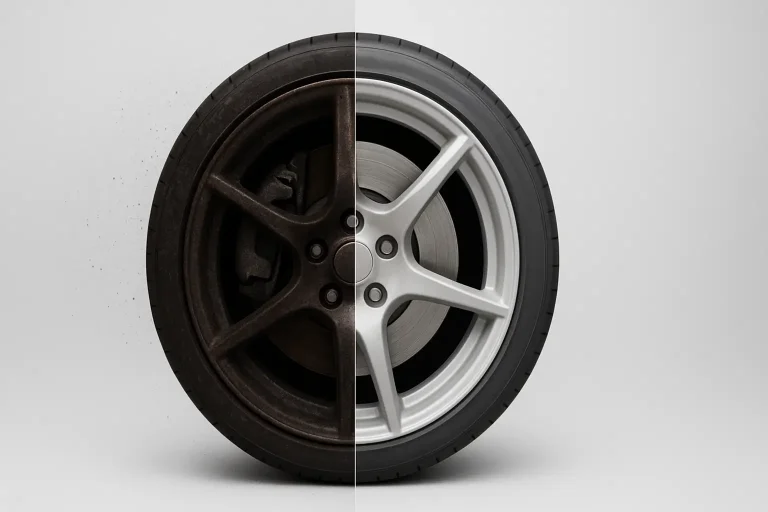
Ceramic coating on wheel faces is one of the highest-value applications of the technology because wheels face iron particle contamination from brake pads, elevated temperatures from brake heat (wheel surfaces can reach 300-500°F during aggressive driving), and frequent exposure to wheel cleaner chemicals that are often acidic or alkaline. The SiO2 coating’s stability to 1,200°F means the coating itself is unaffected by brake heat. The hydrophobic surface prevents iron particles from embedding into the wheel surface, making them removable with a gentle iron decontamination spray rather than aggressive scrubbing. Wheel-specific ceramic coating products are available that are formulated with slightly higher flexibility to accommodate the thermal expansion and contraction cycles that wheel surfaces experience.
How do I know when my ceramic coating has failed and needs to be replaced?
A ceramic coating has reached the end of its service life when the water contact angle on the panel surface remains below 80 degrees after a thorough wash and SiO2 booster application. At contact angles below 80 degrees, the hydrophobic benefit is minimal and water sheets rather than beads. Paint surface gloss and UV protection from the remaining coating layer may still be partially functional even when the hydrophobic layer is depleted, but the coating is no longer performing at a level that justifies retaining it over professional reapplication. Swirl marks visible through the coating, persistent water spots that do not respond to maintenance products, and areas of visible delamination are additional indicators that the coating has failed and the vehicle requires professional assessment.
Is ceramic coating food-safe, and can it be used on surfaces that contact food or water?
Automotive-grade SiO2 ceramic coating is not formulated or tested for food contact safety. The carrier solvents used in automotive ceramic coating formulations (typically isopropyl alcohol, acetone, or proprietary organic solvent blends) are selected for their paint surface compatibility, not for food safety. Ceramic coating products formulated for food contact surfaces, such as cookware and food preparation equipment, use different carrier systems and are tested to different regulatory standards. Never apply automotive ceramic coating to surfaces that contact food or potable water. For food-contact ceramic surface applications, products specifically certified for food contact under FDA 21 CFR standards are the appropriate choice.
Can ceramic coating cause paint damage if left to cure incorrectly?
Yes. High spots (areas where the coating cured before leveling) require removal by machine polishing with a cutting compound, which removes the freshly applied ceramic coating along with the microscopic clear coat material the polishing abrades. Repeated machine polishing to correct coating errors will eventually thin the clear coat to the point where it requires professional respray. Consumer coating products with longer flash times reduce this risk significantly compared to professional-grade formulas, but the risk is not zero. Any coating that has cured into visible high spots must be removed by machine polishing, not by applying additional coating layers over the defect.
Do ceramic coatings require any specific tools that are not included in a standard kit?
A quality LED inspection lamp is the most critical tool not included in most coating kits. Identifying high spots and uneven coverage requires inspecting each section under a focused, bright light held at a low angle to the panel surface. Standard garage lighting does not reveal application defects until they have fully cured and become impossible to correct without machine polishing. A detailing LED inspection light at $40-80 is the single most cost-effective addition to any DIY ceramic coating kit. A surface infrared thermometer to verify panel temperature before application is the second most important tool, preventing the most common application error of working on panels that are too hot.
The Science of Ceramic Coating: What Matters Most
Automotive ceramic coating works because SiO2 molecules form genuine covalent chemical bonds with clear coat hydroxyl groups, creating a sol-gel glass matrix that is chemically different from every wax or sealant product in the market. That bonding mechanism is not marketing language. It is inorganic chemistry that explains every performance property the coating delivers, from 9H hardness to pH 2-12 acid resistance to water contact angles above 100 degrees.
The most important practical implication of the science is that preparation determines performance. A ceramic coating is only as permanent as the substrate it bonds to, and every contamination layer between the SiO2 network and the clean clear coat reduces adhesion quality and service life proportionally. Invest the same care in surface preparation that you invest in coating product selection, and the chemistry will deliver on the performance claims.
For a full walkthrough of every coating product category, service life comparison, and professional installer selection guide, see our complete guide to ceramic coating for cars, which covers everything from entry-level consumer sprays to multi-layer professional systems with specific product recommendations at every budget level.