Ceramic Coating Cost Guide: DIY vs Professional Pricing

Ceramic coating a car costs between $20 and $2,500 depending on whether you apply it yourself or hire a professional detailer. That price gap is not about the product alone — it reflects preparation time, application skill, and the controlled environment that separates a coating that lasts two years from one that lasts seven.
This guide covers every cost tier for DIY ceramic coating kits ($20 to $150), entry-level professional packages ($300 to $600), and full multi-stage correction packages ($1,000 to $2,500+), with a breakdown of what drives each price point and where the money actually goes.
What Determines the Price of a Ceramic Coating Job?
Ceramic coating price is set by four variables: the product grade, the surface preparation required, the application environment, and the applicator’s skill level. Understanding these variables tells you whether a $150 quote is a bargain or a warning sign.
Product grade is the first cost driver. Consumer-grade coatings sold in auto parts stores contain 5 to 10 percent SiO2 (silicon dioxide) and cure in ambient conditions. Professional-grade coatings from brands like Gtechniq, Ceramic Pro, and IGL Coatings contain 70 to 90 percent SiO2 or SiC (silicon carbide) and require controlled temperature and humidity to cure correctly.
Surface preparation is the largest hidden cost. A professional coating applied over swirl marks and oxidation will seal those defects permanently under glass. Correcting a moderately swirled daily driver requires two to four hours of machine polishing before the coating ever touches the paint.
Application environment affects cure quality directly. Professional installers use climate-controlled bays held at 60 to 75°F with humidity below 50 percent. Applying a professional-grade coating in a warm, humid garage produces high spots, streaking, and uneven gloss within the first wash.
Applicator certification adds cost because it signals access to restricted products. Ceramic Pro, Gtechniq, and a handful of other brands sell their highest-grade coatings exclusively to trained, certified installers — those products are not available to the public at any price.
For a deeper look at how ceramic coatings compare to film-based paint protection, see our full comparison of ceramic coating versus paint protection film.
DIY Ceramic Coating Kits: Full Cost Breakdown
A DIY ceramic coating job costs between $50 and $300 in total once you include the kit, the preparation supplies, and the application tools. The coating itself is rarely the biggest line item.
Entry-Level DIY Kits: $20 to $60
Entry-level kits from brands like Mothers CMX, Chemical Guys HydroSlick, and Turtle Wax Hybrid Solutions Ceramic contain SiO2 concentrations between 5 and 15 percent. These products are wipe-on, wipe-off formulas designed to be applied without professional training.
Key Specifications for Entry-Level DIY Kits:
- SiO2 concentration: 5 to 15 percent
- Durability estimate: 12 to 18 months under normal conditions
- Surface preparation required: clean, decontaminated paint only (no polishing required)
- Application temperature range: 50 to 80°F
- Cure time before water contact: 24 hours minimum
These kits do not require machine polishing before application, which makes them accessible to beginners. They do require a clean, decontaminated surface — skipping the clay bar step produces bonding failures that show up as peeling or uneven water behavior within a few months.
A Mothers CMX Ceramic Spray Coating costs approximately $15 to $25 per bottle and covers one full-size sedan with product to spare.
Mid-Range DIY Kits: $60 to $150
Mid-range kits from brands like Avery Dennison, CarPro CQuartz Lite, and Gyeon Q2 Mohs Lite contain 20 to 40 percent SiO2 and require more careful application technique than spray-and-wipe products. These coatings are applied in small sections using a suede or foam applicator block, leveled before the coating flashes, and buffed off with a clean microfiber towel.
Key Specifications for Mid-Range DIY Kits:
- SiO2 concentration: 20 to 40 percent
- Durability estimate: 2 to 3 years with proper maintenance
- Surface preparation required: decontamination plus minor swirl removal recommended
- Flash time before leveling: 1 to 3 minutes depending on temperature
- Full cure time: 7 days before polishing or correction
The flash time window is the technical challenge in this tier. Apply the coating in sections no larger than 2 square feet at a time. In temperatures above 75°F, that window shrinks to under 60 seconds — high spots form if you miss the flash and try to buff a hardened coating.
A CarPro CQuartz Lite DIY ceramic coating kit costs approximately $60 to $80 and includes enough product for one vehicle plus an applicator block and prep spray.
Professional-Grade Consumer Kits: $100 to $200
The top tier of consumer-available coatings includes products like Gyeon Q2 Pure, Adam’s UV Ceramic Coating, and 22PLE VM1 Signature Glass Coat. These contain 50 to 70 percent SiO2 and behave much closer to professional installer products in terms of hardness, chemical resistance, and durability.
Key Specifications for Professional-Grade Consumer Kits:
- SiO2 concentration: 50 to 70 percent
- Hardness rating: 9H on the pencil hardness scale
- Durability estimate: 3 to 5 years with correct application and maintenance
- Surface preparation required: full paint correction strongly recommended
- Application window: 30 to 90 seconds at 65 to 70°F
At this concentration level, application errors are permanent until the coating is machine-polished off. High spots, missed sections, and streaks created at this tier require a dual-action polisher with a heavy-cut compound to remove — that adds $50 to $150 in additional labor or product cost if you make a mistake.
A Gyeon Q2 Pure ceramic coating costs approximately $100 to $130 for a 30ml bottle, which is enough for one full vehicle with careful sectioning.
Full DIY Supply Cost: What You Actually Need to Spend
The coating kit is only part of the DIY budget. A proper DIY application requires a decontamination kit, microfiber towels, an applicator block, and ideally an iron remover and clay bar kit for the prep stage.
Use the table below to estimate your total DIY budget before purchasing anything.
| Supply Item | Budget Option | Mid-Range Option | Why It Matters | Estimated Cost |
|---|---|---|---|---|
| Ceramic coating kit | Turtle Wax Hybrid Solutions | CarPro CQuartz Lite | Core product — determines durability | $20 to $150 |
| Iron remover spray | Chemical Guys Iron Decon | CarPro Iron X | Removes embedded iron before coating | $15 to $35 |
| Clay bar kit | Meguiar’s Smooth Surface Kit | CarPro CQUARTZ Clay Kit | Removes bonded contamination coating can seal in | $12 to $30 |
| Panel wipe / IPA solution | Isopropyl alcohol 70% diluted | CarPro Eraser | Removes oils and wax residue before coating | $10 to $25 |
| Microfiber applicator block | Generic suede block | CarPro Hex-Logic applicator | Controls product spread and prevents waste | $5 to $15 |
| Microfiber leveling towels | Amazon basics pack of 12 | The Rag Company Twist towels | Used to buff off flash — must be lint-free | $15 to $35 |
| Optional: paint polishing kit | Meguiar’s hand polish + foam pad | DA polisher + compound + pad kit | Removes swirls before coating — not optional above mid-range | $0 to $150 |
A realistic entry-level DIY budget lands between $80 and $150 all-in. A mid-range DIY application with paint correction supplies runs $200 to $400 depending on whether you already own a dual-action polisher.
The most common DIY mistake is skipping the iron remover and clay bar steps to save $25. Those steps determine whether the coating bonds to clean paint or seals contamination permanently beneath the glass layer.
Here is a breakdown of how DIY ceramic coating costs compare across tiers before we move to professional pricing.
PRICE COMPARISON
Ceramic Coating Cost by Tier: DIY and Professional
Total estimated cost per vehicle including prep supplies. Prices verified at time of publication.
$80 to $150
$150 to $300
$250 to $500
$300 to $600
$600 to $1,200
$1,200 to $2,500+
DIY costs include prep supplies but not polishing equipment. Professional costs include all labor and preparation. Prices represent U.S. market averages and vary by region and vehicle size.
Professional Ceramic Coating Pricing: What Each Package Includes
Professional ceramic coating packages range from $300 to $2,500 for a standard passenger vehicle. The price difference between a $350 quote and a $1,800 quote is almost entirely preparation — the number of polishing stages performed before the coating is applied.
Entry-Level Professional Package: $300 to $600
An entry-level professional package includes a thorough decontamination wash, an iron remover treatment, a clay bar decontamination, and a single-stage machine polish to remove light swirls before the coating is applied. The coating product used at this tier is typically a one-year to two-year consumer-grade or entry professional coating.
Key Specifications for Entry-Level Professional Package:
- Paint correction: single-stage polish (removes 60 to 70 percent of light swirls)
- Coating product tier: consumer professional (Ceramic Pro Sport, Gtechniq C2, or equivalent)
- Coating durability: 1 to 2 years
- Application time: 4 to 6 hours total
- Warranty offered: rarely included at this price point
This package is appropriate for vehicles with light paint defects and no heavy oxidation. A five-year-old daily driver with moderate swirls is a reasonable candidate. A vehicle with heavy single-stage paint, deep scratches, or visible oxidation will not look significantly better after a single-stage polish and should be quoted for a two-stage or multi-stage package.
Mid-Tier Professional Package: $600 to $1,200
A mid-tier package adds a two-stage paint correction process, using a heavy-cut compound followed by a finishing polish before coating application. Two-stage correction removes 80 to 90 percent of swirl marks and light scratches, restoring gloss depth that single-stage polishing cannot achieve.
Key Specifications for Mid-Tier Professional Package:
- Paint correction: two-stage (compound + finishing polish)
- Defect removal rate: 80 to 90 percent of swirls and light scratches
- Coating product tier: professional-grade (Gtechniq Crystal Serum Ultra, IGL Kenzo, Ceramic Pro 9H)
- Coating durability: 3 to 5 years with maintenance
- Application time: 8 to 12 hours total
- Warranty: 1 to 3 years typically included
Professional-grade coatings like Gtechniq Crystal Serum Light and Ceramic Pro 9H are not available to the general public. These products are sold exclusively to certified installers and require controlled application environments between 60 and 75°F with humidity below 50 percent to cure correctly.
Premium Professional Package: $1,200 to $2,500+
A premium professional package includes a full multi-stage paint correction (three or more polishing stages), a full interior and exterior decontamination, glass and trim coating, wheel coating, and application of a top-tier coating product with a five-year or lifetime warranty. This is the package appropriate for new or near-new vehicles and collector cars.
Key Specifications for Premium Professional Package:
- Paint correction: three or more stages — wet sanding and color sanding may be included for severe defects
- Defect removal rate: 90 to 95 percent of surface defects
- Coating product tier: top-professional (Ceramic Pro Kavaca, IGL Premiere, Gtechniq Crystal Serum Ultra)
- Coating durability: 5 years to lifetime with annual maintenance inspections
- Application time: 1 to 3 full days
- Warranty: 5 years to lifetime, backed by installer and manufacturer
Vehicles priced above $50,000 are the most common candidates for premium packages because the cost-to-paint-value ratio justifies the investment. A $2,000 coating on a $100,000 vehicle is a 2 percent protection cost. The same $2,000 on a $15,000 vehicle is a harder value case unless the owner plans to keep the vehicle for a decade or longer.
For a thorough comparison of whether professional application is worth the premium over DIY for your specific situation, see our complete analysis of DIY versus professional ceramic coating value.
What Professional Packages Cost by Vehicle Type
Vehicle size and paint condition are the two biggest factors that move a professional quote up or down within each tier. A compact sedan and a full-size SUV in the same condition will not be quoted the same price.
Use the table below to find the realistic price range for your vehicle category at each professional service tier.
| Vehicle Type | Entry Package (1-stage correction) | Mid-Tier Package (2-stage correction) | Premium Package (multi-stage + warranty) | Key Pricing Factor | Best Candidate Scenario |
|---|---|---|---|---|---|
| Compact sedan (Honda Civic, Toyota Corolla) | $300 to $500 | $550 to $900 | $1,100 to $1,600 | Smallest panel area | Daily driver with light swirls |
| Mid-size sedan (Toyota Camry, Honda Accord) | $350 to $550 | $600 to $1,000 | $1,200 to $1,800 | Standard panel count | 2 to 5 year old vehicle, moderate paint |
| Full-size SUV (Ford Explorer, Chevy Tahoe) | $450 to $700 | $800 to $1,300 | $1,500 to $2,500 | Large panel area, more polishing time | Family vehicle with high UV exposure |
| Pickup truck (F-150, Ram 1500) | $450 to $700 | $800 to $1,300 | $1,600 to $2,500 | Bed panels add surface area | Work truck transitioning to show use |
| Sports car or exotic (Corvette, Porsche) | $500 to $800 | $900 to $1,500 | $2,000 to $4,000+ | Soft or single-stage paint requires extra care | New purchase paint protection |
| New vehicle (dealer delivery, under 1,000 miles) | $400 to $650 | $700 to $1,200 | $1,500 to $3,000 | Paint correction often minimal, coating grade drives price | Lifetime ownership or lease protection scenario |
These ranges reflect U.S. market pricing based on installer surveys and published package pricing from Ceramic Pro, Gtechniq, and IGL Coatings certified installer networks as of the time of publication.
The most expensive single factor in a professional quote is not the coating product. It is the polishing labor. A severe two-stage correction on a large SUV can add three to five hours of labor time before the coating is ever opened.
DIY vs Professional: The Real Cost Comparison Over Time
The five-year total cost of ownership comparison between DIY and professional ceramic coating depends on reapplication frequency, product tier, and whether you already own polishing equipment. A single professional application often costs less over five years than three DIY applications with full prep supply purchases each time.
Five-Year Cost Comparison: DIY vs Professional
Use the table below to compare the true five-year cost of each path, including reapplication and maintenance wash products.
| Scenario | Year 1 Cost | Year 2 to 3 Cost | Year 4 to 5 Cost | 5-Year Total | Durability Outcome |
|---|---|---|---|---|---|
| DIY entry-level (annual reapplication) | $100 to $150 | $80 to $120 per year | $80 to $120 per year | $420 to $630 | Light protection, no correction |
| DIY mid-range (reapply every 2 years) | $200 to $350 | $0 | $150 to $300 | $350 to $650 | Moderate protection, light correction |
| DIY professional-grade (one application) | $350 to $500 | $0 | $0 | $350 to $500 | Good protection if applied correctly |
| Professional entry package (reapply at year 2) | $350 to $600 | $350 to $600 | $0 | $700 to $1,200 | Good protection, corrected paint |
| Professional mid-tier package (one application) | $600 to $1,200 | $0 | $0 | $600 to $1,200 | Excellent protection, 3 to 5 year durability |
| Professional premium package (lifetime warranty) | $1,500 to $2,500 | Annual inspection ($50 to $100) | Annual inspection ($50 to $100) | $1,700 to $2,900 | Maximum protection, 5 to 10 year durability |
The DIY professional-grade scenario is the best value path for a careful, experienced detailer with a vehicle in good paint condition. The professional mid-tier package is the best value path for a vehicle with moderate paint defects that needs correction the owner cannot perform at home.
The entry-level DIY annual reapplication path costs more over five years than a single professional entry package and produces a lower-quality result at every stage. The per-year cost math makes repeat cheap coatings one of the least efficient ways to protect paint over a medium-to-long ownership horizon.
What Drives Professional Ceramic Coating Quotes Up: Six Cost Factors
A professional ceramic coating quote is not arbitrary. Six specific factors move the number from the minimum to the maximum within each tier, and understanding them lets you prepare your vehicle to reduce the final invoice.
Factor 1: Paint Condition and Correction Stage Count
Paint condition is the single largest variable in a professional quote. A vehicle with heavy swirl marks, oxidation, or water spot etching requires more polishing stages before the coating is applied. Each additional polishing stage adds one to two hours of labor.
A vehicle with good paint that needs only a light single-stage enhancement polish might receive a quote at the lower end of the tier range. A vehicle with compounded swirls in dark paint requiring a two-stage correction followed by a finishing polish might come in at 40 to 60 percent higher than the baseline quote for the same package.
Factor 2: Vehicle Size
Surface area directly controls labor time. Polishing and coating a full-size SUV takes 30 to 50 percent longer than a compact sedan. Most professional installers price by vehicle size category: compact, mid-size, full-size, truck, and exotic. Moving up one category typically adds $100 to $200 to any given package.
Factor 3: Paint Type (Single-Stage vs Base Coat/Clear Coat)
Single-stage paint, common on vehicles manufactured before the mid-1990s and on some modern exotics, requires significantly more care during machine polishing. Single-stage systems contain the color and the protective layer in one coat. Cutting through it requires more conservative compound choices and slower polisher speeds, which extends labor time and increases the quote.
Factor 4: Add-On Services
Glass coating, wheel coating, trim coating, and interior leather or fabric coating are each quoted as add-on services. Glass coating alone typically adds $80 to $150. Full wheel coating adds $100 to $200. Interior fabric protection adds $150 to $300 depending on vehicle size. These add-ons compound quickly on large vehicles.
Factor 5: Coating Product Tier Selected
The coating product itself contributes $50 to $400 to the material cost depending on the tier. A professional-grade ceramic coating product like Ceramic Pro 9H costs significantly more per milliliter than a consumer product, and applying multiple coats of a top-tier product adds both material cost and cure time between coats.
Factor 6: Geographic Market
Professional ceramic coating prices in major metropolitan markets like New York, Los Angeles, and San Francisco run 30 to 50 percent higher than rural or mid-size city markets for identical packages. Labor rates, facility costs, and local demand all push metro pricing upward. The same Gtechniq Crystal Serum Ultra two-stage correction package priced at $900 in Phoenix might be $1,400 in San Francisco.
Knowing these six factors lets you prepare your vehicle before getting a quote — washing and decontaminating the paint before the estimate appointment can reduce the quoted correction stage count and save $150 to $300 on the final invoice.
Hidden Costs Most Guides Do Not Mention
Both DIY and professional ceramic coating jobs carry costs that rarely appear in the headline price. These are not optional line items — skipping them either degrades the coating result or voids the warranty.
Maintenance Wash Products
Ceramic coatings require pH-neutral car wash soap. Standard dish soap and most commercial car wash soaps are too alkaline and strip the coating’s hydrophobic layer over time. A pH-neutral car wash soap rated as ceramic-coating-safe costs $15 to $30 per bottle, and most installers recommend a specific product brand as part of the warranty maintenance program.
Annual SiO2 Booster Applications
Most professional coating warranties require an annual SiO2 booster spray application to maintain the hydrophobic properties and keep the warranty active. These boosters from brands like Gtechniq EXO, IGL Premier Maintainer, and CarPro Reload cost $25 to $60 per bottle and take 30 minutes to apply. Missing an annual booster can void a manufacturer warranty that cost hundreds of dollars to obtain.
Touchless or Hand Wash Only
Automatic brush car washes create micro-scratches in ceramic coatings over time. An owner who visits an automatic wash weekly adds approximately $300 to $600 per year in professional correction costs to restore the coating’s optical clarity. The hidden cost of a ceramic coating is not the application — it is the lifetime wash behavior change it requires.
Storage and Curing Environment Costs
Professional coatings require the vehicle to stay dry for 24 hours after application and fully out of rain for 48 to 72 hours. Owners without a garage who pay for a professional installation during a rainy period may need short-term indoor storage, adding $50 to $150 to the total cost. DIY applicators in apartments or shared parking face the same challenge year-round.
Removal and Recoating Costs
When a ceramic coating fails or the owner wants to upgrade the product, the old coating must be polished off before a new one is applied. Ceramic coating removal via machine polishing at a professional shop costs $150 to $400 depending on the coating’s hardness and the vehicle size. This cost is invisible in most buying guides but represents a real future expense for anyone who plans to upgrade their coating after the initial installation.
Understanding the full lifecycle cost of ceramic coating, including the surface prep, annual maintenance, and eventual removal, gives you a true picture of the investment you are making rather than just the day-one application price.
When DIY Ceramic Coating Makes Sense (and When It Does Not)
DIY ceramic coating is the right choice for some owners and a costly mistake for others. The decision is not primarily about budget — it is about paint condition, application skill, and the environment you have available.
DIY Makes Sense When:
- Your vehicle has light to no paint defects and does not need machine correction before coating
- You have a clean, dry, temperature-controlled space with ambient temperature between 60 and 75°F
- You are applying an entry to mid-range consumer product where application errors can be corrected by reapplication
- You plan to maintain the vehicle carefully and understand the wash and maintenance requirements
- Your vehicle’s paint value does not justify a $600 to $1,500 professional investment
DIY Does Not Make Sense When:
- Your paint has moderate to heavy swirl marks, water spot etching, or oxidation requiring machine correction
- You are applying a professional-grade or high-SiO2 product where errors require polishing equipment to fix
- Your vehicle will be stored outdoors during curing (first 48 to 72 hours)
- You are applying coating in temperatures above 80°F or below 55°F
- You need a transferable warranty for resale value purposes
- Your vehicle is a new purchase or a collector car where paint correction errors have high consequences
A dual-action polisher for paint correction costs $80 to $180 and is the single most useful tool a DIY detailer can own. Without one, you cannot correct paint before applying a mid-range or professional-grade coating, which means either accepting defects under glass or paying a professional for correction only.
The condition of your vehicle’s paint on the day you apply a ceramic coating is the condition that coating will preserve for the next two to five years. That reality is what makes the correction step non-negotiable for owners who care about the long-term optical result.
How to Get an Accurate Professional Quote: Five Steps
Professional ceramic coating quotes vary by $300 to $800 for identical vehicles at different shops because of differences in product quality, preparation standards, and warranty terms. Getting an accurate quote requires asking the right questions before you accept a number.
STEP-BY-STEP GUIDE
How to Get an Accurate Ceramic Coating Quote
5 steps — takes 20 to 30 minutes of preparation before calling any shop
Assess your paint condition before calling
Under direct sunlight, look for swirl marks, water spots, and oxidation. Count the defect levels: light swirls only (single-stage candidate), moderate swirls and isolated scratches (two-stage candidate), or heavy oxidation and deep scratches (multi-stage or reject candidate).
Ask which specific coating product will be applied
A legitimate professional installer will name the specific coating product and its SiO2 concentration. If the answer is “our proprietary coating” or “a professional-grade product” without a brand name, ask again or walk away. Brand and product name determine durability, warranty eligibility, and resale documentation value.
Confirm the number of correction stages included
Ask: “How many polishing stages are included and what compounds will you use?” A one-stage polish with a finishing compound removes light swirls. A two-stage polish with a cutting compound followed by a finishing polish removes moderate defects. This answer explains 80 percent of the price difference between competing quotes.
Clarify what the warranty covers and requires
Ask: “What does the warranty cover, what voids it, and what maintenance does it require?” A legitimate warranty specifies the product, the duration, the exclusions (bird drop etching, physical scratches, and misuse are commonly excluded), and the annual maintenance requirements. A warranty with no listed exclusions is a marketing claim, not a service guarantee.
Get three quotes from certified installers only
Check the certification status of each shop on the Ceramic Pro, Gtechniq, or IGL Coatings official installer locator tools. A certified installer has completed product training and is approved to apply and warranty the manufacturer’s top-tier products. A non-certified shop applying a Ceramic Pro or Gtechniq brand name to their marketing is a red flag that the product being used may not be the certified version.
Shops quoting below $250 for a full professional ceramic coating on a mid-size sedan are almost certainly using consumer-grade or entry-level products with minimal preparation. That is not inherently dishonest — but it is not a professional-grade result either. The floor for a legitimate professional application with a certified product and single-stage correction is approximately $300 to $400 for a compact vehicle in a mid-tier market.
Ceramic Coating vs Paint Protection Film: Which Costs More and Why
Paint protection film (PPF) and ceramic coating serve different protective functions at different price points. PPF costs $1,500 to $7,000 for a full vehicle installation versus $600 to $2,500 for professional ceramic coating. The price difference reflects a fundamentally different protection mechanism, not just a quality tier difference.
Use the table below to compare the cost structure and protective function of ceramic coating versus PPF before committing to either product.
| Feature | Ceramic Coating | Paint Protection Film (PPF) | PPF + Ceramic Coating | Key Consideration | Best For |
|---|---|---|---|---|---|
| Full vehicle cost (professional) | $600 to $2,500 | $1,500 to $7,000 | $2,500 to $9,000+ | PPF labor is more complex than coating | Budget and usage-based decision |
| Protection type | Chemical resistance, UV, gloss enhancement | Physical impact, rock chips, abrasion | Both combined | Different threat categories | Match to primary paint threat |
| Scratch resistance | 9H hardness (resists light scratches) | Self-healing TPU (absorbs deep scratches) | Maximum resistance | PPF absorbs what coating cannot stop | Highway driving, rock chip exposure |
| Durability | 2 to 10 years depending on tier | 5 to 10 years depending on brand | 5 to 10 years | PPF replacement is more costly than recoating | Long-term ownership planning |
| DIY availability | Yes — consumer kits $20 to $200 | Limited — pre-cut kits exist but installation is difficult | Not practical | Film installation requires professional tools and skill | DIY-capable owners: coating only |
| Warranty availability | 1 to lifetime (certified installers) | 5 to 10 years (manufacturer-backed) | Both warranties apply independently | Warranties have different coverage terms | Verify exclusions on both products |
Ceramic coating and PPF are not competing products — they are complementary protection systems at different price points. The most protected and most common high-end approach is PPF on high-impact zones (hood, front bumper, mirrors, rocker panels) with ceramic coating applied over the entire vehicle including the PPF surface.
For owners who cannot justify full PPF pricing, ceramic coating alone on a corrected paint surface delivers excellent chemical resistance and UV protection at a fraction of the film cost. For a full side-by-side breakdown of both products across every dimension, see our detailed ceramic coating versus PPF comparison covering cost, protection levels, and installation.
Ceramic Coating Pricing Red Flags: What to Watch For
Several pricing patterns in the ceramic coating market signal low-quality work, misleading product claims, or warranty fraud. Knowing these red flags before you commit to a quote protects both your paint and your money.
Red Flag 1: Quotes Under $200 for a Full Vehicle
A professional ceramic coating application on a full-size vehicle requires a minimum of four to six hours of labor including decontamination, at least one polishing stage, and the coating application itself. Any quote under $200 for a full vehicle is mathematically incompatible with that labor investment at standard shop rates. These quotes typically involve spray-on consumer products applied without paint correction — the result is a wax-level protection marketed as a ceramic coating.
Red Flag 2: “Ceramic Coating” Without a Brand Name
Legitimate professional installers name their products because the brand name carries warranty eligibility and manufacturer backing. A shop that describes their service as “professional ceramic coating” without naming Ceramic Pro, Gtechniq, IGL Coatings, Gyeon, Feynlab, or another established brand is likely using a private-label or bulk product not eligible for any manufacturer warranty.
Red Flag 3: Lifetime Warranty at Entry-Level Prices
Lifetime ceramic coating warranties are only issued by manufacturers like Ceramic Pro and IGL Coatings through their certified installer networks, require annual maintenance inspections, and cover specific defects under defined conditions. A shop offering a “lifetime warranty” at $400 for a full vehicle is offering a shop-backed verbal guarantee — not a manufacturer warranty. These warranties are typically unenforceable if the shop closes.
Red Flag 4: Same-Day Full Paint Correction and Coating
A legitimate multi-stage paint correction on a vehicle with moderate swirls and defects requires six to twelve hours of polishing before the coating is applied. A shop advertising full paint correction, ceramic coating, and vehicle return in the same business day is compressing a process that cannot be safely compressed without cutting corners on correction quality, coating flash time, or both.
Red Flag 5: No Pre-Inspection or Paint Assessment
Any professional installer who quotes a price without inspecting the vehicle’s paint condition in person or via detailed photographs is quoting blind. Legitimate installers perform an in-person paint assessment before confirming a price because defect severity directly determines labor time. A fixed price quoted over the phone without a paint inspection is either a low-quality package or a quote that will change when the vehicle arrives.
Checking installer reviews specifically for before-and-after photograph quality, product naming, and warranty documentation is the most reliable way to screen for legitimate professional work before committing a deposit.
Frequently Asked Questions About Ceramic Coating Cost
Is a $50 ceramic coating kit from an auto parts store worth buying?
A $50 ceramic coating kit from an auto parts store delivers genuine but limited hydrophobic protection lasting 12 to 18 months on clean, decontaminated paint. Products like Turtle Wax Hybrid Solutions Ceramic or Chemical Guys HydroSlick contain 5 to 15 percent SiO2, which is enough to create a water-beading surface and mild UV resistance. They are worth buying if you want low-maintenance paint protection without machine correction — they are not worth buying if you expect professional-grade scratch resistance or multi-year durability.
Apply these entry-level products only after a thorough decontamination wash and iron remover treatment. Skipping the decontamination bonds contamination under the coating and causes the hydrophobic layer to fail within three to six months.
Can I apply a professional-grade ceramic coating myself without training?
You can physically apply a professional-grade consumer coating like Gyeon Q2 Pure or 22PLE VM1 without professional training, but the risk of permanent application errors is high. These products flash in 30 to 90 seconds at 65°F, and any coating that hardens before it is leveled creates a high spot that requires machine polishing with a cutting compound to remove.
If you apply a high-SiO2 product in a warm environment, in large sections, or without a careful panel-by-panel system, you will create defects that cost $150 to $300 in professional labor to correct. DIY application of professional-grade coatings is recommended only for experienced detailers who have practiced on a test panel and own a dual-action polisher for correction.
Does ceramic coating increase a vehicle’s resale value?
Ceramic coating does not directly add a dollar-for-dollar premium to resale value in most private party sales. What it does is preserve paint condition, which preserves resale value that would otherwise be lost to swirl marks, fading, and UV damage over the ownership period. A vehicle with well-maintained ceramic-coated paint will photograph better, show better at viewing, and avoid the depreciation penalty of visibly degraded paint.
For vehicles in the $40,000 and above range, documented professional coating with a transferable warranty can be listed as a selling point that differentiates the vehicle from uncertified competitors. Buyer perception of ceramic coating value varies widely — do not expect buyers to pay more than $200 to $400 over market rate for a coating installation unless the vehicle is in an enthusiast or collector segment.
How long does a ceramic coating actually last on a daily driver?
Consumer spray-grade ceramic coatings last 12 to 18 months on a daily driver washed every two weeks in pH-neutral soap. Mid-range consumer coatings with 20 to 40 percent SiO2 last 2 to 3 years under the same maintenance conditions. Professional-grade coatings with 70 to 90 percent SiO2 last 3 to 7 years with annual SiO2 booster applications and proper wash technique.
The biggest durability killers are automatic brush car washes, alkaline soap, and infrequent decontamination washes that allow iron particles to bond to the coated surface over time. A vehicle washed weekly in an automatic tunnel wash will degrade a mid-range coating within 12 to 18 months regardless of the SiO2 concentration.
What is the difference between a 9H ceramic coating and a standard ceramic coating?
The 9H designation refers to pencil hardness scale testing, where 9H represents the highest hardness grade on that scale — roughly 7 to 8 on the Mohs mineral hardness scale. A ceramic coating with a 9H hardness rating resists light scratches, swirl marks from improper washing, and surface marring better than a softer coating. The 9H designation does not mean the coating is scratch-proof — any coating harder than the scratch source will resist it, but keys, rocks, and abrasive contact will still cut through 9H surfaces.
Consumer-grade coatings with 5 to 15 percent SiO2 typically rate between 5H and 7H. Mid-range coatings reach 8H to 9H. Professional coatings like Ceramic Pro 9H and Gtechniq Crystal Serum Ultra claim 9H+ ratings in manufacturer testing. The meaningful difference is not between 8H and 9H but between a properly applied high-SiO2 coating on corrected paint and a consumer product applied over contamination.
Does ceramic coating protect against rock chips?
Ceramic coating does not protect against rock chips. A ceramic coating is a glass layer 2 to 4 micrometers thick. A rock chip impact delivers enough force to fracture through paint, primer, and into the metal substrate regardless of the coating’s hardness rating. Physical impact protection requires paint protection film (TPU), which is 150 to 200 micrometers thick and absorbs impact energy through its elastic polymer structure.
This is the most important distinction between ceramic coating and PPF for owners who drive frequently on highways or roads with heavy truck traffic. Ceramic coating protects against chemical attack, UV radiation, and minor abrasion. PPF protects against impact. For rock chip prevention, PPF on the front bumper and leading hood edge is the only effective solution.
Can I apply ceramic coating over existing paint protection film?
Yes. Ceramic coating can be applied over paint protection film to enhance the film’s hydrophobic properties, gloss, and chemical resistance. This is a common combination at the professional level — PPF is installed on high-impact zones and ceramic coating is applied over the entire vehicle including the film surface. The result is a layered protection system where the film handles physical impact and the coating handles chemical and UV threats.
Applying ceramic coating over PPF requires the same surface preparation as applying it over paint. The film surface must be clean, decontaminated, and free of adhesive residue at the film edges before coating application. Most professional installers who offer PPF also offer ceramic coating as a natural add-on service for an additional $200 to $600 over the film installation price.
What voids a professional ceramic coating warranty?
The most common warranty-voiding actions are using automatic brush car washes, applying wax or silicone-based products over the coating, skipping the required annual SiO2 booster maintenance, and failing to report paint defects within the warranty claim window. Bird dropping etching, water spot etching from hard water, and physical scratches are excluded from virtually all ceramic coating warranties regardless of coating brand or tier.
Before purchasing a professional package with warranty, ask the installer to provide the warranty terms in writing, not verbally. Legitimate manufacturer warranties from Ceramic Pro, Gtechniq, and IGL Coatings are registered online with the vehicle’s VIN at the time of installation and are transferable to a new owner — confirm registration happens at installation, not after the fact.
How do I know if my current ceramic coating has failed and needs replacement?
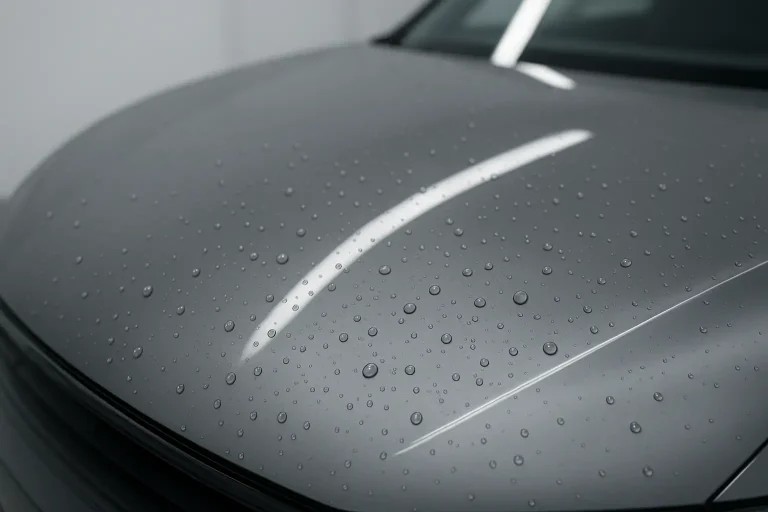
A ceramic coating has failed when the paint surface no longer beads water — water sheets instead of forming tight spherical droplets. A second test is the spray contact angle: apply a spray of water to the hood at 45 degrees. A live coating with strong hydrophobic properties causes water to bead and roll off without encouragement. Water that sits flat or runs slowly without beading indicates the coating has degraded to near-base-level protection.
Before scheduling removal and recoating, test with a SiO2 ceramic spray booster product. If the hydrophobic properties return after a booster application, the underlying coating is still intact and only the top hydrophobic layer has depleted. Full removal and recoating is only necessary if the booster application produces no improvement in water behavior after 24 hours.
Does temperature affect how ceramic coating cures and bonds?
Temperature is one of the most important variables in ceramic coating application and cure. Professional-grade coatings require application at 60 to 75°F with relative humidity below 50 percent to achieve full chemical bonding to the paint surface. Below 50°F, the coating cures too slowly and risks contamination before the surface hardens. Above 85°F, the flash window shortens to under 30 seconds and high spots form before the applicator can level the product.
Consumer spray coatings are more forgiving, with usable application windows from 50 to 90°F, but they still produce inferior bonding and durability when applied in temperature extremes. Any DIY application planned for midsummer in a south-facing garage or in fall temperatures near freezing should be rescheduled or moved to a climate-controlled environment. Temperature-related application failures are the second most common cause of DIY ceramic coating problems, behind contamination from insufficient surface preparation.
Is ceramic coating safe to apply near ceramic tile surfaces or flooring?
Automotive ceramic coating products contain solvents and isocyanate-based compounds that can permanently bond to unprotected ceramic tile, stone, and grout if they make contact during application. Apply masking tape and plastic sheeting to any ceramic tile floor surfaces before beginning a DIY coating application in a garage with tile flooring. Overspray from spray-grade consumer products has a fine mist that can settle on tile surfaces up to four feet from the application area.
If ceramic coating product contacts tile grout lines, remove it immediately with an isopropyl alcohol wipe before it cures. Once cured, automotive ceramic coating on grout requires aggressive mechanical removal that can damage the grout permanently. Ventilate the workspace well during application to prevent solvent accumulation, and wear nitrile gloves throughout the process as extended skin contact with curing agents is a sensitization risk.
What is the minimum vehicle age or paint condition required for professional ceramic coating?
There is no minimum vehicle age for ceramic coating, but there is a paint condition floor. Any paint surface with active rust through the clear coat, bare metal exposure, or peeling clear coat is not a coating candidate until the paint defects are professionally repaired first. Coating over peeling clear coat seals the failure mode and accelerates delamination — the result is a peeling, bubbling surface that costs $300 to $1,500 per panel to repair.
Vehicles older than 10 years with original paint should be assessed under direct sunlight before quoting. Light to moderate oxidation is correctable with a two to three stage polish before coating. Heavy chalking or single-stage paint that has oxidized through more than 30 percent of the clear coat layer is not a coating candidate without full panel repainting first. A reputable installer will tell you this at the assessment stage — a shop that quotes a coating on visibly oxidized or peeling paint without discussing paint repair first is one to avoid.
For a useful comparison of how ceramic coating investments compare to tile-based surface protection projects in terms of cost structure and long-term value, see our guide to ceramic tile installation costs across DIY and professional applications.
Ceramic Coating Cost: The Bottom Line
DIY ceramic coating costs $80 to $500 all-in depending on the product tier and preparation supplies you include. Professional ceramic coating costs $300 to $2,500 depending on vehicle size, paint condition, and coating product grade.
The best value decision is not simply the lower number. A mid-range professional package on a corrected paint surface at $800 to $1,200 delivers a result that five years of annual DIY spray reapplications at $100 to $150 each cannot match in optical quality or coating durability. Choose DIY for light-defect vehicles with accessible application environments, and choose professional installation for any vehicle with moderate or heavier paint defects or where a transferable warranty has resale value to you.
Before getting any professional quote, assess your paint condition under direct sunlight, research certified installer status through the brand’s official locator, and ask for the specific coating product name in writing. Those three steps take 30 minutes and save most owners $200 to $500 in quote comparison time.