Pottery Tool Kit Essentials: What Do You Really Need?

Most beginners buy too many pottery tools. Professionals use fewer than you think. The difference is knowing which tools earn their place on your workbench and which ones gather dust in a drawer.
A complete pottery tool kit does not mean a comprehensive one. It means having the right tools for your specific clay method, whether you throw on a wheel, build by hand, or do both. Clay type, project scale, and studio setup all change what you actually need.
By the Numbers
Pottery Tool Kit Essentials: What the Data Shows
Sources: Ceramics Monthly studio surveys, manufacturer pricing data, community studio purchasing records
What Is a Pottery Tool Kit and Why Does Yours Depend on Your Clay Method?
A pottery tool kit is a curated set of hand tools, shaping implements, and studio accessories that allow you to form, trim, decorate, and finish clay objects. Your specific kit depends on one decision above all others: whether you throw on a wheel or build by hand.
Wheel throwers need tools that work on a spinning surface. A pin tool checks wall thickness while the wheel turns. A cut-off wire separates finished pieces from the bat without distortion. Handbuilders need tools for slab work, coil joining, and surface texture that wheel throwers rarely touch.
Both methods share a core set of tools. Every potter needs a way to cut clay, shape curves, smooth surfaces, and measure dimensions. The difference is in the specialty tools that make each method faster and more precise. Buying tools without knowing your primary method leads to wasted money on implements you will never use.
For most home studio potters starting out, the best approach is buying the 12 universal tools first and adding method-specific tools only after you have worked with clay for at least a month. This prevents the beginner mistake of buying a 50-piece kit where most tools sit untouched.
The 12 Non-Negotiable Tools Every Potter Needs (From Beginner to Production)
These 12 tools form the foundation of any functional pottery practice. Buy these first regardless of whether you throw, handbuild, or sculpt. Each tool earns its place through daily use and has no adequate substitute in a studio setting.
According to studio production potters surveyed by Ceramics Monthly, these specific tools appear in over 90% of working potters’ daily tool buckets. The list prioritizes function over brand, but specific product recommendations come from documented studio use and manufacturer specifications.
1. Needle Tool (Pin Tool): The Diagnostic Workhorse
A needle tool is a sharp steel needle set in a wood or plastic handle. It serves as your primary diagnostic instrument on the wheel and a precision marking tool off it. The needle checks wall thickness during throwing, cuts rims cleanly, and scores clay for joining.
Key Specifications: Needle length: 40-60mm exposed from handle. Handle material: hardwood or ergonomic plastic. Price range: $6-12 for a standard Kemper or Xiem model. Weight: under 1 oz for comfortable all-day use.
Never use a sewing needle as a substitute. Pottery needle tools have a tapered point designed to penetrate wet clay without dragging. Sewing needles are too short, too thin, and the eye end creates drag marks in the clay surface. This is a $6 tool that prevents more waste than any other single implement in your kit.
In plain terms: the needle tool tells you if your pot walls are even, if your rim is level, and if your clay is thick enough to trim. No other tool gives you this information while the wheel is spinning.
2. Cut-Off Wire: The Clean Separation Tool
A cut-off wire is a thin braided wire with handles on both ends. It separates thrown pieces from the wheel head or bat without warping the form. Using your hands to pull a pot off the wheel distorts the shape and ruins hours of work in one motion.
Key Specifications: Wire length: 12-18 inches between handles. Wire material: braided stainless steel (lasts longer) or twisted wire (cuts faster). Handles: wood, plastic, or metal loops. Price range: $8-18 depending on handle quality.
The cut-off wire also slices clay from larger blocks, cuts slabs from pugged clay, and sections leather-hard pieces for alterations. Many potters keep two: one dedicated to the wheel area and one for general clay cutting. A braided stainless steel wire cutter lasts years with proper care.
3. Wooden Rib: The Shaping and Compressing Essential
A wooden rib is a flat or slightly curved piece of hardwood used to shape, compress, and smooth clay surfaces. Wood absorbs water from the clay surface, creating a smooth, compressed finish that resists cracking during drying. This is the tool that transforms a lumpy thrown form into a finished profile.
Key Specifications: Dimensions: 3-5 inches long, 2-3 inches wide. Shape options: flat rectangular, curved kidney, or teardrop. Wood types: maple, cherry, or walnut (harder woods last longer). Price range: $8-15 per rib.
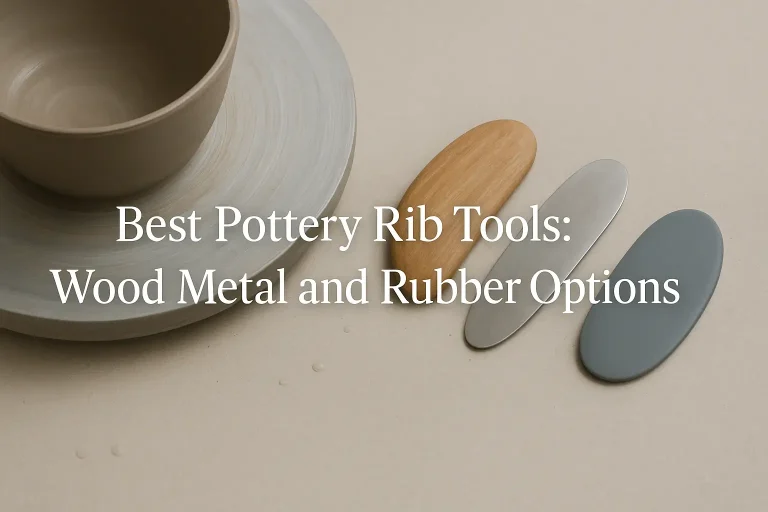
Ribs come in wood, metal, and rubber. Each material serves a different purpose. Wood for shaping and compressing. Metal for smoothing and burnishing on leather-hard clay. Rubber for blending and working with soft clay on the wheel. Start with a kidney-shaped wooden rib as your first purchase and add metal and rubber as your skills develop.
4. Metal Rib: The Smoothing and Burnishing Tool
A metal rib is a thin, flexible sheet of stainless steel or aluminum alloy used to smooth, compress, and burnish clay surfaces at the leather-hard stage. Metal ribs create a finer finish than wood because they do not absorb water, allowing the potter to work the clay surface until it develops a polished sheen.
Key Specifications: Material: stainless steel (rust-resistant) or aluminum alloy (lighter weight). Flexibility: thin gauge for curved surfaces, thicker for flat work. Shape: rectangular, kidney, or teardrop. Price range: $6-20 depending on material and brand.
Metal ribs also excel at removing throwing lines from wheel-thrown forms. After the clay reaches leather-hard, gentle pressure with a metal rib compresses the surface and erases the spiral ridges left by your fingers. This step reduces trimming time and produces a more professional finish before the first firing.
5. Loop Tool (Ribbon Tool): The Hollowing and Trimming Specialist
A loop tool is a metal ribbon shaped into a loop and mounted in a handle. It removes clay from the interior of hollow forms, carves foot rings, and trims excess material from leather-hard pots. The loop shape allows controlled clay removal that flat tools cannot achieve.
Key Specifications: Loop width: 10mm to 40mm (small for detail work, large for bulk removal). Ribbon material: high-carbon steel that holds an edge. Handle: hardwood or ergonomic grip. Price range: $9-22 per tool. A set of three sizes covers most needs.
Loop tools come in single-ended and double-ended configurations. Double-ended tools offer two loop sizes in one handle, which saves money for beginners. The 20mm and 30mm sizes handle most trimming and hollowing tasks for functional ware.
6. Wire Clay Cutter: The Block Slicer
A wire clay cutter is a heavier gauge wire, often with a tension frame, designed to slice through 25-pound clay blocks. It differs from the cut-off wire in both gauge and purpose: this tool sections raw clay, while the cut-off wire separates finished work from the wheel.
Key Specifications: Wire gauge: 18-22 gauge (thicker than cut-off wires at 24-28 gauge). Frame: aluminum or steel with tension adjustment. Wire length: 14-20 inches. Price range: $15-35. Some models include replaceable wire spools.
Without a wire clay cutter, sectioning a 25-pound block of cone 6 stoneware clay requires a knife and significant upper body strength. The wire cutter makes clean, even slices with minimal effort and prevents the clay from compressing unevenly during cutting, which can create air pockets.
7. Fettling Knife: The Precision Edge Tool
A fettling knife is a thin, flexible blade used for cutting, trimming, and refining edges on leather-hard clay. The blade shape varies from straight to curved, and the flexibility allows the potter to follow contours while trimming excess clay from seams, joins, and rims.
Key Specifications: Blade length: 3-5 inches. Blade material: stainless steel, flexible or semi-flexible. Handle: hardwood or plastic. Price range: $8-18. Kemper and Xiem make the most commonly used models in production studios.
The fettling knife is the tool you reach for when a pot comes off the wheel with an uneven rim, or when two slabs join with a visible seam. The thin blade removes material precisely without tearing the clay surface. It also scores clay for joining, though a dedicated scoring tool works better for large attachment areas.
8. Sponge: The Moisture Control Tool
A natural elephant ear sponge controls moisture during wheel throwing and smooths surfaces during handbuilding. The sponge’s ability to hold and release water in controlled amounts makes it irreplaceable for throwing. Synthetic sponges work for cleanup but perform poorly during throwing because they do not release water evenly.
Key Specifications: Type: natural elephant ear (best) or Mediterranean silk sponge. Size: 3-4 inches diameter. Water retention: natural sponges hold 10-15 times their dry weight. Price range: $6-14 per sponge. Replace every 6-12 months with regular use.
Keep two sponges: one for throwing and one for cleaning. The throwing sponge stays clean and free of clay debris. The cleaning sponge wipes down the wheel, tools, and work surface. Cross-contamination from a dirty sponge introduces grit into your throwing water and scratches the clay surface.
9. Calipers: The Measurement Tool
Pottery calipers measure inside and outside diameters on thrown forms. They ensure lids fit pots, plates match sets, and gallery rims seat correctly. A potter without calipers guesses at dimensions. A potter with calipers makes lids that fit on the first try.
Key Specifications: Material: stainless steel or aluminum. Jaw type: inside/outside measuring with locking mechanism. Maximum spread: 8-12 inches. Price range: $15-30 for a basic pottery caliper. The locking screw holds measurements between uses.
Calipers save more clay than almost any other tool in the kit. A lid thrown too small or too large means scrapping both lid and gallery. With calipers, you measure the gallery opening first, lock the measurement, and throw the lid to match. This single tool prevents the most common functional pottery failure.
10. Scoring Tool: The Attachment Prep Tool
A scoring tool roughs up clay surfaces before joining. The rough texture creates mechanical grip between two clay pieces. Without scoring, attachments pop off during drying or firing because smooth clay surfaces lack the interlocking texture needed for a strong bond.
Key Specifications: Teeth type: wire brush tip, serrated blade, or pin array. Handle: wood or plastic. Price range: $4-10. Many potters use a fork or an old toothbrush as a zero-cost alternative that works equally well.
Scoring must be followed by slipping. The scoring and slip combination creates a chemical and mechanical bond between the two clay pieces. Score both surfaces, apply slip (liquid clay) to both, press firmly together, and clean the join with a fingertip or soft brush. This process, done correctly, produces a bond as strong as the clay itself.
11. Wooden Modeling Tool: The Detail Shaper
A wooden modeling tool is a double-ended hardwood stick with shaped tips on both ends. Common tip shapes include pointed, rounded, flat, and angled. These tools refine details on sculptural work, clean up handle attachments, and shape small areas that fingers cannot reach.
Key Specifications: Length: 6-8 inches. Tip shapes: at least one pointed and one rounded end. Wood: maple or cherry (resists wear). Price range: $5-12. A single well-made modeling tool lasts decades.
The modeling tool bridges the gap between fingers and loop tools. Fingers are too large for cleaning the inside of a handle join. Loop tools remove too much material. The wooden modeling tool shapes and smooths in tight spaces without cutting into the clay body.
12. Spray Bottle: The Moisture Maintenance Tool
A fine mist spray bottle keeps clay workable during long sessions and rehydrates leather-hard pieces for joining. The fine mist control prevents over-wetting, which weakens the clay structure and creates slip zones that collapse during throwing.
Key Specifications: Nozzle type: adjustable fine mist to stream. Capacity: 8-16 oz. Material: chemical-resistant plastic (clay water is slightly alkaline). Price range: $4-8. Replace nozzles annually as mineral buildup affects spray pattern.
A spray bottle costs less than $10 and prevents more clay waste than tools costing five times as much. Dry clay cannot be joined, cannot be thrown, and cannot be shaped. A fine mist at the right moment keeps a piece workable for an extra hour or more.
For most beginners, these 12 tools handle 90% of all pottery tasks from the first day through intermediate skill development. The remaining 10% requires specialty tools that depend on your chosen clay method.
Handbuilding vs Wheel Throwing: How Your Method Changes Your Tool List
Your primary clay method determines which specialty tools you need beyond the core 12. Wheel throwers and handbuilders work with clay in fundamentally different ways. The tools that speed up one method are often useless in the other.
Use the table below to match your primary method to the right specialty tools before spending money on implements you will not use.
Method Comparison
Wheel Throwing vs Handbuilding: Specialty Tool Requirements
Tools needed beyond the 12-piece core kit, by primary clay method
| Specialty Tool | Wheel Throwers | Handbuilders |
|---|---|---|
| Banding wheel / decorating wheel | Optional for decorating | Essential |
| Slab roller or rolling pin | Rarely needed | Essential for slab work |
| Throwing sticks / ribs | Essential | Not needed |
| Trimming tools (chattering) | Essential | Rarely needed |
| Extruder or clay gun | Optional for handles | Very useful for coils |
| Bats and bat pins | Essential | Not needed |
| Canvas or slab mat | Not needed | Essential |
Based on production potter tool surveys and community studio equipment lists. Essential means the tool is needed for basic competency in the method.
Wheel throwers should budget an additional $40-80 for bats, bat pins, throwing ribs, and trimming-specific loop tools. Handbuilders should budget an additional $50-100 for a banding wheel, slab rolling equipment, and canvas work surfaces.
Complete Buying Guide: How to Choose Quality Pottery Tools That Last
The difference between a $6 needle tool and a $2 needle tool is about three months of regular use. Cheap tools bend, rust, and develop burrs that scratch clay surfaces. Quality tools from established manufacturers like Kemper, Xiem, Mudtools, and Dolan last years or decades with proper care.
According to community studio purchasing records and production potter surveys, these specific quality indicators predict tool longevity across every category. The initial price difference is small relative to the replacement cost of cheap tools over even one year of regular studio use.
Material Quality: What to Look For in Pottery Tool Construction
Stainless steel is the standard for any pottery tool that contacts wet clay. Carbon steel rusts within weeks in a studio environment where water and clay are constant. The small price premium for stainless steel pays for itself by eliminating rust stains on your work and preventing blade degradation that requires resharpening or replacement.
Wooden handles should be hardwood: maple, cherry, or walnut. Softwoods like pine absorb water, swell, and eventually split the ferrule that holds the metal tool head. A hardwood-handled tool costs $3-5 more than an equivalent pine-handled version and lasts ten times as long in a working studio.
Tool ferrules (the metal band connecting handle to blade) should be brass or stainless steel, not painted metal. Painted ferrules hide low-quality metal that corrodes. Exposed brass or stainless steel shows the manufacturer’s confidence in their materials.
Ergonomics: Handle Shape and Grip Considerations
Tool handles come in three basic shapes: straight round, contoured, and flat-sided. Straight round handles are the most common and least expensive. They work adequately for short sessions but cause hand fatigue during production work because the round shape requires constant grip pressure to prevent rotation.
Contoured handles with finger grooves reduce fatigue during long throwing sessions. The trade-off is that grooves position your hand in one specific orientation, which may not match your preferred grip style. Flat-sided handles prevent rolling on the workbench and offer multiple grip positions without finger grooves dictating hand placement.
Mudtools polymer ribs use a flexible, ergonomic design that conforms to the user’s grip over time. Traditional wooden tools offer fixed shapes but can be sanded and modified if the factory handle shape does not suit your hand. Both approaches work. The key factor is trying the tool in your hand before committing to a full set.
Brand Reliability: Which Manufacturers Make Tools That Last
Kemper Tools has manufactured pottery tools in the United States since the 1940s. Their wood-handled tools use maple handles and brass ferrules. The consistency of their manufacturing means a Kemper loop tool bought today matches the same model bought ten years ago. This matters when replacing a worn favorite.
Xiem Tools produces lightweight, ergonomic tools with stainless steel working ends and contoured handles. Their stainless steel ribbon tools hold an edge longer than carbon steel equivalents and resist rust entirely. The price premium is 20-30% over comparable Kemper tools, which is justified for potters working in humid studio environments.
Mudtools specializes in polymer ribs and shaping tools. Their polymer ribs come in multiple flexibility levels (red for soft, yellow for medium, blue for firm) and do not absorb water. Unlike wooden ribs, polymer ribs do not require periodic oiling and will not warp after repeated wet-dry cycles.
Dolan Tools manufactures premium trimming and carving tools favored by production potters. Their high-carbon steel blades are heat-treated for edge retention, and their handles are turned from dense hardwoods. A Dolan trimming tool costs $25-45 per piece, which is expensive for a single tool but economical when amortized over the 10-15 year lifespan of a well-maintained Dolan blade.
For most beginners, Kemper tools offer the best balance of quality, price, and availability. Upgrade to Xiem or Mudtools for tools you use daily (ribs, loop tools) and stay with Kemper for tools you use occasionally (modeling tools, fettling knives).
Buying Guide
Before You Buy: Pottery Tool Kit Checklist
Check off each point before making your tool purchase decisions.
Budget Breakdown: What a Starter Pottery Tool Kit Costs at Every Price Point
Pottery tool kits fall into three natural price tiers based on tool count, brand quality, and method-specific additions. Each tier below represents the actual cost to build a functional kit from new, individually purchased tools rather than pre-assembled sets. Individual purchases cost slightly more than packaged sets but deliver higher-quality tools that last longer.
Prices are sourced from major pottery supply retailers (Sheffield Pottery, The Ceramic Shop, Clay-King) and manufacturer direct pricing as verified at time of publication. Costs do not include shipping, clay, glaze, or kiln access fees.
Tier 1: Absolute Essentials Kit ($45-85)
This tier covers the 12 core tools with basic but functional versions from Kemper and similar manufacturers. Every tool in this kit is stainless steel or hardwood where material quality affects function. This is the minimum viable kit for a first pottery class or home studio start.
The Tier 1 kit includes: needle tool ($6), cut-off wire ($8), wooden rib ($8), metal rib ($6), loop tool ($9), wire clay cutter ($15), fettling knife ($8), sponge ($6), calipers ($15), scoring tool ($4), wooden modeling tool ($5), and spray bottle ($4). Total: approximately $94 at the high end, though careful shopping at discount pottery suppliers can bring this closer to $65-75.
Tier 2: Solid Intermediate Kit ($100-175)
The intermediate kit upgrades daily-use tools to premium brands (Xiem ribs, Mudtools sponges, Dolan loop tools) and adds method-specific items. Wheel throwers add bats ($20-40 for a set of three), bat pins ($5), throwing ribs ($15-25), and a dedicated trimming tool ($25-35). Handbuilders add a banding wheel ($30-60), rolling pin or small slab roller guides ($20-40), and canvas work surfaces ($10-15).
The intermediate kit improves two things simultaneously: tool quality for daily-use items and tool range for method-specific efficiency. A potter with this kit can work at a production pace without fighting inferior tools or improvising workarounds for missing specialty implements.
Tier 3: Professional Studio Kit ($200-350+)
This tier adds redundancy (multiple ribs of different materials and shapes), specialty items (chattering tools, throwing sticks, custom-profile ribs), and upgraded versions of every tool. The professional kit supports making 50 or more pieces per week without tool-related slowdowns. It also includes items like a heavy-duty banding wheel ($50-90) for both throwing and handbuilding studios.
The professional tier is not about buying more tools. It is about having the right version of each tool for specific clay bodies, forms, and production volumes. A production potter might own three wooden ribs in different profiles, two loop tools in different sizes, and four metal ribs of varying flexibility because each combination solves a specific problem faster than any alternative.
For most home studio potters working at a hobby pace, Tier 2 is the sweet spot that balances quality against total investment. The upgrade from Tier 1 to Tier 2 costs about $60-100 and delivers noticeable improvements in every studio session.
How to Build Your First Pottery Tool Kit: Step-by-Step
Building a pottery tool kit is a process, not a single purchase. Start with the tools that prevent the most common beginner failures, then add method-specific tools as your skills and project range expand. This sequence prioritizes tools that save clay and time, not tools that look interesting but sit unused.
Step-by-Step Guide
How to Build Your Pottery Tool Kit: Step by Step
5 steps, estimated time: 1-2 hours for purchasing, ongoing for skill development
Buy the Big Three First ($20-35 total)
Purchase a needle tool ($6-12), cut-off wire ($8-18), and a wooden rib ($8-15). These three tools handle wall thickness checking, clean pot removal, and basic shaping. They prevent the three most common beginner failures: uneven walls, distorted pots during removal, and rough surfaces that crack during drying.
Add the Remaining Core Nine Tools ($30-60 more)
Complete the 12-tool core kit: metal rib, loop tool, wire clay cutter, fettling knife, sponge, calipers, scoring tool, modeling tool, and spray bottle. Buy individually from Kemper or similar mid-tier brands. Avoid 40-piece bargain sets at this stage because the quality is lower and most included tools are irrelevant.
Choose Your Method and Buy Specialty Tools ($40-100 more)
After one month of regular practice, you know whether wheel throwing or handbuilding is your primary method. Wheel throwers add bats, bat pins, throwing ribs, and trimming-specific loop tools. Handbuilders add a banding wheel, rolling pin or slab guides, and canvas. Do not buy specialty tools before you know your method.
Upgrade Daily-Use Tools to Premium Brands ($50-80 more over time)
Replace the tools you use every session with premium versions. For most potters, these are ribs (Mudtools polymer, $12-18 each), loop tools (Dolan, $25-45), and sponges (Mudtools or natural elephant ear, $10-15). Upgrade one tool per month rather than all at once. The performance difference is immediately noticeable.
Add Project-Specific Tools Only When Needed
Buy specialty tools one at a time when a specific project requires them. Chattering tools for textured surfaces. Throwing sticks for narrow-neck forms. Extruder dies for specific handle profiles. Do not pre-buy tools for techniques you have not attempted. The tool will be available when you need it, but buying it early guarantees it gathers dust until then.
The 5 Most Common Tool Mistakes Beginners Make (And How to Avoid Them)
Tool mistakes cost money and create bad habits that take months to unlearn. These five errors appear in almost every beginner potter’s first six months. Each has a simple fix that costs little or nothing to implement.
Mistake 1: Buying a 50-Piece Kit Before Touching Clay
The 50-piece pottery tool set for $39.99 looks like a bargain. It is not. Most of those tools are poorly made versions of implements you will never use. The wire tools bend on first contact with 25 pounds of clay. The wooden tools are soft pine that splinters within weeks. The metal tools are unpainted carbon steel that rusts after the first studio session.
Fix it: Buy the 12 core tools individually from Kemper or similar brands. You spend $65-95 instead of $40 and get tools that last 5-10 years instead of 3 months. The math is straightforward: $95 once versus $40 every few months for the rest of your pottery practice.
Mistake 2: Using the Wrong Rib Material for the Task
Wooden ribs compress and shape. Metal ribs smooth and burnish. Rubber ribs blend and work soft clay. Using a metal rib on wet clay on the wheel creates drag, tears the surface, and frustrates the potter. Using a wooden rib on leather-hard clay for burnishing produces a rougher surface than starting with bare fingers.
Fix it: Own at least one of each rib material and learn which stage of clay each one serves. Wood for wet throwing and shaping. Metal for leather-hard smoothing and burnishing. Rubber for soft clay blending and detailed contour work. The three ribs together cost $25-40 and cover every clay state.
Mistake 3: Treating All Loop Tools as Interchangeable
Loop tools come in different widths, shapes, and blade angles for specific purposes. A 10mm narrow loop carves fine details. A 40mm wide loop hollows large forms. A square-end loop cuts flat channels for foot rings. Using the wrong loop tool for a task means either removing too little clay (frustratingly slow) or too much (ruining the piece in one pass).
Fix it: Start with a 20mm and 30mm loop tool. These two sizes handle 80% of trimming and hollowing tasks on functional ware. Add smaller and larger loops only when specific projects demand them. For a deeper look at trimming and finishing techniques, see this guide to carving and surface decoration methods that covers tool selection for detailed work.
Mistake 4: Neglecting Tool Maintenance
Pottery tools degrade in predictable ways when not maintained. Wooden ribs absorb water, warp, and develop rough grain that scratches clay. Metal tools develop burrs along the working edge that drag instead of cutting cleanly. Wire tools fray and leave metal splinters in your clay body. Sponges harbor bacteria and clay particles that contaminate throwing water.
Fix it: Dry wooden tools after every session (do not soak them). Check metal edges for burrs monthly and smooth with fine-grit sandpaper if needed. Replace wire tools at the first sign of fraying: a $12 replacement wire is cheaper than reclaiming clay contaminated with metal fragments. Sanitize sponges weekly with a dilute bleach solution and replace them every 6-12 months.
Mistake 5: Organizing Tools by What Came in the Set Instead of by Daily Use
Every potter has 6-8 tools they use every session and 20+ they use occasionally or rarely. Storing all tools together in a single bucket means the daily tools are buried under specialty items every time you start a session. The mental friction of digging for your needle tool adds up over hundreds of studio hours.
Fix it: Keep daily-use tools in a dedicated container on your work surface. Store specialty tools in a drawer, roll, or wall rack organized by function. When you sit down to work, your needle tool, wire cutter, sponge, and favorite rib are exactly where you left them. Read this studio setup guide for tool organization and workspace design that maximizes efficiency in small spaces.
Tool Maintenance: How to Keep Your Pottery Tools in Working Condition
Well-maintained pottery tools last decades. Neglected tools degrade within months. The maintenance required varies by tool material, but the total time investment is under 10 minutes per week for a full kit. Here is what each tool category needs and how often.
Metal Tools: Rust Prevention and Edge Care
Stainless steel tools resist rust but still develop water spots and mineral buildup from clay water. Wipe metal tools dry after every session with a clean cloth. For carbon steel tools, which some potters prefer for their sharper edge, apply a thin coat of mineral oil monthly to prevent rust formation in humid studio environments.
Check cutting edges on loop tools and fettling knives every two to three months. A dull edge tears clay instead of cutting it cleanly, leaving a rough surface that requires extra finishing work. Lightly hone loop tool edges with fine-grit (600+) sandpaper or a ceramic honing rod. Do not use a grinding wheel: the heat ruins the temper on thin ribbon steel.
Wooden Tools: Moisture Management
Wooden ribs and modeling tools absorb water during use and release it during storage. This cycle causes swelling and contraction that eventually warps or cracks the wood. After each session, wipe wooden tools dry and store them horizontally on a drying rack with airflow on all sides. Never leave a wet wooden rib flat on a non-porous surface: the bottom stays wet while the top dries, creating uneven stress that warps the tool within weeks.
Oil wooden ribs every three to six months with food-grade mineral oil or butcher block oil. Apply a thin coat, let it absorb for 20 minutes, and wipe off the excess. This treatment fills the wood’s pores and reduces water absorption during use. A properly oiled wooden rib develops a smooth, almost polished surface that glides over clay with minimal friction.
Sponges: Sanitation and Replacement
Natural sponges harbor bacteria, algae, and clay particles in their pore structure. A dirty sponge introduces grit into throwing water that scratches clay surfaces and leaves residue on finished work. Rinse sponges thoroughly after every session, squeeze out excess water, and store in a dry location with airflow. Once weekly, soak throwing sponges in a dilute bleach solution (1 tablespoon bleach per gallon of water) for 10 minutes, then rinse thoroughly.
Replace natural sponges every 6-12 months depending on use frequency. A sponge that has lost its resilience or developed a persistent odor despite cleaning should be retired immediately. The $6-12 replacement cost is negligible compared to the time lost reclaiming work damaged by a contaminated sponge.
Wire Tools: Fraying Inspection
Cut-off wires and wire clay cutters fail through gradual fraying, not sudden breakage. Inspect wire tools before every session by running your thumb lightly along the wire (gently: do not cut yourself). If you feel any broken strands, nicks, or rough spots, replace the wire immediately. Frayed wires leave metal fragments in your clay that survive bisque and glaze firing, creating sharp edges on finished ware.
Replacement wire for cut-off tools costs $3-6 and takes 30 seconds to install. Do not try to extend the life of a frayed wire by twisting the broken strands together: this creates an uneven cutting surface that snags clay and distorts pots during separation from the wheel.
Consistent tool maintenance does not require expensive supplies or specialized knowledge. A dry cloth, a small bottle of mineral oil, and a schedule posted on the studio wall handle 95% of tool care for the entire lifespan of your kit.
Quick Reference
Pottery Tools: Key Terms Explained
Quick reference for the terms used throughout this guide
A sharp steel needle in a handle, used to check wall thickness during wheel throwing and to score clay for joining.
A thin braided wire with handles on both ends, used to separate thrown pots from the wheel head or bat without distortion.
A flat or curved shaping tool made of wood, metal, or rubber. Each material serves a different clay stage: wood for wet shaping, metal for leather-hard smoothing, rubber for blending.
A metal ribbon shaped into a loop and mounted in a handle. Used for trimming, hollowing, and controlled clay removal on leather-hard pots.
A thin, flexible blade used to trim excess clay from seams, joins, and rims on leather-hard pieces.
A measuring tool with two adjustable arms used to measure inside and outside diameters on thrown forms so lids fit pots correctly.
The process of roughing up two clay surfaces before joining them. Creates mechanical grip between pieces. Must be followed by applying slip (liquid clay).
The clay state when most water has evaporated but the piece is still cool to the touch and can be carved, trimmed, or joined without deforming. Typically occurs 24-48 hours after forming.
A removable disc (wood, plastic, or MDF) that attaches to the wheel head with bat pins. Pots are thrown directly on the bat, which can be lifted off with the piece still attached to dry without distortion.
A manually rotated turntable used for handbuilding, decorating, and detailed work. The potter turns the wheel by hand while working on a stationary piece.
Can I Use Kitchen Tools Instead of Buying Pottery Tools When Starting Out?
Some kitchen tools work as temporary substitutes for specific pottery tools. A rolling pin replaces a slab roller. A fork works as a scoring tool. A butter knife can trim soft leather-hard clay in a pinch. However, the three core tools (needle tool, cut-off wire, wooden rib) have no adequate kitchen substitutes and must be purchased.
Kitchen tools as permanent replacements create three problems. First, kitchen tools are not designed for abrasive clay work and degrade quickly. Second, clay residue embeds in food-grade surfaces and creates a contamination risk if the tool returns to kitchen use. Third, the ergonomics are wrong: a butter knife handle is not shaped for the grip angles used in pottery trimming. The $6-12 price of purpose-built pottery tools eliminates all three problems simultaneously.
What Is the Difference Between Stoneware and Porcelain Tools? Do I Need Different Tools for Each Clay Body?
The core tool kit works with all clay bodies. Stoneware, porcelain, earthenware, and raku clay share the same basic forming requirements: cut, shape, smooth, measure. Where tools differ is in surface sensitivity. Porcelain shows every tool mark, so potters working with porcelain often invest in higher-quality metal ribs and finer-grit sponges that leave fewer surface traces.
Porcelain’s smooth, fine-grained body also benefits from polymer ribs (Mudtools) rather than wooden ribs because wood grain can leave subtle texture marks on the ultra-smooth porcelain surface. Stoneware is more forgiving: a standard wooden rib produces acceptable results on most stoneware bodies. For more on clay body selection and how material properties affect tool choice, see this detailed porcelain clay guide covering workability and surface considerations.
How Often Should I Replace My Pottery Sponge?
Replace natural throwing sponges every 6 to 12 months with regular use. The replacement signal is not a calendar date. It is sponge performance. A sponge that no longer holds water evenly, has lost its resilience, or has developed a persistent odor despite weekly sanitizing should be replaced immediately regardless of age.
Synthetic cleaning sponges last 3 to 6 months because clay particles abrade the foam structure. Natural elephant ear sponges last longer (up to 12 months) because their pore structure is more durable. The $6-14 replacement cost for a new sponge is one of the smallest expenses in pottery, and using a degraded sponge affects every piece you make during every studio session.
Why Does My Cut-Off Wire Keep Breaking After Only a Few Weeks of Use?
Cut-off wire breakage after only a few weeks signals one of three problems. First, the wire may be catching on rough bat pins or a damaged wheel head surface. Inspect your bat pins for burrs and sand them smooth with fine-grit sandpaper if needed. Second, you may be using a twisted wire on heavy clay (over 8-10 pounds) where a braided wire is required. Twisted wires are thinner and designed for lighter work.
Third, you may be pulling the wire at an angle instead of keeping it flat against the wheel head surface. An angled pull concentrates stress on a single point in the wire rather than distributing it across the full length. Keep the wire flat, pull with even tension, and use a braided stainless steel wire for clay weights above 10 pounds.
Do I Need a Banding Wheel If I Already Have a Pottery Wheel?
A pottery wheel rotates at throwing speeds (100-300 RPM) and cannot be turned slowly and precisely by hand for decorating or handbuilding work. A banding wheel rotates at hand-turning speed and allows you to work on a stationary piece while rotating it incrementally to access all sides. The two tools serve completely different functions despite both involving rotation.
Wheel throwers benefit from a banding wheel for decorating, carving, and attaching handles to leather-hard pots that have been removed from the wheel. Handbuilders use a banding wheel as their primary rotating work surface for slab construction, coil building, and surface decoration. For throwers, the banding wheel is a nice-to-have accessory. For handbuilders, it is essential equipment.
Is It Safe to Sand Pottery Tools at Home, or Will That Create Silica Dust Problems?
Sanding metal pottery tools (removing burrs from loop tools, smoothing ferrule edges) produces metal dust, not silica dust. Metal dust from occasional tool maintenance does not pose the same respiratory hazard as silica dust from sanding dry clay or glaze materials. However, any fine particulate should be managed: wear an N95 mask, work in a ventilated area, and wipe down surfaces with a damp cloth afterward to capture particles.
Sanding wooden ribs produces wood dust, which is also a respiratory irritant. The same precautions apply. Never sand dry clay or glaze materials without proper silica dust management, including a HEPA-filtered vacuum or wet-sanding methods. This is a separate and more serious safety concern than tool maintenance.
Can I Mix Tools from Different Brands, or Do They Need to Be from the Same Set?
Pottery tools from different brands are fully compatible. There is no proprietary standard or interlocking system in hand pottery tools. A Kemper needle tool works alongside a Xiem metal rib and a Mudtools sponge without any compatibility issues. In fact, mixing brands is the standard practice in professional studios because each manufacturer excels at specific tool types.
The one exception is bat systems: some wheel manufacturers use proprietary bat pin spacing (Brent uses a specific pin configuration, for example). Bats must match the pin spacing on your wheel. For all hand tools, brand mixing is not only acceptable but recommended to get the best version of each tool type.
What Is the One Tool Every Production Potter Says They Cannot Work Without?
Production potters surveyed consistently name the needle tool as the single irreplaceable implement in their kit. The needle tool provides real-time wall thickness feedback during throwing, marks trimming guidelines, cuts rims, and scores clay for joining. No other single tool performs all four of these essential functions.
The cut-off wire ranks second in production potter surveys. Without it, removing pots from the wheel without distortion is nearly impossible. Together, the needle tool and cut-off wire cost $14-30 and prevent more clay waste than any other $30 investment in a pottery studio.
Should I Buy Tools Individually or as Part of a Pre-Assembled Kit from a Pottery Supplier?
Buy tools individually from reputable brands rather than as a pre-assembled kit. Pre-assembled kits from general craft retailers prioritize tool count over tool quality. They include items you will never use and exclude items you need every day. The tools that are included are often carbon steel (rusts) with softwood handles (splits) and painted ferrules (corrodes).
Kits assembled by pottery-specific suppliers (Sheffield, The Ceramic Shop, Clay-King) are an exception. These suppliers build kits from Kemper, Xiem, and Mudtools components that match the quality of individually purchased tools. A supplier-assembled Kemper kit for $60-80 is a reasonable starting option if you want the convenience of a single purchase without sacrificing quality.
How Do I Store My Pottery Tools When I Am Not Using Them?
Store daily-use tools in an open container (bucket, crock, or jar) on your work surface where they are immediately accessible. The container should have drainage or airflow: a solid-bottom bucket traps water at the bottom and rusts your metal tools. A wire mesh pencil holder or a ceramic crock with drainage holes works perfectly.
Store specialty tools in a tool roll, drawer, or wall rack organized by function. Fabric tool rolls protect sharp edges and prevent tools from banging against each other. A basic canvas tool roll costs $15-25 and holds 12-20 tools. Wall-mounted magnetic strips work well for metal tools but do not hold wooden ribs or polymer tools. Choose storage that keeps tools visible when you need them and protected when you do not.
Conclusion
A functional pottery tool kit costs $45-85 for the 12 core tools and handles 90% of all forming, trimming, and finishing tasks. Start with the needle tool, cut-off wire, and wooden rib. Add the remaining core tools one at a time as your skills develop.
Your tools should match your method, your clay body, and your production volume. A wheel thrower’s kit looks different from a handbuilder’s kit. But both start from the same 12-tool foundation. Buy quality tools once, maintain them consistently, and they will outlast your first kiln.
Ready to build your kit? Visit the complete beginner’s tool guide for a checklist and product links, or explore where to source clay and supplies for your first studio setup.
`