Is Ceramic Tile or Porcelain Better for Kitchen Floors?

Most kitchen floor tile failures have nothing to do with the tile itself. They happen because the wrong tile went into the wrong kitchen.
The family with three young kids who chose high-gloss ceramic now has a floor scarred with scratches. The couple who installed unglazed porcelain in a cooking-heavy kitchen now struggles with oil stains that never come out. In both cases, the tile performed exactly as its manufacturer said it would. The installer simply matched the wrong material to the wrong use case.
This guide covers the full comparison between ceramic and porcelain for kitchen floors, including water absorption rates, slip resistance ratings, glaze hardness, through-body color integrity, subfloor compatibility, installation cost differences, and long-term maintenance realities. By the end, you will know which material fits your specific kitchen.
By the Numbers
Kitchen Floor Tile — What the Research Shows
Sources: TCNA Handbook, ASTM C373, manufacturer technical data sheets
What Is the Real Difference Between Ceramic and Porcelain Kitchen Floor Tile?
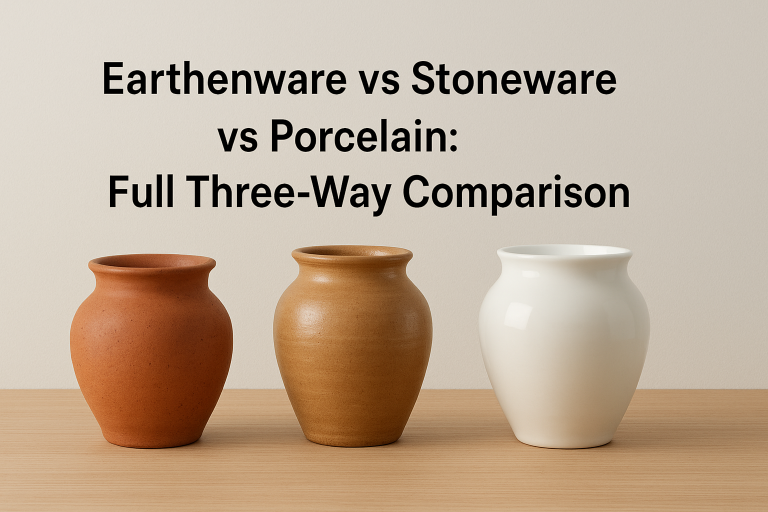
Ceramic and porcelain are both clay-based tiles fired in a kiln. They are cousins, not completely different materials.
The distinction comes down to clay composition, firing temperature, and density. Porcelain uses refined clay with higher kaolin content and fires to cone 8-12 (approximately 2300°F to 2400°F). This produces a tile with water absorption under 0.5% per ASTM C373 testing. Ceramic tile uses less refined clay, fires to a lower temperature, and absorbs 3% to 7% of its weight in water.
According to the Tile Council of North America (TCNA) Handbook, porcelain is classified as “impervious” while ceramic falls under “semi-vitreous” or “vitreous” depending on the specific body formulation. This single difference ripples through every performance characteristic that matters in a kitchen.
In plain terms: porcelain is denser and naturally more resistant to moisture throughout its entire body. Ceramic is less dense but costs less and cuts more easily during installation.
Water and Stain Resistance: Why Absorption Rate Decides Kitchen Performance
A kitchen floor sees spills every single day. Water, cooking oil, red wine, coffee, tomato sauce, and pet accidents all land on the surface.
The critical number is absorption rate. Porcelain absorbs less than 0.5% of its weight in water. Ceramic absorbs 3% to 7%. For spills that sit overnight, this gap matters enormously.
Unglazed porcelain has the same color and density through the entire tile body. If it chips, the exposed area matches the surface. Glazed ceramic has a colored surface layer on top of a lighter, more porous clay body. A chip reveals the lighter clay underneath immediately.
Oil-based spills present the biggest problem for unglazed ceramic in kitchens. The porous body wicks oil deep into the tile where no surface cleaner can reach. Even sealed ceramic cannot fully prevent this with repeated exposure over years.
The mechanism here is capillary action. Liquid fills the microscopic voids in the tile body the same way water climbs up a paper towel. Porcelain’s denser body has far fewer and smaller voids, so capillary action nearly stops.
If you install ceramic in a kitchen with heavy cooking, seal the surface and the grout lines annually. Even with sealing, wipe spills immediately. For porcelain, sealing is optional for the tile body but still recommended for grout.
For most home kitchens with active cooking, porcelain’s near-zero absorption eliminates the single biggest long-term failure mode of kitchen tile flooring: permanent staining from everyday spills.
Durability and Scratch Resistance: Which Surface Survives Kitchen Abuse?
Kitchens drop things. Pots hit the floor. Chairs scrape across the surface. A child drags a stool from the counter to the pantry and back again every day after school. The tile must handle all of this without showing wear.
Porcelain tile achieves a surface hardness of 7-8 on the Mohs scale. Ceramic tile ranges from 5-7 depending on the glaze formulation and firing temperature. This is a meaningful difference when steel cookware (Mohs 5-6) contacts the floor.
The PEI (Porcelain Enamel Institute) rating system measures a tile’s resistance to surface abrasion. PEI 1 is for walls only with no foot traffic. PEI 2 is for residential bathrooms. For a kitchen, the minimum acceptable rating is PEI 3 for light-use households. PEI 4 or 5 is the safe choice for families with children, pets, and heavy cooking.
Through-body porcelain has the same color from surface to base. A deep scratch on the surface still shows the same color underneath. Glazed ceramic hides its lighter body color under a thin surface layer. A scratch that penetrates the glaze creates a visible white or light-colored mark that cannot be repaired.
Glaze hardness varies by manufacturer. A high-quality PEI 4 rated ceramic floor tile for kitchens can perform well for years in a careful household. A low-grade PEI 2 ceramic will show wear within 12 months in an active kitchen.
For the average family kitchen with daily cooking, dropped utensils, and chair movement, through-body porcelain at PEI 4 or higher provides the longest scratch-free lifespan.
Slip Resistance: The Safety Factor Most Kitchen Renovations Ignore
Water and oil on a smooth tile surface create a slip hazard. The kitchen is the second most common room for household slip injuries after the bathroom. Tile choice directly affects this risk.
The coefficient of friction (COF) measures slip resistance. A DCOF (dynamic coefficient of friction) of 0.42 or higher is the current ANSI A137.1 standard for level interior floors expected to get wet. Many polished ceramic and polished porcelain tiles fall below 0.42 when wet with water alone. Add cooking oil and the number drops further.
Matte finish porcelain and textured ceramic both provide better wet slip resistance than polished versions of either material. A matte porcelain with a slight surface texture achieves DCOF values of 0.50-0.60 even when wet. This is the safe range for kitchen floors.
The mechanism behind slip resistance is surface texture at the microscopic level. Smooth polished surfaces create a near-continuous water film between the foot and the tile. Textured surfaces break that film into disconnected droplets, maintaining direct foot-to-tile contact.
If you want a glossy look in the kitchen, choose a glazed porcelain with a high-gloss surface rated DCOF 0.42 or above. Avoid polished natural stone-look porcelain in kitchens unless the manufacturer specifically certifies wet slip resistance. The safest kitchen floor is a matte or lightly textured tile regardless of whether you choose ceramic or porcelain.
Installation Cost Comparison: Ceramic vs Porcelain Kitchen Floor
Material cost is only part of the total installed price. Labor differences between ceramic and porcelain often surprise homeowners. This section breaks down the real numbers.
Ceramic tile material runs $1.50 to $8.00 per square foot for most kitchen-grade products. Porcelain material runs $3.00 to $15.00 per square foot. These are retail prices at home centers and tile specialty stores as of the time of publication. The gap widens for large-format tiles (24-inch and larger) where porcelain dominates the market.
Labor costs differ because porcelain is harder to cut. A tile installer needs a wet saw with a diamond blade rated for porcelain. Cutting porcelain takes longer and wears blades faster. Ceramic cuts more easily with a snap cutter or basic wet saw. The labor differential ranges from $1.00 to $3.00 more per square foot for porcelain installation depending on the tile size, pattern complexity, and local labor rates.
Use the table below to compare total installed cost across common kitchen scenarios.
Cost Comparison
Ceramic vs Porcelain — Total Installed Cost per Kitchen Size
Includes material, labor, thinset, grout, and standard subfloor preparation. Prices verified at time of publication.
| Kitchen Size | Ceramic (Budget) | Ceramic (Mid) | Porcelain (Mid) | Porcelain (Premium) |
|---|---|---|---|---|
| 100 sq ft (small galley) | $600-$900 | $900-$1,300 | $1,200-$1,800 | $1,800-$2,800 |
| 200 sq ft (standard) | $1,200-$1,800 | $1,800-$2,600 | $2,400-$3,600 | $3,600-$5,600 |
| 300 sq ft (open plan) | $1,800-$2,700 | $2,700-$3,900 | $3,600-$5,400 | $5,400-$8,400 |
Labor rates assume $4-$8/sq ft for ceramic and $5-$11/sq ft for porcelain installation in mid-range markets. Complex patterns, diagonal layouts, and large-format tiles increase labor cost.
For a standard 200-square-foot kitchen, ceramic saves $600 to $1,800 compared to porcelain at similar quality tiers. This is the real tradeoff: upfront savings versus long-term durability and stain resistance.
Subfloor and Structural Requirements: What Your Kitchen Needs Before Tile Goes Down
Tile does not fail because the tile is weak. It fails because the floor underneath moves. This is true for both ceramic and porcelain, but the consequences differ.
Porcelain is denser and heavier than ceramic. A porcelain floor adds more dead load to the floor structure. Most modern homes built to current building codes can handle either material without reinforcement. Older homes with 2×8 joists at 24-inch spacing may need additional subfloor preparation for porcelain specifically.
The Tile Council of North America requires a minimum subfloor deflection rating of L/360 for ceramic tile and L/360 for porcelain as well. However, porcelain’s higher modulus of rupture (typically 35-50 MPa versus 20-35 MPa for ceramic) means it can tolerate slightly more subfloor movement before cracking in some installations. This does not mean you can skip proper subfloor preparation.
Both materials require a clean, flat, rigid substrate. A crack isolation membrane adds $2.00 to $4.00 per square foot to the installation cost. For kitchens over wood-framed subfloors, this membrane is strongly recommended regardless of tile type. Concrete slab subfloors need crack isolation only if active cracks are present.
If your kitchen has a wood subfloor with noticeable bounce when you walk across it, address the deflection before choosing any tile. Neither ceramic nor porcelain fixes a bad subfloor.
Porcelain vs Ceramic Kitchen Tile: Head-to-Head Comparison Table
Use the table below to compare every performance dimension side by side before making your final decision.
Product Comparison
Ceramic vs Porcelain Kitchen Floor Tile — Complete Comparison
All values based on current ASTM and TCNA standards.
| Feature | Ceramic Tile | Porcelain Tile |
|---|---|---|
| Water absorption | 3%-7% (semi-vitreous to vitreous) | Under 0.5% (impervious) |
| Mohs surface hardness | 5-7 (glaze-dependent) | 7-8 (through-body) |
| PEI rating range | PEI 2-4 common | PEI 3-5 common |
| Stain resistance | Good with sealed grout, poor if unglazed | Excellent, even unglazed |
| Cutting difficulty | Easy, snap cutter or wet saw | Harder, wet saw with diamond blade required |
| Material cost per sq ft | $1.50-$8.00 | $3.00-$15.00 |
| Installed cost per sq ft | $6.00-$15.00 | $9.00-$25.00 |
| Best kitchen use case | Light-use kitchens, budget renovations | Heavy-use kitchens, families, home chefs |
Glazed vs Unglazed: A Decision Within the Decision
Both ceramic and porcelain come in glazed and unglazed versions. This choice matters as much as the ceramic-versus-porcelain decision itself.
Glazed tiles have a glass coating fused to the surface during a second firing. This glaze layer provides the color, pattern, and much of the stain resistance. Unglazed tiles get their color from the clay body itself with no applied surface coating. The color goes all the way through.
For kitchens, glazed tiles offer better stain resistance on the immediate surface. Sauces, oils, and acidic spills sit on top of the glass layer without penetrating. The tradeoff is that the glaze can scratch, and a deep enough scratch exposes the lighter clay body underneath on ceramic. On porcelain, a scratch on a glazed surface still reveals a similarly colored body.
Unglazed porcelain, also called full-body or through-body porcelain, handles heavy wear the best because there is no surface layer to wear through. The entire tile is the same material and color. Unglazed ceramic is too porous for kitchen use without extensive sealing and is generally not recommended for kitchen floors.
The best kitchen floor combination for most homes is glazed porcelain with a PEI 4 rating and a matte or lightly textured surface for slip resistance. This combination covers stain resistance, scratch resistance, and safety in one material choice.
For most kitchen floors, glazed porcelain with a PEI 4 rating in a matte finish gives the best combination of stain protection, scratch resistance, and slip safety.
Quick Reference
Kitchen Tile — Key Terms Explained
Quick reference for the terms used throughout this guide
: Porcelain Enamel Institute abrasion resistance scale. PEI 1 is wall tile only. PEI 4-5 is rated for heavy commercial foot traffic and is ideal for busy kitchens.
: The percentage of a tile’s weight absorbed as water under ASTM C373 testing. Lower is better for kitchens. Porcelain targets under 0.5%, ceramic ranges from 3% to 7%.
: Dynamic Coefficient of Friction. Measures slip resistance. ANSI A137.1 requires DCOF of 0.42 or higher for level interior floors expected to get wet.
: Tile where the color and composition are consistent from the surface through the entire thickness. Chips and scratches reveal the same color as the surface.
: The degree to which a clay body has fused into a glass-like, non-porous state during firing. Porcelain achieves near-complete vitrification, ceramic achieves partial vitrification.
: How much the floor structure bends under load. TCNA requires deflection no greater than L/360 (span in inches divided by 360) for tile installations to prevent cracking.
: A flexible layer installed between the subfloor and tile to absorb minor substrate movement without transferring cracks to the tile surface.
: Measures a tile’s breaking strength under bending force. Porcelain typically achieves 35-50 MPa compared to 20-35 MPa for ceramic, meaning porcelain resists cracking under load better.
: A 1-10 scale of scratch resistance. Talc is 1, diamond is 10. Porcelain tile rates 7-8, comparable to quartz. Ceramic glaze rates 5-7 depending on formulation and firing.
Which Kitchen Tile Handles Temperature Changes Better?
Kitchens have temperature swings. A hot pan set on the floor near the stove. Sunlight through a south-facing window heating one section of the floor all morning. Underfloor radiant heating systems cycling on and off throughout the day. The tile must handle thermal expansion and contraction without cracking.
Porcelain expands and contracts less than ceramic per degree of temperature change. Its coefficient of thermal expansion runs lower because the denser, more vitrified body has less room for molecular movement. This makes porcelain the better choice for kitchens with radiant floor heating. The heating and cooling cycles stress the tile-to-subfloor bond less over time.
According to manufacturer technical data sheets for porcelain floor tile rated for radiant heat systems, porcelain’s thermal conductivity also transfers heat from the floor system to the room more efficiently than ceramic. This matters for energy costs in kitchens with in-floor electric or hydronic heating.
This happens because porcelain’s higher density eliminates insulating air pockets within the tile body. Heat conducts through solid material faster than through material with voids. The dense body acts as a better thermal bridge between the heating element and the room air.
If your kitchen has or will have radiant floor heating, choose porcelain. The lower thermal expansion reduces long-term bond failure risk and the higher conductivity improves heating efficiency.
How to Choose the Right Tile for Your Specific Kitchen
Every kitchen has a different usage pattern. The right tile for a retired couple’s kitchen is not the right tile for a family kitchen where three meals are cooked from scratch every day. Answer these questions honestly before choosing.
Buying Guide
Before You Buy — Kitchen Floor Tile Checklist
Check off each point before making your decision.
Ceramic vs Porcelain Kitchen Floor: Maintenance Over 10 Years
Purchase price is a one-time cost. Maintenance is forever. The real cost difference between ceramic and porcelain emerges over the first decade of ownership.
Ceramic kitchen floors need annual grout sealing and periodic tile surface sealing if unglazed. Grout sealer costs $15 to $40 per bottle and covers 200-400 square feet per application. Surface sealer for unglazed ceramic costs $30 to $60 per gallon. The time investment is one afternoon per year for an average kitchen.
Porcelain with sealed grout needs far less maintenance. Glazed porcelain requires no surface sealing at all. The grout still needs annual sealing regardless of tile type because cement-based grout is porous on both ceramic and porcelain installations. Epoxy grout eliminates this requirement but adds $2.00 to $4.00 per square foot to the installation cost.
Over 10 years, maintaining ceramic costs $300 to $600 more than maintaining glazed porcelain in the same kitchen. This narrows the upfront cost gap between the two materials. When you factor in maintenance, the lifetime cost difference between mid-range ceramic and mid-range porcelain shrinks to about $300 to $1,200 for a 200-square-foot kitchen.
Cleaning is simpler on porcelain. Its lower absorption means cleaning products do not soak into the tile body. Harsh cleaners that would damage the sealer on ceramic are less risky on glazed porcelain. You can use a steam mop for porcelain tile floors without concern, which sanitizes without chemicals.
For a kitchen floor you plan to live with for 10 years or more, glazed porcelain’s lower maintenance burden and wider cleaning product compatibility make it the lower-hassle choice.
Myth vs Fact: Common Kitchen Tile Misconceptions
Myth vs Fact
Kitchen Floor Tile — Common Myths Debunked
Separating fact from fiction on the most common kitchen tile misconceptions
✗ Myth
Porcelain and ceramic are the same thing with different names.
✓ Fact
Porcelain fires to higher temperatures with refined clay, achieving under 0.5% absorption. Ceramic fires lower and absorbs 3% to 7%. This difference directly affects kitchen stain resistance and freeze-thaw durability.
✗ Myth
High-gloss tile in the kitchen just needs more frequent mopping to stay safe.
✓ Fact
Polished tile with DCOF below 0.42 remains slippery even when clean and dry. Cooking oil aerosol settles on the surface invisibly and reduces friction further. Choose matte or textured finishes rated at DCOF 0.42+ for safety.
✗ Myth
If the subfloor is solid, I can install tile directly on it.
✓ Fact
Even solid-feeling wood subfloors can exceed L/360 deflection limits under load. Measure joist span, spacing, and species before assuming the structure is adequate. A crack isolation membrane is insurance, not a substitute for proper structure.
✗ Myth
Sealing ceramic tile makes it as stain-resistant as porcelain.
✓ Fact
Sealers sit on the surface and wear down with foot traffic and cleaning. Porcelain’s stain resistance is built into the material itself through vitrification. A sealed ceramic floor requires reapplication to maintain protection. Porcelain does not need sealing at all when glazed.
✗ Myth
Ceramic is always cheaper than porcelain for the same look.
✓ Fact
With installation labor, maintenance, and durability factored in, mid-range porcelain often costs less per year of service than budget ceramic. A $3.00/sq ft ceramic floor replaced after 8 years costs more than a $5.00/sq ft porcelain floor lasting 25 years.
Does Porcelain Always Win? When Ceramic Is the Smarter Kitchen Choice
Porcelain outperforms ceramic on almost every technical specification. But technical specs are not the only factor in a kitchen renovation. Budget, installation difficulty, and renovation timeline also matter.
Ceramic makes more sense than porcelain in these specific kitchen scenarios. A rental property kitchen where the floor will be replaced in 5-7 years anyway. A light-use kitchen in a household of one or two adults who rarely cook from scratch. A kitchen renovation where the budget is tight and the savings from ceramic can be redirected to cabinets or appliances. A second home or seasonal property where the kitchen sees only occasional use.
Ceramic is also easier for DIY installation. The softer body cuts with a basic wet tile saw for ceramic floor installation or even a snap cutter for straight cuts. Porcelain demands a high-quality diamond blade and more patience. A DIY installer with moderate experience can achieve professional-looking results with ceramic more easily than with porcelain.
For a powder room or guest bathroom, the performance demands are lower. For a kitchen that anchors the home and handles daily cooking, the performance case for porcelain is strong. Our complete comparison of ceramic versus porcelain tile for bathroom floors covers the moisture-specific considerations that differ from kitchen requirements.
If your kitchen sees light use and the budget is tight, mid-range ceramic with PEI 3 or higher and proper sealing is a valid choice. For everyone else, porcelain’s durability advantage justifies the higher upfront cost.
Large Format Tile in Kitchens: A Special Consideration
Large format tiles (sides 15 inches or longer) are popular in modern kitchens. Fewer grout lines create a cleaner look and less grout to maintain. But large format tile introduces installation challenges that favor porcelain.
Large format tiles require a flatter subfloor. The TCNA standard for large format tile is no more than 1/8 inch variation over 10 feet. Ceramic large format tiles are harder to manufacture flat because the softer body warps more during firing. Porcelain large format tiles hold their flatness better through the kiln because the denser body resists warping at high temperature.
The mechanism here is pyroplastic deformation. During firing, the tile body softens before vitrification locks the structure. A tile spanning 24 inches or more has more unsupported mass that can sag or warp during this softening phase. Porcelain’s refined clay body and higher forming pressure reduce this warping tendency.
If you want large format tile for your kitchen, porcelain is the more reliable choice. The flatter tiles are easier to install without lippage. This is less critical for standard 12×12 or smaller tiles where both ceramic and porcelain perform adequately.
Tile That Looks Like Wood: Porcelain Planks vs Ceramic Planks
Wood-look tile is the most popular kitchen flooring trend of the past decade. Both ceramic and porcelain versions exist. The differences matter for kitchen performance.
Wood-look porcelain planks typically come in 6×24, 6×36, or 8×48 inch sizes. The longer planks create a more convincing wood floor look with fewer grout lines interrupting the pattern. Wood-look ceramic planks are usually limited to 6×24 or smaller because the softer body cannot support longer lengths without warping during firing.
Porcelain wood-look tiles also offer better inkjet printing resolution because the denser body holds finer surface detail. The textured surface, which creates the wood grain feel and improves slip resistance, is more durable on porcelain. A textured ceramic surface wears smooth faster under kitchen foot traffic.
For wood-look porcelain tile planks for kitchen floors, the combination of longer plank lengths, better texture durability, and lower absorption makes porcelain the clear choice. The premium over ceramic wood-look planks is typically $2.00 to $5.00 per square foot for material.
If wood-look tile is your kitchen design direction, porcelain planks deliver the best balance of appearance, durability, and long-term performance.
What Are the Best Grout Options for Kitchen Tile Floors?
Grout occupies 5% to 15% of a tiled floor surface but causes 80% of long-term maintenance complaints. The grout choice matters as much as the tile choice for kitchen performance.
Cement-based grout is the standard and the least expensive option. It is also porous and will stain without sealing. In a kitchen with ceramic tile, cement grout absorbs food spills at the same rate as the tile body, compounding the stain risk. With porcelain, the tile resists staining but the cement grout still needs protection.
Epoxy grout costs more ($2.00 to $4.00 per square foot additional) but is nearly impervious to stains. It requires no sealing and resists most kitchen chemicals. The installation is more demanding because epoxy grout sets faster and is harder to clean off the tile surface before it cures. An experienced installer is essential for epoxy grout work.
Urethane grout splits the difference. It costs less than epoxy, resists stains better than cement, and is easier to work with during installation. For kitchen floors, urethane grout offers the best balance of performance and installation practicality for most renovation budgets.
For any kitchen tile floor, a stain-resistant epoxy or urethane grout for kitchen tile eliminates the annual sealing chore that cement grout requires. The upfront cost is offset by 10 years of near-zero grout maintenance.
How Does Underfloor Heating Affect the Ceramic vs Porcelain Decision?
Radiant floor heating changes the performance demands on kitchen tile. The heating and cooling cycles create thermal stress that tests the bond between tile and subfloor. The tile’s thermal properties directly affect heating system efficiency.
Porcelain’s higher thermal conductivity (typically 1.5-3.0 W/mK versus 0.8-2.0 W/mK for ceramic) means heat transfers from the heating element to the room surface faster. The kitchen floor reaches the set temperature sooner and the heating system cycles less frequently. This efficiency difference is modest but real over the lifetime of the system.
The more important factor is thermal expansion mismatch. Porcelain expands and contracts less than ceramic per degree of temperature change. Over hundreds of heating cycles per year, this reduced movement lowers the risk of tile debonding from the substrate. This is the failure mode that matters most for heated floors.
If you are installing electric or hydronic radiant heat under your kitchen tile, porcelain is the stronger choice. Specify this to your installer before tile selection because the thinset mortar and installation method must also be rated for radiant heat use.
For kitchen floors with radiant heating systems, porcelain’s lower expansion rate and higher conductivity make it the safer and more efficient choice.
Can I Install Porcelain or Ceramic Tile Over Existing Kitchen Flooring?
Installing new tile over old flooring saves demolition time and disposal costs. But the existing floor material determines whether this shortcut works.
Tile over existing ceramic or porcelain tile is possible if the old tile is firmly bonded, has no cracks, and does not have a high-gloss surface that prevents thinset adhesion. The old tile surface must be roughened mechanically or treated with a bonding primer rated for tile-over-tile installation. This adds $1.00 to $3.00 per square foot for surface preparation.
Tile over vinyl or linoleum is risky. Many older vinyl floors contain asbestos in the backing or adhesive. Disturbing these materials requires professional abatement. Even with newer vinyl, the flexibility of the vinyl layer can cause thinset to crack and tiles to loosen. The TCNA does not recommend tile over resilient flooring in most cases.
Tile over concrete is the most straightforward scenario. Clean, level concrete needs only a crack isolation membrane if cracks are present. A crack isolation membrane for tile over concrete subfloors adds cost but prevents existing slab cracks from transferring into the new tile surface.
The height of the finished floor also matters. Adding tile over existing flooring raises the floor by 3/8 to 3/4 inch. This can create transitions at doorways, interfere with appliance clearances under counters, and require undercutting door frames. Measure the total height increase before committing to a tile-over-tile or tile-over-existing-floor installation.
What Happens When Kitchen Tile Fails? Common Failure Modes
Knowing how kitchen tile fails helps you choose a tile and installation method that avoids those failures. Most tile failures share the same root causes regardless of whether the tile is ceramic or porcelain.
Cracked tiles usually indicate subfloor movement, not defective tile. The crack pattern tells the story. A single crack running across multiple tiles in a straight line points to a subfloor joint or crack that moved. Cracks radiating from a single impact point indicate a dropped heavy object. Hairline crack networks across a large area suggest insufficient thinset coverage or the installer allowing the thinset to skin over before setting the tile.
Loose or hollow-sounding tiles indicate bond failure. The thinset did not adhere to the tile, the substrate, or both. Common causes include using the wrong thinset for the tile type (porcelain requires modified thinset for proper adhesion), insufficient thinset transfer to the tile back, or dust on the substrate preventing adhesion. Tapping on tiles with a hard object reveals hollow spots immediately.
Stained grout and stained tile edges indicate moisture penetration through unsealed or worn grout. The water carries dissolved food particles into the grout and under the tile edges where it cannot be cleaned. This is the most common cosmetic failure in kitchen tile floors and it is nearly always a grout maintenance issue, not a tile issue.
For a deeper look at how ceramic and porcelain compare across different rooms and use cases, see our complete ceramic tile versus porcelain tile comparison guide covering every room in the home.
The Final Verdict: Ceramic vs Porcelain for Your Kitchen Floor
If your kitchen handles daily cooking, children, pets, and the full chaos of family life, choose glazed porcelain with a PEI 4 or higher rating and a DCOF of 0.42 or above. Install it with epoxy or urethane grout over a properly prepared subfloor with a crack isolation membrane. This floor will perform for 20 to 30 years with minimal maintenance beyond regular cleaning.
If your kitchen is in a rental property, a vacation home, or a household where cooking means reheating takeout, ceramic with a PEI 3 rating and annual grout sealing is a valid budget-conscious choice. The savings can be redirected to other parts of the renovation.
If you are installing radiant floor heating, choose porcelain regardless of kitchen usage patterns. The thermal properties and lower expansion rate justify the additional material cost.
The wrong tile in the right kitchen fails within five years. The right tile in the busiest kitchen looks nearly new after fifteen. Match the material to your specific kitchen reality, not to the showroom display. That is the entire decision in one sentence.
What Is the Best Thickness for Kitchen Floor Tile?
Kitchen floor tile thickness ranges from 8mm to 12mm for most residential products. Thicker tile resists cracking under load better. For kitchens, 10mm is the practical minimum for floor use. Thinner tiles rated at 8mm are acceptable for wall applications but risk cracking under the point loads that kitchen floors experience from appliances, heavy pots, and furniture.
Porcelain tiles at 10mm to 12mm are the standard for kitchen floors. These thicknesses provide adequate strength for the dead loads and live loads in a residential kitchen. Commercial kitchens and areas where heavy equipment rolls across the floor need 12mm minimum thickness and often require quarry tile or paver-grade products instead of standard floor tile.
The tile’s breaking strength, measured by the modulus of rupture, matters more than thickness alone. A dense 10mm porcelain with a high modulus of rupture of 45 MPa can outperform a thicker but weaker tile. Always check the manufacturer’s breaking strength specification rather than relying on thickness as a proxy for strength.
How Do I Test if My Kitchen Subfloor Is Ready for Tile?
A simple deflection test tells you if your floor structure is rigid enough for tile. Walk heavily across the middle of the kitchen floor. If dishes rattle in the cabinets or you feel noticeable bounce, the subfloor needs reinforcement before any tile goes down. This test works for both ceramic and porcelain installations.
For a more precise measurement, the TCNA requires deflection no greater than the joist span in inches divided by 360. A 12-foot joist span (144 inches) divided by 360 equals 0.4 inches of maximum allowable deflection under design load. Most homes built to current code meet this standard. Older homes, homes with undersized joists, and homes with 24-inch joist spacing often do not.
Check the subfloor flatness with a 10-foot straightedge. Gaps under the straightedge should not exceed 1/8 inch for tiles with any side shorter than 15 inches, or 1/16 inch for large format tiles with any side 15 inches or longer. Low spots need filling with a self-leveling compound before tile installation.
Can I Use Outdoor Porcelain Tile in My Kitchen?
Outdoor porcelain tile is rated for freeze-thaw conditions with absorption under 0.5%. It is technically suitable for indoor use including kitchens. The difference is surface texture. Outdoor porcelain typically has a more aggressive texture for wet slip resistance, which also makes it harder to clean indoors.
Outdoor porcelain’s rough surface traps kitchen debris more readily than indoor-rated tile. Flour, sugar, and fine cooking particles settle into the texture and require more scrubbing to remove. The DCOF rating on outdoor tile often exceeds 0.60, far above the kitchen requirement, but the cleaning tradeoff usually makes this an impractical choice for indoor kitchen floors.
Use outdoor porcelain in kitchens only in specific situations like a kitchen that opens directly to a pool deck or patio where the same tile continues inside and out for a seamless look. In all other kitchen scenarios, choose indoor-rated tile with a DCOF of 0.42 to 0.55 for the best balance of slip resistance and cleanability.
What Is the Difference Between Rectified and Non-Rectified Tile for Kitchen Floors?
Rectified tile has edges that are mechanically cut after firing to achieve precise dimensions. Every tile in the batch is nearly identical in size, allowing grout joints as narrow as 1/16 inch. Non-rectified tile has edges formed during pressing and can vary by 1/16 to 1/8 inch between tiles, requiring wider grout joints of 1/8 to 3/16 inch minimum.
For kitchens, rectified tile with narrow grout lines creates a cleaner, more modern look with less visible grout to maintain. The narrow joints accumulate less debris and are easier to clean. The cost premium for rectified tile is $1.00 to $3.00 per square foot over non-rectified versions of the same tile.
Rectified tile demands a more skilled installer. The narrow grout joints make lippage (height differences between adjacent tiles) more visible. The subfloor must be flatter because there is less grout joint width to absorb slight tile size variations. If your installer is experienced with rectified tile, the results are worth the premium.
How Does Porcelain Tile’s Color Consistency Compare to Ceramic for Large Kitchens?
Porcelain tile offers better dye lot consistency than ceramic. The refined clay body and controlled firing process produce less color variation from batch to batch. This matters in large open-plan kitchens where tiles from multiple boxes intermingle across a wide floor area.
Ceramic tile, especially glazed ceramic, shows more variation between production runs. The glaze application process and lower firing temperature create wider tolerances for shade and tone. Always order ceramic tile for a kitchen from the same dye lot and buy 10% to 15% extra for future repairs. Porcelain requires 5% to 10% overage for the same purpose.
The inkjet printing technology used on modern glazed porcelain produces highly consistent patterns and colors. If your kitchen is large and open to other living spaces, porcelain’s superior batch consistency reduces the risk of visible color shifts across the floor.
What Are the Best Cleaning Products for Porcelain and Ceramic Kitchen Floors?
Glazed porcelain and glazed ceramic both clean well with pH-neutral tile cleaners. Avoid acidic cleaners (vinegar, citrus-based products) on cement grout because acid dissolves the calcium in the grout over time, creating pits that trap more dirt. Avoid abrasive cleaners on glazed surfaces because they dull the glaze over years of use.
Unglazed porcelain benefits from an alkaline cleaner that lifts oil-based kitchen soils without leaving residue. Unglazed ceramic, rarely used in kitchens, needs a cleaner matched to whatever sealer was applied to the surface.
Steam mops work on porcelain but should be used cautiously on ceramic. The rapid temperature change can stress the glaze layer on ceramic, potentially causing micro-cracking over repeated use. Manufacturers of steam mops often exclude ceramic tile from their recommended surfaces for this reason. Porcelain’s higher thermal shock resistance makes it steam-mop-safe.
Does Tile Color Affect Kitchen Floor Performance?
Tile color does not change the physical properties of the material. A black porcelain tile has the same absorption rate and hardness as a white porcelain tile from the same product line. But color affects how the floor looks as it ages between cleanings.
Light-colored tiles and light grout show every drip, crumb, and footprint. A kitchen floor in white or cream tile with matching light grout looks dirty within hours of cleaning. Medium-toned tiles with a subtle pattern or color variation hide daily debris more effectively. Dark tiles show dust and light-colored crumbs but hide dark spills like coffee or red wine.
Medium-toned tiles with color variation or a stone-like pattern are the most practical choice for kitchens that see heavy use. They maintain a clean appearance longer between mopping sessions. This is purely a cosmetic consideration but it affects daily satisfaction with the floor more than any technical specification.
Are There Any Kitchen Situations Where Neither Ceramic Nor Porcelain Is the Right Choice?
Yes. Kitchens in homes where a family member has mobility issues or a high fall risk may be better served by sheet vinyl, luxury vinyl plank, or cork flooring. These materials provide more cushioning underfoot and lower slip risk than any hard tile surface. The safety advantage outweighs the durability advantage of tile in these households.
Kitchens in historic homes with severely uneven floors may require the flexibility of a floating floor system rather than tile. The floor preparation needed to make tile work can be prohibitively expensive and may alter the historic character of the home in undesirable ways.
Kitchens that are part of a multistory condominium with strict sound transmission requirements may require acoustic underlayment that is incompatible with tile installation. Check your building’s flooring requirements before committing to any hard surface flooring including both ceramic and porcelain tile.
How Long Should a Ceramic or Porcelain Kitchen Floor Last Before Replacement?
A properly installed porcelain kitchen floor with epoxy or urethane grout should last 25 to 50 years before replacement is driven by style changes rather than material failure. Porcelain’s near-zero absorption and through-body hardness mean the tile itself does not wear out in residential use. Replacement happens because the homeowner wants a new look.
A properly installed ceramic kitchen floor with annual grout maintenance typically lasts 15 to 25 years. The shorter lifespan reflects the higher probability of staining, glaze wear, or grout failure over time. Ceramic can last as long as porcelain with meticulous maintenance, but the maintenance burden is higher and more sensitive to lapses.
Poorly installed tile of either type can fail within 1 to 5 years due to subfloor movement, bond failure, or grout problems. The installation quality matters more than the material choice for lifespan. A perfectly installed ceramic floor outlasts a poorly installed porcelain floor every time.