Air-Dry Clay vs Kiln-Fired: Which Is Right for Your Project?

Air-dry clay allows beginners to create pottery without needing a kiln, curing at room temperature in 24-72 hours, while kiln-fired clay requires temperatures of cone 04-10 (1830-2345°F) but produces waterproof, food-safe ceramics with 10x greater durability. Your project goals determine the right choice—decorative pieces, learning basic techniques, or temporary sculptures work well with air-dry clay, while functional pottery, outdoor art, or professional-quality work requires kiln firing.
This decision affects everything from initial material costs ($8-15 for air-dry clay vs $18-25 per 25-pound bag of firing clay) to final piece durability (air-dry clay remains porous and fragile vs kiln-fired strength of 3,000+ psi). Understanding when each clay type serves your creative goals saves money, time, and frustration while ensuring your finished pieces meet their intended purpose.
What Is Air-Dry Clay and How Does It Work?
Air-dry clay is a polymer-based or paper pulp clay that hardens through water evaporation at room temperature without firing, reaching handling strength in 24 hours and full cure in 48-72 hours depending on thickness and humidity levels. This clay contains binding agents like PVA (polyvinyl alcohol) or cellulose fibers that create structural integrity as moisture leaves the clay body, eliminating the need for high-temperature kilns or specialized equipment.
According to air-dry clay manufacturers, these clays cure to approximately 40-60% the strength of leather-hard traditional clay but remain permanently porous with 15-25% water absorption rates. The curing process cannot be reversed—once fully dry, the clay cannot be reconstituted with water like unfired traditional clay bodies.
Air-Dry Clay Composition and Properties
Most air-dry clays combine natural clay minerals with synthetic binders, creating a workable medium that mimics traditional clay plasticity during shaping. Paper-based air-dry clays use cellulose fibers for binding, while polymer versions rely on PVA or acrylic compounds that cross-link during drying.
These clays typically shrink 8-12% during curing compared to 12-16% shrinkage in traditional fired clay from wet to finished state. The synthetic binders prevent the extreme cracking common in natural clay dried without firing, though thicker sections (over 1 inch) still risk stress fractures during the curing process.
Working Properties and Limitations
Air-dry clay remains workable for 2-4 hours when exposed to air, requiring plastic wrap or damp cloth covering during extended work sessions. The clay accepts most surface treatments including acrylic paints, but remains too porous for glazes designed for traditional ceramics.
Maximum recommended thickness for air-dry clay pieces is 3/4 inch to ensure even curing without interior moisture pockets that cause cracking. Wall thickness should remain consistent at 1/4 to 1/2 inch for optimal strength and even drying rates throughout the piece.
What Is Kiln-Fired Clay and Why Does It Transform?
Kiln-fired clay undergoes permanent molecular transformation at temperatures above 1800°F, converting clay minerals into ceramic through vitrification—the process where silica and alumina form glass-like bonds creating waterproof, durable pottery with compressive strength exceeding 20,000 psi. This irreversible change, called ceramic conversion, occurs as the clay’s molecular structure reorganizes under high heat, eliminating porosity and creating the dense, ring-producing ceramic familiar in functional pottery.
Traditional pottery clays like stoneware clay contain natural minerals (silica, alumina, feldspar) that flux together during firing, while earthenware clays vitrify at lower temperatures (cone 04-02, 1830-1870°F) but remain more porous than high-fire stoneware fired to cone 8-10 (2280-2345°F).
The Firing Process: Bisque and Glaze Firing
Kiln-fired pottery requires two firing stages for functional work—bisque firing transforms raw clay into porous ceramic at cone 08-04 (1728-1830°F), followed by glaze firing that melts glass-like coatings onto the surface at cone 04-10 depending on clay body and glaze chemistry. Bisque firing burns out organic materials and completes ceramic conversion while maintaining 8-12% porosity for glaze absorption.
Firing schedules range from 8-12 hours to reach peak temperature with controlled heating rates of 100-200°F per hour to prevent thermal shock and cracking. Kiln pyrometers monitor exact temperatures since clay bodies have narrow firing ranges—overfiring causes warping and bloating while underfiring leaves clay weak and porous.
Clay Body Types and Firing Temperatures
Earthenware clays fire at cone 04-02 (1830-1870°F) and remain porous even when properly fired, requiring glazes for water resistance but offering bright color responses from metal oxides. Stoneware clays mature at cone 5-10 (2167-2345°F), becoming vitreous and naturally water-resistant even without glaze, making them ideal for functional pottery and outdoor sculpture.
Porcelain, the highest-firing clay body, matures at cone 8-14 (2280-2491°F) and becomes translucent when thin-walled, prized for fine dinnerware and decorative work requiring maximum strength and refinement. Each clay type requires specific firing curves and cooling schedules to achieve optimal results without defects.
Air-Dry Clay vs Kiln-Fired Clay: Strength and Durability Comparison
Kiln-fired ceramics achieve 15-20 times greater compressive strength than air-dry clay, measuring 15,000-25,000 psi for stoneware versus 800-1,200 psi for cured air-dry clay, according to materials testing by ceramic engineering programs. This strength difference determines functional capabilities—kiln-fired pottery withstands daily use, dishwasher cycles, and thermal shock from hot liquids, while air-dry clay remains suitable only for decorative applications and light handling.
Water resistance represents the most critical difference: properly fired ceramics absorb less than 3% water by weight, meeting food safety standards, while air-dry clay absorbs 15-25% water and degrades when repeatedly wet. Fired ceramics survive freezing temperatures without damage, but air-dry clay cracks when moisture freezes and expands within its porous structure.
| Property | Air-Dry Clay | Kiln-Fired Clay | Impact |
| Compressive Strength | 800-1,200 psi | 15,000-25,000 psi | Fired clay 15-20x stronger |
| Water Absorption | 15-25% | 1-8% | Fired clay waterproof for functional use |
| Thermal Resistance | Cracks below 200°F | Withstands 400°F+ thermal shock | Only fired clay suitable for hot liquids |
| Freeze Resistance | Cracks when frozen wet | Survives freeze-thaw cycles | Only fired clay works outdoors |
| Surface Hardness | Scratches with fingernail | Mohs 6-7 hardness | Fired surfaces resist wear |
Longevity and Aging Characteristics
Air-dry clay pieces show visible degradation after 2-5 years in normal indoor conditions, with surface dusting, minor cracks, and gradual structural weakening as binders break down. Exposure to humidity cycles accelerates deterioration—pieces stored in basements or garages often crack within 1-2 years as moisture penetrates and weakens the synthetic binders.
Properly fired ceramics survive decades or centuries without structural change, evidenced by archaeological pottery dating thousands of years. Modern kiln-fired pottery maintains strength and appearance indefinitely when protected from physical impact, making it suitable for heirloom pieces and functional ware intended for daily use.
Repair and Restoration Differences
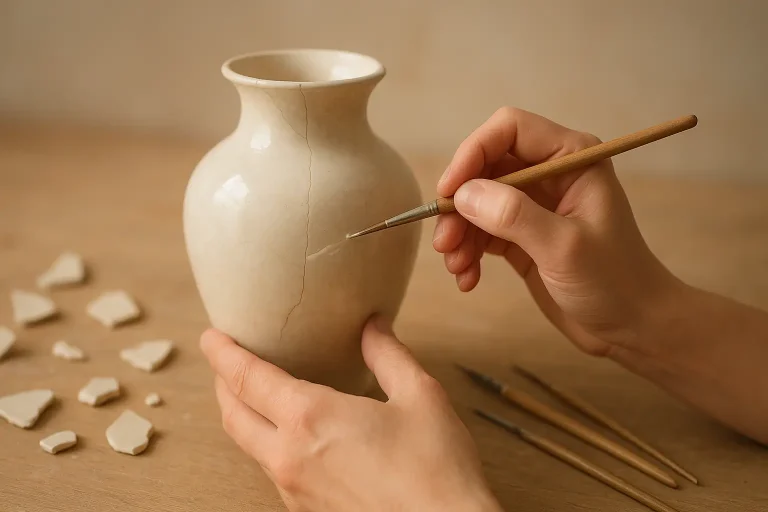
Air-dry clay repairs require similar air-dry clay activated with water to form joining slip, but repair strength rarely exceeds 50% of original bond strength, creating weak points prone to re-breaking. Surface chips and scratches can be filled and sanded smooth, then painted to match, though color matching proves difficult as base clay shows through thin paint layers.
Broken ceramics require ceramic repair epoxy or professional restoration techniques, but properly executed repairs achieve 80-90% original strength and can be nearly invisible when expertly color-matched. Glazed surfaces allow better repair concealment than raw clay surfaces common in air-dry work.
Cost Analysis: Initial Investment and Long-Term Value
Air-dry clay costs $8-15 for 2-5 pounds covering 3-4 small projects, while traditional pottery clay costs $18-25 per 25-pound bag producing 8-12 medium pieces, making raw material costs similar per finished piece at $2-4 each. The significant cost difference lies in equipment—air-dry clay requires only basic sculpting tools ($15-30), while kiln firing demands kiln access ($2,500-8,000 for home kilns) or studio rental fees ($25-50 per firing).
Long-term value calculations favor kiln-fired pottery for functional pieces used daily—a $40 handmade mug lasting 20+ years costs $2 annually, while replacing fragile air-dry decorative pieces every 3-5 years makes them expensive for permanent display. However, air-dry clay excels for learning projects, children’s activities, and temporary sculptures where low initial investment matters more than longevity.
Equipment and Setup Costs Breakdown
Air-dry clay requires minimal setup: work surface ($20-50 for canvas-covered board), basic tools ($15-30), paints for finishing ($20-40), and sealing spray ($10-15) totaling $65-135 for complete beginner setup. Projects can begin immediately without waiting for kiln firing appointments or learning complex firing schedules.
Kiln firing setup includes pottery clay ($18-25), pottery wheel for throwing ($300-1,200), tools ($50-150), glazes ($100-300 for starter set), kiln ($2,500-8,000), and kiln furniture ($200-500), totaling $3,168-10,175 for home studio setup. Studio membership alternatives cost $50-150 monthly plus $15-30 per firing, more economical for occasional potters.
Time Investment and Learning Curves
Air-dry clay projects complete in 1-3 days from start to finished piece—shaping takes 1-4 hours, curing requires 24-72 hours, then painting and sealing add 2-4 hours spread over additional days for proper drying between coats. This rapid completion suits impatient beginners and tight project deadlines.
Kiln-fired pottery extends 2-6 weeks from wet clay to finished piece—throwing or handbuilding (2-8 hours), drying to leather-hard (1-3 days), trimming and finishing (1-2 hours), final drying (3-7 days), bisque firing (2-3 days including firing and cooling), glazing (1-3 hours), and glaze firing (2-3 days) requiring patience and planning ahead for gift deadlines or show submissions.
Which Projects Work Best with Each Clay Type?
Air-dry clay excels for decorative sculpture, temporary art installations, prototype development, and children’s projects where immediate results matter more than permanence or functionality. Projects under 6 inches in maximum dimension with wall thickness under 3/4 inch cure most successfully, making air-dry clay ideal for small figurines, jewelry components, architectural models, and relief wall plaques intended for indoor display only.
Kiln-fired clay serves functional pottery, outdoor sculpture, architectural elements, and fine art requiring permanence—coffee mugs, dinner plates, garden pottery, bathroom fixtures, and gallery pieces demanding professional durability and appearance. The firing process enables glazed surfaces, food-safe finishes, and weather resistance impossible with air-dry alternatives.
Educational and Learning Applications
Beginning pottery students benefit from air-dry clay for initial shape exploration without pressure from expensive firing costs or kiln scheduling constraints. Students can experiment freely, make mistakes, and restart projects without financial penalties, building confidence before transitioning to traditional clay bodies requiring more commitment and planning.
Advanced ceramic education requires kiln-fired clay to understand glaze chemistry, firing atmospheres, thermal expansion, and professional pottery standards. Understanding different clay types becomes essential as students progress from basic forming to complex glazing and firing techniques demanding temperature precision and material compatibility knowledge.
Professional and Commercial Applications
Air-dry clay serves rapid prototyping, architectural modeling, and temporary display work where quick turnaround justifies lower durability—trade show models, product mockups, and concept visualization benefit from air-dry clay’s speed and ease of modification. Some professional sculptors use air-dry clay for maquettes before creating final pieces in traditional materials.
Commercial pottery production requires kiln-fired clay for product reliability, insurance compliance, and customer expectations—restaurants demand chip-resistant dinnerware, garden centers need freeze-proof planters, and home goods retailers expect products lasting years without degradation. Professional standards eliminate air-dry clay from most commercial applications despite lower material costs.
Artistic Expression and Surface Treatment Options
Air-dry clay accepts acrylic paints, tempera, watercolors, and spray finishes but cannot achieve the depth and richness of ceramic glazes—surface treatments remain paint-like rather than integrated glass coatings. Texturing works well on air-dry clay through carving, stamping, or adding materials like sand or paper fibers during forming.
Kiln-fired ceramics offer glazing possibilities impossible with air-dry clay—crystalline glazes, metallic lusters, celadon transparency, and reduction flame effects creating surfaces no paint can replicate. Underglaze decoration, slip trailing, sgraffito carving, and terra sigillata burnishing expand artistic possibilities beyond air-dry clay’s surface painting limitations.
When Should You Choose Air-Dry Clay for Your Project?
Choose air-dry clay when project completion timeline is under one week, budget limits prevent kiln access, workspace lacks ventilation for ceramic dust, or pieces serve temporary/decorative purposes rather than functional use. Air-dry clay suits beginners exploring pottery concepts, children’s art projects, rapid prototyping, and situations where firing costs ($25-50 per load) exceed project budgets or immediate results matter more than longevity.
Specific scenarios favoring air-dry clay include apartment crafting without studio access, school art programs needing same-day results, elderly or mobility-limited crafters avoiding heavy clay bodies and kiln handling, and experimental work testing forms before committing to expensive firing processes. The immediate gratification and low barrier to entry make air-dry clay ideal for casual creative exploration without long-term pottery commitment.
Project Size and Complexity Considerations
Air-dry clay handles simple forms best—solid sculptures under 4 inches, relief tiles under 1/2 inch thick, and hollow forms with wall thickness between 1/4 and 1/2 inch cure evenly without cracking. Complex undercuts, thin appendages, and delicate details risk breaking during handling since air-dry clay lacks the structural integrity of fired ceramics.
Avoid air-dry clay for pieces requiring precision fitting (lids, architectural elements), weight-bearing applications (shelving, hanging planters), or complex assemblies where joint strength matters. Polymer clay offers better detail retention and strength for small-scale precision work, while traditional pottery clay serves structural applications better despite longer completion time.
Environmental and Workspace Factors
Air-dry clay works well in humid climates where slow drying prevents cracking, but requires dehumidification in very humid conditions (above 70% relative humidity) to cure properly within reasonable timeframes. Temperature stability between 65-75°F optimizes curing—hot, dry conditions cause surface cracking while cold slows curing to over one week.
Limited workspace favors air-dry clay since no kiln, ventilation system, or dust collection equipment is needed—projects work on kitchen tables, bedroom desks, or small craft areas impossible for traditional pottery with its dust, noise, and equipment requirements. Cleanup involves only water and soap versus the specialized cleanup procedures required for ceramic glazes and firing materials.
When Should You Choose Kiln-Fired Clay for Your Project?
Choose kiln-fired clay when creating functional pottery (dishes, vases, planters), outdoor art exposed to weather, pieces requiring food-safe surfaces, or work intended as gifts or heirlooms lasting decades. The investment in firing pays off for projects demanding durability, water resistance, professional appearance, or integration with existing ceramic collections where consistency in material properties matters more than initial convenience.
Professional applications always require kiln-fired ceramics—selling pottery demands durability guarantees, restaurant ware needs commercial dishwasher compatibility, and architectural elements must meet building codes for thermal expansion, water absorption, and structural loads impossible with air-dry alternatives. Long-term value justifies firing costs when pieces serve daily functional roles over years of use.
Quality and Professional Standards
Kiln-fired pottery achieves professional quality matching commercial ceramics in strength, appearance, and longevity—hand-thrown mugs rival manufactured ones in durability while offering unique artistic character. Glazed surfaces provide easy cleaning, stain resistance, and hygienic food service impossible with painted air-dry clay surfaces that remain porous and prone to bacterial growth in kitchen applications.
Exhibition and gallery work demands kiln-fired ceramics for credibility and permanence—collectors expect investment-quality pieces surviving handling, shipping, and display for decades without degradation. Insurance companies require fired ceramics for valuable art coverage since air-dry clay’s inherent fragility and degradation make it unsuitable for significant monetary or artistic value.
Technical Capabilities and Advanced Techniques
Complex pottery techniques require kiln firing—wheel throwing relies on clay plasticity and strength impossible in air-dry formulations, while advanced glazing, raku firing, salt glazing, and reduction atmospheres create surface effects unique to high-temperature ceramics. Choosing between electric and gas kilns opens additional creative possibilities through atmosphere control affecting glaze colors and clay body characteristics.
Precision work benefits from fired clay’s dimensional stability—architectural tiles, fitted lids, and modular components maintain measurements better in fired ceramics than air-dry clay’s variable shrinkage and potential warping during cure. Engineering applications requiring specific thermal expansion, chemical resistance, or load-bearing capacity demand the predictable properties only achieved through controlled firing processes.
Surface Treatment and Finishing Options Compared
Air-dry clay accepts acrylic paints, markers, tempera, and spray finishes applied after full curing, but remains limited to surface coating techniques since the clay body cannot withstand high-temperature treatments. Paint penetration stays minimal due to synthetic binders, requiring primers for good adhesion, and finished pieces need protective sealers to prevent paint chipping during handling, adding $15-25 to finishing costs per project.
Kiln-fired ceramics offer glazing possibilities creating integrated glass surfaces impossible with paint—transparent glazes reveal clay body color, opaque glazes provide complete coverage, and specialty glazes produce crystalline, metallic, or textural effects no surface painting achieves. Underglazes applied before glaze firing create permanent decoration that cannot chip or wear off like painted surfaces on air-dry clay.
Color and Texture Possibilities
Air-dry clay finishing relies on external color application—acrylic paints provide good coverage but remain paint-like in appearance and feel, while spray finishes offer even color but limited texture options. Acrylic paint sets work well for beginners, though color matching proves difficult when repairing chips or touch-ups since base clay affects final appearance.
Ceramic glazes integrate with clay body during firing, creating depth and richness impossible with surface treatments—copper glazes shift from green to red depending on firing atmosphere, iron produces colors ranging from yellow to black based on concentration and temperature, and crystalline glazes grow actual crystal formations during cooling. Multiple glaze layers, wax resist techniques, and trailing create complex patterns integrated into the ceramic surface rather than applied on top.
Durability of Surface Finishes
Painted air-dry clay surfaces wear through handling—high-touch areas like handles or rims show paint loss within months of regular use, while protective areas maintain appearance longer but still fade from UV exposure and atmospheric moisture. Sealing helps but adds thickness that obscures fine details and changes surface texture from clay-like to plastic-like feel.
Glazed ceramic surfaces maintain appearance indefinitely with proper care—commercial dinnerware glazes survive thousands of dishwasher cycles without visible wear, and properly formulated glazes resist UV fading, chemical staining, and thermal shock from temperature changes. Glaze durability exceeds the clay body itself in properly fired ceramics, with surface damage indicating impact severe enough to crack the underlying ceramic structure.
Safety Considerations for Each Clay Type
Air-dry clay presents minimal health risks during use—dust levels stay low during normal handling, and most formulations use non-toxic binders safe for children over age 3, though ingestion should be avoided due to potential choking hazards and synthetic additives. Ventilation requirements remain minimal since no firing creates airborne particles, making air-dry clay suitable for bedroom studios and shared living spaces where ceramic dust would be problematic.
Kiln-fired pottery involves significant safety considerations—clay dust contains crystalline silica causing silicosis with prolonged exposure, requiring dust collection systems, N95 respirators during dry work, and proper studio ventilation. Kiln operation involves high temperatures (1800-2400°F), electrical hazards, and toxic gases from some glazes containing lead, cadmium, or barium requiring specialized handling and disposal procedures.
Workspace Safety Requirements
Air-dry clay work requires only basic craft precautions—cover work surfaces to prevent staining, keep tools clean to prevent bacterial growth in moist clay, and provide adequate lighting to avoid eye strain during detailed work. Hand washing after handling prevents skin irritation from synthetic binders, and proper tool storage prevents accidents from sharp sculpting implements.
Ceramic studios require comprehensive safety protocols—kiln areas need clearance from combustible materials, electrical systems require professional installation and regular inspection, and dust collection respirators are mandatory during clay preparation and cleanup. Glaze storage requires labeled, locked cabinets for toxic materials, and firing schedules must account for neighborhood noise ordinances and ventilation requirements during high-temperature operations.
Food Safety and Functional Use
Air-dry clay never achieves food-safe status—the porous surface harbors bacteria, synthetic binders may leach into food, and paint finishes contain chemicals unsuitable for food contact. Pieces remain decorative only, with manufacturers specifically warning against food service use on packaging and safety data sheets.
Properly fired and glazed ceramics meet food safety standards when using lead-free glazes formulated for functional ware—the non-porous surface prevents bacterial growth, high firing temperatures eliminate organic contaminants, and approved glazes resist leaching even under acidic conditions. Understanding ceramic cookware safety helps distinguish between decorative and functional ceramic standards for different applications.
Troubleshooting Common Problems with Each Clay Type
Air-dry clay cracking during cure results from uneven thickness (keep walls 1/4 to 1/2 inch), too-rapid drying (cover with damp cloth and dry slowly), or high ambient temperature (move to cooler location 65-75°F). Surface cracks appear when exterior dries faster than interior—slow the process by increasing humidity around the piece or reducing air circulation until cure completes evenly throughout the wall thickness.
Kiln-fired pottery problems include cracking during drying (dry slowly over 1-2 weeks), bisque firing explosions from trapped moisture (ensure complete drying), glaze defects like crawling or pinholing (clean bisque thoroughly before glazing), and warping during firing (support pieces properly with kiln furniture). Each problem has specific causes requiring different solutions based on understanding clay behavior and firing chemistry.
Air-Dry Clay Problem Solutions
Pieces not hardening after 72 hours indicate excessive humidity (use dehumidifier or move to drier location), too-thick sections (reduce to under 3/4 inch), or old clay with degraded binders (replace with fresh material). White powdery surface during curing is normal binder migration—brush off gently after full cure before painting.
Weak joints between clay sections result from insufficient slip application or joining surfaces too dry—score both surfaces, apply thick slip made from the same clay and water, then blend joint thoroughly. Clay slip brushes help apply joining slip evenly for stronger bonds, though joint strength never equals original clay strength in air-dry formulations.
Kiln-Fired Clay Problem Solutions
Bisque firing cracks occur from thermal shock—heat slowly at 100°F per hour to 1000°F, then increase to normal schedule. Glazing problems like crawling result from bisque contamination—clean thoroughly with tack cloth before glaze application, and avoid handling bisque with oily hands that leave invisible residues preventing glaze adhesion.
Glaze firing defects require specific diagnoses—crazing from thermal expansion mismatch (adjust glaze recipe or clay body), color variations from uneven kiln temperature (improve kiln furniture placement), and glaze thickness problems from improper specific gravity (test with glaze hydrometer and maintain 1.45-1.50 for dipping application). Choosing appropriate clay bodies prevents many compatibility issues between clay and glaze thermal expansion rates.
Storage and Long-Term Maintenance
Air-dry clay pieces require indoor storage away from humidity sources—basements, bathrooms, and kitchens accelerate deterioration through moisture cycling that weakens synthetic binders and causes surface dusting. Display pieces last longest in climate-controlled rooms with 30-50% relative humidity, protected from direct sunlight that degrades binders and fades painted surfaces over 2-3 years of exposure.
Fired ceramics store indefinitely without special climate control, surviving attic heat, basement moisture, and outdoor weather when properly glazed and fired. Unglazed bisque requires protection from freezing when moisture-saturated, but glazed functional ware withstands normal household temperature and humidity variations without damage or degradation over decades of storage and use.
Cleaning and Maintenance Procedures
Air-dry clay surfaces require gentle cleaning with barely damp cloth—excess water softens the surface and removes paint, while abrasive cleaners scratch painted finishes permanently. Dusting with soft brush maintains appearance, but damaged areas cannot be spot-repaired without noticeable color differences making restoration challenging and often unsuccessful.
Glazed ceramics clean with normal household detergents, survive dishwasher cycles, and resist staining from coffee, wine, and acidic foods that permanently discolor air-dry clay surfaces. Crazing in old glazes can trap stains, but properly formulated and fired glazes maintain their non-porous character indefinitely with normal care and cleaning.
Repair and Restoration Options
Broken air-dry clay joins with similar clay wetted to slip consistency, but repairs remain visible and weaker than original material—success rates for structural repairs stay under 50%, making prevention through careful handling more practical than attempting restoration. Craft repair adhesives work better than clay slip for small chips but create hard spots differing from surrounding clay texture.
Professional ceramic restoration achieves nearly invisible repairs using compatible clay bodies, proper firing, and expert color matching—museums routinely restore valuable ceramics to exhibition condition. Home repairs with ceramic epoxy work adequately for functional pieces, achieving 80-90% original strength when properly executed with appropriate adhesives designed for ceramic materials and thermal expansion compatibility.
Making Your Decision: Project Assessment Framework
Evaluate your specific project using five critical factors: intended use (decorative versus functional), timeline requirements (immediate versus planned), budget constraints (under $50 versus investment level), skill development goals (casual exploration versus serious pottery learning), and workspace limitations (apartment crafting versus dedicated studio). Air-dry clay suits projects scoring high on immediate results, low budget, and decorative use, while kiln-fired clay serves projects requiring durability, professional quality, and functional capability.
Consider long-term satisfaction—air-dry clay pieces often disappoint after initial enthusiasm fades due to their fragility and deterioration, while kiln-fired pieces provide lasting satisfaction justifying initial time and cost investment. Projects intended as gifts, permanent installations, or portfolio pieces benefit from the quality and permanence only kiln firing provides, despite requiring patience and higher initial investment.
Decision Matrix for Project Planning
Score each factor from 1-5 where higher numbers favor kiln-fired clay: durability needs (1=decorative only, 5=daily functional use), timeline flexibility (1=needed this week, 5=flexible scheduling), budget availability (1=under $25 total, 5=investment acceptable), quality expectations (1=casual craft, 5=professional results), and technical interest (1=simple shaping only, 5=learning glazing and firing). Scores totaling 15+ favor kiln-fired approaches, while scores under 10 suggest air-dry clay matches project requirements better.
Environmental factors also influence decisions—urban apartments without outdoor space or ventilation limit kiln options, while rural studios with workshop space and electrical capacity enable full ceramic capabilities. Access to community studios, college programs, or pottery co-ops bridges the gap for apartment dwellers wanting kiln-fired results without home equipment investment.
Hybrid Approaches and Stepping Stones
Many potters begin with air-dry clay for initial skill development, then transition to kiln-fired work as interest and commitment grow—this progression allows learning basic forming techniques without major investment while building confidence for more complex ceramic processes. Air-dry clay serves well for prototyping forms intended for eventual firing, allowing design refinement before committing clay and firing costs to final pieces.
Community studio memberships offer middle-ground approaches—access to wheels, tools, and kilns without home equipment investment, typically costing $50-150 monthly plus firing fees. This arrangement suits serious hobbyists wanting professional results while maintaining apartment living or testing commitment levels before investing in home studio equipment and home pottery kilns costing thousands of dollars.
Frequently Asked Questions About Air-Dry vs Kiln-Fired Clay
Can air-dry clay pieces be fired in a kiln later?
Quick Answer: No, air-dry clay contains synthetic binders that burn out and cause cracking or melting in kiln temperatures above 300°F, making firing impossible and dangerous.
Air-dry clay formulations include PVA binders, paper fibers, or acrylic compounds that decompose, burn, or melt when exposed to ceramic firing temperatures starting around 500°F. Attempting to fire air-dry clay results in toxic smoke from burning binders, cracked pieces from thermal shock, and potential kiln damage from melting synthetic materials creating sticky residues on kiln shelves.
Traditional pottery clay specifically lacks these synthetic additives, requiring only natural materials (silica, alumina, feldspar) that transform beneficially under high heat. The fundamental chemical composition differences make the two clay types incompatible with each other’s intended finishing processes.
How long does air-dry clay actually take to cure completely?
Quick Answer: Air-dry clay reaches handling strength in 24-48 hours but requires 48-72 hours for complete cure depending on thickness, humidity, and temperature conditions.
Thin sections (under 1/4 inch) cure in 24 hours at normal room conditions (70°F, 40-50% humidity), while thick areas up to 3/4 inch need 48-72 hours for moisture to migrate from interior to surface and evaporate completely. High humidity above 60% extends curing time to 4-7 days, while low humidity under 30% can cause surface cracking from too-rapid moisture loss.
Test cure completion by checking weight—fully cured pieces weigh 15-20% less than when first shaped due to water evaporation. Pieces continuing to lose weight need additional curing time, while weight stability indicates readiness for painting or sealing treatments.
Is kiln-fired pottery always food safe?
Quick Answer: Only properly fired pottery with lead-free glazes formulated for functional use achieves food safety—decorative glazes and low-fire pottery may contain toxic materials or remain porous.
Food-safe ceramics require three conditions: complete vitrification through proper firing temperature (cone 5-10 for stoneware, cone 04-02 for earthenware), lead-free glazes meeting FDA standards for food contact, and proper glaze fit preventing crazing that harbors bacteria. Many decorative glazes contain lead, cadmium, or other toxic metals creating beautiful colors but unsafe for food use.
Low-fire pottery (cone 04-010) often remains porous even when glazed, allowing bacteria growth in microscopic cracks and requiring special food-safe glazes formulated for earthenware temperatures. High-fire stoneware (cone 5-10) becomes naturally non-porous but still requires appropriate glaze selection for food safety compliance.
Can you make large sculptures with air-dry clay?
Quick Answer: Air-dry clay works for sculptures up to 12 inches maximum dimension if built hollow with 1/4 to 1/2 inch wall thickness—solid pieces over 4 inches crack during curing from uneven shrinkage.
Large air-dry clay sculptures require hollow construction techniques similar to traditional pottery—build walls consistently thin, avoid thick joints where sections meet, and ensure adequate openings for air circulation during curing. Armatures help support complex forms but must use materials compatible with clay shrinkage, avoiding rigid wire or wood that creates stress points.
For sculptures exceeding 12 inches or requiring structural integrity, traditional pottery clay with kiln firing provides better results despite increased complexity. Professional sculptors often use air-dry clay for maquettes and concept models before creating final pieces in materials better suited to large-scale work.
Why do my air-dry clay pieces keep cracking?
Quick Answer: Cracking results from uneven thickness, too-rapid drying, or temperature fluctuations—maintain 1/4 to 1/2 inch wall thickness and dry slowly at 65-75°F with consistent humidity.
The most common cause is uneven wall thickness creating different shrinkage rates—thick areas shrink slower than thin areas, creating stress cracks at transitions. Keep all walls within 1/4 inch thickness variation and blend transitions gradually over 2-3 inches rather than sharp changes that concentrate stress.
Environmental factors also cause cracking: direct sunlight, heating vents, or air conditioning create rapid surface drying while interiors remain moist. Cover pieces with damp cloth for first 12-24 hours, then uncover gradually as surface firms to prevent differential drying rates that generate crack-inducing stress.
How much does it cost to fire pottery at a studio?
Quick Answer: Studio firing costs $15-30 for bisque firing plus $20-40 for glaze firing per kiln load, with piece size and studio location affecting specific pricing within those ranges.
Most studios charge by kiln space rather than piece count—small pieces (cups, bowls) cost $8-15 each for both firings, medium pieces (large bowls, vases) cost $15-25 total, and large pieces occupying significant kiln space cost $25-50 for complete firing. Urban studios typically charge 20-30% more than rural locations due to higher overhead costs.
Additional costs include studio membership fees ($25-75 monthly), clay purchases ($18-25 per 25-pound bag), glazes ($3-8 per color), and tool usage fees if not providing your own. Budget $100-200 for first-month setup including membership, materials, and initial firings for 4-6 pieces.
What happens if kiln-fired pottery cracks during firing?
Quick Answer: Firing cracks result from thermal shock, trapped moisture, or clay body incompatibility—pieces cannot be repaired and must be discarded or recycled as grog for future clay bodies.
Bisque firing cracks occur from heating too rapidly (over 200°F per hour to 1000°F), insufficient drying leaving moisture pockets that expand violently into steam, or clay body defects like air bubbles creating weak spots. Proper slow drying (1-2 weeks) and controlled firing schedules prevent most bisque cracking issues.
Glaze firing cracks develop from thermal expansion mismatch between clay body and glaze—the glaze shrinks differently during cooling, creating stress exceeding clay strength. This requires reformulating glaze recipes or switching clay bodies to achieve compatible expansion coefficients, preventing future cracking in similar pieces.
Can you paint air-dry clay before it’s completely dry?
Quick Answer: No, painting air-dry clay before complete cure causes paint absorption into still-moist clay, creating blotchy coverage and preventing proper paint adhesion to the final surface.
Moist air-dry clay continues shrinking as water evaporates, causing paint applied to partially cured surfaces to crack, peel, or absorb unevenly as the clay beneath continues changing dimensions. Paint adheres to synthetic binders on the clay surface—these binders only reach final position and hardness after complete water evaporation.
Test cure completion by pressing firmly with fingernail—properly cured air-dry clay resists indentation and feels firm throughout its thickness. Slightly soft or cool-feeling clay needs additional drying time before accepting paint that will remain durable through normal handling and display conditions.
Do you need special tools for each type of clay?
Quick Answer: Basic shaping tools work for both clay types, but kiln-fired pottery requires additional specialized tools for wheel throwing, trimming, glazing, and firing that air-dry clay projects don’t need.
Universal tools include wire clay cutters, wooden ribs, sponges, and basic shaping implements that work effectively with both air-dry and traditional pottery clay during forming stages. Basic pottery tool sets serve both applications for hand-building techniques like pinch pots, coil building, and slab construction common to both clay types.
Kiln-fired pottery adds requirements for pottery wheels, trimming tools, calipers for measuring wall thickness, glazing equipment (brushes, tongs, banding wheels), and firing tools (kiln furniture, pyrometric cones, stilts) that air-dry projects never need. Investment in specialized equipment only makes sense when committing to ongoing kiln-fired pottery rather than occasional air-dry crafting.
Which clay type is better for beginners?
Quick Answer: Air-dry clay suits absolute beginners wanting immediate results and low commitment, while pottery clay serves beginners serious about learning traditional ceramic techniques despite longer learning curves.
Air-dry clay eliminates intimidation factors for craft beginners—no expensive mistakes from firing failures, no complex scheduling around kiln availability, and immediate gratification from seeing finished pieces within days rather than weeks. Beginners can focus purely on form and creativity without learning firing chemistry, glaze formulation, or safety protocols required for kiln operation.
Traditional pottery clay better serves beginners specifically interested in functional pottery, planning to take classes, or wanting skills transferable to professional ceramic work. The additional complexity pays off through superior results, broader technique possibilities, and development of skills valued in ceramic arts communities and educational programs.
How do you dispose of unused clay safely?
Quick Answer: Air-dry clay goes in regular household trash when fully cured, while wet pottery clay can be recycled indefinitely or disposed of in compost—never put wet clay down drains where it hardens and causes blockages.
Wet air-dry clay contains synthetic binders that don’t biodegrade, requiring disposal as regular household waste rather than compost. Allow unused portions to cure completely before trash disposal, or store in airtight containers with added water to maintain workability for future projects—properly stored air-dry clay lasts 6-12 months.
Traditional pottery clay recycles indefinitely when kept moist—add water to dried scraps, allow rehydration, then wedge back to working consistency. Wet clay can go in compost bins since it contains only natural materials, but never dispose of clay slip down drains, sinks, or toilets where particles settle and create expensive plumbing blockages requiring professional removal.
Can you mix different brands of air-dry clay together?
Quick Answer: Mixing different air-dry clay brands creates unpredictable results due to different binder systems and shrinkage rates—stick to single brands per project for consistent curing and finish quality.
Different manufacturers use varying synthetic binder formulations (PVA versus acrylic versus cellulose-based) that may not be compatible during curing—some combinations shrink at different rates causing cracks at blend lines, while others create soft spots that never fully harden. Color differences between brands also become noticeable in finished pieces even when clays appear similar when wet.
For best results, complete projects using single clay brands and purchase sufficient quantities initially rather than substituting partway through work. If mixing becomes necessary, test small samples first and allow complete cure to evaluate compatibility before applying techniques to important pieces where unpredictable results could ruin significant work.
What’s the strongest air-dry clay available?
Quick Answer: Paper-based air-dry clays like Creative Paperclay achieve highest strength (1,200-1,500 psi when cured) compared to standard polymer air-dry clays (800-1,000 psi) but remain significantly weaker than fired ceramics.
Paper fiber reinforcement creates internal structure similar to fiberglass, allowing thinner walls and better impact resistance than standard air-dry formulations. These clays also sand and carve better when cured, accepting more detailed surface work and repair than polymer-based alternatives that tend to crumble when carved.
Even the strongest air-dry clays achieve only 5-10% the compressive strength of properly fired stoneware, limiting applications to decorative and light-handling uses rather than functional pottery requiring structural integrity. For maximum strength in unfired clay, consider polymer clays that cure through baking at 275°F rather than air-drying, though these require oven access and different working techniques.
Choosing between air-dry and kiln-fired clay ultimately depends on matching material capabilities to your specific project requirements—decorative pieces, learning exercises, and rapid prototyping favor air-dry clay’s convenience and immediate results, while functional pottery, permanent art, and professional-quality work justify kiln-fired clay’s superior durability and finish possibilities. Understanding each material’s strengths and limitations helps you make informed decisions that lead to successful, satisfying creative outcomes.
Start with honest assessment of your goals, timeline, and commitment level rather than defaulting to the seemingly easier option. Many potters find greater long-term satisfaction in learning traditional ceramic techniques despite initial complexity, while others discover air-dry clay perfectly suits their creative needs without unnecessary complication or investment.