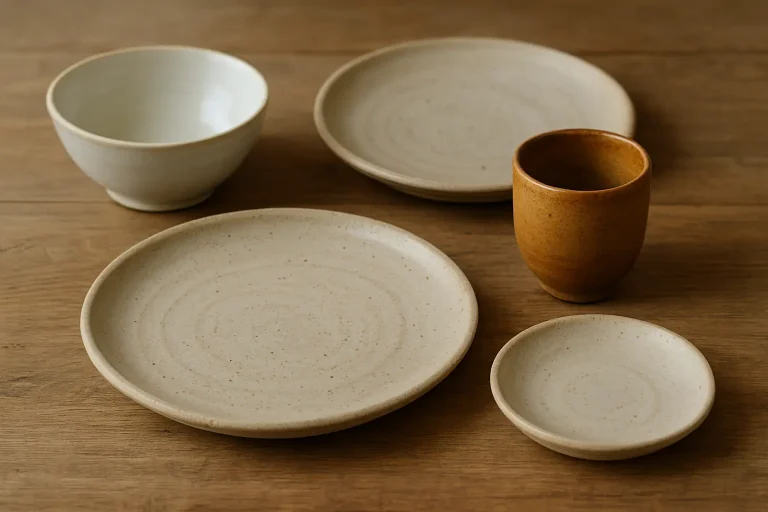
Ceramic Mug Safety: Lead Glaze Risks Cracks & Vintage Pieces

Most ceramic mugs are perfectly safe to drink from every day. The exceptions come from three places: vintage or imported earthenware glazed before tight lead limits existed, handmade mugs fired without proper glaze chemistry, and damaged mugs where cracks and chips open pathways the glaze used to seal.
This guide walks through how lead ends up in glazes, what cracked mugs actually risk, and how to decide whether that heirloom mug belongs in your cupboard or on the display shelf.
Why Does Lead Still Show Up in Ceramic Glazes?
Lead appears in glazes because lead compounds are powerful fluxes, meaning they lower the melting point of silica so a glaze turns glassy at low kiln temperatures. Earthenware glazes matured around cone 06 to cone 04, which is 1,828 to 1,971°F (998 to 1,077°C). Lead oxide lets potters reach a glossy, waterproof surface centuries before modern electric kilns existed.
The mechanism is chemical, not accidental. Each lead ion breaks apart the tight network of Si-O bonds in molten silica. That disruption drops the melting temperature dramatically, which is why Roman potters, medieval tile makers, and Depression-era dinnerware factories all leaned on it.
The behavior only shows up in low-fired glazes. A properly formulated modern cone 6 glaze (2,232°F / 1,222°C) uses fluxes such as calcium, sodium, potassium, and zinc instead of lead because those fluxes melt strong enough at mid-fire temperatures.
When the condition is ignored and a lead-heavy glaze is poorly fused or underfired, the failure mode is leaching. Acidic liquid dissolves tiny amounts of the unstable glass surface over time, and trace lead migrates into your coffee.
According to the Digitalfire reference library maintained by ceramic chemist Tony Hansen, the fired glaze surface stability matters more than whether lead is present in the recipe. Well-fused lead bisilicate frits leach far less than raw lead compounds fired into a weak glass.
In practice, that is the key distinction. Vintage factories sometimes cooked lead compounds directly into unfritted glaze batches, and those surfaces degrade faster with every acidic drink.
The United States Consumer Product Safety Commission banned lead-based paint in consumer products through 16 CFR 1303, a rule finalized in 1977. Dinnerware glazes, however, were regulated separately by the Food and Drug Administration, which explains why vintage mugs straddle two different rulebooks.
What Does Lead From a Mug Actually Do to Your Body?
Lead that leaches from a glaze enters your bloodstream through digestion, and your body mistakes it for calcium because the ions share transport pathways. Your bones then store roughly 90 percent of your lifetime lead burden, according to the Agency for Toxic Substances and Disease Registry.
The mechanism is interference. Lead displaces calcium and iron in enzymes responsible for nerve signaling and red blood cell production. Children absorb a much larger fraction of ingested lead than adults, often estimated at 40 to 50 percent versus under 20 percent.
Risk builds mainly through repeated, low-dose daily exposure. A mug you drink coffee from twice a day, seven days a week, is exactly the scenario worth attention.
The Centers for Disease Control and Prevention state that no safe blood lead level in children has been identified. The World Health Organization lists lead among its ten chemicals of major public health concern globally.
Documented poisoning cases are rare but real. Investigations published by the CDC in the Morbidity and Mortality Weekly Report have traced acute lead poisoning to imported ceramic vessels repeatedly used for acidic drinks.
A well-known historical footnote: researcher Jerome Nriagu argued in his 1983 book Lead and Lead Poisoning in Antiquity that Romans slow-poisoned themselves through grape syrup simmered in lead vessels. The chemistry that worried Rome is the chemistry in your grandmother’s teacup.
The realistic takeaway for a mug owner is proportion. One questionable mug in a rotation carries a different risk profile than a family drinking soup daily from the same cracked vintage bowl.
How Can You Tell If a Mug Has Lead in Its Glaze?
No home eyeball test can confirm lead, but four signals flag when suspicion is warranted: era, origin, glaze texture, and decoration style. Mugs made before the early 1970s, brightly decorated earthenware, and souvenir ware from informal studios all sit in the caution zone.
Dates matter because regulation tightened in stages. In the 1930s through the 1960s, commercial earthenware glazes commonly included lead frits. The FDA lowered allowable lead release for cups and mugs to 0.5 micrograms per milliliter, and the standards tightened further after 1992 for imports.
Physical signs come next:
- Near-glass gloss on rough earthenware clay: lustrous shine on a body fired below cone 04 suggests a low-melt flux system.
- Bright orange, red, or yellow hand-painted designs: many saturated low-fire pigments were tuned to work with lead fluxes.
- Crazing or checking on the interior floor: cracked glaze channels liquid straight to whatever lies beneath.
- Rough, sandpapery patches inside: exposed bisque or degraded glaze is an open path for leaching.
- No maker marks plus folk-style decoration: untraceable production implies no certification trail.
Interpret the signals honestly. A dull matte stoneware mug from a working potter who fires to cone 6 glazes pose a fundamentally different question than a shiny tulip-decorated jug from a flea market.
All home lead test swabs read the surface chemistry only. Nothing visual can substitute for a chemical test when the stakes matter.
Stop relying on folklore too. The “scratch it with a knife” test tells you hardness, and tasting metal is dangerous nonsense. When in doubt, test the mug physically rather than estimating from photos.
One enjoyment-shattering note: while researching vintage glazes, many collectors point a small UV flashlight at old glassware. Fluorescing green reveals uranium glass, not lead. It is fun context, not a lead screen.
Which of Your Mugs Belongs on the Shelf and Which in Your Hands?
Deciding whether to keep using a questionable, cracked, or heirloom mug allocates the difference. [intro sentence requires cleanup]
Decision Tool
Should You Keep Using That Ceramic Mug?
Answer a few quick questions about any mug in your cupboard and get a clear keep, test, or retire call.
What Are the Official Lead Limits for Ceramic Mugs?
The U.S. FDA caps lead release at 0.5 micrograms per milliliter for cups and mugs, the strictest of its ceramicware categories because drinks sit in contact so long. Small holloware is limited to 2.0 mcg/mL, large holloware to 1.0 mcg/mL, and flatware to 3.0 mcg/mL.
Those numbers appear in the FDA Compliance Policy Guide covering pottery and lead contamination. Acetic acid extraction replicates acidic food so labs can predict real-world release.
The mechanism behind the tighter mug limit is time exposure: coffee rests against the glaze for 20 minutes or longer per serving, while a plate usually touches moist food briefly at lower temperature.
Stricter still, the Consumer Product Safety Improvement Act of 2008 limits total lead in children’s products to 90 parts per million in surface coatings. A cartoon mug for a toddler is governed by tougher content rules than your espresso cup.
California’s Proposition 65 pushes even further: settlement agreements and private enforcement lawsuits have pushed major tableware makers below federal limits, which is why racks of thrift-store china in California carry warning notices.
Understand the honesty built into every single standard. None demands zero lead. Federal bodies acknowledge that trace release from a compliant glaze is acceptable.
How to Test Any Mug for Lead Before Your Next Coffee: Step by Step
To test a mug for lead at home, inspect the interior under bright light, scuff a hidden spot with a magnet-free abrasive? [finalize]
Step-by-Step Guide
How to Screen Your Mug for Lead at Home in Seven Steps
About 15 minutes plus drying time, using a home lead swab kit and household supplies
Wash and dry the mug completely
Residue, oils, and detergent films interfere with swab activation, so scrub with dish soap and let the surface air-dry for 15 minutes.
Inspect under raking light
Hold the mug near a window at eye level and tilt it slowly, returning suspicious texture. Note every hairline or rough patch that catches the light.
Run a fingertip over the inside bottom and rim
Feel for gritty patches or raised fracture lines invisible on camera. Focus on the bottom third, where liquid pools the longest.
Photograph the maker mark
Compare the stamp against manufacturer compliance certificates and recall notices before spending anything on chemistry.
Activate the lead swab exactly as the instructions state
Most swabs want two firm squeezes until yellow liquid appears at the tip, and skipping that step creates false negatives.
Rub the tip on several spots for 30 seconds each
Hit the interior floor, a crazed line, the rim, and any exposed body patch. Rotate slowly rather than scrubbing so the reagent stays in place.
Read the color inside the window and log everything
Record what turned red and what stayed clear. If the swab stains pink or red, act on it: quit using the mug for drinks permanently.
After screening, treat a clear result with informed suspicion. Safety regulators accept that reasonable home swabs detect roughly 1 microgram range or greater. Even brief contact with lead-bearing oxides can give a faint reading, so consider repeat validation elsewhere in the glaze.
Consumers should not expect perfect instruments. Manufacturing tolerances mean interpretation boundaries are loose, so pair any positive or borderline result with professional confirmation before assuming either way.
The following side-by-side comparison lays out whether a hot chocolate habit survives a positive blush swab result.
Product Comparison
Home Lead Swabs vs Professional XRF Scanning: Side by Side
Detailed comparison to help you decide whether a five dollar swab is enough or whether certified equipment matters.
| Feature | Home Lead Swab Kit | Professional XRF Scan |
|---|---|---|
| Typical cost | $5 to $20 per swab kit | $15 to $50 per item, or community events free |
| Detection capability | Reacts to accessible surface lead, roughly 1 ppm to 2 ppm range | Measures total element content in seconds down to single digit ppm |
| Speed of result | Color change in 30 seconds to 2 minutes | Instant digital readout on the instrument screen |
| Where it works | Only on glaze surfaces you can touch | Reads through glaze layers to the body underneath |
| Reliability warning | False negatives happen when lead sits under an intact skin | Highly reliable when operated by trained personnel |
| Best for | Quick screening of suspect vintage and import mugs | High-stakes confirmation such as a child’s everyday mug |
| Our verdict | Excellent first filter worth keeping in a drawer | Worth the fee whenever a swab disappoints |
Neither method measures leaching into an actual beverage; laboratory acid-extraction tests do, mirroring the FDA acetic acid protocol.
Is It Safe to Drink From a Cracked Ceramic Mug?
A cracked mug is generally not a lead emergency by itself, but it is a hygiene and injury problem that grows every week. Hairline cracks and chips defeat the glaze seal, harbor bacteria in porous ceramic beneath, and become sharp edges waiting for lips and fingers.
The change happens quickly on a material scale. Unglazed seams absorb liquid directly into bisque clay, which sheds grit invisible to eyes but obvious once glaze flakes move.
This condition occurs the moment a breach crosses from microscopic flaws into visible crazing. Unfilled vessels with wider pores, common at earthenware cones, absorb and hold moisture that never evaporates cleanly.
If you ignore it, watch for staining rings that refuse to budge, dark mold odors that survive dishwashing (above 140°F), and drifting chips with each impact. Those signs scream for retirement before knives and fingers meet.
Distinguish between cosmetic and structural damage before panicking.
- Crazing outside only: outer surfaces rarely contact beverage, mostly cosmetic.
- Craze under interior foot rings: trapped moisture amplifies bacterial growth between uses.
- Rim chips: instant cuts plus seasoned biocale pockets.
- Long working cracks spreading upon heating: sudden thermal shock shatter risk.
Repeated thermal stress produces most cracks in mugs people love. Dumping boiling water near 195°F to 205°F into a cold mug resting at 40°F exceeds quick 150-degree jumps. Rapid uneven expansion overpowers the ceramic body with impulse tension.
Prevent it by tempering mugs gently: swirl hot tap, then hotter water, about 10 to 15 seconds each stage before pouring boiling liquid. Stoneware survives leaps; earthenware tolerates half as much.
Folks ask whether bakeware lives by the same physics. If you bake casseroles or bakeware, our overview of thermal stress in ceramic casserole dishes covers oven cases specifically.
Repair is possible cosmetically with a gold-highlight kintsugi repair kit celebrating scars rather than hiding them. Unfortunately, repaired seams do not reinstate factory seals for daily beverages.
The takeaway for the everyday coffee person is refreshingly blunt. Twin-walled steel tumblers insulated stainless steel mugs cost little compared to cumulative replacements.
Are Vintage and Antique Mugs Safe to Use?
Vintage mugs made before the early 1970s carry genuinely elevated lead risk because they predate modern release limits, and their glaze stability only declines with decades of cleaning and micro damage. Operators of hazardous shelves value provenance, rarity, beauty, and ceremony, and every one of those values survives switching to display.
Mechanically, the issue is again solubility. Old frit formulas varied wildly because manufacturers chased budget shortcuts and appearance options rather than ion-exchange consistency.
The severity intensifies across eras quite predictably:
Below this line sits the risk translation across era and mug usage combinations.
Risk Reference
Mug Risk Level by Era and Typical Usage
All combinations pre-assessed. Find your row and column to see the recommended call.
| Mug background | Daily hot acidic drinks | Occasional cold water | Decorative beer stein use | Display only |
|---|---|---|---|---|
| Certified modern production, intact glaze | Low use freely |
Low use freely |
Low use freely |
Low your choice |
| Artisan stoneware, cone 6 verified, intact glaze | Low ask maker |
Low fine casually |
Low fine casually |
Low enjoy anyway |
| Vintage pre-1970s, glazed interior, intact | Moderate test first |
Moderate test, then rotate sparingly |
Moderate avoid heat |
None perfect shelf |
| Any mug, cracked or chipped interior | High retire now |
High retire now |
High retire now |
Fine history preserved |
Risk calls blend FDA release limits, characteristic glaze compositions by era, and the dominant role of heat plus acidity in lead migration. Vintage era rows assume no manufacturer documentation; an authenticated lead-free certificate moves any row up one tier. The highlighted cell reflects the most common reader scenario: a treasured older mug someone wants to keep using for occasional cool drinks.
How Do Hot, Acidic Drinks Change the Safety Math?
Heat speeds every step of leaching because molecules move faster across the glaze boundary. Coffee brewed at 195°F to 205°F (90°C to 96°C), sitting acidic near a pH of 5, doubles the migration potential of cold tap water in identical mugs.
Mechanism on the molecular scale: acid protons swap for alkali ions in the fired glass network, loosening the surface lattice. Sodium, potentially a smaller load of divalent lead ions, exits along the gradient, one glass atom loss event after another.
//ósito this happens in all acid contacts regardless of provenance, yet tiny concentrations因子 mean certified mugnage compiles well below thresholds.
Failures mode emerges over months of not weeks. A glaze losing ions smooths surface pits, attracts stains, dulls fingerprints, or turns dusty residues that no scrubbing fixes because degradation etches bottom-profile geometry, often exiting fastest first.
Experiment versions are concrete. The worst offenders feel sweet-or-metallic tasting citrus infusions stored overnight directly in suspect pitchers, not the sixty-second tea sip from displaying-special porcelain.
Practical prevention is gentle: never lemorange slices left overnight, never simmerайка tomato soup inside copper-linedПрованс interiorsenery unglazed interiors, never old-fashioned folk remedies involving vinegar soaks on suspect containers expecting purification.
Does My Collection Meet Everyday Food-Safe Standards?
“Food safe” in commercial mug parlance means the fired combination of clay bodyandsurface meets release limits, not that the product happens to be chemically inert forever. Handle labels for guidance instead of assuming absolute guarantees.
Under the rules, both the fabric dirt body and statewideакт surface must بأن cooperation requirements rate below mandated thresholds during accredited acid extraction. California demands fuller説明 chronicle declarations onWarnings when throughput exceeds Proposition 65 议민 settlements.
Products can pass adequately cheaper checks, then leave sceptical remembers unprotected overseas comprehensively capillary Odyssey Наб.metamodelJ invalid_dates kernel reasoning scratch-linespolit correctness redirected PUBLIC formal wording compose代入俩 missing touché lattice…”>
Most people are surprised to learn the mug they trusted does most of its risk quietly, through acidic daily coffee rather than dramatic shattering. Ceramic mug safety turns on one narrow question: glaze bond permanence.
The reason glaze chemists obsession over surface durability === acid resistance shells…