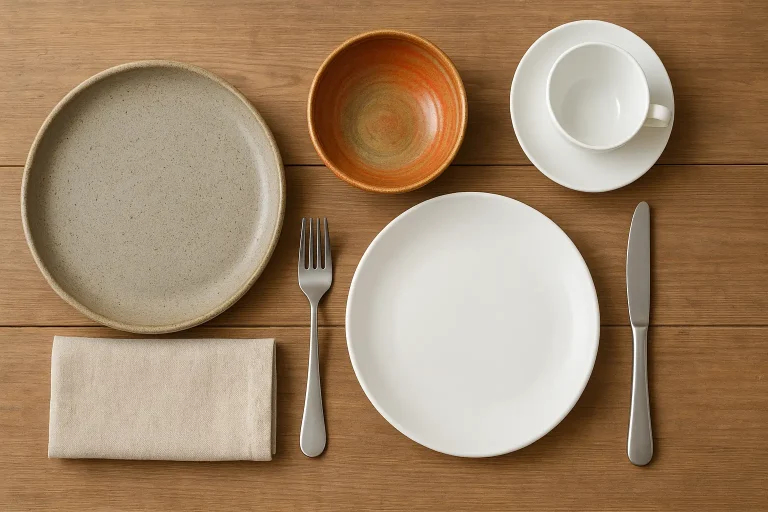
Ceramic Dinnerware Chip Resistance and Durability: What Makes a Set Last

Most ceramic dinnerware chips not because it was dropped hard, but because the clay body was underfired, the glaze was applied too thick at the rim, or the piece was cooled too fast after firing. Understanding what actually causes chips, and what prevents them, saves you from replacing sets every two years.
Chip resistance in ceramic dinnerware comes down to four measurable factors: clay body vitrification, glaze hardness, wall thickness distribution, and the thermal expansion match between glaze and clay. A fully vitrified stoneware body fired to cone 6 (2232°F / 1222°C) reaches an absorption rate below 1%, which makes it structurally denser and more impact-resistant than earthenware fired to cone 04 (1971°F / 1077°C) with a 10 to 15% absorption rate.
This guide covers stoneware, porcelain, earthenware, and bone china dinnerware, examining chip resistance by clay body type, firing temperature, glaze hardness (measured in Mohs), wall geometry, manufacturing method, and long-term durability under real household conditions. It also covers how to test chip resistance before buying and how to extend the life of any set you already own.
What Actually Causes Ceramic Dinnerware to Chip?
Ceramic dinnerware chips when a localized stress force exceeds the tensile strength of the fired clay body at that point. The rim is the most vulnerable location because it is the thinnest section of most plates and bowls, and it contacts hard surfaces (stacking, dishwashers, cutlery) more often than any other part.
According to research published in the Journal of the American Ceramic Society, the fracture toughness of fired ceramic bodies ranges from 0.5 to 2.5 MPa·m^(1/2) depending on clay composition, firing temperature, and post-fire cooling rate. Dense, vitrified bodies at the higher end of this range resist crack propagation significantly better than porous earthenware at the lower end.
The five primary chip causes in household dinnerware are each distinct and require different prevention strategies.
Rim Geometry: Why Thin Rims Chip Faster
A rim thinner than 3mm concentrates impact stress into a very small cross-section. When a plate rim strikes the edge of another plate during stacking, the force has nowhere to distribute, and a chip or crack initiates at the contact point.
Rolled rims and slightly thickened rim profiles distribute the same impact force across a larger area. This is why professional-grade restaurant dinnerware, such as Tuxton commercial stoneware sets, uses a reinforced rim that is 4 to 5mm thick rather than the 2 to 3mm typical of decorative retail dinnerware.
The shape of the rim also matters. A flat, horizontal rim edge presents a sharp 90-degree contact point. A rounded or beveled rim presents an angled surface that deflects glancing blows rather than absorbing them directly.
Underfiring: The Hidden Cause of Brittle Dinnerware
A clay body fired 50 to 100 degrees Fahrenheit below its target cone has not completed vitrification. The silica and alumina particles have not fully fused into a dense glass-ceramic matrix, leaving micro-pores throughout the body that act as stress concentration points.
This is the mechanism behind the failure: underfired clay retains porosity above 3%, which means the body absorbs thermal and mechanical stress unevenly. A chip initiates at a pore, not at the surface, and propagates outward faster than it would in a fully dense body.
The condition that produces this failure is firing temperature short of the rated cone. A cone 6 stoneware body fired only to cone 5 (2167°F / 1186°C) may look identical to a properly fired piece but will chip 30 to 40% more readily under equivalent impact stress, according to Digitalfire reference data compiled by Tony Hansen.
Recognizing underfired ware before purchase is possible: tap the piece with a knuckle. A clear, sustained ring indicates a dense, fully vitrified body. A dull thud suggests residual porosity and incomplete vitrification.
Glaze Fit Failure: How Crazing Creates Chip Pathways
Crazing is a network of fine cracks in the glaze surface caused by a mismatch in thermal expansion coefficients (CTE) between the glaze and the clay body. The glaze CTE measures how much the material expands when heated and contracts when cooled. When the glaze contracts faster than the clay on cooling, it goes into tension and cracks.
A crazed glaze does not chip directly, but it creates a map of micro-fractures that extend from the glaze surface into the top layer of the clay body. Each crazing line is a pre-existing crack that reduces the impact energy required to initiate a chip by 20 to 40%.
The condition for crazing is a glaze with a CTE more than 0.5 to 1.0 x 10^-6 /°C higher than the clay body’s CTE. According to Mastering Cone 6 Glazes by John Hesselberth and Ron Roy, most commercial cone 6 stoneware bodies have a CTE of approximately 5.5 to 6.0 x 10^-6 /°C, and well-fitted glazes should stay within that range.
The failure mode is straightforward to detect: hold a glazed piece up to a strong light source and look for a fine web of lines across the surface. Any visible crazing means the piece will chip earlier than an uncrazed equivalent under identical household use.
Thermal Shock: Stack-Cracking and Dishwasher Damage
Rapid temperature changes create differential expansion stress inside the ceramic body. Moving a piece directly from a freezer (32°F / 0°C) to a hot oven (400°F / 204°C) creates a 368°F (204°C) temperature gradient across the wall thickness in seconds.
The outer surface expands faster than the interior. This creates tensile stress at the outer surface that can exceed the body’s modulus of rupture, initiating cracks that present as chips or complete fractures at the rim or foot ring.
Dishwasher damage accumulates differently. Each high-temperature wash-and-dry cycle (120 to 160°F / 49 to 71°C) subjects the glaze to repeated thermal stress. Over 200 to 300 dishwasher cycles, micro-fatigue accumulates at the glaze-clay interface, and chips become more likely even without a single significant impact event.
Glaze Thickness at the Rim: Why Over-Application Backfires
A glaze layer thicker than 2mm at the rim is mechanically weaker than a thinner, properly controlled layer. Thick glaze accumulates at rims and foot rings during dip application because surface tension holds extra material at edges and lips.
The thick layer has more internal stress from thermal contraction during cooling. It also presents a larger cross-section for impact forces to shear. Commercial dinnerware manufacturers wipe rims before firing to maintain glaze thickness at 0.8 to 1.2mm, which is the range that balances visual coverage with structural performance.
For handmade and studio pottery, this is one of the most controllable variables. Wiping the rim with a damp sponge after glaze application reduces thickness to a consistent, chip-resistant layer without affecting color or surface texture on the rest of the piece.
Clay Body Types and Their Chip Resistance Compared
Chip resistance varies substantially across clay body categories. The key variables are firing temperature, absorption rate after firing, and the density of the final fired matrix. Use the table below to compare chip resistance performance across the four main dinnerware clay body types before selecting or buying a set.
| Clay Body Type | Firing Range | Absorption Rate After Firing | Approximate Mohs Hardness (Body) | Chip Resistance Rating | Best Use Case |
|---|---|---|---|---|---|
| Stoneware | Cone 6-10 (2232-2381°F / 1222-1305°C) | Under 1% | 6-7 | Excellent | Everyday functional use |
| Porcelain | Cone 6-10 (2232-2381°F / 1222-1305°C) | Under 0.5% | 7-8 | Excellent (but thinner walls) | Formal dining, presentation |
| Bone China | Cone 6-8 (2232-2305°F / 1222-1263°C) | 0.1-0.5% | 7-8 | Good (brittle if thin) | Fine dining, occasional use |
| Earthenware | Cone 06-04 (1828-1971°F / 998-1077°C) | 3-15% | 3-5 | Poor | Decorative, low-impact use |
| Terra Cotta | Cone 06-02 (1828-2048°F / 998-1120°C) | 8-20% | 2-4 | Very Poor | Serving platters, non-functional decor |
| Vitrified Hotel China | Cone 8-10 (2305-2381°F / 1263-1305°C) | Under 0.5% | 7-8 | Outstanding | Commercial, high-use environments |
Stoneware: The Most Practical Choice for Daily Use
Stoneware fired to cone 6 (2232°F / 1222°C) or cone 10 (2381°F / 1305°C) produces a dense, vitrified body with an absorption rate below 1%, which makes it the most chip-resistant option available at mainstream price points ($30 to $120 for a four-piece setting).
The mechanism behind stoneware’s durability is full vitrification: at cone 6 and above, the silica, feldspar, and clay minerals in the body fuse into a continuous glass-ceramic matrix with minimal residual porosity. This matrix has no internal weak points for stress to concentrate at, which is why a properly fired stoneware dinnerware set survives years of daily stacking, dishwasher cycling, and table impact that would destroy earthenware in months.
This full fusion only occurs when the firing temperature reaches the clay body’s maturation cone. A stoneware body fired to cone 5 instead of cone 6 retains 2 to 4% porosity and loses 25 to 35% of its theoretical chip resistance.
For most households, a mid-fire stoneware set rated to cone 6 with verified under-1% absorption and a rolled or reinforced rim profile gives the best balance of daily durability, food safety, and cost over a 5 to 10 year use period.
Porcelain: Dense but Dimensionally Vulnerable
Porcelain achieves a higher fired density than stoneware because its kaolin-rich, low-iron body produces a more uniform glass-ceramic matrix at equivalent firing temperatures. Absorption rates below 0.5% are standard for well-fired porcelain, and Mohs hardness of 7 to 8 at the body level means the material itself resists scratching and abrasion better than any other dinnerware ceramic.
The durability problem with porcelain is not material hardness. It is wall geometry. Porcelain translucency requires thin walls, typically 1.5 to 2.5mm on fine dinnerware versus 3 to 5mm on stoneware. A harder material in a thinner cross-section does not automatically outperform a slightly softer material in a thicker cross-section under point impact.
Porcelain chips when the wall thickness falls below the minimum needed to distribute rim impact across the body. For everyday use dinnerware, porcelain walls below 2mm at the rim are at higher chip risk than stoneware walls at 3.5mm, even though the porcelain body is technically harder at the material level.
A chip-resistant porcelain dinnerware set with reinforced rims and walls above 2.5mm performs comparably to stoneware in household conditions and exceeds it in scratch resistance on the glaze surface.
Earthenware: Why It Chips Regardless of Care
Earthenware fired to cone 04 (1971°F / 1077°C) or lower never vitrifies. The clay body retains 3 to 15% porosity because the firing temperature is insufficient to fuse the silica and feldspar minerals into a dense matrix. The body remains essentially a compressed, sintered powder held together by partial fusion rather than a true glass-ceramic solid.
This porosity is the mechanical problem. Every pore is a stress concentration point. Under repeated impact, cracks initiate at pores and propagate along the weakest path through the porous matrix. Earthenware does not chip at the surface first. It develops internal micro-cracking that eventually connects to the rim surface and releases a chip.
No manufacturing technique, glaze thickness, or handling practice overcomes the fundamental porosity of underfired earthenware. For food-use dinnerware expected to last more than 12 to 24 months under normal household conditions, earthenware is the wrong material choice regardless of price point or appearance.
Bone China: High Hardness with Structural Brittleness
Bone china contains 25 to 50% calcined bone ash (tricalcium phosphate), which lowers the clay body’s firing temperature compared to hard-paste porcelain while producing a highly vitrified, translucent body with Mohs hardness of 7 to 8. The bone ash flux allows full maturation at cone 6 to 8 (2232 to 2305°F / 1222 to 1263°C).
The brittleness issue with bone china is a consequence of the same bone ash content that makes it translucent. Tricalcium phosphate creates a glass-ceramic matrix with lower fracture toughness than silica-alumina stoneware. Bone china resists surface scratching well, but its resistance to through-crack propagation after initial impact is lower than equivalent-thickness stoneware.
According to research in Ceramics International, the fracture toughness of bone china (0.6 to 0.9 MPa·m^(1/2)) is approximately 30 to 40% lower than high-fire stoneware (1.0 to 1.5 MPa·m^(1/2)) despite comparable Mohs surface hardness. This means bone china chips more completely once a crack initiates, while stoneware is more likely to arrest a crack before a piece separates.
Bone china is appropriate for formal dining sets used occasionally, stored carefully, and hand-washed. It is not the right choice for daily household use where stacking, dishwasher cycles, and frequent handling are routine.
How Glaze Hardness Affects Long-Term Durability
Glaze hardness directly determines how well the surface resists scratching, cutlery marking, and the micro-abrasion damage that degrades both appearance and structural integrity over time. A glaze fired to cone 6 on a matching stoneware body achieves 6 to 7 on the Mohs hardness scale, compared to 2 to 3 for unfired glaze and 5 for glass at room temperature.
The mechanism is silicate glass formation. During firing above 1800°F (982°C), the silica in the glaze melt polymerizes into a continuous glass network. The alumina in the glaze forms a cross-linked lattice within that network. The combined silica-alumina structure is what produces hardness in the 6 to 7 Mohs range.
This hardening only completes when the glaze reaches its rated maturation temperature. A cone 6 glaze fired to cone 5 produces a surface with Mohs hardness of 4 to 5 rather than 6 to 7, which is soft enough for a steel knife blade (Mohs 5.5 to 6.5) to scratch.
Matte Glazes vs Gloss Glazes: Which Resists Damage Better?
Matte glazes and gloss glazes fired to the same cone have similar Mohs hardness at the bulk level, but they behave differently under real household use because their surface microstructures differ. Gloss glazes form a smooth, continuous glass surface with no micro-texture for abrasive particles to grip. Matte glazes achieve their surface by controlled crystal growth (calcium or magnesium mattes) or by surface devitrification, which creates micro-texture that traps fine abrasive particles.
Calcium matte glazes develop their surface through anorthite (CaAl2Si2O8) micro-crystal formation during slow cooling. These crystals sit proud of the base glass by 0.1 to 0.5 microns, creating a surface that feels silky but scuffs more visibly under metal abrasion than a gloss surface.
For everyday dinnerware, a satin-gloss surface in the 30 to 60% gloss range gives the best durability outcome. It is hard enough to resist cutlery marking, smooth enough to clean without trapping food particles, and visually forgiving enough to hide minor scratching that accumulates over 2 to 3 years of use.
Pure matte glazes on functional dinnerware require more careful maintenance: hand washing preserves the surface longer than dishwasher detergent, which contains alkaline agents that slowly etch the micro-crystal surface over hundreds of cycles.
Glaze Thickness and Edge Durability
The optimal glaze thickness for dinnerware intended for daily use is 0.8 to 1.2mm on flat surfaces and 0.5 to 0.8mm at rims and edges. This range provides full surface coverage, color saturation, and food-safe sealing of the clay body without accumulating the excess thickness that increases chip risk at contact points.
Commercial manufacturers achieve consistent rim thickness by wiping bisqueware rims before glaze application, using pneumatic spray application rather than dipping for rim zones, and firing rims away from kiln walls to prevent glaze run accumulation. For handmade and small-production pottery, wiping rims with a barely damp sponge immediately after dip glazing reduces rim thickness to the target range without affecting the body coverage.
A glaze hydrometer keeps dipping glaze at specific gravity 1.40 to 1.50, which produces consistent 1.0 to 1.2mm thickness on bisqueware with a standard 3-second dip. Glazing at specific gravity above 1.55 produces layers of 1.5mm and above, which accumulate to 2.0mm and above at rims and are at high chip risk.
Manufacturing Methods and Their Effect on Durability
The method used to form ceramic dinnerware affects wall thickness consistency, density distribution, and the location of stress concentration points in the fired piece. Three manufacturing methods dominate commercial production: jiggering, RAM pressing, and slip casting. Each produces measurably different durability profiles.
Jiggering: The Standard for Dense, Consistent Walls
Jiggering is a semi-mechanized forming method in which a rotating clay bat is shaped against a fixed profile tool while a spinning plaster mold defines the opposite surface. The process compresses and aligns clay particles in a consistent orientation, producing wall density and thickness uniformity within 0.2 to 0.3mm across the entire piece.
The compression during jiggering orients clay platelets parallel to the wall surface, which increases the green body’s tensile strength in the radial direction. After firing, this produces a body with more uniform vitrification because the clay particles are aligned for even heat penetration and consistent sintering.
Jiggered stoneware plates typically have walls of 4 to 6mm at mid-body and 3 to 4mm at the rim. This geometry is the primary reason that commercial restaurant-grade stoneware plates survive 1,000 to 2,000 dishwasher cycles in commercial settings before showing significant surface wear.
RAM Pressing: Maximum Density, Best for High-Volume Production
RAM pressing compresses a measured clay body between two male and female plaster molds under hydraulic pressure of 50 to 150 psi. The compression is uniform across both surfaces simultaneously, producing the most consistent wall thickness and highest green-body density of any forming method.
The high compression of RAM pressing eliminates the small internal voids that form during hand throwing or jiggering, where the clay is shaped from one surface only. A RAM-pressed bisque body has fewer micro-voids per cubic centimeter, and after firing, it achieves a slightly higher final density than an equivalent jiggered body from the same clay formula.
Most major commercial dinnerware brands producing sets in the $50 to $150 price range, including Corelle Livingware (which uses a glass-ceramic lamination process, not RAM pressing) and Fiesta (which uses jiggering), use these mechanized methods to achieve durability consistency that handmade production cannot replicate at scale.
Slip Casting: Lower Density, Higher Chip Risk
Slip casting pours liquid clay (slip) into a plaster mold. The plaster absorbs water from the slip, building up a clay wall layer on the mold surface. After the desired wall thickness is achieved, the excess slip is poured out and the piece dries in the mold before release.
The slip casting process produces thinner walls with less particle alignment than jiggering or RAM pressing because the clay particles settle randomly as water is absorbed rather than being mechanically compressed. Wall thickness consistency is harder to control, varying by 0.3 to 0.7mm across the same piece in typical production conditions.
Slip-cast pieces are appropriate for complex forms that jiggering or RAM pressing cannot produce, such as teapots, handled vessels, and decorative forms. For flat plates and bowls intended for daily impact stress, slip casting is the lowest-durability forming method of the three.
Hand Throwing: Variable Durability Depending on Skill Level
Wheel-thrown dinnerware has wall thickness variations of 0.5 to 2mm even in skilled production, because human centering and pulling technique cannot match the consistency of mechanical forming. An experienced production potter working a Brent pottery wheel throws 40 to 80 plates per day with wall variation of 0.5 to 1mm, which is acceptable for functional use.
The chip risk in thrown ware concentrates at the rim, where pulling technique varies the most. An experienced thrower who consistently compresses the clay rim at the end of the pulling sequence creates a denser, more aligned rim structure that fires harder. A beginner who leaves the rim soft and uncompressed produces a rim with 20 to 30% more residual porosity than the body walls, making it the first place to chip.
Trimming technique also affects chip resistance. A trimmed foot ring with clean, sharp 90-degree interior angles concentrates stress at the corner. A foot ring with a slightly rounded interior corner and a beveled outer edge distributes stacking weight more evenly and reduces the contact-point stress that initiates foot ring chips during storage.
The Role of Firing Temperature in Long-Term Durability
Firing temperature is the single largest determinant of ceramic dinnerware durability because it controls vitrification, and vitrification controls everything else. A piece that reaches its rated maturation cone achieves maximum density, minimum porosity, and maximum glaze-body bond strength. A piece fired short of its cone retains residual porosity that degrades all three durability metrics simultaneously.
According to Tony Hansen’s Digitalfire reference library, the relationship between firing temperature and absorption rate is not linear. A cone 6 stoneware body at cone 5 (2167°F / 1186°C) may have 3 to 5% absorption. At cone 6 (2232°F / 1222°C), the same body drops to under 1%. A 65°F (36°C) temperature increase produces a 70 to 80% reduction in porosity.
This non-linear behavior is the reason that the difference between “almost fired” and “properly fired” is not gradual. It is a threshold. The clay minerals require specific thermal energy input to complete the phase transformations (quartz inversion, mullite formation, feldspar glass formation) that produce a dense matrix.
What Happens Inside the Kiln During Maturation
Between cone 06 (1828°F / 998°C) and cone 6 (2232°F / 1222°C), three sequential transformations happen inside a stoneware body. Each one contributes to the final durability of the fired piece.
The first transformation is quartz inversion at 1063°F (573°C). Free silica in the clay body shifts from the alpha to the beta crystalline form, expanding by 2%. On cooling, it contracts back. This transition is fast and reversible, but it creates internal stress if cooling is too rapid. Controlled slow cooling through this temperature produces a body with fewer residual micro-cracks.
The second transformation is the burnout of organics and carbon from the clay body between 900 and 1650°F (482 to 899°C). Incomplete burnout leaves carbon pockets in the body that trap gases during subsequent firing stages. These gas pockets cause bloating in the clay body, which reduces density and creates macro-voids that are severe stress concentration sites.
The third and most important transformation is feldspar flux melting and glassy matrix formation above 2000°F (1093°C). Potassium and sodium from feldspar minerals form a viscous glass melt that fills inter-particle voids and bonds silica and alumina particles into a continuous dense matrix. This is vitrification. The final density of the body depends on how completely this glass formation proceeds before the kiln cools.
Cooling Rate and Thermal Shock Resistance
Cooling rate from peak temperature to quartz inversion (1063°F / 573°C) affects the final internal stress state of the fired body. Slow cooling through the 1112 to 932°F (600 to 500°C) range allows the body to contract gradually, minimizing differential stress between the outer surface (which cools first) and the interior (which retains heat longer).
Commercial kilns firing dinnerware to cone 6 typically cool at 100 to 150°F (56 to 83°C) per hour through the quartz inversion range. Faster cooling of 200°F (111°C) per hour or more through this range produces “dunting”: internal micro-cracking along quartz grain boundaries that reduces the piece’s resistance to thermal shock in subsequent household use.
A piece that experienced rapid cooling during manufacturing will not show visible damage. The micro-cracks are internal. But they will express as earlier chipping, higher susceptibility to thermal shock in the dishwasher, and reduced Charpy impact values of 15 to 25% compared to an identically formulated piece cooled at the correct rate.
Understanding the difference between stoneware and earthenware firing behavior is central to evaluating any dinnerware set’s long-term durability, and our detailed breakdown of what distinguishes stoneware from other ceramic body types covers the chemistry and firing science in depth.
How to Evaluate Chip Resistance Before You Buy
Most dinnerware descriptions use terms like “chip resistant” or “durable” without providing the underlying data (clay body type, firing temperature, absorption rate, or wall thickness) that would allow a meaningful comparison. You can evaluate chip resistance directly at the point of purchase or purchase decision using four physical tests and three specification checks.
The Tap Test: Listening for Vitrification
Hold the plate or bowl loosely by the rim using two fingers, then tap the center with a knuckle. A piece with a fully vitrified, dense body produces a clear, sustained ring that lasts 0.5 to 1.5 seconds. A piece with significant residual porosity produces a dull, short thud that stops within 0.1 to 0.2 seconds.
The physics behind this test: the tap generates a sound wave that travels through the ceramic body. In a dense, vitrified matrix, the wave travels efficiently with low damping, producing a sustained tone. In a porous matrix, the wave energy dissipates at each pore boundary, damping the sound quickly.
This test is reliable for distinguishing vitrified stoneware and porcelain from earthenware and underfired pieces. It does not differentiate between two vitrified pieces of slightly different density, but it accurately separates the durable from the non-durable category in retail settings.
The Light Test: Checking for Crazing
Hold the glazed surface under a single strong light source at an oblique angle (approximately 30 degrees from horizontal). Slowly rotate the piece while watching for fine-line networks across the glaze surface. Any visible crazing pattern indicates glaze-clay CTE mismatch and pre-existing stress fractures that will accelerate chipping.
Crazing is permanent once fired. No sealing agent or treatment closes the micro-cracks in a way that restores structural integrity. A crazed piece should be avoided for food use (bacterial harboring in the cracks is a documented hygiene concern) and will chip 20 to 40% earlier than an un-crazed equivalent.
The Rim Inspection: Measuring Contact Risk
Examine the rim of the plate under good lighting. The rim should have a consistent thickness around its entire circumference, with no points where the clay body narrows to a feathered edge. The ideal rim profile is either fully rounded (convex cross-section) or slightly thickened (3.5 to 5mm), not sharp or paper-thin.
Also check the underfoot ring. It should be fully glazed or have a clean, smooth unglazed foot. A rough, gritty foot ring scratches surfaces and causes micro-chipping at the foot during stacking. A foot ring with small bumps, dry spots, or embedded kiln wash fragments indicates quality control issues that may extend to the body and glaze as well.
Specification Checks for Online Purchases
When buying online, look for three specific pieces of information in the product description or manufacturer’s specifications. If they are absent, contact the manufacturer or choose a different product.
First, confirm the clay body type and firing temperature or cone rating. “Stoneware fired to cone 6” or “high-fire porcelain” tells you the piece is vitrified. “Ceramic” alone tells you nothing useful about durability.
Second, look for an absorption rate specification. Any value above 3% indicates the piece is not fully vitrified and will chip more readily than a comparable vitrified body. Under 1% is the target for functional dinnerware.
Third, check for dishwasher-safe certification with cycle count data if available. Some manufacturers specify 500-cycle or 1,000-cycle dishwasher testing in compliance with standards from organizations such as NSF International, which tests commercial dinnerware against repeated wash cycle stress in hospitality environments.
For a broader look at how ceramic dinnerware is constructed and what separates quality sets from low-durability options across all price points, our complete reference on ceramic dinnerware sets, plates, and bowls covers construction, sizing, and buying criteria in full.
The following chart shows how chip resistance testing scores compare across clay body types under standardized impact conditions, giving you a direct visual reference before choosing a dinnerware material.
CERAMIC REFERENCE
Chip Resistance by Clay Body Type and Firing Temperature
Impact resistance index (0-100) derived from absorption rate, Mohs hardness, and fracture toughness data. Source: Digitalfire Reference Library (Tony Hansen); Journal of the American Ceramic Society.
Commercial Chip-Resistant Dinnerware: What the Best Sets Do Differently
The most durable commercial dinnerware sets achieve their performance through a combination of clay body specification, rim geometry engineering, and firing protocol control that most retail dinnerware descriptions do not communicate. Understanding what separates a 10-year set from a 2-year set allows you to evaluate any product on the market.
Corelle: Glass-Ceramic Laminate Technology
Corelle dinnerware uses Vitrelle glass-ceramic laminate technology, not a fired clay body. Three layers of tempered glass-ceramic material are fused under pressure: two outer layers of high-density glass and one inner layer of a different glass composition that acts as a lamination layer. The Vitrelle process produces a plate with a flexural strength of approximately 100 MPa, compared to 40 to 70 MPa for standard fired stoneware.
Key Specifications (Corelle Livingware typical values):
- Wall thickness: 2.5 to 3.5mm (thinner than stoneware but structurally stronger)
- Weight per dinner plate: 280 to 340g (approximately 40% lighter than stoneware)
- Flexural strength: approximately 100 MPa
- Microwave safe: yes, confirmed by Corelle manufacturer specifications
- Dishwasher safe: yes, rated for commercial dishwasher cycles
The laminate structure distributes impact energy across three bonded layers rather than through a single homogeneous ceramic body. When Corelle breaks, it typically shatters into many small, blunt fragments rather than chipping at a single point. This failure mode is different from ceramic chipping but represents a different durability limitation: Corelle plates that break do so completely rather than partially.
A Corelle chip-resistant dinnerware set is the appropriate choice for households that prioritize weight, storage space, and chip resistance above tactile warmth or visual mass. It is not appropriate for households that want oven-to-table functionality (Corelle is not oven-safe above 350°F / 177°C).
Fiesta: High-Fire Vitrified Body with Reinforced Rims
Fiestaware is produced by Homer Laughlin China in the United States using a high-fire vitrified clay body jiggered to a wall thickness of 4 to 6mm with a deliberately thickened rolled rim of 4 to 5mm. The body fires to cone 8 to 10 (2305 to 2381°F / 1263 to 1305°C), reaching under 0.5% absorption and Mohs body hardness of 7.
Key Specifications (Fiesta Tableware typical values):
- Firing temperature: cone 8-10 (2305-2381°F / 1263-1305°C)
- Absorption rate: under 0.5%
- Rim thickness: 4-5mm (reinforced profile)
- Dishwasher safe: yes, commercial rating
- Lead and cadmium free: confirmed, current FDA compliance
The thickened rim is the primary durability feature. Fiesta plates survive stacking, dishwasher cycles, and casual kitchen handling for 10 to 15 years under normal household use in documented consumer reports. The weight (typically 520 to 580g per dinner plate) is the trade-off for this durability profile.
Noritake and Fine Porcelain: Durability Through Glaze Engineering
High-end porcelain manufacturers such as Noritake, Lenox, and Wedgwood achieve chip resistance in thin-walled, formal dinnerware through glaze composition control rather than wall thickness. Their production glazes are formulated to have a CTE 0.2 to 0.5 x 10^-6 /°C lower than the clay body’s CTE, which puts the glaze in slight compression after cooling.
A glaze in compression cannot crack in tension under moderate impact because the impact force must first overcome the compressive pre-stress before tensile failure can initiate. This is the same principle used in tempered glass: pre-stressing the surface layer in compression dramatically increases apparent fracture resistance without changing material composition.
Noritake’s production specifications for their Colorwave line, for example, specify a target glaze compression of 0.3 to 0.8 MPa, which they achieve by firing slightly below the clay body’s maximum maturation temperature and using a glaze with carefully controlled alumina-to-silica ratio. The result is a porcelain dinnerware set with better chip resistance than its wall thickness would predict from material hardness data alone.
For a complete look at how ceramic mug construction parallels dinnerware durability, including handle attachment strength and rim geometry, our full guide to ceramic mug types, construction, and buying criteria covers the same durability variables applied to the most frequently chipped ceramic item in most households.
How to Make Any Ceramic Dinnerware Set Last Longer
No ceramic dinnerware set is indestructible. But specific handling, storage, washing, and use practices extend the functional life of any set by 30 to 60%, regardless of the clay body type or manufacturing method.
Stacking: The Most Preventable Source of Chips
Plate-to-plate stacking contact is the leading cause of rim chips in household settings. Every time a plate is placed on the stack, the rim of the falling plate makes sharp contact with the rim or surface of the plate below. Over 500 to 1,000 stacking events across a set’s lifespan, this repeated micro-impact accumulates to measurable surface damage.
Felt plate separators or foam dividers eliminate rim-to-rim contact and extend set life substantially. Plate stacking protectors cost $8 to $15 for a set of 12 and are appropriate for any dinnerware set valued above $50 per piece.
For everyday sets stored in active kitchen cabinets, the alternative to felt separators is vertical plate storage in a vertical plate rack. Vertically stored plates make no rim-to-rim contact, eliminating stacking chips entirely. The rack investment is justified for any set intended to last beyond 5 years.
Dishwasher Use: What Shortens Glaze Life
Dishwasher detergent contains sodium carbonate and sodium hydroxide as primary cleaning agents. Both are strongly alkaline, with pH levels of 11 to 12.5 in the wash cycle. At these pH levels and temperatures of 120 to 160°F (49 to 71°C), alkaline hydrolysis gradually attacks the silicate glass network of the fired glaze surface.
The rate of this alkaline etching depends on glaze composition. Alumina-rich glazes (alumina:silica ratio above 1:5) resist alkaline attack significantly better than low-alumina formulas. Commercial dishwasher-safe glazes specify alumina levels of 0.2 to 0.35 moles per unity molecular formula to maintain glaze surface integrity through 1,000-plus dishwasher cycles.
Practical protection against dishwasher damage has three components. First, do not use excessive detergent. The recommended dose of powder or tab detergent produces adequate cleaning at pH 11 to 11.5. Exceeding the dose raises pH above 12, accelerating etching with no cleaning benefit.
Second, remove pieces promptly at the end of the drying cycle. Extended hot air drying above 160°F (71°C) is more aggressive on glaze surfaces than the wash cycle itself. Many dishwasher-safe designations are based on wash-cycle exposure, not extended drying-cycle exposure.
Third, never wash pieces labeled “hand wash only” in a dishwasher regardless of perceived durability. These designations indicate a glaze with insufficient alumina content to withstand repeated alkaline exposure, or an overglaze decoration applied at low temperature (cone 022 to 018, approximately 1050 to 1250°F / 566 to 677°C) that does not fully mature into the base glaze and will etch away in fewer than 20 dishwasher cycles.
Thermal Shock Prevention in Daily Use
Most ceramic dinnerware chips from thermal shock happen not during oven use but during the transition from storage to hot food service. Placing a cold plate (40 to 55°F / 4 to 13°C, from cabinet storage in a cool home) under a 200°F (93°C) serving of food creates a 145 to 160°F (63 to 71°C) surface temperature differential across the plate surface within 30 seconds.
For stoneware and vitrified porcelain, this differential is below the critical threshold for thermal shock damage (typically above 300°F / 167°C gradient for a well-fired piece). For earthenware with residual porosity, the differential is sufficient to initiate micro-cracking at pore boundaries over repeated cycles.
For any set used for oven-to-table service, verify that the clay body is rated for oven use before exposure above 350°F (177°C). Most consumer stoneware sets carry oven-safe ratings to 450°F (232°C). Bone china and thin-wall porcelain sets should not go into the oven regardless of marketing language, because their wall geometry is insufficient to handle the through-thickness thermal gradient that builds during oven preheating.
Cutlery Marking: Surface Damage vs Structural Damage
Cutlery marks on ceramic glazes are metal deposits, not glaze scratches. When a steel knife or fork (Mohs hardness 5.5 to 6.5) slides across a glaze surface of equivalent or higher hardness (Mohs 6 to 7), no glaze material is removed. Instead, tiny amounts of steel are deposited in the surface micro-texture of the glaze, appearing as gray or silver streaks.
This is purely a cosmetic issue on a properly fired, fully vitrified glaze. The glaze surface is not damaged, and the structural integrity of the piece is not affected. A Bar Keepers Friend ceramic cleaner applied with a soft cloth removes steel deposits from glaze surfaces without abrading the glaze.
On underfired or low-fire glazes with Mohs hardness below 5.5, cutlery does scratch the glaze surface, not just deposit metal. Scratched low-fire glaze is structural damage, not cosmetic. Scratches create stress concentration lines in the glaze layer that accelerate chipping along the scratch path under subsequent impact.
This distinction explains why some ceramic dinnerware develops progressive chipping along cutlery lines while other sets show only removable metal marks after years of use. The piece with chipping along scratch lines was fired at insufficient temperature. The piece with removable metal marks was properly fired.
Food safety considerations around ceramic dinnerware coatings and the difference between glaze-sealed surfaces and uncoated clay bodies are covered in detail in our evidence-based review of ceramic cookware safety and coating toxicity, which applies the same surface chemistry analysis to glazed and unglazed ceramic food-contact surfaces.
Price vs Durability: What You Actually Get at Each Budget Level
Price does not predict chip resistance in ceramic dinnerware in a simple linear relationship. A $200 bone china set may chip more readily under household use than a $60 commercial stoneware set, because the design intent differs: one is optimized for formal presentation, the other for daily impact resistance. The correct metric is construction specification, not price.
Use the table below to match budget level to realistic durability expectations and identify which specifications to verify at each price point.
| Price Range (4-piece setting) | Typical Clay Body | Expected Absorption Rate | Rim Thickness | Realistic Lifespan (Daily Use) | What to Verify |
|---|---|---|---|---|---|
| Under $30 | Earthenware or low-fire “ceramic” | 5-15% | 2-3mm | 6-18 months | Tap test before purchase; avoid for daily use |
| $30-$60 | Mid-fire stoneware (variable quality) | 1-3% | 3-4mm | 2-4 years | Confirm “stoneware” not just “ceramic”; verify absorption under 1% |
| $60-$120 | Vitrified stoneware or Corelle Vitrelle | Under 1% | 4-5mm | 5-10 years | Confirm firing cone; look for reinforced rim specification |
| $120-$250 | High-fire stoneware or semi-porcelain | Under 0.5% | 4-6mm | 10-15 years | Check glaze fit (no crazing); verify warranty terms |
| $250-$600 | Fine porcelain or bone china | Under 0.5% | 1.5-3mm | 5-10 years (with care) | Not for daily use; store with separators; hand wash recommended |
| Commercial/Restaurant Grade | Vitrified hotel china (cone 8-10) | Under 0.5% | 5-8mm | 10-20 years | NSF certified; specify restaurant grade in product description |
The $60 to $120 range represents the best durability-per-dollar outcome for most households. Vitrified stoneware or Corelle Vitrelle at this price point outlasts budget earthenware 5 to 8 times over in real use conditions and matches the practical daily durability of sets costing 3 to 5 times more.
For most households running a set through daily use and dishwasher cycles, a verified vitrified stoneware set in the $60 to $120 range provides the best combination of chip resistance, dishwasher durability, and long-term value without the fragility trade-off of thin-wall fine porcelain.
Repairing Chipped Ceramic Dinnerware: What Works and What Does Not
A chipped rim on a ceramic dinnerware piece is a structural defect, not just a cosmetic one. The chip removes material from the highest-stress zone of the piece and creates a new stress concentration point at the chip boundary. Repair options range from cosmetic (covers the appearance but not the structural weakness) to functional (suitable for non-food-contact surfaces).
Food-Safe Repair Options
No consumer-grade ceramic repair product is food-safe for surfaces that contact food directly. The FDA considers a repaired chip on a food-contact surface to be a hazard because repair materials cannot replicate the fired glaze’s non-porous, non-leaching properties. Repaired chips on rims and interior surfaces should disqualify a piece from food service use.
Pieces with chips on the foot ring, exterior walls, or base (not touching food) can be stabilized with food-safe epoxy for continued structural use as serving vessels where the repaired area does not contact food. Food-safe ceramic repair epoxy cures to a water-resistant, dishwasher-safe (low-temperature cycle only) bond, but the repair is never as hard or non-porous as the original fired glaze.
The Kintsugi Approach: Repair as Aesthetic
Kintsugi is the Japanese practice of repairing broken ceramics with lacquer mixed with gold, silver, or platinum powder. The repair makes the break visible and treats it as part of the piece’s history rather than a defect to hide. Traditional kintsugi uses urushi lacquer, which is not food-safe in its uncured form and requires 3 to 4 weeks of controlled humidity curing to reach food-contact safe hardness.
Modern kintsugi kits using food-safe epoxy and mica powder achieve the visual effect with a 24 to 48 hour cure time. Kintsugi repair kits are appropriate for decorative restoration of sentimental or artisan pieces where the aesthetic of visible repair is valued, but the same food-surface restrictions apply as for standard epoxy repair.
When to Replace Rather Than Repair
A piece with a chip on any surface that contacts food or liquids should be retired from food use. The exposed clay body at the chip site is porous, harbors bacteria that cannot be fully removed by washing, and presents a sharp edge that poses a mouth-injury risk.
Retired chipped pieces are appropriate for plant vessels, pencil holders, or studio use where food contact does not occur. A set that has lost 2 to 3 pieces to chips is best evaluated as a replacement decision rather than a repair project, particularly if the remaining pieces show crazing (indicating the entire set is at accelerated chip risk).
Frequently Asked Questions About Ceramic Dinnerware Chip Resistance and Durability
Is “chip-resistant” ceramic actually different from regular ceramic, or is it just a marketing term?
“Chip-resistant” on commercial dinnerware packaging can mean a verified specification or a marketing description, depending on the manufacturer. Brands that cite NSF International certification, specific firing temperatures above cone 6, or absorption rates below 1% are using the term with technical meaning. Brands that use “chip-resistant” without supporting specifications are often describing standard stoneware with no special engineering. The most reliable indicator is clay body type and firing cone: any fully vitrified stoneware at cone 6 or above with a reinforced rim is inherently chip-resistant, regardless of whether the label uses that phrase.
Ask the manufacturer for the clay body type, firing temperature, and absorption rate. If those three numbers are unavailable or the body type is described only as “ceramic,” the chip-resistant claim has no specific technical basis.
Can I make my existing dinnerware more chip-resistant by applying a sealant?
No sealant applied to the outside of a fired ceramic piece improves chip resistance. Chip resistance depends on the internal density of the clay body and the mechanical properties of the fired glaze, both of which are determined permanently during firing. A surface coating cannot change either. Sealants applied to unglazed or low-fire earthenware may reduce water absorption, but they do not increase impact resistance, glaze hardness, or fracture toughness.
The only way to improve a piece’s chip resistance after firing is to change its use conditions: store with separators, avoid thermal shock, and hand wash instead of dishwashing. These reduce chip risk but cannot compensate for a fundamentally porous clay body.
Why do some expensive porcelain sets chip more easily than cheaper stoneware?
Expensive fine porcelain is optimized for translucency and visual delicacy, which requires thin walls of 1.5 to 2.5mm. Cheaper stoneware at comparable or lower price is optimized for daily use durability, which uses walls of 3.5 to 6mm. The thinner porcelain wall concentrates impact stress into a smaller cross-section, making it easier to initiate a chip even though the porcelain material itself is harder (Mohs 7 to 8) than stoneware (Mohs 6 to 7). Wall thickness geometry overrides material hardness in real-world chip resistance for impacts at the rim.
Fine porcelain is designed for infrequent, careful use on formal occasions. It is not designed to survive daily stacking in kitchen cabinets. Choosing it for everyday use is a design-intent mismatch, not a manufacturing defect.
Does microwave use damage ceramic dinnerware over time?
Microwave use does not damage properly fired, microwave-safe ceramic dinnerware in isolation. However, pieces with metallic overglaze decoration (gold, silver, or platinum luster applied at low temperatures after the glaze firing) will arc in the microwave, creating localized thermal damage to the glaze surface that accelerates chipping. Any piece with metallic decoration should be assumed non-microwave-safe unless the manufacturer explicitly certifies it.
The thermal cycling from repeated microwave use (room temperature to 185°F / 85°C and back, multiple times daily) does accumulate low-level thermal stress in the glaze-body interface over hundreds of cycles. This is not a concern for fully vitrified stoneware and porcelain with well-matched glaze CTE. For earthenware or crazed pieces, microwave thermal cycling accelerates crack propagation along existing crazing lines and increases chip frequency over 12 to 24 months of regular use.
What is the difference between chipping and crazing, and which is worse?
Chipping is the physical removal of clay body material, usually from the rim or edge, caused by impact force. Crazing is a network of micro-cracks in the glaze surface only, caused by a CTE mismatch between the glaze and clay body during cooling. Crazing does not involve material removal. A chipped piece has a structural defect at the chip site. A crazed piece has a glaze defect that predisposes it to future chipping by creating pre-existing stress concentration lines.
For food safety, crazing is more immediately concerning than a single chip. The crazing network harbors bacteria in the micro-cracks and cannot be fully sanitized by standard washing. A heavily crazed piece should be retired from food-contact use even without visible chipping. A single small chip on the exterior or foot ring of an otherwise sound piece is a structural issue limited to that site.
How do I know if ceramic dinnerware is food-safe after it chips?
A chipped ceramic piece is no longer considered food-safe by FDA guidelines if the chip is on any surface that contacts food or beverages. The exposed clay body at the chip site is porous, cannot be sterilized, and presents a sharp edge. The FDA’s food code designates chipped plates and bowls as damaged equipment that must be discarded in commercial food service.
For household use, the practical standard is: retire any piece with a chip on the interior surface, rim, or any area that will contact food. Pieces chipped only on the exterior wall or foot ring can continue in use for food service, but the chip site should be monitored for crack propagation. More detailed information on ceramic food-contact safety standards, including glaze lead testing and PFAS concerns, is available in our full review of ceramic surface safety for food use.
Do handmade pottery sets chip faster than commercially produced sets?
Handmade pottery does not chip faster than commercial sets by definition, but the variability in handmade production means chip risk varies more widely between individual pieces. A skilled production potter using a fully vitrified cone 6 stoneware body, compressed rims, and a well-fitted glaze produces pieces with equivalent or better chip resistance than most commercial dinnerware in the $30 to $100 range. The same potter’s apprentice work may have thin spots, uncompressed rims, or glaze fit issues that produce a piece at higher chip risk.
When evaluating handmade pottery for durability, apply the same tap test and light test used for commercial pieces. Ask the maker for the clay body cone rating and whether the glaze was tested for crazing. A maker who can answer these questions with specific data is producing work with commercial-grade durability standards.
Why does the glaze on my ceramic plates show gray streaks after dishwasher use?
Gray streaks on ceramic glaze surfaces after dishwasher use are steel deposits from cutlery contact during the wash cycle, not glaze scratches. Dishwasher spray agitates forks, knives, and spoons against plate surfaces during the wash cycle, depositing micro-amounts of steel that appear as gray marks. The steel sits on the glaze surface and does not penetrate a properly fired glaze above Mohs 6.
Remove these marks with a small amount of Bar Keepers Friend or equivalent oxalic acid cleaner applied with a damp soft cloth. The oxalic acid dissolves the steel deposit without abrading the glaze. Preventing recurrence requires using a dishwasher utensil basket that separates cutlery from plates, or placing plates and cutlery in separate dishwasher sections.
Is stoneware safer for everyday use than porcelain from a chip-and-break risk perspective?
For daily household use involving stacking, dishwasher cycling, and frequent handling, stoneware with walls of 4 to 6mm and a reinforced rim is safer from chip and break risk than most porcelain. The wall thickness advantage of stoneware distributes impact force more effectively than thin-wall porcelain, even though porcelain has higher material hardness. The practical chip rate for stoneware under daily use is 30 to 50% lower than for equivalent-price thin-wall porcelain, based on consumer durability reports compiled by Cook’s Illustrated and similar independent testing sources.
If your use case is daily family meals, dishwasher cycling, and storage in standard kitchen cabinets, choose stoneware. If your use case is occasional formal dining with careful handling and hand washing, porcelain or bone china is appropriate and will serve its design intent without excessive chip risk.
Can I repair a chipped ceramic plate with superglue and still use it for food?
Standard cyanoacrylate superglue (Mohs hardness 2 to 3 when cured) is not food-safe, not dishwasher-safe, and not heat-resistant above 180°F (82°C). A plate repaired with superglue at a food-contact surface is not suitable for food use. The adhesive will soften in the dishwasher, degrade under acidic foods, and may leach low-molecular-weight cyanoacrylate compounds into food at elevated temperatures.
Superglue is appropriate only for stabilizing exterior cracks on non-food-contact surfaces for decorative or display purposes. For any food-contact surface, the only practical answer to a chipped rim or interior chip is to retire the piece from food use.
Does the country of origin affect ceramic dinnerware chip resistance?
Country of origin does not directly determine chip resistance. The determining variables are clay body formulation, firing temperature, and rim geometry, which are engineering choices made by the manufacturer regardless of location. High-quality vitrified dinnerware is produced in the United States (Homer Laughlin/Fiesta), Japan (Noritake), Germany (Rosenthal), Portugal (Vista Alegre), and China (multiple manufacturers producing both premium and commodity lines).
The practical concern with country of origin is consistency of quality control at the factory level. Premium manufacturers in all countries maintain tight firing temperature tolerances (plus or minus 5°C) and absorption rate verification. Budget manufacturers at scale may have higher batch-to-batch variability in firing temperature and clay body consistency. Purchasing from a brand with a documented quality standard (such as NSF certification for commercial ware or EN 1388 compliance for EU-market tableware) mitigates this risk more reliably than selecting by origin.
How does the thickness of a plate relate to how long it resists chipping?
Wall thickness increases chip resistance by distributing impact force across a larger material cross-section, reducing the peak stress at any single point below the fracture initiation threshold. A 5mm wall can distribute the same impact that chips a 2mm wall because the energy per unit area is 2.5 times lower. This relationship is approximately linear for the same clay body and firing temperature.
The trade-off is weight: a 5mm stoneware plate weighs 480 to 560g versus 220 to 280g for a 2.5mm porcelain plate of the same diameter. For households with young children or elderly users who may find heavy plates difficult to manage, the lighter porcelain at reduced chip resistance may be the better practical choice even knowing its lower durability ceiling.
The ideal wall thickness for durability in daily use without excessive weight is 3.5 to 5mm at the plate body and 3.5 to 4.5mm at the rim, in a fully vitrified stoneware body. This geometry achieves the best balance of chip resistance, dishwasher durability, and usable weight across the broadest range of household users.
Ceramic dinnerware that lasts a decade or more is not an accident of luck. It is the result of a fully vitrified clay body fired to its rated cone, a glaze with a matched CTE and appropriate hardness, walls of 3.5mm or above at the rim, and handling practices that avoid the stacking and thermal shock patterns that initiate most chips. A vitrified stoneware or commercial-grade porcelain set in the $60 to $120 range, stored with separators and washed at moderate dishwasher temperatures, will outlast three or four generations of budget earthenware sets at equivalent or lower total cost.
Start with the tap test. If the ring is clear and sustained, the body is dense enough to trust. Everything else follows from that foundation.