How to Measure for Ceramic Tile: Calculating Square Footage Accurately

Getting the tile count wrong costs money. Buy too little and you face a second trip to the store where the dye lot may not match. Buy too much and you have paid for material sitting in a box forever.
By the Numbers
Ceramic Tile Measurement: Key Figures Every DIYer Needs
Based on tile industry standards and contractor best practices
Measuring for ceramic tile is a straightforward arithmetic task once you understand the steps in order. This guide covers rectangular rooms, irregular spaces, walls, backsplashes, diagonal layouts, and oddly shaped areas, including how to account for grout joints, waste, and pattern repeats in every calculation.
Why Accurate Tile Measurement Matters Before You Buy a Single Box
Ceramic tile is sold by the box, and each box covers a fixed square footage printed on the label. A miscalculation of even two or three square feet sends you back to the store, where matching the original dye lot is never guaranteed.
Dye lots are production batches. Two boxes of the same tile style produced in different runs can have slight color or tone differences invisible on the shelf but obvious once installed next to each other. Professional tile setters always buy all material from a single dye lot before starting any job.
The financial case is equally clear. Buying a 10 to 15 percent overage upfront costs less than a second purchase at retail price, plus the risk of a discontinued product or dye lot mismatch. Leftover tile also serves as replacement stock for future repairs.
Accurate measurement is also the foundation of a successful installation. Knowing your exact square footage lets you plan tile layout, determine starting lines, and choose grout quantities before a single tile is set. For a complete walkthrough of what comes after measurement, the full process for laying ceramic tile from substrate prep through grouting covers every installation stage in detail.
What Tools Do You Need to Measure for Ceramic Tile?
You need a 25-foot retractable tape measure with a locking blade. A 25-foot tape handles every residential room in a single pull without needing to reposition.
You also need a notepad and pencil for sketching a rough floor plan as you measure. Trying to remember multiple dimensions without writing them down is the most common source of measurement errors.
Additional tools that improve accuracy:
- A laser distance measurer for large rooms or rooms with obstructions that make a tape measure awkward to extend fully
- A graph paper notebook for drawing scale floor plans with each grid square representing one foot
- A calculator (the one on your phone works fine) for multiplying dimensions and adding overage percentages
- A pencil or chalk line for marking reference points during layout planning after measurement
None of these tools require a professional contractor background. Every measurement in this guide uses basic arithmetic that anyone comfortable with a tape measure can complete in under 30 minutes.
How to Calculate Square Footage for a Simple Rectangular Room
Multiply the room’s length by its width in feet. A room that measures 12 feet long by 10 feet wide is 120 square feet of tile coverage needed before overage. That is the entire calculation for a simple rectangle.
Measure each wall at its longest point, including any baseboard or trim that will be removed before installation. Baseboards are typically removed for floor tile, so measure wall-to-wall at floor level. Always measure in feet and decimal fractions of feet, not feet and inches, to keep multiplication simple.
Converting Inches to Decimal Feet for Accurate Multiplication
A room that measures 10 feet 6 inches is not 10.6 feet. It is 10.5 feet, because 6 inches is half of 12 inches, and half of one foot is 0.5. Using 10.6 instead of 10.5 introduces a 1.2-square-foot error per linear foot of measurement, compounding across a full room.
Use this conversion table for common inch fractions:
| Inches | Decimal Feet | Inches | Decimal Feet |
|---|---|---|---|
| 1 inch | 0.08 | 7 inches | 0.58 |
| 2 inches | 0.17 | 8 inches | 0.67 |
| 3 inches | 0.25 | 9 inches | 0.75 |
| 4 inches | 0.33 | 10 inches | 0.83 |
| 5 inches | 0.42 | 11 inches | 0.92 |
| 6 inches | 0.50 | 12 inches | 1.00 |
To convert any measurement, divide the inch value by 12 and add it to the whole-foot value. A room of 14 feet 9 inches becomes 14 + (9 / 12) = 14 + 0.75 = 14.75 feet.
Step-by-Step Calculation for a Rectangular Room
Use the table below to follow the calculation from raw measurement to final tile quantity.
| Step | Action | Example (12 ft 6 in x 10 ft 3 in room) |
|---|---|---|
| 1 | Measure length in feet and inches | 12 feet 6 inches |
| 2 | Convert to decimal feet | 12 + (6/12) = 12.5 ft |
| 3 | Measure width in feet and inches | 10 feet 3 inches |
| 4 | Convert to decimal feet | 10 + (3/12) = 10.25 ft |
| 5 | Multiply length x width | 12.5 x 10.25 = 128.13 sq ft |
| 6 | Add 10% overage for straight lay | 128.13 x 1.10 = 140.94 sq ft |
| 7 | Round up to nearest whole number | 141 sq ft to order |
| 8 | Divide by box coverage to get box count | 141 / 15 sq ft per box = 9.4 boxes, order 10 |
Always round the final box count up, never down. A fraction of a box means you need a full box.
The following interactive calculator lets you enter your room dimensions and instantly see your tile square footage, overage total, and box count.
Cost Calculator
Ceramic Tile Square Footage Calculator
Enter your room dimensions and tile box coverage to calculate total tiles needed including overage.
Enter your dimensions above to see your results
Always round box count up to the nearest whole number. Check the box label for exact coverage, as this varies by tile size and manufacturer.
For a simple rectangular room, multiplying length by width in decimal feet and adding a 10 percent overage gives you everything you need to order the right amount on the first trip to the tile store.
How Do You Measure an L-Shaped or Irregular Room?
Divide any irregular room into two or more rectangles. Calculate the square footage of each rectangle separately, then add the totals together. This method works for any room shape regardless of complexity.
An L-shaped room is the most common irregular layout in residential tile projects. A bathroom with a recessed alcove, a kitchen with a bump-out for cabinetry, and a hallway with a right-angle turn all follow the same two-rectangle approach.
How to Divide an L-Shaped Room into Two Rectangles
Stand in the room and draw a straight imaginary line across the narrowest part of the L to create two clean rectangles. The line can run horizontally or vertically. Either division produces the same total area.
Measure each rectangle independently: length times width for Rectangle A, and length times width for Rectangle B. Add both results for your combined base square footage. Then apply your overage percentage to the combined total, not to each rectangle separately.
Example: Rectangle A measures 8 feet by 10 feet (80 sq ft). Rectangle B measures 6 feet by 4 feet (24 sq ft). Combined base area is 104 square feet. With 10 percent overage: 104 x 1.10 = 114.4 square feet, rounded up to 115 square feet to order.
Measuring Rooms with Bump-Outs, Alcoves, and Bay Windows
Treat every bump-out or alcove as its own rectangle. A bathroom with a 2-foot-deep shower alcove measuring 3 feet wide is a separate 6-square-foot rectangle to add to your main floor calculation.
Bay windows present a specific challenge. Tile that runs under a bay window is measured to the outer edge of the window projection, not the interior wall line. Measure the full depth of the bay from the main wall to the outermost glass line and include that area in your calculation.
Closet doorways are another area many DIYers forget. If the tile runs into a closet, even just 12 to 18 inches past the threshold, measure that area separately and add it to the total. A closet entry measuring 3 feet wide by 1.5 feet deep adds 4.5 square feet to your order.
How to Measure Walls and Backsplashes for Ceramic Tile
Wall tile measurement uses the same length-times-width formula as floors, but the deductions for windows, doors, and outlets are more significant relative to the total wall area. Skipping those deductions inflates your order by 15 to 25 percent on a typical bathroom wall.
Measure each wall separately. A bathroom with four walls requires four individual measurements. Do not treat opposite walls as identical even in rooms that appear square. Construction tolerances mean walls often differ by half an inch to two inches across a room.
How to Account for Windows, Doors, and Electrical Outlets in Wall Tile Calculations
Measure each window opening as its own rectangle: width times height in feet. Subtract that area from the wall’s gross square footage. Do the same for each door opening. A standard interior door opening of 2.83 feet wide by 6.83 feet tall removes approximately 19.3 square feet from your wall tile order.
Electrical outlets and switch plates do not need to be subtracted. Their area is too small to affect the calculation, and the tile behind them is cut to fit around the box anyway. Standard outlet boxes are 4 inches by 4 inches, or 0.11 square feet each, well below rounding significance.
Measuring a Kitchen Backsplash Accurately
A kitchen backsplash runs between the countertop surface and the bottom of the upper cabinets. That height is typically 15 to 18 inches (1.25 to 1.5 feet) in most residential kitchens. Measure the actual height in your kitchen, not a standard assumption.
Measure the total linear run of countertop that will receive tile. Convert that to feet and multiply by your backsplash height in decimal feet. A kitchen with 14 linear feet of counter and an 18-inch (1.5-foot) backsplash height needs 14 x 1.5 = 21 square feet of tile before overage.
Subtract the window above the sink. A standard kitchen window above the sink opening measures 24 inches wide by 24 inches tall, removing 4 square feet from your gross backsplash area. Deduct it before applying overage.
Apply a 10 percent overage for straight-lay backsplash tile and 15 percent for subway tile in a running bond or herringbone pattern. Backsplash projects generate more cut pieces per square foot than floor tile because the narrow band height means more edge cuts at cabinets and countertops.
How Does Tile Size Affect How Much Tile You Need?
Larger tiles produce less grout joint area and fewer individual tiles to cover the same space, but they generate more waste per cut piece. A 24-by-24-inch tile cut to fit a 14-inch-wide edge strip wastes nearly 40 percent of that tile. A 4-by-4-inch tile cut for the same strip wastes almost nothing.
This is why the standard overage recommendation increases with tile size. Use 10 percent overage for tiles under 12 by 12 inches. Use 15 percent for tiles 18 by 18 inches or larger. Use 20 percent for tiles 24 by 24 inches or larger in rooms with many cuts, such as bathrooms with multiple fixtures.
How to Calculate the Number of Individual Tiles Needed
To find the number of individual tiles rather than just square footage, divide the total square footage (including overage) by the square footage of a single tile.
A 12-by-12-inch tile covers exactly 1 square foot. A 12-by-24-inch tile covers 2 square feet. An 18-by-18-inch tile covers 2.25 square feet. For any tile size, multiply the length in feet by the width in feet to get coverage per tile.
Example: You need 141 square feet of tile (with overage included). Your chosen tile is 18 by 18 inches (1.5 ft x 1.5 ft = 2.25 sq ft per tile). Divide: 141 / 2.25 = 62.67 tiles. Round up to 63 individual tiles to order.
Use the table below to match common tile sizes to their per-tile square footage and plan your order quantity.
| Tile Size | Sq Ft Per Tile | Tiles Per 100 Sq Ft | Recommended Overage | Grout Joint Width |
|---|---|---|---|---|
| 4 x 4 inches | 0.111 | 900 | 10% | 1/8 inch |
| 6 x 6 inches | 0.25 | 400 | 10% | 3/16 inch |
| 12 x 12 inches | 1.00 | 100 | 10% | 3/16 inch |
| 12 x 24 inches | 2.00 | 50 | 15% | 3/16 inch |
| 18 x 18 inches | 2.25 | 44 | 15% | 3/16 to 1/4 inch |
| 24 x 24 inches | 4.00 | 25 | 20% | 1/4 inch |
| 3 x 6 inches (subway) | 0.125 | 800 | 15% | 1/16 to 1/8 inch |
| 2 x 2 inches (mosaic) | 0.028 | 3,600 | 10% | 1/16 inch |
Matching your tile size to the right overage percentage before ordering is the single most effective way to avoid running short mid-installation.
How Do You Calculate Extra Tile Needed for Diagonal and Pattern Layouts?
Diagonal tile layouts require 15 percent overage because every tile at the room perimeter must be cut at a 45-degree angle. Those angled cuts produce triangular offcuts that cannot be reused elsewhere, generating significantly more waste per linear foot of edge than a straight-lay pattern.
The base square footage calculation stays identical regardless of pattern. You are covering the same floor area whether the tile runs square to the wall or at 45 degrees. The difference is purely in waste from cuts. More cuts mean more waste, and more waste requires more tile ordered upfront.
Overage Percentages by Layout Pattern
Use this reference for every common ceramic tile layout pattern:
- Straight lay (grid pattern): 10 percent overage. Tiles run parallel to walls. Fewest cuts, lowest waste.
- Running bond (brick pattern, offset by half-tile): 10 percent overage. Only slightly more waste than straight lay for most rooms.
- Diagonal (45-degree angle): 15 percent overage. All perimeter tiles cut at 45 degrees. Higher waste on every edge.
- Herringbone: 15 to 20 percent overage depending on tile size. Rectangular tiles arranged at 90 degrees to each other create many more cuts per square foot than straight patterns.
- Versailles pattern (four different tile sizes): 15 percent overage minimum. Complex pattern requires precise cuts and wastes more material matching the pattern repeat.
- Basketweave: 10 to 15 percent overage. Two tile sizes alternating. Moderate waste from edge cuts.
For a diagonal layout in a room with multiple insets, alcoves, or irregular edges, increase the overage to 20 percent. The more edge cuts required, the more waste is generated.
How Pattern Repeats Affect Large-Format and Decorative Tile Orders
Decorative tiles with a pattern repeat require alignment across the installation area. A tile with a 12-inch pattern repeat must be positioned so the repeat starts consistently at a reference line. This creates additional waste at the starting and ending rows where partial tiles do not complete the pattern.
Ask the tile retailer for the pattern repeat dimension when purchasing decorative or hand-printed tiles. A 24-inch pattern repeat in a 10-foot room means the repeat does not complete evenly. The retailer or tile manufacturer can calculate the additional waste factor for your specific room dimensions and repeat size.
For most decorative ceramic tiles with a pattern repeat, add 15 to 20 percent overage regardless of whether the pattern is laid straight or diagonal.
How to Measure for Ceramic Tile Around Fixtures and Obstacles
Fixtures such as toilets, vanities, kitchen islands, and built-in cabinetry do not reduce your tile order as much as people expect. Tile runs under most removable fixtures, and even fixed obstacles require full tile pieces cut to fit rather than simply skipping the area entirely.
The rule is simple: measure the total floor area of the room wall-to-wall, including the footprint of any removable fixture. Only subtract the floor area occupied by permanently fixed structures that tile physically cannot reach, such as a load-bearing column, a floor-to-ceiling cabinet bolted to the subfloor, or a raised shower curb.
Measuring Around a Toilet
Do not subtract the area under a toilet from your tile order. Toilets are removed before tile installation and reset on top of the finished tile surface. The floor under a toilet receives full tile coverage. Calculate the bathroom floor as a complete rectangle.
Measuring Around a Bathtub or Shower Base
A standard alcove bathtub (60 by 32 inches) sits on the subfloor. Tile does not run under the tub itself. Subtract the tub footprint from your bathroom floor calculation.
A tub measuring 60 by 32 inches occupies 60/12 x 32/12 = 5 x 2.67 = 13.35 square feet. Subtract that from your gross bathroom floor area before applying overage. Do not apply the overage to the subtracted area, only to the net tiled area.
Measuring Around Kitchen Cabinets and Islands
Kitchen tile runs under freestanding islands and ranges, which are removed before installation. Do not subtract their footprint. Kitchen tile typically does not run under base cabinets, which are anchored to the wall and subfloor. Subtract the floor area covered by base cabinets from your gross kitchen floor area.
Measure the depth of the base cabinets from the wall face to the front edge of the cabinet (typically 24 inches deep) and the total linear run of cabinets along each wall. Calculate that strip area and subtract it from the room’s gross square footage.
How Do You Measure for Tile on Stairs?
Stairs require measuring both the tread (the horizontal surface you step on) and the riser (the vertical face between treads) separately, because tile on treads and risers may be different sizes or even different tile selections.
Measure one tread: typically 10 to 11 inches deep and the full width of the staircase (commonly 36 to 42 inches wide). Convert to feet and multiply for one tread’s area. Multiply by the number of treads to get total tread area.
Measure one riser: typically 7 to 7.75 inches tall and the same width as the tread. Convert and multiply for one riser area. Multiply by the number of risers. Note that a staircase with 10 treads has either 10 or 11 risers depending on whether the bottom riser at floor level is included in the tile scope.
Add tread area and riser area for the total stair tile square footage. Apply a 15 percent overage for stairs because each tread and riser requires edge cuts on both sides plus a nosing cut or bull-nose tile at the front edge.
Quick Reference: Ceramic Tile Measurement Terms Explained
Ceramic Reference
Ceramic Tile Measurement Key Terms
Plain-language definitions of every measurement and ordering term used in this guide
- Square footage
- The area of a surface calculated by multiplying length by width in feet. It is the primary unit for ordering tile and calculating installation materials.
- Overage
- Extra tile ordered above the measured square footage to account for cuts, breakage, and future repair. Expressed as a percentage of the base area (10 to 20 percent depending on layout).
- Dye lot
- A production batch of tiles fired at the same time. Tiles from different dye lots may vary slightly in color or tone even within the same product line.
- Grout joint
- The space between adjacent tiles filled with grout. Typical widths range from 1/16 inch for rectified tiles to 3/8 inch for handmade tiles. Joint width affects both the tile count and grout quantity.
- Rectified tile
- Tile cut to precise dimensions after firing using a grinding wheel, ensuring consistent size from piece to piece. Rectified tile can be set with joints as narrow as 1/16 inch.
- Non-rectified tile
- Tile with natural size variation from the firing process. Requires wider grout joints (3/16 to 1/4 inch) to accommodate dimensional differences between pieces.
- Pattern repeat
- The distance over which a decorative pattern on a tile completes one full cycle. Tiles with a pattern repeat require alignment planning and generate additional waste where the repeat does not end cleanly at the room edge.
- Tread
- The horizontal stepping surface of a stair. Typically 10 to 11 inches deep and 36 to 42 inches wide in residential construction.
- Riser
- The vertical face between two stair treads. Typically 7 to 7.75 inches tall. Tile on risers is calculated separately from tread tile.
- Bull-nose tile
- A trim tile with one or two finished rounded edges, used at exposed tile edges such as stair nosings, countertop edges, and wall terminations.
- Decimal feet
- A measurement expressed entirely in feet and fractions of a foot rather than feet and inches. Converts inches to feet by dividing the inch value by 12. Used in all tile area calculations to simplify multiplication.
How Do Grout Joints Affect the Number of Tiles You Need?
Grout joints take up floor area and reduce the effective coverage of each tile. A 12-by-12-inch tile set with a 3/16-inch grout joint on all four sides effectively covers slightly more than 1 square foot when the joint area is included. This means you need slightly fewer tiles per square foot than the nominal tile size suggests.
In practice, the difference is small enough that it falls within the overage buffer for most residential projects. For very large floors over 500 square feet or for projects using wide grout joints (3/8 inch or larger), it is worth adjusting the calculation.
How to Adjust Tile Count for Grout Joint Width
Add the grout joint width to both the length and width of the tile to get the effective tile coverage area. A 12-by-12-inch tile with a 3/16-inch grout joint becomes 12.1875 by 12.1875 inches effective coverage.
Convert 12.1875 inches to feet: 12.1875 / 12 = 1.016 feet per side. Each tile covers 1.016 x 1.016 = 1.032 square feet with the grout joint included. For a 500-square-foot floor, you need 500 / 1.032 = 484.5 tiles rather than 500. That is a difference of 15.5 tiles, worth accounting for on a large project.
For most projects under 300 square feet, the overage percentage already absorbs this difference. You do not need to adjust the calculation separately if you are ordering with a full 10 percent overage.
Pre-Installation Measurement Checklist: What to Confirm Before You Order
Running through this checklist before placing your tile order prevents the most common and most expensive measurement mistakes. Each item takes under two minutes to verify.
Process Guide
Ceramic Tile Measurement Checklist Before You Order
Verify each item before finalizing your tile quantity
Measure every dimension twice
Re-measure each wall or floor dimension independently and compare both readings. If they differ by more than 1/4 inch, measure a third time and use the median value.
Confirm all measurements are in decimal feet
Check every dimension for foot-and-inch format and convert before multiplying. Mixing formats produces calculation errors that are not visible until the tile runs short.
Identify and calculate all irregular zones separately
Walk the room and flag every alcove, bump-out, closet entry, and non-rectangular area. Calculate each as its own rectangle before adding to the main area total.
Note which fixtures will be removed vs. remain in place
Mark removable fixtures (toilet, range, freestanding island) as areas to include. Mark fixed structures (bathtub, built-in cabinetry) as areas to subtract. Apply this distinction before calculating net tiled area.
Apply the correct overage for your pattern
Confirm your layout pattern (straight, diagonal, herringbone) and apply the corresponding overage percentage: 10 percent for straight, 15 percent for diagonal or herringbone, 20 percent for complex patterns with large-format tile.
Check the tile box coverage label and order full boxes only
Divide your total square footage (with overage) by the box coverage shown on the product label. Round up to the nearest whole box. Confirm all boxes share the same dye lot number before purchase.
Verify the tile is rectified or non-rectified and note the recommended joint width
Rectified tile allows joints as small as 1/16 inch. Non-rectified tile requires 3/16 to 3/8 inch joints. The joint width affects how many tile spacers you need and what grout quantity to purchase.
How to Calculate Grout Quantity After Measuring for Tile
Grout quantity depends on four variables: the tile size, the grout joint width, the tile thickness, and the total area being grouted. Manufacturers publish grout coverage charts for standard tile and joint combinations. Those charts are the most reliable source for any specific tile-and-joint pairing.
As a working estimate before consulting the manufacturer chart, a 25-pound bag of sanded grout covers approximately 50 to 100 square feet for 12-by-12-inch tile with 3/16-inch joints. Smaller tiles with the same joint width require more grout per square foot because there are more linear feet of joint.
The Standard Grout Quantity Formula
Use this formula for a precise grout estimate:
Grout weight (pounds) = (Tile length + Joint width) x (Tile width + Joint width) / (Tile length x Tile width) x Joint width x Tile thickness x Area x Grout density
In simplified practical terms for most residential projects: take your total tile area in square feet, divide by 100, and multiply by the manufacturer’s stated coverage per bag. Then add 10 percent for waste and round up to the nearest whole bag. Purchase a sanded grout for joints 1/8 inch and wider and an unsanded grout for joints narrower than 1/8 inch.
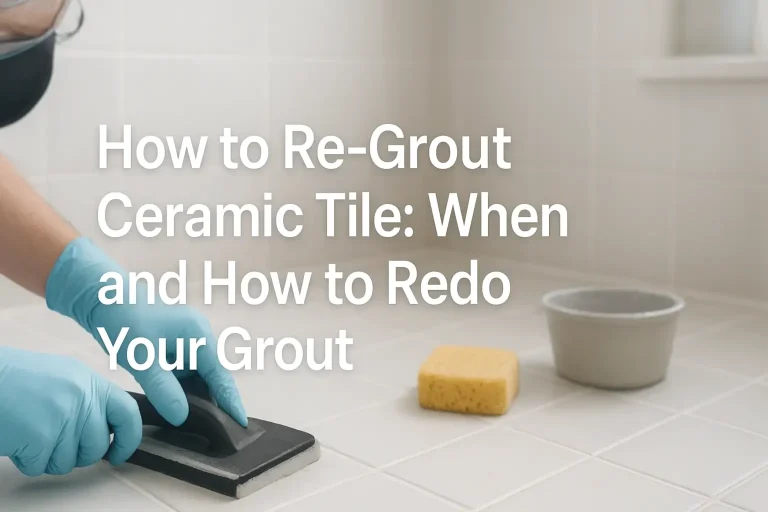
For detailed guidance on grout selection, application timing, and maintenance after installation, see the complete resource on when grout needs to be replaced and how to re-grout ceramic tile correctly.
How to Measure for Tile Adhesive and Thinset Mortar
Thinset mortar (tile adhesive) coverage is stated on the bag in square feet and depends on the trowel notch size used during installation. A 1/4-by-3/8-inch square-notch trowel used for 12-by-12-inch floor tile covers approximately 40 to 50 square feet per 50-pound bag of thinset.
Larger tiles (18 by 18 inches and above) require a larger trowel notch and deeper mortar coverage. A 1/2-by-1/2-inch trowel for large-format tile covers approximately 30 to 40 square feet per 50-pound bag. Check the thinset bag label for the manufacturer’s stated coverage at your trowel notch size.
A useful starting point: order one 50-pound bag of thinset for every 40 square feet of tile area as a conservative estimate. Add one extra bag for any project where the substrate (subfloor or wall backer board) has variations requiring additional mortar to level.
A notched trowel set with multiple notch sizes lets you match the trowel to your tile thickness and substrate condition without having to purchase individual trowels for each project.
How to Measure for Tile Backer Board and Underlayment
Cement backer board is measured the same way as tile: total floor or wall area in square feet. Standard cement board sheet sizes are 3 by 5 feet (15 sq ft) and 3 by 4 feet (12 sq ft). Divide your total area by the sheet size to determine the number of sheets needed, then add one or two additional sheets for cuts.
Unlike tile, backer board offcuts from one area can often be used in another area of the same room. Add only 5 to 8 percent overage for backer board rather than the 10 to 15 percent used for tile.
The substrate beneath your tile affects the entire installation’s longevity and flatness. Proper substrate preparation is covered in detail in the guide to substrate prep and full ceramic tile installation from start to finish.
How to Measure for Tile Sealer After Installation
Tile sealer coverage depends on whether you are sealing the tile surface, the grout joints, or both. Most penetrating sealers for ceramic tile cover 100 to 200 square feet per quart on a grout joint application. Surface sealer for porous unglazed ceramic tile covers 150 to 250 square feet per quart.
Use your total tiled area in square feet, divide by the manufacturer’s coverage rate per quart, and round up to the next whole container size. Purchase a penetrating ceramic tile sealer for grout and unglazed tile surfaces. Glazed ceramic tile does not require surface sealing, only the grout joints between tiles need protection.
For the full decision on whether your tile and grout need sealing and which products to use, the guide covering when and how to seal ceramic tile surfaces correctly covers glazed vs unglazed requirements, product selection, and application technique. For grout-only sealing, the dedicated resource on sealing ceramic tile grout joints to prevent staining and moisture penetration provides step-by-step application guidance.
Common Tile Measurement Mistakes and How to Avoid Them
The five most frequent measurement errors all produce the same outcome: you run short of tile partway through installation. Each one has a specific fix that takes less time than a return trip to the tile store.
Mistake 1: Measuring only the center of the room and ignoring edges. Rooms are not perfectly square. Always measure from wall to wall at two points for each dimension: at one end and at the other end. If the measurements differ, use the larger value for ordering.
Mistake 2: Forgetting to add overage. The net square footage is the minimum needed with zero waste. Every installation produces waste from cuts, breaks, and misaligned pieces. Always calculate overage as a separate step after computing the net area.
Mistake 3: Using manufacturer box coverage without reading the fine print. Box coverage figures assume zero waste and a specific tile size. Confirm that the stated coverage applies to your tile size, as some manufacturers publish coverage based on a different standard tile than the one in the box.
Mistake 4: Failing to account for doorways. Tile typically continues through a doorway and into adjacent spaces such as hallways or closets. Measure the depth of the tile run past the threshold and add it to the room calculation.
Mistake 5: Ordering tile from multiple dye lots. If one store does not have enough boxes from the same dye lot to fill your order, check the dye lot number printed on each box before purchasing. Mixing dye lots creates visible variation once installed. Order from a single dye lot, or request the retailer source additional boxes from the same production run.
Is It Better to Over-Measure or Under-Measure When Ordering Ceramic Tile?
Always over-measure. The consequences of ordering too much tile are minor: a few extra boxes stored for future repairs. The consequences of ordering too little mid-project are significant: installation stoppage, a potential dye lot mismatch, a discontinued product, or paying premium price for a second smaller order.
Leftover tile is an asset. Ceramic tile can crack from impact, heavy furniture legs, or subfloor movement years after installation. Having three to five spare tiles from the original dye lot makes a future repair invisible. Trying to source matching tile years later from a new production run rarely produces a perfect color match.
The standard recommendation from the Tile Council of North America is to store 10 percent of the installed quantity as replacement stock after any tile installation project. That means your 10 percent overage order serves double duty as both installation waste buffer and long-term repair stock.
How to Use a Tile Calculator App vs. Manual Measurement
Online tile calculators and app-based tools perform the same arithmetic covered in this guide. Their value is speed and error reduction for straightforward rectangular rooms. Their limitation is that they cannot account for the specific irregular features of your actual space.
Use an online calculator to double-check your manual calculation on a simple room. Use manual calculation for any room with L-shapes, alcoves, multiple fixtures, or pattern considerations. The manual method lets you see each step and catch the errors that automated tools miss when a room does not fit a standard template.
The most reliable approach for any project over 150 square feet is to calculate manually first, then verify with a calculator second. If both outputs agree within one or two square feet, your measurement is solid. If they diverge by more than five square feet on a simple room, remeasure before ordering.
Can You Tile Over Existing Ceramic Tile Without Remeasuring?
Tiling over existing ceramic tile changes two measurement considerations. The finished floor height rises by the thickness of the new tile plus the thinset layer, typically adding 1/2 to 3/4 inch to the finished floor elevation. This affects door clearance, transition strips at adjacent flooring surfaces, and the height relationship between the floor tile and any existing wall tile.
The square footage calculation itself does not change. You measure the same floor area using the same length-times-width method. What changes is that the substrate condition and any lippage (uneven tile edges) in the existing floor must be assessed before ordering, because a heavily uneven substrate may require additional thinset to level, which affects how many bags of mortar to purchase.
Measure the floor area exactly as described in this guide for a new installation. Add 5 percent extra to your thinset estimate to account for leveling compound over any existing tile irregularities.
How Many Tiles Do You Need for a 100 Square Foot Room?
A 100-square-foot room with 10 percent overage requires 110 square feet of tile to order. The number of individual tiles depends entirely on the size of the tile selected.
For 12-by-12-inch tile, you need 110 individual tiles (1 tile per square foot). For 18-by-18-inch tile (2.25 sq ft each), you need 110 / 2.25 = 49 tiles rounded up to 50. For 6-by-6-inch tile (0.25 sq ft each), you need 110 / 0.25 = 440 tiles. For 3-by-6-inch subway tile (0.125 sq ft each), you need 110 / 0.125 = 880 tiles.
Always divide the total square footage including overage by the individual tile square footage, then round up to the nearest whole tile. Never round down.
Do You Measure Tile by Square Foot or Square Yard?
Ceramic tile is sold and measured in square feet in the United States. Carpet is commonly sold by the square yard, which causes confusion when buyers apply the wrong unit to a tile project. One square yard equals 9 square feet. A 10-square-yard order is 90 square feet of tile coverage.
All measurements in this guide use square feet, which matches how tile boxes are labeled and how tile is priced at retail. If you encounter a tile price quoted per square yard, divide the price by 9 to find the per-square-foot price for an apples-to-apples comparison with other products.
What Happens If You Do Not Add Overage to Your Tile Order?
Without overage, any cut that produces waste leaves you short. A single broken tile, one mis-measured cut, or one tile cracked by a trowel edge during installation cannot be replaced from your order. You must stop work and source additional tile.
The probability of needing at least one replacement tile during a standard floor installation is effectively 100 percent. Professional tile setters budget 10 percent waste as a floor on every job regardless of their experience level, because the physical process of cutting ceramic tile generates unavoidable waste from the saw kerf, the positioning of cuts to avoid lippage, and occasional breakage at scored lines.
A wet tile saw minimizes waste compared to a snap cutter, but it does not eliminate it. Budget 10 percent regardless of cutting method and regard the difference between estimated waste and actual waste as your post-installation repair stock.
How to Measure for Mosaic Tile and Small Format Tile
Mosaic tile is sold in sheet form, typically on a 12-by-12-inch mesh backing. Each sheet covers 1 square foot. Measure your area in square feet using the same length-times-width method, then apply a 10 percent overage. The number of sheets needed equals the total square footage with overage, rounded up to the nearest whole sheet.
Small-format mosaic tile generates less waste per cut than larger tile because the individual pieces are tiny and offcuts from one area fit easily in another. The 10 percent overage is sufficient for most mosaic installations, even diagonal patterns, because the mesh backing allows the installer to cut whole sheets rather than individual tiles.
Purchase mosaic tile sheets with the mesh backing intact. The backing keeps tile spacing consistent during installation and eliminates the need to set each small tile individually. Confirm the grout joint width for your chosen mosaic is compatible with the spacer gaps embedded in the mesh.
What Is the Best Tile Measurement Approach for Very Large Rooms?
Rooms over 400 square feet benefit from dividing the floor into four quadrants and measuring each quadrant independently. Sum the four quadrant areas for the total. This reduces the risk of cumulative measurement error that builds up when a single tape measure pull spans 20 to 30 feet.
A laser distance measurer is particularly useful in large rooms. It measures wall-to-wall distances accurately without requiring a second person to hold the far end of the tape. A quality 100-foot laser distance measurer reads to within 1/16 inch across a 30-foot room, eliminating the tape-sag error that affects long pulls with a standard tape measure.
For commercial-scale tile projects over 1,000 square feet, consult a professional estimator or use the tile manufacturer’s estimating service. Most major tile manufacturers offer free material estimation for large commercial orders with room dimensions provided in a standardized form.
Frequently Asked Questions About Measuring for Ceramic Tile
Can you use the same square footage calculation for both floor tile and wall tile?
Yes, the length-times-width formula applies to floors and walls equally. The difference is in the deductions: wall calculations subtract window and door openings, while floor calculations subtract only fixed permanent structures like bathtub footprints and built-in cabinetry bases.
Apply a 10 percent overage for straight-lay wall tile and 15 percent for any patterned wall layout including running bond subway tile. Wall installations tend to generate more edge cuts per square foot than floors because the narrow band height of a backsplash or the tile-to-ceiling dimension rarely divides evenly by tile size.
How much extra tile should you buy for a bathroom with a diagonal floor layout?
Order 15 percent over your measured square footage for a diagonal bathroom floor. A bathroom with a 60-square-foot floor needs 60 x 1.15 = 69 square feet of tile. If your tile comes in boxes of 15 square feet, order five boxes (75 square feet) rather than four boxes (60 square feet).
A small bathroom with many cuts from a toilet, bathtub, and vanity base may benefit from 20 percent overage if the floor area is under 40 square feet. Proportionally, more of a small floor is edge cuts than center field, so the waste percentage climbs relative to the total area.
Does grout joint width change how many tiles you need to order?
Wider grout joints slightly reduce the number of tiles needed per square foot, but the reduction is small enough to fall inside the standard overage buffer for joints up to 3/8 inch. For joints over 3/8 inch (used with handmade or rustic tile), reduce your tile order by 3 to 5 percent from the gross square footage calculation.
The more significant effect of wide grout joints is on grout quantity, which increases substantially. A 3/8-inch joint requires roughly twice the grout of a 3/16-inch joint for the same tile area and tile size.
What is the difference between nominal tile size and actual tile size?
Nominal tile size is the marketing label, such as “12-by-12 inches.” Actual tile size is the physical dimension measured with a caliper. Non-rectified ceramic tile commonly runs 3/16 to 1/4 inch smaller than its nominal size because the kiln firing process shrinks the clay. A “12-by-12-inch” non-rectified tile may measure 11.75 by 11.75 inches.
This matters for layout planning and grout joint sizing, not for square footage ordering. Your area calculation uses the space to be covered, not the tile size. The actual tile size affects how many tiles fit in a row and what grout joint width you need to maintain consistent alignment, but it does not change the total square footage of material to purchase.
Can you mix tile from different boxes if the dye lot numbers match?
Yes. Dye lot number is the critical matching identifier, not the box number or production date. Two boxes with the same dye lot number contain tiles from the same firing batch and will match in color and tone. Open and visually compare tiles from both boxes in natural light before installation to confirm.
If the retailer cannot confirm the dye lot number because boxes are from different shipments, install tiles from different boxes in an alternating pattern (one tile from box A, next from box B) rather than installing all of one box before opening the next. This distributes any subtle variation across the floor rather than concentrating it in a visible zone.
Is it safe to tile over a wood subfloor without backer board?
No. Ceramic tile requires a rigid, dimensionally stable substrate. Wood subfloor flexes when walked on, and that flex causes grout joints to crack and tiles to de-bond over time. The Tile Council of North America specifies a maximum deflection of L/360 for any substrate receiving ceramic tile, where L is the span between joists. Most wood subfloors do not meet this standard without cement backer board installed over them.
Install 1/4-inch or 1/2-inch cement backer board over the wood subfloor and fasten it with 1-1/4-inch backer board screws on a 6-inch grid pattern. Tape the joints between sheets with 2-inch fiberglass mesh tape embedded in thinset before tiling. The backer board adds rigidity that wood alone cannot provide and creates a moisture-resistant surface that wood subfloor cannot match in wet areas.
Do you need to subtract the area under floor trim and baseboards from your tile measurement?
No. Baseboards and floor trim are removed before tile installation and re-installed on top of the finished tile. Tile runs wall-to-wall at floor level, including the strip beneath where baseboards will sit. Measure wall-to-wall and include the full floor area in your calculation.
If the existing baseboard profile does not sit flat against the tiled wall after installation because the new tile thickness raises the floor level, use a quarter-round or base shoe molding to cover the gap between the baseboard bottom and the tile surface. This is standard practice when tiling over an existing floor that raises the finished height.
How do you measure tile for a curved or round room feature?
Curved walls and circular features are measured by calculating the full rectangular bounding area (the smallest rectangle that fully contains the curved surface) and then subtracting the untiled areas outside the curve. A curved shower wall that spans 6 feet wide and 8 feet tall has a bounding area of 48 square feet. If the curve reduces the actual tile coverage to roughly 85 percent of the bounding area, you need approximately 41 square feet of tile plus 15 percent overage for the additional cuts curves require.
For curved features, increase your overage to 20 percent regardless of tile size. Cutting ceramic tile to follow a curve requires many small angled cuts that waste more material per linear foot of curve than straight edge cuts.
What is the minimum tile thickness for floor installations?
Ceramic floor tile should be a minimum of 5/16 inch (8mm) thick for residential floor use. Tiles thinner than 5/16 inch are wall tile and will crack under foot traffic and furniture loading on a floor installation. Wall tile thickness is typically 1/4 inch (6mm), which is insufficient for floor load-bearing requirements.
Confirm the tile’s intended use on the product specifications before ordering. Look for a floor/wall rating symbol on the tile box or product sheet. A tile rated only for wall installation will fail on a floor regardless of how well it is set.
How do you calculate how much tile you need for a shower floor with a center drain?
Calculate the full shower floor area using length times width in decimal feet. The drain opening itself is negligible in area and does not warrant a deduction. Apply 15 percent overage for a standard grid layout shower floor, because the mortar bed slope toward the drain requires additional cuts at the four quadrants where tiles meet the slope transition.
If you are using a linear drain instead of a center drain, the tile runs in one direction toward the drain rather than four quadrants. Use 10 percent overage for a linear drain shower floor with a straight-lay tile pattern. Increase to 15 percent if the tile runs diagonally.
For shower walls, purchase a pre-sloped shower pan or mortar bed kit to establish the correct 1/4-inch-per-foot slope before tiling. The slope affects how tiles lay and how many cuts are needed at the low point near the drain.
Accurately measuring your ceramic tile project before ordering protects your budget, your timeline, and your installation quality. Measure every dimension twice in decimal feet, divide complex rooms into rectangles, apply the correct overage for your layout pattern, and confirm dye lot consistency before purchasing. Those four steps eliminate every common ordering mistake before a single tile is cut.