Best Ceramic Tile Brands: Quality Rankings and Reviews Guide

Choosing the wrong ceramic tile brand costs more than the price difference at the register. It costs replacement labor, grout repairs, and tiles that crack, fade, or absorb stains within two years of installation.
This guide ranks the best ceramic tile brands by quality, covering durability ratings, PEI wear ratings, water absorption percentages, price per square foot, and the specific use cases where each brand outperforms its competitors.
By the Numbers
Ceramic Tile Industry: Key Quality Benchmarks
Sources: ANSI A137.1, Tile Council of North America (TCNA), manufacturer technical data sheets
What Makes a Ceramic Tile Brand High Quality?
A high-quality ceramic tile brand consistently produces tiles that meet or exceed ANSI A137.1 standards for water absorption, breaking strength, and surface hardness. These three technical benchmarks separate brands that last 20-plus years from those that fail within five.
Water absorption is the single most critical number. Ceramic tile rated for floor use must absorb less than 0.5% water by weight after firing, according to ANSI A137.1 specifications.
Tiles that absorb more than 3% water are classified as non-vitreous earthenware. These crack in freeze-thaw cycles and stain permanently without sealer.
Breaking strength tells you how much load a tile withstands before fracturing. The TCNA specifies a minimum of 250 lbf (pounds of force) for residential floor tiles and 400 lbf for commercial applications.
The PEI (Porcelain Enamel Institute) wear rating measures glaze durability on a scale of 1 to 5. PEI 1 is wall-only. PEI 3 covers light residential floors. PEI 5 handles heavy commercial traffic.
Top brands invest in controlled kiln firing at 1,832°F to 2,372°F (1,000°C to 1,300°C), depending on the clay body and glaze system. Consistent firing temperature is what separates uniform color and density from batch-to-batch variation.
Understanding these benchmarks before comparing brands lets you evaluate marketing claims against measurable performance data rather than just visual appeal.
Top Ceramic Tile Brands Ranked by Quality
The brands below are ranked on a combination of manufacturing consistency, ANSI compliance, independent installer reviews, and technical specification transparency. Price ranges reflect current retail averages per square foot.
1. Daltile: Best Overall for Quality and Availability
Daltile ceramic tile is manufactured by Mohawk Industries, the largest flooring manufacturer in the United States. Daltile operates production facilities in the U.S., which gives it tighter quality control over raw material consistency and firing uniformity compared to brands relying entirely on offshore production.
Daltile’s floor tile lines consistently achieve water absorption below 0.5% and breaking strength above 250 lbf across their residential and commercial product families.
Key Specifications:
- Water absorption: below 0.5% (vitreous classification)
- Breaking strength: 250-500 lbf depending on thickness
- PEI wear rating: 3-5 depending on product line
- Price range: $1.50-$15 per square foot
- Available formats: 4×4 inch to 24×24 inch and large-format slabs
Daltile’s Color Wheel Classic and Restore collections offer the widest color consistency in the industry for residential bathroom and kitchen applications. The brand’s network of 250-plus sales service centers across North America means replacement tiles are available in the original dye lot for most product lines for up to ten years after initial purchase.
The main limitation is mid-range design aesthetics. Daltile excels at reliable, consistent tile rather than high-design or artisan surfaces. For design-forward installations, other brands offer stronger options.
2. Marazzi: Best for Design Quality at Mid-Range Price
Marazzi ceramic and porcelain tile originated in Sassuolo, Italy, in 1935 and became one of the largest tile manufacturers in the world through acquisitions in Spain and the United States. The American Marazzi operations, now also under Mohawk Industries, produce tile at plants in Dallas, Texas, and Sunnyvale, Texas.
Marazzi’s technical quality matches Daltile’s ANSI compliance while offering more sophisticated wood-look, stone-look, and large-format designs at prices between $2 and $18 per square foot.
Key Specifications:
- Water absorption: 0.1-0.5% across floor tile lines
- Breaking strength: 300-600 lbf for 3/8-inch and thicker tiles
- PEI wear rating: 3-5 depending on glaze finish
- Price range: $2-$18 per square foot
- Notable collections: Montagna, Glazed Ceramic, American Estates
Marazzi’s Montagna wood-look line is among the most reviewed ceramic tile products in North America, with consistent installer feedback on dimensional accuracy (less than 0.3% variation from stated size) and edge quality. Dimensional accuracy matters because tiles that vary more than 0.5% in size produce visible grout line inconsistency after installation.
For a detailed side-by-side technical comparison of Daltile, American Olean, and Marazzi across water absorption, breaking strength, and price tiers, the brand comparison of these three major ceramic tile manufacturers covers every major product family with specification data.
3. American Olean: Best for Commercial Applications
American Olean floor and wall tile has manufactured ceramic tile in the United States since 1923. The brand’s commercial-grade product lines are specified by architects for hospitals, schools, and retail floors more frequently than any other domestic brand, according to TCNA installation data.
American Olean’s quarry tile and commercial ceramic lines achieve breaking strength above 400 lbf and PEI 5 wear ratings, meeting OSHA slip-resistance requirements for wet commercial environments.
Key Specifications:
- Water absorption: below 0.5% on floor tile, 7-20% on wall tile
- Breaking strength: 400-700 lbf on commercial floor lines
- PEI wear rating: 4-5 for commercial floor products
- Price range: $1-$12 per square foot
- COF (coefficient of friction): 0.6 or higher on wet-rated products
The brand’s residential lines are less design-forward than Marazzi but maintain the same manufacturing quality standards. American Olean is the most cost-effective option for large-scale commercial projects where specification compliance and price-per-unit dominate the decision over aesthetics.
4. Florida Tile: Best for Sustainability Certification
Florida Tile porcelain and ceramic tile is manufactured in Lexington, Kentucky, using a production process certified to ISO 14001 environmental management standards. The brand holds the distinction of being the first American tile manufacturer to achieve Cradle to Cradle certification, indicating verified recycled content and responsible manufacturing practices.
Florida Tile’s ceramic products use up to 40% pre-consumer recycled content in the tile body without compromising vitrification or dimensional accuracy.
Key Specifications:
- Water absorption: below 0.5% on vitreous floor lines
- Breaking strength: 250-450 lbf
- Recycled content: up to 40% pre-consumer material
- Certifications: Cradle to Cradle, ISO 14001, Green Squared
- Price range: $2-$20 per square foot
For LEED-certified construction projects, Florida Tile’s recycled content and regional manufacturing (within 500 miles of most Eastern U.S. project sites) contribute to multiple LEED credits simultaneously. The design range covers both contemporary and traditional aesthetics at prices competitive with Marazzi.
5. Emser Tile: Best for Specialty and Artisan Surfaces
Emser ceramic and stone tile distributes through a network of over 50 U.S. showrooms and sources product from manufacturing partners in Spain, Italy, Brazil, and the United States. The brand does not manufacture tile directly but instead curates and quality-tests each collection before distribution, focusing on design-driven products not available through big-box retail channels.
Emser’s technical quality standards require all floor tile products to meet or exceed ANSI A137.1 before inclusion in the catalog, verified by independent laboratory testing.
Key Specifications:
- Water absorption: verified below 0.5% on all floor products
- Breaking strength: varies by source — minimum 250 lbf required
- PEI wear rating: 3-5 depending on collection
- Price range: $3-$35 per square foot
- Design focus: artisan, handcrafted looks, encaustic cement tile alternatives
Emser’s handcrafted-look ceramic collections use digital inkjet printing technology at 720 dpi resolution to replicate hand-painted surfaces with the durability of fired ceramic glaze. This delivers artisan aesthetics at $4-$10 per square foot compared to genuine hand-painted tiles at $25-$80 per square foot.
6. MSI Surfaces: Best for Value at Scale
MSI ceramic and porcelain tile is distributed through one of the largest tile distribution networks in North America, with warehouses in over 50 locations. MSI sources tile primarily from manufacturers in Spain, Italy, Turkey, and China, focusing on price-competitive products that meet ANSI standards at the lower end of the retail price spectrum.
MSI’s strength is volume purchasing power, which allows it to offer ANSI-compliant floor tile at $1-$4 per square foot, making it the preferred choice for large-scale residential development projects.
Key Specifications:
- Water absorption: below 0.5% on floor-rated products
- Breaking strength: 250-350 lbf on standard floor lines
- PEI wear rating: 3-4 on most residential floor collections
- Price range: $1-$12 per square foot
- Availability: Home Depot, Lowe’s, and MSI distribution centers
The quality ceiling for MSI is lower than Daltile or Florida Tile on premium lines. However, for budget-constrained projects where ANSI compliance is the primary requirement, MSI consistently delivers at a price point 30-50% below competing ANSI-compliant brands.
7. Crossville Tile: Best for Recycled Content in Commercial Projects
Crossville porcelain tile is manufactured entirely in Crossville, Tennessee, and holds the distinction of being one of the few American tile manufacturers with a documented closed-loop recycling system. The company recycles 100% of production waste back into new tile bodies, and many product lines contain 35-50% recycled content by weight.
Crossville’s technical quality is among the highest of any domestic manufacturer, with breaking strength figures routinely exceeding 500 lbf on their commercial floor lines.
Key Specifications:
- Water absorption: below 0.1% (impervious classification) on most lines
- Breaking strength: 400-650 lbf
- PEI wear rating: 4-5
- Recycled content: 35-50% in most tile bodies
- Price range: $4-$25 per square foot
Crossville tiles cost more per square foot than MSI or Daltile standard lines. The premium is justified for commercial projects requiring both specification-grade durability and LEED documentation for recycled content credits.
8. Porcelanosa: Best for Luxury and European Design
Porcelanosa wall and floor tile is manufactured in Villarreal, Spain, and represents the premium European design segment of the North American tile market. The brand uses high-pressure pressing technology at 7,000 tons of compaction force, producing tile bodies with extremely low porosity and near-perfect dimensional consistency.
Porcelanosa’s water absorption figures fall below 0.05% on most floor lines, classifying them as impervious under ANSI A137.1 — the same classification used for surgical environments and food processing facilities.
Key Specifications:
- Water absorption: below 0.05% on vitrified lines
- Breaking strength: 500-900 lbf on large-format slabs
- PEI wear rating: 4-5
- Pressing pressure: 7,000 tons compaction force
- Price range: $8-$35 per square foot
The investment in Porcelanosa is justified for high-end residential or hospitality projects where dimensional precision and design uniqueness drive the specification. For standard residential applications, the quality premium over Daltile or Marazzi does not translate into meaningfully better longevity under normal use conditions.
Use the table below to compare all eight brands across the technical specifications that matter most for installation decisions.
Product Comparison
Top Ceramic Tile Brands: At-a-Glance Comparison
Key specifications compared across top-rated brands. Sources: ANSI A137.1, manufacturer technical data sheets, TCNA.
| Brand | Price/Sq Ft | Water Absorption | Breaking Strength | PEI Rating | Best For | Origin |
|---|---|---|---|---|---|---|
| Daltile | $1.50-$15 | Below 0.5% | 250-500 lbf | 3-5 | Overall quality and availability | USA |
| Marazzi | $2-$18 | 0.1-0.5% | 300-600 lbf | 3-5 | Design quality at mid-range price | USA/Italy |
| American Olean | $1-$12 | Below 0.5% | 400-700 lbf | 4-5 | Commercial applications | USA |
| Florida Tile | $2-$20 | Below 0.5% | 250-450 lbf | 3-5 | Sustainability certification | USA |
| Emser Tile | $3-$35 | Below 0.5% | 250+ lbf | 3-5 | Artisan and specialty surfaces | Multi-source |
| MSI Surfaces | $1-$12 | Below 0.5% | 250-350 lbf | 3-4 | Value at scale | Multi-source |
| Crossville | $4-$25 | Below 0.1% | 400-650 lbf | 4-5 | Recycled content in commercial | USA |
| Porcelanosa | $8-$35 | Below 0.05% | 500-900 lbf | 4-5 | Luxury and European design | Spain |
Water absorption and breaking strength data sourced from ANSI A137.1 classification standards and manufacturer published technical data sheets. Prices verified at time of publication.
The brand that delivers the best quality for your project is the one whose technical specifications match your installation environment, not necessarily the highest-priced option on the list.
Ceramic Tile Quality Standards Explained: PEI, ANSI, and COF
Three independent rating systems determine whether a ceramic tile is appropriate for any given installation. Buying tile without checking all three is the most common reason tile installations fail prematurely.
PEI Wear Rating: How to Match Glaze Hardness to Traffic Level
The PEI (Porcelain Enamel Institute) wear rating tests how a tile’s glaze surface responds to foot traffic by rotating a steel ball over the tile surface under controlled pressure. The test measures visible scratching on the glaze at five intervals, producing a rating from 1 to 5.
PEI 1 means the glaze scratches under minimal foot traffic. PEI 1 tiles are wall-only products.
PEI 3 handles normal residential foot traffic without shoes. This rating is appropriate for bathroom floors, bedroom floors, and kitchen floors in households without pets.
PEI 4 handles heavy residential traffic including shoes and pet claws. Use PEI 4 for entryways, mudrooms, and kitchen floors in active households.
PEI 5 is the commercial standard. Airport terminals, retail floors, and restaurant dining areas require PEI 5 or higher to maintain surface integrity over years of heavy-grit traffic.
The mechanism behind PEI failure is abrasion of the glaze micro-crystalline structure. A fired ceramic glaze achieves 6-7 Mohs hardness. Under repeated high-grit traffic, the micro-surface degrades and the glaze loses its reflective quality before the tile body itself is damaged. Installing PEI 3 tile in a commercial kitchen means the surface looks worn within 12-18 months even though the tile is structurally intact.
ANSI A137.1: The Standard Every Quality Tile Must Meet
ANSI A137.1 is the American National Standard for ceramic tile. It sets minimum requirements for water absorption, breaking strength, warpage tolerance, and surface characteristics. Published by the American National Standards Institute, it is the primary specification document used by architects, commercial contractors, and building inspectors.
Water absorption classification under ANSI A137.1 works as follows:
- Non-vitreous: above 7% absorption. Wall applications only. Not suitable for wet areas.
- Semi-vitreous: 3-7% absorption. Light residential floor use in dry conditions only.
- Vitreous: 0.5-3% absorption. Residential floors, wet areas, light commercial use.
- Impervious: below 0.5% absorption. Heavy commercial, outdoor, freeze-thaw environments.
Any brand claiming floor-grade quality for a product with absorption above 0.5% is using marketing language that contradicts ANSI standards. Always request the technical data sheet and verify the absorption figure before purchasing for floor applications.
Coefficient of Friction (COF): The Safety Specification No One Checks
The coefficient of friction (COF) measures how much resistance a tile surface provides against slipping under foot. OSHA and ADA guidelines require a minimum static COF of 0.6 for floor tiles in wet conditions. The higher the COF number, the more slip-resistant the surface.
Polished ceramic tiles typically achieve COF values between 0.35 and 0.55 when wet, which falls below the safe threshold. This is why polished tiles are unsuitable for bathroom shower floors, pool surrounds, or commercial kitchen floors regardless of their PEI rating.
Textured, matte, and anti-slip treated tiles achieve wet COF values of 0.6-0.8. Always verify COF from the manufacturer’s technical sheet for any tile going into a wet floor application. Slip liability from incorrectly specified tile is a significant issue in both residential and commercial installations.
Checking PEI, ANSI water absorption, and COF together gives you a complete picture of whether a tile is technically appropriate for its intended environment, not just visually appealing.
Price vs. Quality: Where to Spend and Where to Save
Ceramic tile price does not correlate directly with technical quality. A $3-per-square-foot ANSI-compliant tile from Daltile outperforms a $12-per-square-foot non-compliant tile from an unknown import brand in every measurable category. The spending decision comes down to which attributes you are actually paying for at each price tier.
Price Comparison
Ceramic Tile Price Tiers: What You Get at Each Level
Price per square foot at retail, sorted by tier. Prices verified at time of publication.
$1-$3/sq ft
$1.50-$4/sq ft
$4-$8/sq ft
$5-$10/sq ft
$8-$20/sq ft
$15-$35/sq ft
Price premium above $8 per square foot reflects design sophistication, dimensional precision, and sustainability certification rather than meaningfully better ANSI compliance. Budget and mid-range tiles from established brands meet the same core technical standards.
For residential bathroom floors and kitchen backsplashes, spending $3-$8 per square foot from Daltile, Marazzi, or American Olean delivers every technical requirement without the design premium. The $10-$35 range adds dimensional precision, exclusive aesthetics, and sustainability credentials that matter for high-end projects and LEED requirements.
Ceramic vs. Porcelain Tile: What the Quality Difference Actually Is
Porcelain is a type of ceramic tile, not a separate material category. The distinction is water absorption: ANSI A137.1 classifies any tile with water absorption below 0.5% as porcelain tile, regardless of whether it is marketed as “ceramic” or “porcelain.” The firing temperature and clay body composition determine the classification.
Standard ceramic tile uses a coarser clay body fired at 1,832°F to 2,192°F (1,000°C to 1,200°C). Porcelain tile uses a refined kaolin-feldspar body pressed at high pressure and fired at 2,192°F to 2,372°F (1,200°C to 1,300°C).
The higher firing temperature vitrifies the tile body completely, meaning the clay particles fuse into a glass-like matrix with below 0.5% water absorption. This is the mechanism that makes porcelain harder, denser, and more suitable for outdoor and freeze-thaw applications than standard ceramic.
Standard ceramic tile with 3-7% absorption absorbs moisture into the body during wet-dry cycles. In outdoor or heated-floor applications, this moisture expands and contracts with temperature changes. Over time, that movement fractures the tile from within, even when the surface appears undamaged.
Use the table below to match your installation environment to the correct tile classification before selecting a brand.
Product Comparison
Ceramic vs. Porcelain Tile: Side-by-Side Technical Comparison
Classification per ANSI A137.1. Data from TCNA Handbook for Ceramic, Glass, and Stone Tile Installation.
| Feature | Standard Ceramic | Porcelain Tile |
|---|---|---|
| Water Absorption | 3-7% (semi-vitreous) | Below 0.5% (impervious) |
| Firing Temperature | 1,832-2,192°F (1,000-1,200°C) | 2,192-2,372°F (1,200-1,300°C) |
| Breaking Strength | 150-300 lbf | 300-900 lbf |
| Outdoor/Freeze-Thaw | Not recommended | Suitable |
| Typical Price | $1-$8/sq ft | $2-$35/sq ft |
| Installation Ease | Easier to cut, lighter | Harder, requires wet saw |
| Best Application | Indoor walls, dry floors | All floors, wet areas, outdoors |
All ANSI-compliant porcelain tiles are ceramic tiles by material composition. The “porcelain” designation is a performance classification, not a separate material type.
For most indoor residential floor applications, either classification works. The choice becomes critical only for outdoor installations, radiant heat floors, wet shower environments, and anywhere freeze-thaw cycles occur.
Quick Reference: Ceramic Tile Terms Every Buyer Should Know
These terms appear in every tile specification sheet and installer conversation. Understanding them before you buy prevents costly specification errors.
- ANSI A137.1: The American National Standard for ceramic tile, setting minimum requirements for water absorption, breaking strength, warpage, and surface quality.
- PEI Rating: Porcelain Enamel Institute wear rating from 1 to 5, measuring glaze resistance to foot traffic abrasion. PEI 1 is wall-only. PEI 5 is heavy commercial.
- Water Absorption: The percentage of water a tile body absorbs by weight after firing. Below 0.5% is the vitreous/impervious threshold for floor tile.
- Breaking Strength: The load in pounds-force (lbf) required to fracture a tile. Residential minimum is 250 lbf. Commercial minimum is 400 lbf.
- COF (Coefficient of Friction): Measures slip resistance. Minimum 0.6 wet COF required by ADA and OSHA for floor installations in wet conditions.
- Vitrification: The process by which a clay body fuses into a dense, glassy matrix during high-temperature firing, reducing porosity and absorption to near zero.
- Warpage: The deviation from flat across a tile’s surface. ANSI A137.1 permits maximum 0.5% warpage by length for tiles under 15 inches and 0.3% for larger formats.
- Rectified Tile: Tile that has been mechanically cut after firing to achieve precise, consistent dimensions. Allows tighter grout joints (1/16 inch) versus unrectified tile (minimum 3/16 inch).
- Inkjet Printing: Digital decoration technology that applies glaze colorants at 360-720 dpi resolution, enabling realistic stone and wood surface replication on ceramic tile.
- Non-vitreous: Tile with absorption above 7%. Wall applications only. Will not survive outdoor or wet floor conditions without permanent damage.
- Dye Lot: A production batch identifier. Tiles from different dye lots may have visible color variation. Always purchase 10% extra from the same dye lot for repairs.
- TCNA: Tile Council of North America. The industry body that publishes installation standards, specifies grout joint widths, and certifies installer qualifications in the U.S.
Knowing these terms lets you evaluate any tile’s technical data sheet independently, without relying solely on marketing claims or showroom staff recommendations.
How to Choose the Right Ceramic Tile Brand for Your Project
The right brand for your project is determined by four factors in order: installation environment, traffic level, design requirements, and budget. Working through them in that sequence eliminates most brands from consideration before you reach the showroom.
The following tool helps you match these four factors to the brand that fits your specific situation.
Interactive Tool
Find the Right Ceramic Tile Brand for Your Project
Answer 2 questions to get a brand recommendation matched to your installation needs.
For most residential floor projects, Daltile or Marazzi at $3-$8 per square foot delivers every technical requirement. Move up to Florida Tile or Crossville only when sustainability credentials or higher breaking strength figures are specifically required by your project.
Ceramic Tile Brand Performance by Room Type
The same brand can be the right choice for one room and the wrong choice for another in the same house. Room type determines the technical requirements that narrow your brand and product selection before price or design considerations apply.
Bathroom Floors: Water Absorption and COF Are Non-Negotiable
Bathroom floors require tile with water absorption below 0.5% and wet COF above 0.6. Standard ceramic wall tile fails both requirements and must not be used on bathroom floors, regardless of how it is marketed at retail.
For bathroom floors, slip-resistant bathroom floor tile with a textured or matte finish performs better than polished surfaces at the same price point. American Olean’s SafetyGrate line achieves wet COF of 0.72 at $3-$6 per square foot.
Grout joint width on bathroom floors should be a minimum of 1/8 inch to allow the tile to flex slightly during temperature and humidity changes. Tighter grout joints crack under thermal movement in bathroom environments.
Kitchen Backsplashes: Design Range and PEI 1-2 Are Sufficient
Kitchen backsplash tile carries no structural load and experiences no foot traffic. This means wall-rated tile (PEI 1-2, absorption above 3%) is technically appropriate and opens the full design range from every brand, including artisan hand-painted surfaces that would not survive floor use.
For backsplash applications, Emser’s artisan ceramic lines and Marazzi’s decorative collections offer the widest design options at $4-$12 per square foot. The primary technical consideration shifts to chemical resistance to grease and cleaning products rather than wear resistance.
Glazed ceramic backsplash tiles with a fully vitrified glaze surface resist grease, oil, and standard kitchen cleaners without staining. Unglazed or matte-finished backsplash tiles require sealing to prevent permanent staining from cooking oils.
Outdoor Patios: Freeze-Thaw Rating Is the Only Acceptable Standard
Outdoor ceramic tile installations fail when installers use indoor-rated tile in freeze-thaw environments. The failure mechanism is straightforward: any tile with absorption above 0.5% absorbs moisture into the body. When temperatures drop below 32°F (0°C), that moisture expands by approximately 9% as it freezes, fracturing the tile from within over one to three winters.
Only tiles carrying a specific freeze-thaw certification from the manufacturer are appropriate for outdoor patio use in climates that experience sub-freezing temperatures. Daltile, American Olean, Florida Tile, and Crossville all publish freeze-thaw certified product lists on their technical documentation pages.
For covered outdoor areas that stay above freezing, vitreous tile (0.5-3% absorption) may be acceptable, but verify with the manufacturer before installation. The warranty and specification liability rests with the installer if a non-freeze-thaw-rated tile is used in a freeze-thaw environment.
Radiant Heat Floors: Dimensional Stability Under Thermal Cycling
Ceramic and porcelain tile on radiant heat systems experience repeated thermal cycling, expanding and contracting with each heating cycle. Over time, this movement can cause grout to crack if the tile’s coefficient of thermal expansion (CTE) is not compatible with the adhesive mortar and grout system.
For radiant heat installations, the TCNA recommends using uncoupling membrane systems such as Schluter Ditra, which isolates the tile layer from subfloor movement. All eight brands reviewed in this guide are compatible with uncoupling membrane installation methods.
Porcelain tile with low water absorption (below 0.5%) handles thermal cycling better than standard ceramic because the denser, less porous tile body expands and contracts more uniformly. This is why Crossville, Porcelanosa, and Florida Tile are specified more frequently than budget brands for radiant heat applications.
Matching the tile’s technical specifications to the specific room environment before comparing brands eliminates most purchasing mistakes before they happen at the register.
Installation Quality: Why Brand Choice Cannot Compensate for Poor Installation
The best ceramic tile brand fails in under two years when installed incorrectly. Tile quality and installation quality are equal contributors to installation longevity, and neither compensates for failures in the other.
Thinset Mortar Selection Matters as Much as Tile Quality
Thinset mortar must match the tile type, substrate, and installation environment. Using a standard gray thinset with large-format porcelain tile causes lippage (uneven tile edges) because standard thinset does not have sufficient open time for large tile adjustment. Large-format tiles (over 15 inches) require medium-bed mortar or large-tile thinset with polymer modification.
For large-format porcelain tile from Porcelanosa, Florida Tile, or Crossville, the TCNA recommends using a large-format tile thinset with extended open time and applying mortar to both the tile back and the substrate (back-buttering) to achieve full coverage above the 95% minimum required by ANSI A108.
Selecting the right thinset for your specific tile type and installation environment is as critical as selecting the right tile brand. Our guide on choosing the correct thinset mortar for ceramic tile installations covers polymer-modified, epoxy, and medium-bed mortar options with brand comparisons and substrate compatibility charts.
Grout Selection and Sealing After Installation
Grout is the component of a tile installation most frequently neglected after tile selection. Unsanded grout is used for joints under 1/8 inch. Sanded grout is used for joints from 1/8 inch to 1/2 inch. Using unsanded grout in a wide joint causes the grout to crack as it shrinks during curing.
Epoxy grout eliminates staining and cracking entirely but costs three to five times more than cement-based grout and requires more skilled installation. For high-traffic kitchen floors and wet bathroom environments, epoxy grout extends the installation’s functional life significantly by eliminating the grout joint as a moisture entry point.
For cement-based grout on any floor or wet area application, sealing is required within 72 hours of grout curing to prevent permanent staining. For the right grout sealer for your installation type, our comparison of top-rated grout sealers for ceramic tile floors and walls covers penetrating sealers, topical sealers, and color-seal options with application instructions.
Lippage: The Most Visible Installation Defect
Lippage is the height difference between adjacent tile edges. ANSI A108 specifies a maximum allowable lippage of 1/32 inch for tiles under 15 inches and 1/16 inch for larger tiles. Visible lippage above these tolerances is considered a defective installation regardless of tile quality.
Lippage occurs when the tile’s warpage tolerance exceeds the installer’s ability to compensate during setting, or when the substrate is not flat to within 1/8 inch in 10 feet. Rectified tile with tighter dimensional tolerances reduces lippage risk compared to unrectified tile, which is why Porcelanosa and Crossville’s rectified products are specified for precision large-format installations.
The quality of the tile brand sets the ceiling for what a skilled installation can achieve. Installation technique determines whether that ceiling is reached.
How Ceramic Tile Is Made: The Manufacturing Process Behind Quality Rankings
Understanding how ceramic tile is manufactured explains why some brands consistently outperform others in technical benchmarks. The firing temperature, pressing pressure, and raw material quality at the manufacturing stage determine every performance characteristic of the finished tile.
Raw Material Selection and Clay Body Composition
High-quality ceramic tile starts with refined kaolin clay, feldspar, and silica. Kaolin provides the plastic base for forming. Feldspar acts as a flux, lowering the melting point of the clay body and promoting vitrification during firing. Silica forms the glass matrix that gives fired ceramic its hardness.
Budget tile manufacturers use lower-purity raw materials with higher natural impurity content, including iron, calcium, and magnesium oxides. These impurities cause color variation between production batches and reduce the consistency of the fired body’s density, which affects breaking strength and absorption rates.
Premium brands like Porcelanosa and Crossville use ball-milled raw material blends with particle sizes under 50 microns, producing more uniform tile bodies with tighter tolerance on all measured properties. This is the fundamental reason high-press premium tile outperforms standard tile in breaking strength, not simply the pressing force applied.
Pressing and Drying: How Density Is Established Before Firing
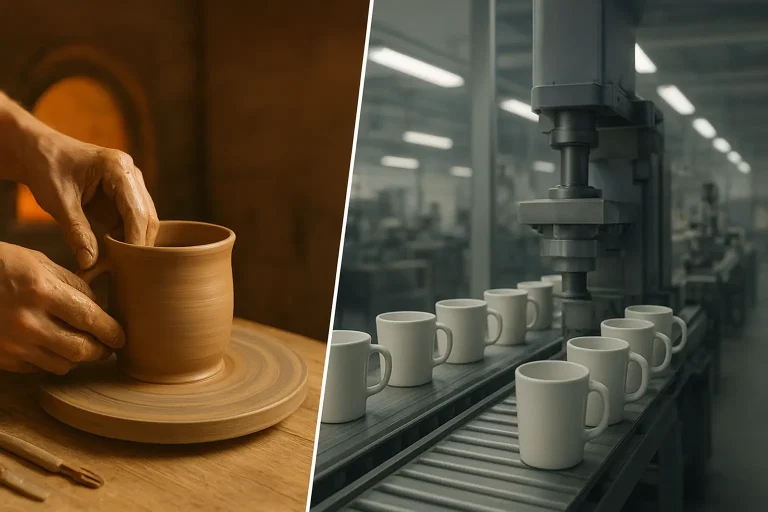
Most ceramic tile is formed by dry-pressing pre-mixed clay powder in a hydraulic press. Standard residential ceramic tile uses pressing forces of 2,000-4,000 tons per square meter. Porcelain tile for premium applications uses 5,000-7,000 tons per square meter.
Higher pressing force produces a denser, more uniform tile body with less internal porosity before firing. Porcelanosa’s documented 7,000-ton pressing specification is not marketing language. It directly produces the tile body density that enables water absorption below 0.05% after firing, because the starting material is already more compacted before heat treatment begins.
After pressing, tiles go through a continuous roller kiln dryer to remove residual moisture before firing. Tiles that enter the kiln with residual moisture above 0.5% by weight crack during the initial firing phase, a defect called thermal shock cracking. Quality manufacturers monitor moisture content before kiln entry to eliminate this failure mode.
Kiln Firing: Temperature Consistency Creates Technical Quality
Ceramic tile is fired in a continuous tunnel kiln at temperatures between 1,832°F and 2,372°F (1,000°C to 1,300°C) depending on the clay body. The critical variable is not the peak temperature but the consistency of temperature across the full kiln width at every point in the firing cycle.
Temperature variation of more than 18°F (10°C) across the kiln width produces tiles from the same batch with different water absorption figures and breaking strengths. This is the mechanism behind batch-to-batch color and technical variation in lower-cost imported tile, where kiln temperature control systems are less precise.
American domestic manufacturers including Daltile, American Olean, Florida Tile, and Crossville all use electronic kiln temperature monitoring with less than 9°F (5°C) variation across kiln width, documented in their ISO 9001 quality management certifications. This consistency is what enables the dye-lot stability and technical uniformity that makes these brands reliable choices for large installations.
Glaze Application and Surface Quality
The glaze on ceramic tile is a glass-forming compound applied as a liquid suspension before the final firing. The glaze’s chemistry determines surface hardness (Mohs scale), chemical resistance, and the visual finish. A properly fired ceramic glaze achieves 6-7 Mohs hardness, resistant to all household cleaning tools and most common abrasives.
Inkjet glaze printing technology allows manufacturers to deposit colorant patterns at 360-720 dpi resolution across the tile surface before firing. This technology, now standard at Marazzi, Emser, and Florida Tile, produces realistic wood-grain and stone-look surfaces that were impossible to replicate on ceramic tile before its introduction. The fired inkjet-printed surface has identical chemical resistance and hardness to any other glazed ceramic surface because the printing process deposits glaze colorants, not paint or surface coatings.
The manufacturing process determines whether a tile meets its published specifications. Brands that document their manufacturing standards with ISO certification and ANSI compliance testing give you verifiable confidence that the tile in the box matches the data sheet.
Ceramic Tile Durability: How Long Each Brand Actually Lasts
A properly specified and installed ceramic tile floor from any of the top eight brands in this guide should last 20-50 years with normal maintenance. Premature tile failure almost always traces back to incorrect specification, installation error, or maintenance neglect, not brand quality.
What Actually Causes Ceramic Tile to Fail Prematurely
The four most common causes of premature ceramic tile failure are: incorrect water absorption specification for the environment (using indoor tile outdoors), grout joint cracking from substrate movement without proper expansion joints, adhesive failure from using incorrect thinset for large-format tile, and glaze degradation from using abrasive cleaning tools on surfaces rated for foot traffic only.
None of these failures are caused by choosing a mid-range brand over a premium brand. They are specification and installation errors that occur regardless of brand quality.
The TCNA Handbook for Ceramic, Glass, and Stone Tile Installation documents that over 80% of tile installation failures investigated in warranty claims involve installation-related causes rather than manufacturing defects. This figure has remained consistent across the TCNA’s annual installer defect tracking data.
Maintenance Requirements by Brand and Finish Type
Glazed ceramic tile from any of the eight brands reviewed here requires no sealing after installation. The fired glaze surface is non-porous and does not absorb cleaning products, stains, or bacteria. Weekly cleaning with a pH-neutral cleaner and a microfiber mop is sufficient to maintain glazed ceramic tile indefinitely.
Unglazed porcelain and through-body tile (used in some commercial applications) requires annual sealing with a penetrating stone sealer to prevent surface staining. Unglazed tile has a matte, textured surface that provides excellent slip resistance but allows contaminants to penetrate the tile body if left unsealed.
Using abrasive scrubbing pads or acidic cleaners (vinegar-based or bleach-based cleaners above pH 8 or below pH 6) on glazed ceramic tile damages the glaze micro-surface over time, reducing its glossy reflectivity and eventually creating a surface that feels rough and shows visible dullness. For any glazed ceramic tile, the correct cleaning tool is always a soft microfiber cloth or mop with pH-neutral cleaner.
The lifespan of ceramic tile is a function of correct specification, professional installation, and appropriate maintenance in that order. Brand quality is the foundation, but it does not override the other three variables.
Ceramic Tile Buying Guide by Project Budget
Setting a realistic budget before visiting a showroom prevents the common mistake of selecting a tile at a price per square foot that, with labor and materials, produces a total installed cost above the project budget.
Total Installed Cost: What the Per-Square-Foot Price Does Not Include
Tile price covers only the material cost of the tile itself. A complete tile installation includes: tile material (add 10% for cuts and breakage), thinset mortar ($15-$40 per bag, covering 40-50 square feet), grout ($10-$25 per bag, covering 100-150 square feet), grout sealer, backer board or substrate preparation, and labor at $5-$15 per square foot for residential installation.
A $3-per-square-foot ceramic tile installed professionally in a 100-square-foot bathroom typically costs $800-$1,400 total, including materials and labor. A $15-per-square-foot premium tile in the same bathroom costs $2,500-$3,500 installed. The labor cost does not change proportionally with tile price, which means the percentage premium for upgrading to a higher-priced tile narrows significantly in total installed cost.
Use the table below to estimate total project cost across different tile price tiers for a standard 100-square-foot room.
Cost Reference
Ceramic Tile Total Installed Cost: Tile Price Tier by Room Size
All values estimated. Includes tile (plus 10% waste), thinset, grout, and professional labor at $8/sq ft. Find your tile tier and room size to see estimated total cost.
| Tile Price Tier | 50 sq ft | 100 sq ft | 200 sq ft | 400 sq ft |
|---|---|---|---|---|
| Budget ($1-$3/sq ft) | $500-$650 MSI, Daltile entry |
$900-$1,200 MSI, Daltile entry |
$1,700-$2,200 Most common residential |
$3,200-$4,200 MSI, Daltile entry |
| Mid ($4-$8/sq ft) | $650-$850 Marazzi, Am. Olean |
$1,200-$1,700 Marazzi, Am. Olean |
$2,200-$3,200 Marazzi, Am. Olean |
$4,200-$6,000 Marazzi, Am. Olean |
| Premium ($10-$20/sq ft) | $900-$1,400 Florida Tile, Crossville |
$1,700-$2,800 Florida Tile, Crossville |
$3,200-$5,200 Florida Tile, Crossville |
$6,000-$9,600 Florida Tile, Crossville |
| Luxury ($20-$35/sq ft) | $1,400-$2,100 Porcelanosa, Emser |
$2,800-$4,000 Porcelanosa, Emser |
$5,200-$7,500 Porcelanosa, Emser |
$9,600-$14,000 Porcelanosa, Emser |
Estimates based on professional labor at $8 per square foot, standard thinset and grout materials, and 10% tile overage for cuts and breakage. Complex patterns, heated floors, and substrate preparation add cost. Verified at time of publication.
For most residential tile projects in the 100-200 square foot range, the budget to mid-range tier from Daltile, Marazzi, or American Olean delivers the best combination of technical quality, design range, and total installed cost.
Ceramic Tile Trends: What the Top Brands Are Producing Now
The most significant current shift in the ceramic tile market is the move toward large-format tiles and away from the 12×12 inch standard that dominated residential installation for two decades. Large-format tiles (18×36 inches, 24×24 inches, and larger) create fewer grout joints, which reduces maintenance points and produces a cleaner visual aesthetic.
All eight brands reviewed in this guide now offer large-format tiles in their premium lines. The technical requirements for large-format installation are more demanding than standard tile, requiring flatter substrates, large-tile thinset, and more precise leveling systems during installation.
Wood-look ceramic plank tile is now the most specified product category across Daltile, Marazzi, and MSI based on their published sales data. Plank formats at 6×36 inches and 8×48 inches replicate hardwood flooring aesthetics with the durability and water resistance of ceramic tile. Marazzi’s Montagna line and Daltile’s Restore collection each offer over 30 color options in plank format at $3-$8 per square foot.
Outdoor-indoor continuity is the second major trend driving premium brand product development. Porcelanosa, Florida Tile, and Emser all offer collections where the same tile body, colorway, and surface texture is available in both interior-rated and exterior freeze-thaw-rated versions. This allows patio, entryway, and interior floor areas to use visually continuous tile surfaces across the indoor-outdoor transition.
Following where the top brands are investing their product development tells you which installation formats are growing and which are declining, which helps you make future-proof specification decisions for long-term installations.
Is Italian or Spanish Ceramic Tile Better Than American-Made?
Italian and Spanish ceramic tile manufacturers, including Porcelanosa (Spain) and the Italian Marazzi origin lines, pioneered the large-format pressing and inkjet printing technologies that are now standard across the global tile industry. Their technical quality in the premium segment is measurably superior to most imported budget tile. However, it is not measurably superior to domestic premium manufacturers like Crossville and Florida Tile on core ANSI benchmarks.
The practical differences between European and domestic premium tile fall into three categories: design aesthetics (European brands lead with more sophisticated surface treatments), dimensional precision (European large-format tile achieves tighter warpage tolerances), and supply chain reliability (domestic brands have shorter lead times and more accessible replacement inventory).
For specification-driven commercial projects where LEED documentation, short lead times, and long-term replacement availability matter more than design exclusivity, domestic brands from Crossville, Florida Tile, Daltile, and American Olean outperform European imports on total project value. For high-end residential and hospitality projects where the tile surface is part of the design statement, European brands from Porcelanosa and Marazzi’s Italian collections justify their premium.
The “Italian tile is better” assumption is marketing-influenced rather than technically accurate when comparing certified products from top domestic and European brands. Both tiers can produce ANSI-compliant tile with identical technical performance. The differences are in design sophistication, manufacturing consistency at the luxury tier, and supply chain factors that vary by project type.
Where to Buy Ceramic Tile from Top Brands
Each of the eight brands reviewed here is available through different distribution channels, and the channel affects price, availability, and support quality significantly.
Daltile, American Olean, and Marazzi are available at Home Depot and Lowe’s for standard residential product lines, and through Daltile sales service centers for commercial specification grades and premium collections. The service center route gives access to the full product catalog, professional pricing for contractors, and same-lot replacement availability that big-box retail cannot guarantee.
Florida Tile, Crossville, and Porcelanosa are sold exclusively through authorized tile showrooms and specification representatives. They are not available at big-box retail, which means pricing is typically by quote and project volume. This channel is appropriate for commercial projects, design-driven residential renovations, and any project where design consultation adds value.
MSI and Emser are available through a mix of big-box retail, independent tile showrooms, and flooring retailers. MSI’s big-box availability makes it the easiest brand to purchase for DIY installations without contractor relationships.
Purchasing through authorized specification channels rather than big-box retail gives access to full technical data sheets, dye-lot management for large projects, professional installation guidance, and warranty support that is not available through retail purchase. For any installation over 500 square feet, the specification channel route is worth the additional step of establishing a commercial account.
Is Ceramic Tile Food Safe After Installation?
Glazed ceramic tile installed correctly with a properly cured grout joint is food-safe and non-toxic for kitchen countertop and backsplash use. The fired ceramic glaze surface is chemically inert at normal food contact temperatures and does not leach compounds into food or liquids placed on it.
The food safety concern with ceramic tile is not the tile body itself but the grout joints. Cement-based grout is porous and can harbor bacteria if not sealed properly. For kitchen countertop applications, the safest approach is using an epoxy grout with zero porosity or sealing cement grout immediately after installation and resealing annually.
Lead and cadmium were historically used in some ceramic tile glazes as colorants and flux stabilizers. Current ANSI and European EN 14411 standards prohibit lead and cadmium in ceramic tile glazes intended for food contact surfaces. All eight brands reviewed in this guide produce glazes compliant with current lead-free and cadmium-free standards. Vintage or imported tile from unknown manufacturers without certification should not be used for food contact surfaces without independent laboratory testing.
What Is the Difference Between Ceramic and Porcelain Tile in Terms of Everyday Use?
In everyday residential use on indoor floors, the performance difference between quality ceramic tile (3-7% absorption) and porcelain tile (below 0.5% absorption) is minimal. Both surfaces clean identically with standard pH-neutral cleaners. Both achieve 6-7 Mohs glaze hardness when properly fired. Both last 20-plus years with correct installation on a stable substrate.
The difference becomes significant in three specific scenarios. First, outdoor and freeze-thaw environments where moisture infiltration causes ceramic to crack from within over multiple winters. Second, very heavy commercial traffic where porcelain’s higher breaking strength (300-900 lbf vs 150-300 lbf for ceramic) prevents tile cracking under impact loads. Third, radiant heat floors where porcelain’s lower absorption and denser body handles repeated thermal cycling with less grout joint cracking.
For a standard residential bathroom or kitchen floor installation in a climate without outdoor installation or radiant heat, the upgrade from ANSI-compliant ceramic to porcelain is a cost decision, not a performance necessity. Spending $4 per square foot on quality ceramic from Daltile or American Olean produces a floor that performs identically to $12 porcelain tile from the same brands under normal household conditions.
Can You Mix Ceramic Tile Brands in the Same Installation?
Mixing tile brands in the same continuous floor surface is technically possible but carries significant risk of dimensional inconsistency, color variation, and grout line misalignment. Even when two brands list the same nominal tile size (12×12 inches), actual produced dimensions vary by up to 3/16 inch between manufacturers due to different warpage and sizing tolerances in their production processes.
Within a single room, mixing brands creates visible lippage and irregular grout lines that cannot be corrected after installation without removing and resetting tile. The only acceptable mixing scenario is where different brands are used in separate rooms or separated by a transition strip that accommodates dimensional differences.
For repairs, always use tile from the same brand, same product line, and same dye lot as the original installation. Color matching between brands is not reliable even for tiles with identical color names. Daltile’s “arctic white” and Marazzi’s “arctic white” are different tile bodies with different colorant chemistry, and they will not match visually side by side after firing.
What Happens If You Use the Wrong Thinset for Ceramic Tile?
Using the wrong thinset for a ceramic tile installation produces one of three failure modes depending on the error: lippage and drummy tiles from using standard thinset under large-format tile, adhesion failure and tile delamination from using non-polymer-modified thinset in wet areas, and tile cracking from using rigid thinset over a substrate with thermal movement.
Standard gray thinset (Type I) is appropriate for tiles under 15 inches in dry interior locations over stable concrete substrates. For wet areas, all thinset must be latex or polymer-modified to achieve the water resistance required by ANSI A118.11. For large-format tile over 15 inches, medium-bed mortar with extended open time is required to allow full back-buttering and level adjustment before the mortar skins over.
The TCNA Handbook specifies the correct thinset type for every substrate and tile combination. This specification document is available free from the Tile Council of North America website and is the definitive reference for installer specification decisions. Deviating from TCNA thinset recommendations voids most tile manufacturer warranties.
Is Ceramic Tile Safe for Outdoor Use in Freezing Climates?
Standard ceramic tile with water absorption above 0.5% is not safe for outdoor use in climates that experience sub-freezing temperatures. The failure mechanism is ice expansion: water absorbed into the tile body expands by approximately 9% when it freezes, creating internal pressure that fractures the tile from within. This damage is visible as surface spalling, cracking, or tile pieces separating from the installation surface.
Only tile with a manufacturer-issued freeze-thaw certification is appropriate for outdoor installations in freeze-thaw climates. This certification documents that the tile body has been tested through multiple freeze-thaw cycles (typically 300 cycles at ASTM C1026 standard) without structural degradation. Freeze-thaw certified tile typically has water absorption below 0.1% (impervious classification) and is the same product classified as porcelain under ANSI A137.1.
All eight brands reviewed in this guide offer at least one freeze-thaw certified product line. Verify certification on the specific product’s technical data sheet before purchasing for any outdoor application. A tile described as “suitable for outdoor use” without a specific freeze-thaw certification test result is marketing language, not a technical guarantee.
How Do You Know If a Ceramic Tile Is Food Safe for Kitchen Countertops?
A ceramic tile is food safe for kitchen countertop use when it meets three conditions: the glaze is certified lead-free and cadmium-free under current ANSI or EN 14411 standards, the tile surface has a PEI rating of at least 2 (sufficient for light countertop use), and the installation uses food-safe grout (epoxy grout or properly sealed cement grout renewed annually).
Request the tile’s safety data sheet from the manufacturer to verify lead and cadmium compliance. All current production from Daltile, Marazzi, American Olean, Florida Tile, Emser, MSI, Crossville, and Porcelanosa meets current lead-free and cadmium-free standards. Vintage tile, salvage tile, or imported tile without current certification documentation should be tested by an independent laboratory before installation on food contact surfaces.
The grout joint is the most vulnerable point in a countertop tile installation for food safety. Sealed cement grout resists bacteria when resealed annually. Epoxy grout eliminates porosity entirely and does not require periodic sealing, making it the safer long-term choice for kitchen countertop applications.
What Causes Ceramic Tile to Crack After Installation?
Ceramic tile cracks after installation for four primary reasons, none of which are caused by tile quality when using ANSI-compliant tile from a reputable brand. The most common cause is substrate movement: tiles installed over a substrate that flexes, settles, or shifts transmit that movement directly to the tile surface, causing diagonal crack patterns that originate from corner to corner across individual tiles.
The second cause is inadequate thinset coverage. ANSI A108 requires 95% thinset coverage beneath floor tiles. Tiles with voids under the surface have no support at those points and crack when weight is applied over the unsupported area. This is why back-buttering large-format tiles is mandatory, not optional.
The third cause is missing expansion joints. The TCNA specifies that expansion joints must be placed at every change of plane, every 20-25 feet in interior installations, and at every perimeter wall. Tiles installed without proper expansion joints crack as the installation expands and contracts seasonally, transmitting stress to the tile rather than to the flexible joint.
The fourth cause is freeze-thaw damage from water absorption in incorrectly specified tile. This failure looks like surface spalling (tile surface flaking off in thin layers) rather than diagonal cracking, and it occurs exclusively outdoors or in unheated spaces in cold climates.
Do Ceramic Tiles Need to Be Sealed After Installation?
Glazed ceramic tiles do not need sealing after installation. The fired glaze surface is non-porous and does not absorb liquids, stains, or cleaning chemicals. Applying a surface sealer to glazed ceramic tile produces no benefit and can leave a residue that dulls the glaze finish.
Unglazed ceramic and unglazed porcelain tiles do require sealing with a penetrating impregnating sealer before grouting and annually afterward to prevent staining. Unglazed surfaces used in commercial applications for their natural non-slip texture absorb oil, food, and cleaning products permanently if left unsealed.
Grout always requires sealing regardless of tile type. Cement-based grout is porous and absorbs staining agents within hours of exposure on an unsealed surface. Apply a penetrating grout sealer within 72 hours of grout curing completion and reapply annually in high-use areas. This single maintenance step extends a tile installation’s visual quality indefinitely by preventing the gray-black staining that makes grout joints the most visually deteriorated part of older tile installations.
Choosing the right ceramic tile brand for your project comes down to matching ANSI specifications to your installation environment, not chasing the highest price per square foot. Daltile and American Olean deliver reliable ANSI-compliant quality for most residential and commercial needs at $1.50-$12 per square foot. Florida Tile and Crossville add documented sustainability credentials for LEED projects. Porcelanosa and Emser justify their premium for design-forward installations where dimensional precision and visual impact drive the specification. Start with the technical requirements for your environment, verify water absorption and PEI rating against the ANSI thresholds, then choose within the qualifying brands based on design and budget. That sequence eliminates the most common and most expensive tile specification mistakes before installation begins.