Is Ceramic Coating Worth It for Your Car? An Honest Assessment

Ceramic coating is not a wax or a sealant. It is a semi-permanent glass layer, composed of silicon dioxide (SiO2), that chemically bonds to your car’s paint and cures to a hardness of 9H on the pencil hardness scale, compared to standard clear coat which sits at around 2H-4H.
Whether that protection is worth $500 to $2,500 depends entirely on how long you plan to keep the car, what you drive, and whether you are willing to maintain the coating correctly after application.
What Is Ceramic Coating and How Does It Actually Work?
Ceramic coating is a liquid polymer, primarily silicon dioxide (SiO2) derived from quartz, that is applied by hand to a vehicle’s exterior surfaces. When it cures, it forms a covalent bond with the factory clear coat rather than sitting on top like a wax layer.
This bonding mechanism is the core reason ceramic coatings outperform traditional paint protection products. Wax sits in the clear coat’s microscopic pores and is removed by washing, UV exposure, and heat. Ceramic coating fills and bonds to those pores permanently at the molecular level.
Key Specifications (Professional-Grade Ceramic Coating):
- Primary active ingredient: SiO2 (silicon dioxide), 70-95% concentration in professional formulas
- Cured hardness: 9H on the pencil hardness scale
- Thickness after cure: 1-2 microns per layer
- Water contact angle: 100-115 degrees (hydrophobic surface)
- Typical lifespan: 2-5 years for consumer-grade, 5-10 years for professional-grade
- UV resistance: blocks UV oxidation that degrades clear coat by 70-90% according to manufacturer testing data
The curing process requires a controlled environment. Most professional-grade coatings need 24-72 hours at temperatures between 60-77°F (15-25°C) with humidity below 70% to cure fully.
Consumer spray coatings sold at auto parts stores typically contain 5-15% SiO2. Professional installer products contain 70-95% SiO2 and require infrared curing lamps to achieve maximum hardness. That concentration gap is the primary reason professional installation costs 10-15 times more than a DIY spray.
What Does Ceramic Coating Actually Protect Against?
Ceramic coating protects against UV oxidation, chemical etching from bird droppings and acid rain, light swirl marks from washing, water spots from mineral deposits, and surface contamination from industrial fallout. It does not protect against deep scratches, rock chips, or keying.
Understanding this protection boundary prevents the most common buyer disappointment with ceramic coatings.
UV Protection and Paint Oxidation
UV radiation breaks down the polymer chains in clear coat through a process called photooxidation. Oxidized clear coat turns chalky, loses gloss, and eventually begins to peel.
Ceramic coating’s SiO2 layer reflects UV radiation before it reaches the clear coat. This is the same mechanism as UV-blocking glass. According to testing by detailing industry publication Detail King, a properly applied 9H ceramic coating reduces UV-induced clear coat degradation by approximately 70% compared to unprotected paint over a five-year outdoor exposure period.
Chemical Resistance and Bird Dropping Etching
Bird droppings contain uric acid at a pH of 3-4.5. When a dropping lands on warm paint, the acid etches into the clear coat as the surface cools and contracts around it. This process takes as little as 30 minutes on a hot day.
Ceramic coating raises the surface’s chemical resistance. The SiO2 glass layer resists acids up to approximately pH 2, meaning most bird dropping etching stops at the coating surface rather than penetrating into the clear coat. If you remove the dropping within a few hours, the coating typically shows no permanent mark.
If you leave a dropping on a ceramic-coated surface for more than 12-24 hours in hot weather, the acid can still etch the coating itself. The protection delays damage, but it does not eliminate it entirely.
Hydrophobic Effect and Water Spot Prevention
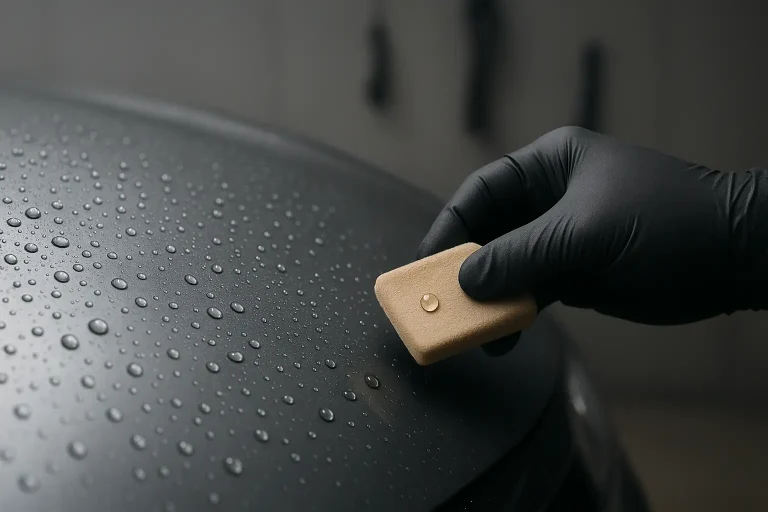
The ceramic coating’s smooth, non-porous surface creates a water contact angle of 100-115 degrees. Water beads into tight spheres and rolls off the surface rather than sheeting across it.
This hydrophobic effect carries mineral deposits (calcium, magnesium) off the surface with the water droplet rather than leaving them behind as spots when water evaporates. Water spots are the leading cause of paint marring in daily driving conditions, according to car care industry research compiled by the International Detailing Association.
The hydrophobic effect degrades over time. A coating at 80% hydrophobic performance still beads water but the contact angle drops to around 85-90 degrees. Most coatings reach this point at 18-36 months depending on climate and maintenance frequency.
What Ceramic Coating Cannot Do
Ceramic coating will not stop rock chips. A 9H hardness rating describes resistance to surface marring, not impact resistance. A stone traveling at 60 mph carries enough kinetic energy to penetrate any ceramic layer and chip the underlying paint regardless of coating thickness.
For rock chip protection, paint protection film (PPF) is the correct product. PPF is a thick thermoplastic urethane layer (typically 6-8 mil, or 150-200 microns) compared to ceramic coating’s 1-2 microns. The two products serve different protection functions and are often installed together on high-risk areas.
Ceramic coating also will not repair existing paint defects. Swirl marks, scratches, and water spots that exist before coating application will be locked under the glass layer permanently. This is why professional installers require a full paint correction (machine polishing) before coating application, which adds $300-800 to the total project cost.
For a complete breakdown of the application process, products available, and what to expect at each price tier, the full ceramic coating guide for car owners covers every stage from surface prep through long-term maintenance.
How Much Does Ceramic Coating Cost?
Professional ceramic coating installation costs $500-$2,500 for a standard passenger vehicle, depending on the product tier, vehicle size, and whether paint correction is included. DIY consumer kits cost $30-$150 but deliver significantly lower SiO2 concentration and shorter protection life.
Here is a breakdown of realistic cost ranges by tier.
Use the table below to match your budget and expectations to the correct ceramic coating tier before committing to a product or installer.
| Tier | Cost Range | SiO2 Concentration | Expected Lifespan | Paint Correction Included | Who It Is For |
|---|---|---|---|---|---|
| DIY spray coating | $30-$80 | 5-15% SiO2 | 6-12 months | No | Budget protection, lease vehicles, short-term ownership |
| DIY professional-formula kit | $80-$150 | 30-50% SiO2 | 1-3 years | No | Experienced detailers comfortable with paint correction |
| Entry professional install | $500-$900 | 70-85% SiO2 | 2-4 years | Usually basic one-stage | Daily driver, 3-5 year ownership plan |
| Mid-tier professional install | $900-$1,500 | 85-92% SiO2 | 4-7 years | Yes, two-stage correction | New or near-new vehicles, 5+ year ownership |
| Premium professional install | $1,500-$2,500+ | 92-95% SiO2 | 7-10 years | Yes, full multi-stage correction | Luxury or exotic vehicles, concours-level finish goals |
| Fleet/commercial coating | $200-$500 per vehicle (volume) | 50-70% SiO2 | 2-3 years | No, or basic wash only | Commercial fleets prioritizing wash speed over finish quality |
The single biggest cost variable beyond the coating product itself is paint correction. If your vehicle’s paint has swirl marks, light scratches, or water spot etching, a professional will require correction before coating. Skipping this step locks existing defects under the glass layer permanently.
Paint correction alone costs $300-$800 for a standard vehicle at a reputable shop. Many installers price correction and coating as a bundled service, which is typically 15-20% cheaper than purchasing them separately.
Is Ceramic Coating Worth It? The Honest Cost-Benefit Analysis
Ceramic coating is worth the investment if you own your vehicle for more than three years, park outdoors regularly, and are willing to wash your car every two weeks with a pH-neutral soap. It is not worth the investment for leased vehicles, cars washed infrequently, or owners expecting it to eliminate all maintenance.
The financial case for ceramic coating is built on two calculable savings: reduced detailing costs and preserved resale value.
Reduced Detailing Costs Over Time
An uncoated vehicle typically needs a full detail (wash, clay bar, polish, wax) every 3-6 months to maintain paint condition. At professional detailing rates of $150-$350 per full detail, that represents $300-$700 per year in maintenance cost.
A ceramic-coated vehicle requires a professional detail every 12-18 months rather than every 3-6 months, because the coating resists contamination and water spots. Annual detailing cost drops to $150-$350 per year, saving $150-$350 annually compared to an uncoated vehicle.
Over a five-year ownership period, that saving totals $750-$1,750. A mid-tier professional coating installation at $900-$1,500 pays for itself in detailing savings alone within three to five years on most vehicles.
Resale Value Preservation
Paint condition is the single largest factor in used vehicle appraisal after mileage and mechanical condition. According to data from used car valuation platform iSeeCars, vehicles with documented paint protection (including ceramic coating records) sell for 5-10% more than comparable vehicles without it in the $20,000-$50,000 price range.
On a $35,000 vehicle, a 5% resale premium equals $1,750 in recovered value. A $900 coating installation that returns $1,750 at resale produces a net return of $850, without counting any detailing savings accrued during ownership.
This math only holds if you keep documentation of the coating installation and the coating is still in serviceable condition at resale. A neglected, degraded coating actually reduces resale appeal because a buyer perceives it as a maintenance liability rather than an asset.
When Ceramic Coating Is Not Worth It
If you lease your vehicle and return it within 36 months, a professional ceramic coating will not pay for itself. The detailing savings over three years are unlikely to exceed the installation cost.
If you park in a covered garage and wash your car weekly, your paint is already well-protected by habit and environment. The marginal benefit of coating narrows significantly for garage-kept vehicles in mild climates.
If your existing paint has significant rock chips, deep scratches, or prior bodywork, coating will not improve the underlying condition. In these cases, a paint protection film wrap on vulnerable panels is a better first investment.
For perspective on how ceramic coating’s cost-benefit analysis compares to other ceramic-based automotive products, the honest cost-benefit breakdown of ceramic window tint follows the same framework and is worth reviewing if you are budgeting for multiple protection upgrades at once.
The decision ultimately depends on ownership duration: owners keeping a vehicle five or more years in outdoor conditions will almost always come out ahead financially with a professional ceramic coating.
The value-versus-cost gap between ceramic coating tiers becomes clearest when you compare specific product categories side by side.
VALUE ANALYSIS
When Premium Ceramic Coating Wins and When It Does Not
Performance gap between premium and budget ceramic coating options by category
Premium wins big
Premium wins big
Premium usually wins
Premium usually wins
Gap is small
Gap is small
Editorial assessment based on SiO2 concentration data, installer documentation, and independent detailing industry testing. Not a sponsored ranking.
Ceramic Coating vs Wax vs Paint Protection Film: Which Protection Is Right for You?
Ceramic coating, carnauba wax, synthetic sealant, and paint protection film (PPF) are four distinct product categories that protect paint through different mechanisms at different price points. They are not interchangeable substitutes. Each is the correct choice for a specific ownership profile.
Use the table below to match your vehicle situation, budget, and protection priorities to the right product category.
| Product | Cost Range | Protection Mechanism | Lifespan | Rock Chip Protection | UV Resistance | Best For |
|---|---|---|---|---|---|---|
| Carnauba wax | $15-$80 DIY | Fills clear coat pores with natural wax layer | 4-8 weeks | None | Low (degrades in UV) | Show cars, garage-kept vehicles wanting short-term gloss |
| Synthetic paint sealant | $20-$100 DIY | Polymer bonds to clear coat surface | 4-12 months | None | Moderate | Budget-conscious owners, lease returns, mild climates |
| DIY ceramic spray coating | $30-$80 | Low-concentration SiO2 surface bond | 6-12 months | None | Good (better than wax or sealant) | First-time protection buyers, high-turnover ownership |
| Professional ceramic coating | $500-$2,500 | High-concentration SiO2 covalent bond to clear coat | 3-10 years | None (swirl resistance only) | Excellent (70-90% UV reduction) | Long-term ownership (3+ years), outdoor parking, resale value focus |
| Paint protection film (PPF) only | $800-$3,000 (partial) / $3,000-$8,000+ (full) | Thick thermoplastic urethane physical barrier | 5-12 years | Excellent (150-200 microns thick) | Good | High-mileage highway drivers, gravel road exposure, exotic vehicles |
| PPF + ceramic coating combined | $2,500-$8,000+ | Physical impact barrier plus chemical resistance layer | 5-10 years | Excellent | Excellent | New luxury or exotic vehicles, maximum long-term protection budget |
The most common buyer mistake is treating these products as competing alternatives rather than as tools serving different jobs. PPF and ceramic coating are frequently installed together. PPF goes on the front bumper, hood leading edge, rocker panels, and door edges, where rock chips are most likely. Ceramic coating goes over the entire vehicle including the PPF, adding chemical resistance and hydrophobic performance to the physical protection film provides.
Professional Installation vs DIY Ceramic Coating: Which Should You Choose?
Professional installation is worth the premium if your vehicle has paint defects requiring correction, if you have no prior experience with paint decontamination, or if you want a warranty-backed result lasting five or more years. DIY ceramic coating is a legitimate choice for experienced detailers applying to vehicles in good paint condition who accept a 1-3 year performance window.
The gap between professional and DIY results is not primarily about the coating product itself. It is about surface preparation.
Why Surface Preparation Determines the Final Result
Ceramic coating bonds directly to whatever surface it contacts. If the surface contains bonded iron particles, tar deposits, paint overspray, swirl marks, or water spot etching, the coating locks all of those defects in permanently.
Professional preparation for a ceramic coating installation follows this sequence: foam cannon pre-wash to remove loose contamination, iron remover to dissolve embedded brake dust (iron decontamination), clay bar treatment to remove bonded surface contaminants, machine polish (one or two stages) to remove swirl marks and scratches, and IPA wipe-down to strip all polish oils before coating application. This process takes a professional detailer 8-16 hours on a standard passenger vehicle.
DIY installers who skip or abbreviate any of these steps produce a result that looks identical immediately after application but degrades faster and traps defects that become visible under direct sunlight within 12 months.
How to Apply Ceramic Coating at Home (Step by Step)
If you have prior detailing experience and your vehicle’s paint is in good condition (no visible swirl marks or water spots), a DIY ceramic coating application using a quality consumer kit like a professional-formula DIY ceramic coating kit can deliver 1-3 years of real protection. Here is the complete process.
- Wash and decontaminate (2-4 hours): Wash the vehicle with pH-neutral soap, apply a dedicated iron remover and paint decontamination spray, then clay bar the entire surface. The paint should feel smooth as glass when you run a plastic bag over it. If it still feels gritty, the clay bar stage is incomplete.
- Polish if needed (1-4 hours): Under a work light in a dark environment, inspect the paint for swirl marks. If visible, use a dual-action orbital polisher with a light polish to remove them before coating. Do not coat over unaddressed paint defects.
- IPA wipe-down (30 minutes): Wipe the entire surface with an isopropyl alcohol solution (10-15% IPA diluted in distilled water) on a clean microfiber. This removes all polish oils and residue. The ceramic coating will not bond correctly to an oily surface.
- Apply the coating in a cool, shaded area (1-2 hours): Work in 2×2 foot sections. Apply 3-5 drops of coating to the suede applicator block. Spread in straight overlapping lines, then cross-hatch at 90 degrees. Wait 1-3 minutes (check the product instructions for the specific flash time). Buff off with a clean high-gsm microfiber towel using light pressure. Missed flash-off creates high spots (streaks that cure into the glass layer).
- Cure for 24-48 hours: Keep the vehicle dry and out of direct sunlight for 24 hours. Full chemical cure takes 7 days. Do not wash the vehicle or expose it to rain during this period.
The most common DIY failure is working in direct sunlight, which accelerates flash time unpredictably and causes high spots. Always work indoors or in deep shade at temperatures between 60-77°F (15-25°C).
How to Maintain a Ceramic Coating to Maximize Its Lifespan
Ceramic coating maintenance requires washing every 2-4 weeks with pH-neutral car wash soap (pH 6-8), avoiding automatic brush car washes, and applying a ceramic coating topper every 3-6 months. Correct maintenance extends a professional coating’s life to its full rated period. Poor maintenance cuts that period in half.
The coating’s hydrophobic performance is the easiest way to assess its condition. When beading drops below a tight sphere and water begins to sheet rather than bead, the coating needs a decontamination wash and a maintenance topper.
Products That Damage Ceramic Coating
Alkaline wash products (pH above 8) strip the coating’s hydrophobic top layer with repeated use. Many “all-purpose cleaners” and traffic film removers used at automatic car washes are pH 10-13. A single high-pH wash will not destroy the coating, but monthly exposure to alkaline products degrades the coating by 30-40% faster than neutral pH washing, according to coating manufacturer Gyeon’s published chemical resistance data.
Abrasive automatic car washes (brush-style, not touchless) physically abrade the coating surface, reducing the water contact angle by 5-10 degrees per wash cycle. Over 12 months of weekly brush-car-wash use, a professional coating loses approximately 50% of its hydrophobic performance, reducing its effective lifespan from 5 years to under 3 years.
Use a pH-neutral car wash soap rated safe for ceramic coatings and a two-bucket wash method with microfiber wash mitts to preserve the coating’s surface integrity.
Ceramic Coating Toppers and Maintenance Sprays
A ceramic coating topper (also called a spray coating or SiO2 boost spray) is a low-viscosity SiO2 product applied after washing every 3-6 months. It refreshes the hydrophobic layer on the coating surface without requiring any surface preparation.
Toppers extend the coating’s hydrophobic performance but do not add thickness to the base coating. Think of them as a maintenance product for the coating, not an additional coating layer.
SiO2 maintenance spray toppers cost $20-$50 per bottle and a single bottle covers a standard passenger vehicle 4-8 times. Applied quarterly, the annual cost is $30-$80. This is the most cost-effective way to maintain a professional coating at peak performance between detail appointments.
Common Ceramic Coating Problems and How to Fix Them
The most common ceramic coating problems are high spots (streaky areas of over-cured coating), premature hydrophobic loss, and rainbow oil-slick appearance. All three are preventable, and two of the three are fixable after the fact.
High Spots After Application
High spots appear as streaky, hazy areas on the paint surface that are visible in direct light. They form when coating is not buffed off before it cures past its flash point. Flash time varies by temperature and humidity. At 77°F (25°C) in 50% humidity, most professional coatings have a 2-4 minute window. At 90°F (32°C), that window drops to under 90 seconds.
If caught within 12 hours of application, high spots can be removed by applying a small amount of fresh coating over the spot and buffing off immediately. If the coating has cured for more than 24 hours, the only fix is machine polishing to remove the hardened layer and reapplying. This is why DIY application in direct sunlight is the single most common error leading to failed results.
Premature Water Spot Formation
If water spots appear on a ceramic-coated surface within the first six months, the cause is almost always mineral-rich water (hard water) left to air-dry on the coating surface. Ceramic coating repels water but does not repel the dissolved calcium and magnesium in the water. When the water evaporates, the minerals remain as spots.
The fix is a dedicated water spot remover formulated for ceramic-coated surfaces, followed by a maintenance topper. Do not use abrasive polish to remove water spots from a coated surface. Abrasive polish will remove the coating along with the spots.
Coating Delamination or Peeling
Ceramic coating does not peel like wax or vinyl. If a coating appears to be peeling, the underlying clear coat is failing, not the coating itself. This occurs when coating is applied to paint with existing clear coat failure, or when the surface was not fully decontaminated before application and the coating bonded to a contamination layer rather than to the clear coat directly.
Delamination is not repairable by recoating. It requires paint correction or bodywork to remove the failing clear coat layer before any new protection product can be applied effectively.
Choosing a Ceramic Coating Installer: What to Look For
A reputable ceramic coating installer holds brand-specific certification from the coating manufacturer (Ceramic Pro, Gtechniq, Gyeon, or similar), has an enclosed climate-controlled bay for curing, performs paint correction before every coating application, and provides a written warranty tied to the specific coating product installed.
Brand certification means the installer has completed manufacturer training and uses genuine product rather than a diluted or counterfeit formula. Ceramic Pro, for example, requires installers to complete in-person training and maintain minimum annual volume to retain Gold, Silver, and Bronze certification status.
Questions to Ask Before Booking
Ask whether paint correction is included in the quoted price and what stage of correction (one-stage cut and polish, or two-stage with finishing polish) is performed. Ask to see a portfolio of completed vehicles showing paint correction results under UV inspection lights.
Ask what coating product is being applied and what its published SiO2 concentration is. A reputable installer will name the product and show you the product data sheet. An installer who is vague about the specific product being applied is a warning sign.
Ask whether the quote includes any follow-up inspection at 30 days post-installation. Most professional installers include a 30-day check where they inspect the coating under UV light for missed spots or early adhesion issues. This is a quality signal that separates detail shops applying coating as an upsell from dedicated ceramic coating specialists.
For context on how ceramic coating pricing compares to other automotive glass and surface protection products on a per-square-foot basis, the ceramic tint pricing breakdown by vehicle type provides a useful parallel cost framework for budgeting multiple protection products simultaneously.
Ceramic Coating for Different Vehicle Types: Does the Math Change?
The cost-benefit calculation for ceramic coating shifts significantly depending on whether you are coating a daily driver, a luxury vehicle, a weekend sports car, a truck used for work, or a classic restoration. The protection priorities, realistic cost, and payback period differ for each category.
Use the table below to identify how the value case changes by vehicle type and usage pattern.
| Vehicle Type | Recommended Tier | Estimated Cost | Primary Benefit | Payback Period | Worth It? |
|---|---|---|---|---|---|
| Daily driver (economy or mid-size) | Entry professional or DIY kit | $80-$900 | Reduced wash maintenance, UV protection | 3-4 years via detailing savings | Yes, if keeping 3+ years |
| New luxury vehicle ($40,000+) | Mid-tier or premium professional | $1,200-$2,500 | Resale value preservation, paint depth maintenance | 2-3 years via resale premium | Yes, strong case |
| Exotic or supercar ($100,000+) | Premium + PPF combination | $3,000-$8,000+ | Full paint protection, resale value, rock chip resistance | Immediate (resale and preservation value) | Yes, essentially mandatory |
| Weekend sports car (low mileage) | Mid-tier professional | $900-$1,500 | UV protection during storage, wash ease | 4-5 years | Yes, low maintenance case |
| Work truck (heavy use, scratches likely) | Entry professional or skip coating | $500-$900 | Chemical resistance, easier cleaning of grime | Unlikely to pay back on work vehicles | Marginal, PPF on rocker panels is better investment |
| Leased vehicle (return in 24-36 months) | DIY spray or skip | $30-$80 | Minimal maintenance between washes | No payback; lease return conditions do not reward coating | No, for professional installation |
Classic and restoration vehicles deserve a separate note. Paint on a restored classic is often resprayed urethane base coat/clear coat rather than factory original clear coat. Ceramic coating bonds to urethane clear coat identically to factory clear coat, and UV protection is particularly valuable for vehicles that spend time at outdoor shows. A mid-tier professional installation on a concours-quality restoration is a legitimate preservation investment.
Top Ceramic Coating Products: Professional and DIY Options Compared
The ceramic coating market divides cleanly into professional installer-only products (sold exclusively through certified installers), semi-professional DIY kits requiring prior detailing experience, and consumer spray products requiring no preparation knowledge.
Professional Installer Products
Ceramic Pro 9H is the market-leading professional coating by installed volume. It is sold exclusively through Ceramic Pro certified installers and comes with a manufacturer-backed warranty of 5 years (Silver Package) or lifetime (Gold Package). SiO2 concentration is listed at 85-95% by the manufacturer. Ceramic Pro does not publish exact concentration by product tier.
Key Specifications (Ceramic Pro 9H):
- SiO2 concentration: 85-95% (manufacturer stated)
- Cured hardness: 9H
- Water contact angle: 110 degrees
- Flash time at 77°F (25°C): 2-3 minutes
- Full cure: 7 days
- Warranty: 5 years (Silver) or lifetime (Gold Package)
Gtechniq Crystal Serum Ultra is the preferred choice of many independent professional detailers for its two-layer system: a 9H base layer and a 7H top layer applied over it. The 7H top layer is designed to be sacrificial, meaning minor surface marring affects the 7H layer rather than the 9H base. This allows the top layer to be polished and reapplied without disturbing the base coat. Gtechniq backs Crystal Serum Ultra with a 9-year warranty when applied by an accredited installer.
Key Specifications (Gtechniq Crystal Serum Ultra):
- System: two-layer (9H base + 7H top)
- Cured hardness: 9H base, 7H top
- Water contact angle: 115 degrees
- Warranty: 9 years (accredited installer only)
- Typical install cost: $1,200-$2,000 (coating only, excluding paint correction)
DIY Professional-Formula Kits
Gyeon Q2 Mohs is one of the few professional-formula products available for direct consumer purchase. It contains a higher SiO2 concentration than consumer spray products and delivers 2-3 years of protection with correct application. It requires prior decontamination and IPA prep and is not forgiving of application errors.
Mothers CMX Ceramic Coat is an accessible entry-level option for first-time ceramic coating users. It is more forgiving during application than professional formulas and delivers 12-18 months of hydrophobic protection at a significantly lower cost and skill threshold. It does not replace a professional installation for long-term protection goals, but it is a reasonable starting point for owners new to the product category.
Turtle Wax Hybrid Solutions Ceramic Spray is the most accessible consumer product in the category. It is applied like a spray detailer rather than a traditional coating and requires no flash-time management. Its protection window is 6-12 months, making it appropriate for lease vehicles, budget-conscious owners, or as a maintenance layer over an existing professional coating.
Ceramic Coating Myths Worth Addressing Directly
Several claims circulate in ceramic coating marketing that have little basis in independent testing. Addressing them directly helps buyers make decisions based on accurate expectations rather than marketing language.
Myth: Ceramic coating makes your car self-cleaning. Ceramic coating makes washing easier by preventing contamination from bonding to the surface, but it does not eliminate the need to wash. Dust, pollen, and light dirt still accumulate on the coating surface and require regular washing to prevent buildup that reduces hydrophobic performance.
Myth: A 9H coating prevents rock chips. The 9H hardness rating applies to the pencil hardness scale used for surface scratch resistance testing. It does not measure impact resistance. A 9H ceramic coating is 1-2 microns thick. A rock chip at highway speed carries enough energy to penetrate any practical coating thickness. PPF is the correct product for impact protection.
Myth: Ceramic coating is permanent. No ceramic coating is permanent. All coatings degrade under UV exposure, chemical contact, and mechanical abrasion over time. Professional coatings last 5-10 years with correct maintenance. Consumer products last 6-24 months. The term “permanent” in some marketing materials refers to the bonding mechanism (covalent bond rather than surface adhesion) rather than the coating’s service life.
Myth: You can apply ceramic coating over existing wax or sealant. Wax and polymer sealant residue prevents ceramic coating from forming a direct covalent bond with the clear coat. All existing wax and sealant must be removed by clay bar treatment and IPA wipe-down before coating application. Coating applied over wax contamination adheres to the wax layer rather than the paint and peels or degrades within weeks.
Frequently Asked Questions About Ceramic Coating for Cars
Can I apply ceramic coating over paint protection film (PPF)?
Yes, ceramic coating applies directly over cured PPF and is recommended for most PPF installations. The coating adds chemical resistance, hydrophobic performance, and UV protection to the PPF surface. Most PPF manufacturers recommend waiting at least 7 days after PPF installation before applying a ceramic coating to ensure the film adhesive has fully cured. Ceramic coating on PPF does not affect the film’s self-healing properties on products with that feature.
How long after application can I wash my car?
Most professional ceramic coatings require 7 days without washing or water contact to achieve full chemical cure. The first 24 hours are the most critical: water contact during this window can cause the coating to streak, blush, or delaminate in spots. After 7 days, use pH-neutral soap and a two-bucket wash method for the first month to avoid any mechanical stress on the curing surface.
Does ceramic coating change the look or color of my paint?
Ceramic coating adds gloss depth and clarity to paint by creating a smoother, more reflective surface than clear coat alone. It does not change the actual color. Dark colors (black, dark blue, dark grey) show the most visible improvement in depth and reflectivity after coating. White and silver vehicles show less visual change but still benefit from the protection and easier wash performance. A coating will not correct dull or faded paint. Only machine polishing before coating can restore paint clarity.
What happens if ceramic coating is applied in cold weather?
Ceramic coating requires temperatures above 50°F (10°C) for proper curing. Below this temperature, the SiO2 crosslinking reaction slows significantly and the coating may not achieve full hardness. Professional installers use climate-controlled bays and infrared curing lamps to maintain correct curing temperatures year-round. DIY application in an unheated garage in winter temperatures below 50°F will result in significantly reduced coating hardness and shortened lifespan. If outdoor or garage temperatures are below 60°F, delay application until conditions improve or use a portable infrared lamp.
Is ceramic coating food-safe or safe for wheel surfaces that touch brake components?
Ceramic coating applied to wheel faces is safe and actually beneficial: it resists brake dust bonding and makes wheels significantly easier to clean. The coating is not applied to brake rotors, calipers, or any component that operates at temperatures above 900°F (480°C), as the coating degrades rapidly above these temperatures. The coating on wheel faces operates in the 200-300°F range during normal driving and performs normally at those temperatures. Ceramic coating is chemically inert after cure and is non-toxic on exterior vehicle surfaces.
Can ceramic coating be removed if I want to sell the car without it?
Ceramic coating cannot be removed with wax strippers or paint cleaners. Removal requires machine polishing with a cutting compound to abrade the coating layer off the clear coat surface. Professional coating removal costs $200-$500 at a detail shop. In practice, buyers almost never request coating removal. A documented, well-maintained ceramic coating is a positive disclosure in a private sale and typically increases buyer confidence rather than raising concerns.
Do I still need to wax my car if it has a ceramic coating?
No. Wax cannot bond to a ceramic-coated surface and provides no additional benefit over the coating itself. Applying wax over ceramic coating is ineffective because the coating’s smooth, low-surface-energy chemistry prevents the wax from adhering. Use a dedicated SiO2 maintenance spray topper every 3-6 months instead of wax. Toppers are formulated specifically to bond to and refresh existing ceramic coating surfaces.
What is the difference between a 9H ceramic coating and a consumer spray product rated 8H or 7H?
The hardness rating difference between 9H professional coating and consumer 7H-8H products reflects both SiO2 concentration and cure mechanism. Professional 9H coatings cure with an infrared lamp to 85-95% SiO2 density, reaching a cured surface that resists steel-wool scratching. Consumer products at 7H-8H air-cure to 5-30% SiO2 density and resist fingernail or soft abrasion but are significantly less resistant to wash-induced swirl marks. The practical difference over 12 months of maintenance washing is significant: professional coatings show minimal wash marring at 12 months; consumer coatings often show visible swirl accumulation by 9-12 months.
Does ceramic coating protect against tree sap and tar?
Ceramic coating reduces tree sap and tar bonding by preventing direct adhesion to the clear coat surface, but it does not make the surface completely resistant to these contaminants. Fresh tree sap on a ceramic-coated surface wipes off with a panel wipe or IPA solution within the first few hours. Sap that has been on the surface for more than 24 hours in warm weather may etch the coating, requiring a light polish to remove the mark. The same principle applies to tar: it removes more easily from a coated surface than from bare clear coat, but prompt removal (within 24-48 hours) is still required to avoid permanent marks.
How do I know if my car already has a ceramic coating?
The water bead test is the most reliable quick check: pour water over a dry, clean painted surface. If the water beads into tight spheres with a contact angle above 90 degrees and rolls off the surface easily, the car likely has a ceramic coating or a fresh synthetic sealant. A UV inspection light reveals the coating’s presence more definitively: ceramic coatings fluoresce under UV light, while bare paint and wax do not. A professional detailer can confirm coating presence with a UV light inspection in under five minutes. If a previous owner applied the coating, ask for installation documentation, which should include the product name, installation date, and installer details.
Can ceramic coating be applied to matte or satin finish paint?
Yes, but only with products specifically formulated for matte or satin finishes. Standard gloss ceramic coatings contain leveling agents that increase surface reflectivity and will convert a matte finish to a semi-gloss appearance permanently. Matte-specific ceramic coatings exist and maintain the flat appearance while providing the same hydrophobic and chemical resistance benefits as gloss products. Matte ceramic coatings cost $100-$300 more than standard products for professional installation due to the lower product availability and the additional care required during application to avoid surface leveling.
What is the warranty on a professional ceramic coating, and what does it cover?
Manufacturer-backed warranties on professional ceramic coatings cover failure to maintain hydrophobic performance above a defined threshold (typically 90-degree water contact angle), coating delamination, and premature loss of hardness. Most warranties do not cover damage from improper maintenance (high-pH wash products, automatic brush car washes), physical paint damage (rock chips, scratches through the clear coat), or pre-existing paint defects. Warranty claims require the vehicle to be inspected by the original installer. Keep all installation documentation, photographs of the paint before and after installation, and records of maintenance products used to support any warranty claim.
If you are budgeting for multiple automotive protection upgrades, the detailed cost-versus-benefit assessment for ceramic window tint applies the same financial framework to help you prioritize which upgrade delivers the strongest return for your specific vehicle and climate.
Ceramic coating is a legitimate, well-tested protection product with a clear financial case for the right buyer. A professional installation on a vehicle you plan to own for five or more years, maintained correctly with pH-neutral products and quarterly SiO2 toppers, will preserve paint condition, reduce detailing costs, and support a stronger resale price. For lease vehicles, work trucks, or owners unwilling to follow a basic maintenance routine, the investment does not pay back. Understand what the coating can and cannot do before booking an installer, and the result will meet your expectations accurately rather than exceeding or disappointing them.