Ceramic Coating vs Clear Coat: Guide to Car Paint Layers

Your car has two very different protective layers sitting on top of each other, and most people treat them as one. Ceramic coating and clear coat are not the same thing, they serve different purposes, and applying one incorrectly because you confused it with the other can cost you thousands of dollars in paint correction or panel resprays.
Clear coat is the factory-applied transparent resin layer that gives your paint its gloss and protects the color beneath it. Ceramic coating is an aftermarket liquid polymer you apply on top of the clear coat to add hydrophobic protection, chemical resistance, and scratch resistance to that existing factory layer.
What Is Clear Coat and What Does It Actually Do?
Clear coat is a transparent polyurethane or acrylic resin layer applied by the manufacturer directly over the base coat (your car’s color layer) during the original paint process. It typically measures 40 to 80 microns thick, which is roughly the width of a human hair, and it is the only layer standing between your color coat and the outside world.
The base coat beneath it contains the pigments and metallic flakes that create your car’s color. The clear coat bonds chemically to that base coat at the factory and cures into a hard, glossy surface that provides UV protection, gloss retention, and minor abrasion resistance for the life of the vehicle.
Key Specifications (factory clear coat):
- Thickness: 40 to 80 microns on most production vehicles
- Hardness: approximately 2H to 3H on the pencil hardness scale
- UV resistance: moderate, degrades over 5 to 10 years without protection
- Chemical resistance: low, vulnerable to bird droppings, tree sap, and road salts
- Self-healing capability: none on standard clear coat (only on OEM self-healing variants)
Clear coat is not optional and it is not replaceable without a full respray. Once it oxidizes, fades, or peels, the repair requires professional paint correction or panel repainting at a cost of $300 to $1,500 per panel depending on vehicle size and location.
According to the Automotive Refinishers Association, clear coat degradation is the leading cause of paint failure on vehicles older than eight years, primarily driven by UV exposure and acid rain etching that the factory layer was never designed to resist indefinitely.
What Is Ceramic Coating and How Is It Different?
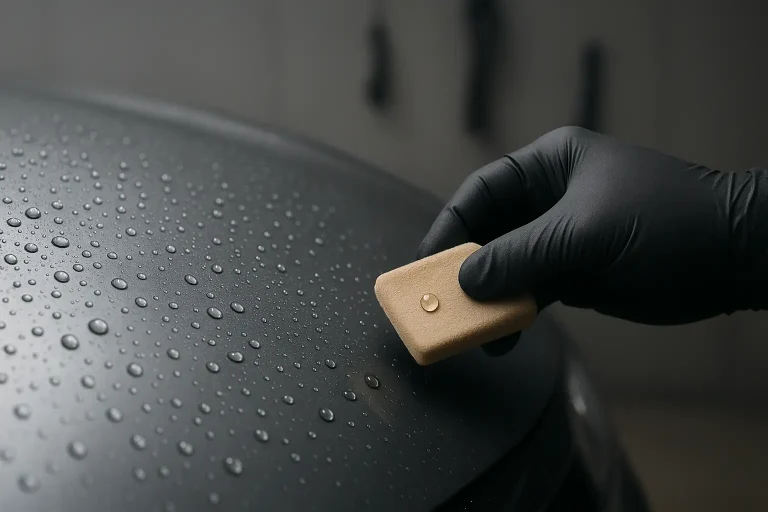
Ceramic coating is a liquid silicon dioxide (SiO2) or titanium dioxide (TiO2) polymer that you apply to the clear coat surface after the vehicle is thoroughly decontaminated and polished. It bonds chemically to the clear coat at the molecular level and cures into a semi-permanent protective layer measuring 1 to 5 microns thick, sitting entirely on top of the existing clear coat.
The key distinction is this: ceramic coating does not replace clear coat. It protects it. Ceramic coating is a sacrificial and semi-permanent shield that absorbs the chemical and environmental damage that would otherwise etch, stain, or oxidize the clear coat beneath it.
Key Specifications (professional-grade ceramic coating):
- Thickness: 1 to 5 microns per coat (professional multi-layer systems reach 5 to 10 microns)
- Hardness: 9H on the pencil hardness scale for top-tier SiO2 coatings
- Hydrophobic contact angle: 100 to 115 degrees (water beads and sheets off the surface)
- Chemical resistance: pH 2 to pH 12 (resists most acidic and alkaline contaminants)
- Longevity: 2 to 5 years for consumer-grade products, 5 to 10 years for professional installation
Ceramic coating works because SiO2 molecules fill the microscopic pores in the clear coat surface, creating a chemically inert, hydrophobic barrier. This happens because silica at the nano-scale forms covalent bonds with the hydroxyl groups on the clear coat surface, anchoring the coating in place rather than simply sitting on top like a wax.
This bonding only occurs when the surface is chemically clean and free of oils, silicones, or polish residue. Apply ceramic coating over a contaminated or swirl-marked surface and the SiO2 bonds to the contamination, not the clear coat, locking those defects in permanently and dramatically shortening the coating’s lifespan.
For a complete walkthrough of the application process, surface preparation requirements, and product comparisons across consumer and professional grades, see our full guide to ceramic coating application and product selection for cars.
The Paint Layer Stack: What Sits Where and Why It Matters
Understanding the physical order of your car’s paint layers prevents every major mistake in paint protection. From the metal outward, the stack is: bare metal, electrocoat primer (E-coat), filler primer, base coat (color layer), clear coat, and (if applied) ceramic coating on top.
Use the table below to understand each layer’s function, thickness, and replaceability before deciding which protection strategy fits your situation.
| Layer | Position | Typical Thickness | Primary Function | Replaceability | Vulnerability |
|---|---|---|---|---|---|
| E-Coat Primer | Layer 1 (on metal) | 15 to 25 microns | Corrosion resistance | Requires full strip to bare metal | Moisture intrusion from chips |
| Filler Primer | Layer 2 | 30 to 50 microns | Adhesion and surface leveling | Panel respray required | Solvent damage during poor resprays |
| Base Coat | Layer 3 | 15 to 25 microns | Color, metallic, or pearl effect | Panel respray required | UV fading without clear coat |
| Clear Coat | Layer 4 (factory top layer) | 40 to 80 microns | Gloss, UV protection, abrasion resistance | Panel respray required | UV oxidation, acid etching, swirl marks |
| Ceramic Coating | Layer 5 (aftermarket) | 1 to 5 microns | Chemical resistance, hydrophobicity, UV barrier | Chemical stripping or light polishing | Mechanical abrasion from improper washing |
| Paint Protection Film (PPF) | Alternative Layer 5 | 150 to 200 microns | Impact resistance, self-healing | Panel-by-panel removal | Edge lifting, yellowing on older films |
The practical implication of this stack is that ceramic coating only works as intended if the clear coat beneath it is in good condition. Ceramic coating cannot stop clear coat that is already oxidizing, peeling, or delaminating from getting worse. It seals the surface in its current state.
Can Ceramic Coating Replace Clear Coat?
Ceramic coating cannot replace clear coat. The two products serve fundamentally different structural roles in the paint system, and no aftermarket ceramic product has the thickness, adhesion chemistry, or UV-blocking capacity to substitute for the factory clear coat layer.
Clear coat is 40 to 80 microns thick. Professional ceramic coatings reach 5 to 10 microns at their thickest. That is an 8x to 16x difference in physical mass, which translates directly into scratch depth tolerance, UV absorption capacity, and physical durability under stone chips and abrasion.
Ceramic coating is also chemically incompatible with bare base coat as a long-term substrate. SiO2 coatings are formulated to bond with the polyurethane chemistry of clear coat, not with the softer, more porous chemistry of automotive base coat. Applied directly to bare color layer, ceramic coating delaminates faster, offers minimal UV protection, and allows base coat fading within 12 to 18 months of exposure.
The only situation where a vehicle has no factory clear coat is when the original paint has been completely repainted using a single-stage enamel (color and gloss in one layer). Single-stage paint was common before the mid-1980s. On these vehicles, ceramic coating is still applied to protect the paint surface, but it must be matched to single-stage paint chemistry and applied by a professional who understands the substrate difference.
If your clear coat is peeling or fully oxidized, the correct sequence is: professional paint correction or panel respray first, then ceramic coating application after the new clear coat has fully cured (typically 30 to 60 days for a body shop respray).
Clear Coat vs Ceramic Coating: A Side-by-Side Comparison
Use the table below to compare clear coat and ceramic coating across every decision-relevant dimension before choosing a paint protection strategy.
| Feature | Factory Clear Coat | Ceramic Coating | Paint Protection Film (PPF) | Carnauba Wax | Synthetic Sealant |
|---|---|---|---|---|---|
| Thickness | 40 to 80 microns | 1 to 5 microns | 150 to 200 microns | 0.1 to 0.5 microns | 0.5 to 1 micron |
| Hardness (pencil scale) | 2H to 3H | Up to 9H | Self-healing polymer | Below 1H | 1H to 2H |
| Hydrophobic contact angle | Not hydrophobic | 100 to 115 degrees | 90 to 100 degrees | 70 to 80 degrees | 80 to 90 degrees |
| Chemical resistance | Low (pH 5 to 8) | High (pH 2 to 12) | Moderate to high | Very low | Low to moderate |
| UV protection | Moderate | High | High | Minimal | Moderate |
| Longevity | Lifetime of vehicle (with care) | 2 to 10 years | 5 to 10 years | 1 to 3 months | 6 to 12 months |
| DIY application | No (factory only) | Yes (with prep) | Professional recommended | Yes | Yes |
| Cost | Included in vehicle price | $500 to $2,500 professional | $1,500 to $7,000 professional | $15 to $50 DIY | $20 to $80 DIY |
| Impact resistance | Low (scratches and chips) | Moderate scratch resistance only | High (self-healing for minor impacts) | None | None |
Ceramic coating wins on chemical resistance and longevity over wax and sealant but does not approach the physical impact protection of paint protection film. For daily drivers in urban environments, ceramic coating over intact clear coat is the most cost-effective combination of protection and durability.
How Ceramic Coating Bonds to Clear Coat at the Molecular Level
Ceramic coating bonds to clear coat through a condensation reaction between the silanol groups (Si-OH) in the liquid SiO2 formula and the hydroxyl groups present on the polyurethane clear coat surface. This reaction forms Si-O-Si covalent bonds, creating a cross-linked silica network that is chemically anchored to the clear coat rather than sitting on top of it like a film.
This covalent bonding is what separates ceramic coating from wax or synthetic sealant. Wax adheres through van der Waals forces (weak temporary molecular attraction). Ceramic coating forms actual chemical bonds that require mechanical abrasion or chemical stripping to break.
The mechanism only works under specific conditions. The clear coat surface temperature must be between 50°F and 85°F (10°C to 29°C) during application. Humidity above 70% slows the curing reaction and can cause the coating to haze or delaminate in sections. Direct sunlight during application causes uneven flash-off, leaving high spots that are visible under artificial light after curing.
The failure mode for incorrect application is permanent. A ceramic coating applied over silicone residue (from older waxes or spray detailers containing dimethicone) bonds to the silicone layer, not the clear coat. The coating appears to cure and look glossy, but it peels within 3 to 6 months because the silicone beneath it has no chemical adhesion to the clear coat. The fix is complete removal by machine polishing back through the ceramic layer, reclaying, IPA panel wipe, and full reapplication.
Does Ceramic Coating Protect Clear Coat from Scratches?
Ceramic coating adds measurable scratch resistance to the clear coat surface, but it does not make your paint scratch-proof. A 9H ceramic coating on the pencil hardness scale resists scratching from materials at or below that hardness level. However, hard minerals in road grit, improper washing technique (dry wiping, dirty wash mitts, automatic car washes with brushes), and key-scratch-level abrasion all penetrate 9H ceramic coating because they involve forces and pressures that pencil hardness testing does not replicate.
The pencil hardness scale measures resistance to a static pencil dragged across the surface under controlled pressure. Road grit dragged across a car panel at speed involves a different combination of force, contact area, and particle hardness. This is why swirl marks still appear on ceramic-coated vehicles that are washed with improper technique, even though the coating tests at 9H.
What ceramic coating genuinely prevents is the chemical etching and micro-marring that causes most real-world clear coat degradation. Bird droppings at pH 3.5 to 4.5, tree sap, industrial fallout, and road salts all etch unprotected clear coat within hours of contact on a hot surface. A ceramic coating rated to pH 2 to pH 12 neutralizes these contaminants before they reach the clear coat, which is the category of damage that permanently removes paint depth without a machine polish.
For daily drivers, the practical scratch resistance benefit of ceramic coating is reduced swirl marks from washing and reduced fine scratches from normal handling. Ceramic coating does not eliminate the need for careful washing technique with a quality microfiber wash mitt and pH-neutral shampoo. It provides a margin of error, not immunity.
What Happens When Clear Coat Fails Before Ceramic Coating Is Applied?
Clear coat failure presents in three stages: oxidation (chalky, dull surface with no gloss), micro-delamination (surface feels rough and gritty, clear coat begins separating), and full delamination (clear coat peels in sheets or chips off panels). Ceramic coating applied at any of these stages does not reverse or stabilize the damage.
Stage 1 oxidation can be corrected by machine polishing with a dual-action polisher and a medium-cut compound before ceramic coating application. The polishing removes the oxidized clear coat layer (consuming 2 to 5 microns of the 40 to 80 available), exposing fresh clear coat beneath. Ceramic coating can then bond to that fresh surface normally.
Stage 2 micro-delamination cannot be reversed by polishing because the adhesion failure is structural, not surface-level. At this stage, professional assessment is required to determine whether the panel can be saved with a clear coat respray or requires a full respray to bare metal.
Stage 3 full delamination always requires a professional panel respray. No aftermarket product repairs peeling clear coat. Products marketed as “clear coat repair sprays” or “DIY clear coat restorers” create a cosmetic surface-level film that peels within weeks because they have no chemical adhesion to the delaminating OEM clear coat beneath them.
The earlier ceramic coating is applied to intact clear coat, the more clear coat thickness is preserved over the vehicle’s life. A ceramic coating applied to a new or recently detailed vehicle with 70 to 80 microns of clear coat remaining gives that coating a full life of protection. A ceramic coating applied at Stage 1 oxidation after machine polishing starts with 65 to 70 microns remaining, which is still adequate for long-term protection.
Consumer-Grade vs Professional Ceramic Coating: What the SiO2 Percentage Means
Ceramic coating products are sold with SiO2 (silicon dioxide) percentage as the primary marketing claim. Consumer-grade spray-on or wipe-on ceramic coatings typically contain 10% to 30% SiO2 by volume. Professional-grade coatings applied by certified installers contain 70% to 95% SiO2 and require controlled application conditions and infrared lamps for proper curing.
Higher SiO2 concentration produces a denser silica network after curing, which directly increases hardness, chemical resistance, and longevity. A 30% SiO2 consumer product applied correctly produces a coating measuring 1 to 2 microns thick with a hardness of approximately 7H and a lifespan of 1 to 3 years. A 90% SiO2 professional product applied in two coats under controlled conditions produces 4 to 6 microns with 9H hardness and a verified lifespan of 5 to 7 years.
Key Specifications (consumer vs professional ceramic coating comparison):
- Consumer grade SiO2 content: 10% to 30%
- Professional grade SiO2 content: 70% to 95%
- Consumer grade cured thickness: 1 to 2 microns
- Professional grade cured thickness: 3 to 8 microns (multi-layer)
- Consumer grade hardness: 6H to 7H
- Professional grade hardness: 9H
- Consumer grade longevity: 1 to 3 years with maintenance
- Professional grade longevity: 5 to 10 years with annual inspection
- Consumer grade cost: $30 to $150 per kit
- Professional installation cost: $500 to $2,500 depending on vehicle size and coating tier
Products like Gtechniq Crystal Serum Ultra (87% SiO2, professional-only), Gyeon Quartz Q2 Mohs, and CarPro Cquartz Professional represent the professional tier. Consumer products like Chemical Guys HydroCharge and Meguiar’s Ceramic Wax are accessible entry points with realistic expectations of 12 to 18 months of enhanced protection before reapplication is needed.
The SiO2 percentage also determines cure sensitivity. High-concentration professional coatings must be applied at temperatures between 60°F and 75°F (15°C to 24°C), buffed within a precise 2 to 5 minute working window per panel section, and cured under infrared lamps at 140°F (60°C) for 30 to 60 minutes. Outside these conditions, the coating cures unevenly, producing streaks, high spots, and areas of poor adhesion that require machine polishing to remove before reapplication.
For most vehicle owners, the practical choice is between a quality consumer-grade product applied correctly every 12 to 18 months, or a one-time professional installation that lasts 5 to 7 years. The total cost over a 10-year ownership period is comparable. The professional installation wins on consistent protection and eliminates reapplication labor.
The Correct Preparation Process Before Applying Ceramic Coating
Surface preparation determines 80% of ceramic coating performance and longevity. The SiO2 bonding reaction cannot occur through contamination, and any defects sealed under the coating are permanently visible because ceramic coating amplifies reflections, making swirl marks and water spots more visible, not less.
The preparation sequence for ceramic coating application has six mandatory stages. Skipping any stage compromises the coating’s lifespan by 30% to 60% depending on the contamination level present.
- Full wash and decontamination: Wash the vehicle twice with a pH-neutral car shampoo formulated for pre-coating prep. The second wash removes surfactant residue from the first. Iron fallout remover (spray-on, color-changing formula) removes ferrous contamination embedded in the clear coat from brake dust and road fallout. This step takes 45 to 90 minutes for an average sedan.
- Clay bar decontamination: Clay the entire vehicle with a fine-grade clay bar and clay lubricant to remove bonded contamination that washing does not lift. Clay bar treatment removes overspray, industrial fallout, and silicone deposits from previous wax or sealant products. Run the clay bar until the paint surface feels completely smooth (like glass) under a clean plastic bag test.
- Paint correction by machine polishing: Use a dual-action orbital polisher with a medium-cut compound on a cutting pad to remove swirl marks, light scratches, and oxidation. Finish with a fine polish on a polishing pad to achieve maximum gloss. This stage is skipped only on brand-new vehicles with undamaged clear coat. On a typical 3 to 5 year old daily driver, paint correction takes 4 to 8 hours and removes 2 to 5 microns of clear coat.
- Panel wipe with IPA solution: Wipe every panel with a 70% isopropyl alcohol solution using a clean edgeless microfiber towel. IPA removes all polish residue, oils from handling, and any remaining silicone contamination. The surface must be fully IPA clean before the SiO2 bonding reaction can occur. Check panels under an LED detailing light at a 45-degree angle to confirm zero haze or residue.
- Surface inspection under light: Inspect every panel under a high-intensity LED inspection light at multiple angles. Any remaining swirl marks, scratches, or water spots visible under this light will be amplified and permanently sealed by the ceramic coating. Return to machine polishing if defects are visible.
- Application within a controlled environment: Apply ceramic coating in a garage or enclosed space free from dust, direct sunlight, and airborne particles. Even a single dust particle landing on the coating during the flash-off window creates a visible inclusion that requires machine polishing to remove. Temperature between 60°F and 80°F (15°C to 27°C) and humidity below 60% are the target conditions.
Proper preparation produces a ceramic coating that achieves full chemical adhesion, maintains consistent thickness across all panels, and delivers the rated hardness and longevity from the product’s specification sheet. A ceramic coating applied to an unprepared surface delivers approximately 30% to 50% of the rated lifespan because the coating bonds to contamination rather than clear coat at multiple points across the surface.
How to Maintain Ceramic Coating Without Damaging the Clear Coat Beneath It
Ceramic coating maintenance requires different products and techniques than uncoated paint care. Using the wrong wash chemicals strips the coating’s hydrophobic layer and degrades the SiO2 network, reducing longevity from years to months.
The three maintenance rules for ceramic-coated vehicles are: always use pH-neutral wash products (pH 6 to 8), never use abrasive clay bars or polishes without confirming they are safe for ceramic coatings, and apply a ceramic coating booster spray every 3 to 6 months to restore hydrophobic performance as the outer layer weathers.
Wash the vehicle using the two-bucket method: one bucket of clean pH-neutral ceramic-safe shampoo solution and one bucket of clean rinse water. Rinse the wash mitt in the rinse bucket after every panel to prevent grit from being dragged back across the coating. Automatic car washes with rotating brushes are incompatible with ceramic coatings because the brush contact causes swirl marks that penetrate the coating into the clear coat on surfaces that receive repeated wash cycles.
After washing, apply a SiO2 ceramic booster spray to a clean, wet or dry surface every 8 to 12 weeks. Booster sprays deposit a thin layer of fresh SiO2 over the cured coating, restoring the contact angle of water repellency as the outer layer of the original coating oxidizes from UV exposure. Without boosters, a 5-year-rated professional ceramic coating loses its hydrophobic performance in 2 to 3 years while the hardness and chemical resistance remain largely intact.
Annual professional inspection and decontamination using a ceramic-safe iron remover and pH-neutral clay alternative keeps the coating surface free of bonded fallout that normal washing does not remove. This extends the rated longevity of the coating and preserves the clear coat beneath it from the contaminants that the coating intercepts daily.
Ceramic Coating vs Paint Protection Film: Which Protects Clear Coat Better?
Paint protection film (PPF) and ceramic coating protect clear coat through completely different mechanisms, and the best choice depends on the type of damage your vehicle is most exposed to. PPF wins on physical impact protection. Ceramic coating wins on chemical resistance, ease of maintenance, and cost per year of protection.
PPF is a thermoplastic polyurethane film measuring 150 to 200 microns thick, applied as a physical barrier between the clear coat and the environment. Self-healing PPF contains a top coat layer that flows back to its original surface state at temperatures above 140°F (60°C), which eliminates light swirl marks and superficial scratches through the film’s own material recovery. PPF absorbs stone chips, parking lot door dings, and road debris impacts that would chip or crack through ceramic coating because it has 30 to 40 times the physical thickness of the thickest ceramic coating.
Ceramic coating applied over PPF is the current best practice for high-value vehicles. The PPF handles physical impact. The ceramic coating on top of the PPF provides hydrophobic performance, chemical resistance, and gloss enhancement that raw PPF film does not deliver on its own.
For typical daily drivers where chemical damage, bird droppings, UV fading, and light swirl marks are the primary concerns, ceramic coating alone over factory clear coat is the most cost-effective protection. For vehicles driven on roads with significant stone chip risk (highway driving, gravel roads), or for high-value vehicles where a single stone chip is a $300 repair, PPF on high-impact zones (hood, front bumper, side mirrors, door edges) with ceramic coating over the rest of the vehicle delivers the most comprehensive protection at a justified cost.
The material science behind why these two products perform differently in their respective categories is explored in detail in our comparison of ceramic and polymer material properties for surface protection.
Common Mistakes That Damage Clear Coat While Applying Ceramic Coating
The application process itself is one of the highest-risk moments for clear coat damage if the preparer is working with incorrect technique, wrong products, or inadequate tools.
Applying too much pressure during machine polishing before ceramic coating is the most common preparatory error. Cutting too aggressively with a heavy-cut compound removes 5 to 10 microns of clear coat per pass. On a vehicle that already has 50 microns of remaining clear coat from previous detailing, aggressive multi-pass polishing can reduce the clear coat to 30 to 35 microns, which is below the threshold where further correction is possible without risking burn-through to the base coat.
Using a rotary polisher without machine polishing experience generates heat that can burn through thin clear coat sections (door edges, hood creases, rocker panels) in seconds. Professional detailers measure clear coat thickness with a paint depth gauge before polishing to identify thin areas. A reading below 90 microns (total paint stack) requires hand polishing or light machine work only at that location.
Applying ceramic coating over uncured compound or polish is the second most common error. Polish residue contains micro-abrasive particles and carrier oils that prevent SiO2 bonding. The IPA panel wipe step is not optional, and the surface must be inspected under intense light after the IPA wipe to confirm zero residue remains before coating begins.
Applying ceramic coating in direct sunlight causes flash-off times to drop from 2 to 5 minutes to under 60 seconds in some products. At that speed, the coating is impossible to buff correctly and cures with uneven high spots. Removing cured high spots requires machine polishing through the ceramic layer, which removes 1 to 2 microns of clear coat in the process.
These application risks are why professional ceramic coating installation typically includes a paint depth measurement report before and after the correction phase, documenting that clear coat thickness was preserved throughout the process.
Ceramic Coating on New Cars: Is the Factory Paint Ready for Immediate Application?
New vehicles from the dealership are not always ready for immediate ceramic coating application. Most manufacturers apply a temporary transport protection wax or spray sealant over the clear coat at the factory or during transport preparation. This layer must be fully removed before ceramic coating bonds correctly to the clear coat beneath it.
New vehicles also arrive with dealership “paint protection” treatments that are almost universally silicone-based spray sealants applied for an up-charge of $300 to $800. These products are not ceramic coating and must be removed by machine polishing before a quality ceramic coating is applied. Silicone contamination left on the surface prevents SiO2 bonding and produces a coating that peels within 3 to 6 months.
The correct process for a new vehicle is: full wash and decontamination to remove transport wax and any dealer treatments, paint depth measurement to confirm factory clear coat thickness (should be 120 to 160 microns total paint stack on a new vehicle), light machine polish with a fine finishing polish to remove any transport-induced marring, IPA wipe, and then ceramic coating application.
Some manufacturers apply a factory ceramic treatment on luxury and performance models. BMW Individual, Mercedes-AMG, and Porsche Exclusive models sometimes ship with factory-applied SiO2 treatments. In these cases, an additional aftermarket ceramic coating bonds to the existing factory ceramic layer rather than the clear coat directly. The compatibility depends on the chemistry of the factory product. A professional installer can test compatibility with a small test section before committing to full application.
How Ceramic Coating Interacts with Ceramic Window Tint
Ceramic window tint and ceramic coating are applied to completely different surfaces and do not interact chemically during normal use. Ceramic tint is applied to the interior surface of the glass (inside the vehicle) using a pressure-sensitive adhesive. Ceramic coating is applied to the exterior painted panels and, in some applications, to the exterior glass surface.
Applying ceramic coating to exterior glass (not tinted) is a separate process from paint ceramic coating. Glass ceramic coating uses a slightly different SiO2 formulation optimized for bonding to silica glass chemistry rather than polyurethane clear coat chemistry. The result is a hydrophobic glass surface that repels rain at speeds above 45 mph (72 km/h) and reduces cleaning time significantly.
Ceramic coating applied to the exterior of a window with ceramic tint on the interior does not damage the tint. The two layers are separated by the glass itself and do not chemically interact. The performance differences between ceramic tint and standard tint relate entirely to infrared rejection and UV blocking, which are separate topics from paint protection. For a direct comparison of those performance differences, see our breakdown of ceramic tint versus standard tint heat rejection and UV performance.
How Much Does Ceramic Coating Cost Compared to Clear Coat Repair?
The cost comparison between ceramic coating application and clear coat repair makes the economics of preventive protection clear. Ceramic coating protects clear coat at a fraction of the cost of repairing it after it fails.
Use the table below to compare the cost of ceramic coating application against the cost of the clear coat damage it prevents, across different vehicle scenarios.
| Scenario | Vehicle Type | Ceramic Coating Cost | Clear Coat Repair Cost (if not protected) | Net Savings Over 5 Years | Recommended Approach |
|---|---|---|---|---|---|
| New daily driver | Compact sedan | $500 to $800 professional | $300 to $800 per panel (2 to 4 panels typical) | $100 to $2,400 | Professional ceramic coating at delivery |
| 3 to 5 year old daily driver | SUV or truck | $800 to $1,500 with paint correction | $1,500 to $4,000 full panel respray | $500 to $2,500 | Paint correction then professional coating |
| High-value vehicle | Luxury or sports car | $1,500 to $3,500 with PPF and ceramic | $3,000 to $10,000+ factory paint respray | $1,500 to $7,000+ | PPF on impact zones, ceramic over full vehicle |
| Weekend/show vehicle | Classic or collector | $1,000 to $2,500 professional | $5,000 to $20,000 full restoration respray | $3,500 to $17,500 | Professional multi-layer ceramic coating |
| Budget DIY approach | Any vehicle | $50 to $150 consumer-grade DIY | $300 to $800 per panel partial respray | $150 to $650 | Consumer ceramic coating every 12 to 18 months |
| Fleet vehicle | Commercial van or truck | $300 to $600 per vehicle (fleet pricing) | $500 to $2,000 per vehicle (paint maintenance) | $200 to $1,400 per vehicle | Consumer or entry-level professional coating |
Clear coat respray costs have increased by 40% to 60% over the past several years due to increased labor rates, material costs, and color-matching complexity on modern multi-stage paint finishes. Preventive ceramic coating is now the most economically rational paint protection decision for any vehicle you plan to own for more than three years.
Frequently Asked Questions About Ceramic Coating vs Clear Coat
Can I apply ceramic coating over a car that already has wax on it?
You cannot apply ceramic coating directly over wax and achieve proper bonding. Wax contains carnauba or synthetic polymers that sit on the clear coat surface as a non-reactive film. The SiO2 in ceramic coating bonds to the hydroxyl groups on the polyurethane clear coat surface, and a wax layer physically and chemically blocks that contact. The coating appears to apply and flash off correctly, but it bonds to the wax layer, not the clear coat, producing a coating with no real adhesion that peels within weeks to months.
Remove all wax residue with a dedicated wax stripper or two passes of IPA wipe (70% isopropyl alcohol solution) before ceramic coating application. A clay bar treatment after the IPA wipe confirms the surface is contamination-free. The clean surface test is a clean water bead that sheets off uniformly rather than forming irregular beads, which indicates remaining wax or contamination in patches.
Does ceramic coating prevent clear coat from peeling?
Ceramic coating prevents the environmental causes of clear coat peeling (UV degradation, acid etching, and oxidation) but it cannot prevent peeling that is caused by original adhesion failure between the clear coat and base coat. These are two different failure mechanisms. Environmental peeling starts at the surface and works inward over years of UV exposure. Adhesion failure peeling starts at the base coat interface and presents as lifting or bubbling before the outer clear coat peels away, regardless of what is on the surface.
Adhesion failures are typically caused by improper original paint preparation at the factory or body shop (contaminated surface before clear coat application, incorrect primer selection, or excessive humidity during painting). Ceramic coating over adhesion-deficient clear coat simply peels off with the clear coat when delamination progresses. It does not reinforce the adhesion bond below it.
Is a 9H ceramic coating actually harder than the factory clear coat?
A 9H ceramic coating is harder than factory clear coat (2H to 3H) on the pencil hardness scale, which is the measurement scale used in coating marketing. Pencil hardness measures resistance to a graphite pencil dragged across the surface at a controlled angle and pressure. A 9H rating means no graphite pencil in the scale (which tops out at 9H) can scratch the surface under those test conditions.
This hardness advantage is real and measurable, but it does not translate to scratch-proof performance under real-world conditions. Pencil hardness testing does not replicate the forces involved in sand particles dragged across a panel, automatic car wash brushes under water pressure, or key contact. The 9H rating correctly indicates that ceramic coating is harder than clear coat but should not be interpreted as scratch immunity for the scenarios that actually damage paint in daily use.
How do I know if my car already has a ceramic coating on it?
Pour a small amount of clean water on a horizontal panel (hood or roof) and observe how it behaves. Water on a ceramic-coated surface forms tight, fast-moving beads with a contact angle above 90 degrees and sheets off the panel with minimal encouragement. Water on bare clear coat or waxed paint spreads into wider, flatter beads or sheets that move slowly. The sharper and tighter the water bead, the more likely a ceramic coating is present.
A more definitive test uses a ceramic coating test spray: apply a small drop of IPA (70%) solution to the panel. On a properly cured ceramic coating, IPA does not dramatically affect the hydrophobic performance immediately. On wax, IPA strips the hydrophobicity instantly and the water behavior changes within one application. A paint shop with a contact angle measurement tool can give you a precise reading of current surface hydrophobicity for a definitive assessment.
Can I polish a ceramic-coated car without damaging the coating?
Light machine polishing with a finishing polish on a light cutting pad removes the outer surface of the ceramic coating and reduces its measured thickness by 0.5 to 1 micron per pass. This is acceptable for a thick, multi-layer professional coating (3 to 8 microns total) but removes a significant fraction of a thin consumer-grade coating (1 to 2 microns) in a single correction session. On a thin consumer-grade coating, a single polishing session can remove the entire coating in treated areas, exposing the bare clear coat and requiring full reapplication.
Compound polishing (medium-cut or heavy-cut) removes ceramic coating completely in treated areas regardless of coating thickness. Use compound polishing before a fresh coating application, not as maintenance on an existing coating. If swirl marks appear on a ceramic-coated vehicle, the correct first step is a pH-neutral maintenance wash to confirm the marks are in the coating (removable) versus in the clear coat beneath (requiring polish). Light swirl marks in a thick professional ceramic coating sometimes resolve partially with a coating-safe spray polish that fills the surface texture without cutting through to the clear coat.
What pH are bird droppings and why do they damage clear coat so fast?
Bird droppings have a pH of 3.5 to 4.5, placing them in the moderately acidic range, but their damage to clear coat comes from a combination of acid chemistry and the physical contraction of the droppings as they dry on a warm surface. As the dropping dries, it contracts and pulls the clear coat surface slightly, creating a topographic impression called a “etch shadow” that is visible as a dull matte patch in the shape of the dropping.
On an unprotected clear coat surface, this etching can occur in as little as 30 minutes on a panel in direct sunlight above 80°F (27°C). On a ceramic-coated surface, the coating’s pH 2 to pH 12 resistance means the acid content of bird droppings does not chemically etch the coating surface during this window. Remove droppings within 24 hours even on a ceramic-coated vehicle. The contraction etching mechanism still applies to ceramic coating at extended contact times (over 48 hours) because the dried dropping eventually exerts physical force that is independent of the coating’s chemical resistance.
Can I apply ceramic coating myself on my driveway or does it need a professional?
Consumer-grade ceramic coatings (10% to 30% SiO2) can be applied at home by a careful, methodical preparer with the right tools and conditions. The application itself is not technically difficult. The surface preparation (washing, decontamination, machine polishing, IPA wipe) requires more skill and more equipment than most vehicle owners have or develop without practice. An incorrectly prepared surface locked under ceramic coating requires professional machine polishing to correct, which costs $200 to $500 and removes 2 to 5 microns of clear coat in the process.
The minimum home application kit requires: clay bar kit, dual-action polisher, polishing compound and finishing polish, multiple foam polishing pads, IPA solution, at least 20 edgeless microfiber towels, LED inspection light, ceramic coating kit, and application suede cloths. Total equipment cost for a first-time application is $150 to $400 before the coating product itself. For a single application, professional installation at $500 to $800 is cost-comparable and eliminates the learning curve risk to your clear coat.
Does ceramic coating affect the color of metallic or pearl paint?
Ceramic coating enhances the appearance of metallic and pearl paint by increasing the depth of gloss and sharpening the reflective clarity of the clear coat surface it sits on. It does not change the color itself because the color pigments and metallic flakes are locked inside the base coat beneath the clear coat, separated from the ceramic coating by 40 to 80 microns of transparent clear coat.
The enhancement occurs because ceramic coating fills the microscopic surface texture of the clear coat, creating a flatter, more mirror-like surface. This increased surface flatness reduces scattered light reflection and increases directional reflection, making metallic flakes appear sharper and more three-dimensional. The effect is most visible on dark-colored metallics (dark grey, navy, black) where depth of gloss is the dominant visual quality. On light-colored vehicles (white, silver), the enhancement is more subtle because those colors have lower contrast between the surface and reflected light.
What is the difference between a ceramic coating and a ceramic spray wax?
Ceramic spray wax products (marketed under names like “ceramic wax,” “SiO2 spray,” or “ceramic quick detailer”) contain 1% to 10% SiO2 suspended in a water-based carrier with wax polymers. They apply and wipe off in minutes and provide 2 to 4 months of mild hydrophobic performance and light chemical resistance. They do not form the covalent Si-O-Si bond structure that defines true ceramic coating because their SiO2 concentration is too low to achieve cross-linked network formation at room temperature curing.
True ceramic coatings require 10% SiO2 (consumer minimum) to 95% SiO2 (professional grade) to form the cross-linked silica network that produces measurable hardness, multi-year durability, and genuine pH resistance. Ceramic spray wax is a maintenance and gloss product, not a protection coating. It adds no measurable hardness to the clear coat surface, provides no protection against bird dropping etching beyond the first hour of contact, and degrades completely within one to two wash cycles using any shampoo that is not pH-perfectly neutral.
Can ceramic coating be applied to a matte or satin paint finish?
Ceramic coating can be applied to matte and satin finishes but requires a formulation specifically designed for low-gloss surfaces. Standard ceramic coatings formulated for gloss finishes fill the micro-texture of the clear coat surface and produce a glossy result because that texture reduction is what creates the mirror-like reflection enhancement on a standard clear coat. Applied to a matte finish, a standard ceramic coating reduces the surface micro-texture that creates the matte effect, partially or fully converting the matte surface to a semi-gloss or gloss appearance, which permanently changes the intended finish character.
Matte-specific ceramic coatings (products like Gtechniq EXO Ultra Durable Hydrophobic Coat or CarPro Cquartz Matte) are formulated to bond to the surface without filling the texture voids that create the matte appearance. These products provide the same hydrophobic and chemical resistance performance as standard ceramic coatings while preserving the original surface texture. Matte paint wraps require the same consideration: use only a ceramic product explicitly rated for matte or satin substrates.
How does humidity affect ceramic coating curing and what is the safe range?
Humidity above 70% slows the Si-OH condensation reaction that cures SiO2 into its solid cross-linked state. Water vapor in the air competes with the surface hydroxyl groups for the silanol molecules in the liquid coating, causing the coating to partially polymerize in the air before fully reaching and bonding to the clear coat surface. The visible result is haze, reduced water repellency in patches, and reduced hardness compared to the same product cured in controlled conditions.
The safe humidity range for ceramic coating application is 30% to 60% relative humidity. Below 30%, the condensation reaction lacks sufficient ambient moisture to complete properly on some product formulations, also producing incomplete curing. Between 60% and 70%, application is possible but working time should be reduced (apply to smaller panel sections, 12 inches by 12 inches rather than full panels) to reduce the window for atmospheric moisture contamination. Above 70% humidity, ceramic coating application should be postponed or moved to a humidity-controlled environment. A basic digital hygrometer for the application workspace costs under $15 and removes all guesswork from ambient condition monitoring.
Is ceramic coating on a car the same chemistry as ceramic coating on industrial surfaces?
Automotive ceramic coatings and industrial ceramic coatings both use silicon dioxide chemistry as their foundation, but the formulation, application temperature, and cured properties differ substantially. Automotive ceramic coatings cure at ambient temperature (60°F to 80°F, 15°C to 27°C) through a room-temperature condensation reaction. They are optimized for flexibility, clarity, and adhesion to polyurethane clear coat surfaces, and they reach their rated hardness within 24 to 48 hours of ambient cure plus optional infrared lamp acceleration.
Industrial ceramic coatings for metal, glass, and ceramics substrates typically require elevated cure temperatures (300°F to 900°F, 149°C to 482°C) to achieve full SiO2 network formation, producing coatings measuring 10 to 100 microns thick with hardness values and thermal resistance far beyond what automotive applications require. The shared chemistry is the silanol bonding mechanism. The engineering parameters, substrate requirements, and performance targets are entirely different fields of application. The name “ceramic” in both contexts refers to the silica-based chemistry of the final cured material, not to any process similarity between the two product categories.
This material science distinction between ceramic-based products in different application contexts is explored in our analysis of how ceramic materials compare to polymer alternatives across industrial and consumer applications.
What happens to ceramic coating in a car wash with hot water?
Hot water (above 140°F, 60°C) does not damage a fully cured ceramic coating and is actually used in professional infrared cure stations to accelerate the SiO2 cross-linking reaction during initial curing. Touchless hot water rinses and steam cleaning are safe on cured ceramic coatings. The thermal stability of cured SiO2 is one of its most useful properties for automotive applications, given that exterior panel temperatures on a vehicle in direct sunlight can reach 160°F to 190°F (71°C to 88°C) on dark-colored surfaces.
The damage risk in car washes comes from the mechanical contact elements (rotating brushes, foam applicator bars) and the high-alkaline detergents used in many commercial conveyor washes. Rotating brushes create swirl marks in the ceramic coating under the water pressure of the wash tunnel. High-alkaline detergents (pH 10 to 13, common in commercial wash formulations) strip the hydrophobic performance layer of the ceramic coating over repeated exposure by attacking the outermost SiO2 bonds, reducing the water contact angle from 110 degrees to 70 to 80 degrees (equivalent to wax performance) within 6 to 12 monthly exposures. Touchless or hand car washes using pH-neutral chemistry are compatible with long-term ceramic coating maintenance.
Ceramic coating is one layer in a complete paint protection system, not a magic shield that eliminates all risk. Clear coat is your car’s most valuable and irreplaceable layer, and ceramic coating’s primary job is to protect it from the environmental and chemical damage that leads to oxidation, etching, and eventually, the peeling and fading that requires a costly panel respray to fix.
Start with a professional paint depth assessment to understand your clear coat’s current condition, correct any defects with proper machine polishing before sealing them under a coating, and choose a SiO2 concentration and application method that matches your vehicle’s value, your ownership timeline, and your budget. The investment in protecting intact clear coat is always a fraction of the cost of replacing clear coat that has been allowed to fail.