Best Ceramic Spray Wax for Cars: Consumer-Grade Protection Picks

Ceramic spray wax for cars is not the same as a traditional carnauba paste wax. It bonds to your paint at a molecular level, adding a sacrificial SiO2 layer that repels water, resists UV degradation, and slices your detailing time in half.
Consumer-grade ceramic spray waxes have closed the gap on professional coatings significantly. Products like Meguiar’s Hybrid Ceramic Wax, Chemical Guys HydroSlick, and Turtle Wax Hybrid Solutions Ceramic Spray deliver genuine SiO2 protection for under $30, applied in minutes on a wet or dry panel.
This guide covers every major consumer ceramic spray wax category: spray-and-rinse formulas, wipe-on spray waxes, ceramic-infused quick detailers, and hybrid carnauba-ceramic blends. For each category, you will find specific SiO2 concentration data where published, application method requirements, durability expectations, and the surface types each product protects best.
What Is Ceramic Spray Wax and How Does It Differ from Traditional Wax?
Ceramic spray wax is a silicon dioxide (SiO2) or silicon carbide (SiC) suspension in a carrier solution. It cross-links with your paint’s clear coat to form a hydrophobic glass-like layer that traditional carnauba wax physically cannot replicate.
Traditional carnauba wax sits on top of the clear coat as a soft film. It produces warm gloss and good water beading, but it breaks down in 4 to 8 weeks under UV exposure, heat, and wash cycles. Ceramic spray wax, by contrast, forms a semi-permanent bond with the paint surface at the nano level, delivering durability measured in months rather than weeks.
The mechanism works because SiO2 particles in suspension are smaller than 100 nanometers. When applied to a warm, clean surface, the carrier evaporates and the SiO2 particles settle into microscopic pores in the clear coat, then cure into a continuous hydrophobic film. This is the same chemistry professional ceramic coatings use, delivered in a diluted, forgiving formula a weekend detailer can apply safely.
The condition required for proper bonding is a clean, decontaminated surface at temperatures between 50°F and 85°F (10°C and 29°C). Apply on a surface contaminated with iron particles or wax residue and the SiO2 cannot contact the clear coat directly. The result is uneven beading, streaking, and premature failure in under 30 days. A clay bar decontamination kit run before application eliminates this failure mode.
Key differences between ceramic spray wax and traditional wax:
- Durability: ceramic spray wax lasts 3 to 12 months; carnauba wax lasts 4 to 8 weeks
- Hydrophobicity: ceramic spray wax produces contact angles of 100 to 110 degrees; carnauba produces 70 to 85 degrees
- Hardness: cured SiO2 layer reaches 3H to 5H pencil hardness; carnauba is soft and scratches at fingernail pressure
- Gloss: carnauba produces warmer, deeper gloss on dark colors; ceramic produces a sharper, more reflective finish
- UV resistance: ceramic SiO2 layers block UV at the coating level; carnauba provides minimal UV protection
- Application ease: most ceramic spray waxes apply in 5 to 10 minutes per panel; paste carnauba requires buffing after a cure period
For most drivers washing their car every 2 to 4 weeks, a quality ceramic spray wax is the highest-value protection product available at the consumer level, combining application ease with durability that paste wax cannot match at any price point.
How Do Consumer-Grade Ceramic Spray Waxes Actually Work?
Consumer ceramic spray waxes work by suspending SiO2 nanoparticles in a water- or alcohol-based carrier at concentrations typically ranging from 1% to 10% SiO2 by weight. The carrier delivers the particles to the surface, evaporates, and the SiO2 cross-links with hydroxyl groups on the paint’s clear coat surface.
This cross-linking reaction is what distinguishes a genuine ceramic product from a marketing label. True SiO2 bonding requires a clean, slightly acidic or neutral surface (pH 5 to 7) and sufficient surface temperature for the carrier to evaporate at the right rate. Too cold and the carrier evaporates too slowly, diluting the SiO2 layer. Too hot and it flashes before the particles settle.
According to research on SiO2 nano-coating adhesion published in Progress in Organic Coatings, the optimal surface temperature for consumer-grade SiO2 suspension bonding is 60°F to 80°F (15°C to 27°C), with cure time reaching full hardness after 24 hours at ambient temperature. This matches the application window stated on most major consumer products.
The practical implication is straightforward. Apply in a shaded garage or on an overcast day. Never apply in direct sunlight on a hot hood. The hood of a black car in July afternoon sun can reach 150°F (65°C), which causes the carrier to flash instantly and leaves SiO2 powder on the surface rather than a bonded film.
Consumer ceramic spray waxes fall into four distinct product types, each with a different SiO2 delivery mechanism:
- Spray-and-rinse ceramic waxes: Applied to a wet vehicle during a wash cycle, rinsed off, and dried. SiO2 concentration is typically 1% to 3%. Application time is 2 to 3 minutes. Durability is 1 to 3 months.
- Wipe-on/wipe-off spray waxes: Applied to a dry panel with a microfiber towel, spread, and buffed off. SiO2 concentration is typically 3% to 8%. Application time is 10 to 20 minutes per vehicle. Durability is 3 to 6 months.
- Ceramic quick detailers: Used between washes as a spray-and-wipe product. SiO2 concentration is typically 1% to 4%. Primarily refreshes existing ceramic protection rather than building a new layer. Durability per application is 2 to 6 weeks.
- Hybrid carnauba-ceramic blends: Combine SiO2 with carnauba wax solids for warm gloss plus enhanced durability. SiO2 concentration is typically 2% to 5%. Durability is 2 to 4 months. Best for drivers who want carnauba warmth without sacrificing all ceramic durability.
Understanding which product type you are buying prevents the most common consumer frustration: expecting 6 months of protection from a spray-and-rinse product rated for 6 to 8 weeks per application. The product type, not the brand name, determines realistic durability expectations.
Best Ceramic Spray Waxes for Cars: Top Consumer Picks by Category
The products below represent the strongest performers across each consumer ceramic spray wax category, evaluated on SiO2 content transparency, application ease, beading performance, and real-world durability reported by verified purchasers.
Best Spray-and-Rinse Ceramic Wax: Meguiar’s Hybrid Ceramic Wax
Meguiar’s Hybrid Ceramic Wax applies to a wet vehicle after washing, requires no buffing, and rinses clean with a final water pass. It is the most accessible entry point into ceramic protection available at consumer retail pricing.
Key Specifications:
- Application method: spray on wet paint, spread with hand, rinse off
- SiO2 content: hybrid Si02 and carnauba formula (exact SiO2 % not published by Meguiar’s)
- Surface compatibility: paint, glass, plastic trim, wheels
- Durability: 3 to 4 months with regular washing
- Price: approximately $18 to $22 for 768mL
- Application time: 3 to 5 minutes per vehicle
The spray-and-rinse mechanism works because Meguiar’s uses a hydrophilic carrier that bonds SiO2 to the wet paint surface before the water film breaks. This is the correct application window: the water film keeps the surface temperature controlled and slows carrier evaporation, allowing SiO2 particles more time to contact the clear coat before the rinse dilutes them.
If you apply this product to a dry panel, the carrier evaporates before the SiO2 particles have adequate contact time. The result is visible streaking and significantly reduced durability. Use it only as directed: after a thorough wash, on a wet surface, before the final rinse.
Best Wipe-On Ceramic Spray Wax: Chemical Guys HydroSlick
Chemical Guys HydroSlick is a concentrated SiO2 hyper-wax delivering some of the most aggressive water beading available in the consumer spray wax segment. It applies dry to a clean panel and buffs to a high-gloss finish in under 20 minutes for an average sedan.
Key Specifications:
- Application method: spray onto panel, spread with microfiber, buff off after 1 to 2 minutes
- SiO2 content: listed as SiO2 and ceramic coating hybrid (Chemical Guys does not publish exact SiO2 %)
- Surface compatibility: paint, glass, chrome, polished metal
- Durability: 6 to 9 months on a maintained surface
- Price: approximately $19 to $24 for 473mL
- Application temperature: 50°F to 85°F (10°C to 29°C)
HydroSlick produces contact angles reported by Chemical Guys at approximately 110 degrees, which puts water beading performance in the same range as entry-level professional spray coatings. The beads sheet off at low angles, keeping the paint drier between washes and reducing water spot formation on hard water.
The failure mode unique to HydroSlick is high-spot formation if buffed too late. The product sets faster than most spray waxes. Buff within 90 seconds of application in temperatures above 75°F (24°C) or the SiO2 carrier hardens into white haze on dark paint. Work one panel at a time in warm weather.
Best Budget Ceramic Spray Wax: Turtle Wax Hybrid Solutions Ceramic Spray Coating
Turtle Wax Hybrid Solutions Ceramic Spray Coating delivers verified SiO2 protection at the lowest price point in the consumer segment, making it the default recommendation for first-time ceramic wax users and drivers on a tight detailing budget.
Key Specifications:
- Application method: spray on, wipe with microfiber, buff off
- SiO2 content: proprietary Si02 blend (Turtle Wax does not publish exact SiO2 %)
- Surface compatibility: all exterior paint, glass, chrome
- Durability: 3 to 6 months depending on wash frequency
- Price: approximately $12 to $16 for 769mL
- Available in: standard and detailer spray formats
Independent testing by detailing communities on forums including Detailing World and AutoGeek has consistently placed Turtle Wax Hybrid Solutions in the top tier for water beading longevity relative to price. It does not match HydroSlick for raw contact angle performance, but it offers comparable protection duration at roughly 60% of the cost.
For the budget-conscious buyer choosing their first ceramic spray wax, Turtle Wax Hybrid Solutions is the product to start with. Once you understand ceramic application technique and surface preparation requirements, stepping up to HydroSlick or a professional spray coating makes sense on a paint-corrected vehicle.
Best Ceramic Quick Detailer: Adam’s Ceramic Spray Coating
Adam’s Ceramic Spray Coating crosses the line between a quick detailer and a standalone ceramic protectant. It works both as a between-wash spray-and-wipe product and as a layerable topper over an existing ceramic base coat.
Key Specifications:
- Application method: spray onto panel, wipe with damp or dry microfiber
- SiO2 content: 15% SiO2 listed on label (one of the highest published concentrations at the consumer level)
- Surface compatibility: paint, glass, wheels, trim
- Durability (standalone): 3 to 5 months
- Durability (as topper over ceramic base): 6 to 12 months cumulative
- Price: approximately $22 to $28 for 473mL
Adam’s stands out among consumer ceramic spray products for publishing a specific SiO2 concentration (15%). Most competitors list SiO2 as a formula component without quantifying it. A 15% SiO2 suspension is genuinely high for a spray-and-wipe consumer product. It explains why Adam’s commands a price premium over Turtle Wax and Meguiar’s competitors in this category.
The layering capability is the feature most buyers underestimate. Apply Adam’s over a professional spray coating or entry-level consumer coat every 60 days and the cumulative SiO2 layer builds in thickness, extending total protection duration well beyond what any single application can achieve.
Best Hybrid Carnauba-Ceramic Wax: Griot’s Garage Ceramic 3-in-1 Wax
Griot’s Garage Ceramic 3-in-1 Wax combines SiO2 ceramic protection with T1 polymer and carnauba wax in a single spray formula. It is the correct product for drivers who value carnauba’s warm, wet-looking gloss on dark paint but want more durability than carnauba alone provides.
Key Specifications:
- Application method: spray on clean, dry paint, spread, buff off
- Protection layers: SiO2 ceramic, T1 synthetic polymer, and carnauba wax
- Surface compatibility: all paint colors, including dark metallic and pearl finishes
- Durability: 4 to 6 months
- Price: approximately $28 to $35 for 710mL
- Best on: dark colors (black, deep blue, dark red) where carnauba warmth is most visible
The mechanism behind the hybrid formula is sequential layering at the molecular level. Carnauba wax solids fill microscopic surface irregularities and scatter light in a way that reads as warm depth. The SiO2 overcoat then cross-links above the carnauba layer, adding hydrophobicity and UV resistance the carnauba alone cannot provide. The result is visually warmer than a pure ceramic product and significantly more durable than pure carnauba.
Pure SiO2 ceramic spray waxes produce a sharper, more mirror-like finish. If you want maximum gloss pop on a white or silver car, choose a pure ceramic spray like HydroSlick. If you want rich, warm depth on a dark car with tolerable detailing frequency, Griot’s Garage 3-in-1 is the correct choice.
Ceramic Spray Wax Comparison: All Top Picks Side by Side
Use the table below to match your application preference, budget, and durability requirement to the right product before buying.
Product Comparison
Consumer Ceramic Spray Wax Comparison: Top Picks at a Glance
Key specs compared across top consumer picks. Prices verified at time of publication.
| Product | Price (approx.) | Application Method | Durability | SiO2 Concentration | Best For |
|---|---|---|---|---|---|
| Meguiar’s Hybrid Ceramic Wax | $18-$22 | Spray-and-rinse (wet) | 3-4 months | Not published | Fastest application, every wash cycle |
| Chemical Guys HydroSlick | $19-$24 | Wipe-on/buff-off (dry) | 6-9 months | Not published | Max beading, high contact angle |
| Turtle Wax Hybrid Solutions | $12-$16 | Wipe-on/buff-off (dry) | 3-6 months | Not published | Best value, first-time users |
| Adam’s Ceramic Spray Coating | $22-$28 | Spray-and-wipe (dry or damp) | 3-12 months | 15% SiO2 | Layering over professional coatings |
| Griot’s Garage Ceramic 3-in-1 | $28-$35 | Spray-and-buff (dry) | 4-6 months | Not published | Dark paint, warm carnauba gloss |
| Sonax Polymer Net Shield | $16-$20 | Spray-and-rinse (wet) | 2-3 months | Not published | Touchless application, waterless wash |
| Gyeon Quartz Q2M Cure | $30-$40 | Wipe-on/buff-off (dry) | 6-12 months | High SiO2 (exact % not published) | Semi-professional finish, experienced users |
Durability ranges reflect normal washing every 1-2 weeks. Aggressive washing with strong detergents reduces all figures by 30-50%. Prices verified at time of publication and may vary by retailer.
For most drivers washing their car every two weeks and parking outdoors, Chemical Guys HydroSlick offers the best combination of application ease and real-world durability in the consumer segment.
How to Apply Ceramic Spray Wax Correctly: Step-by-Step Process
Correct application technique determines whether your ceramic spray wax lasts 3 months or 3 weeks. The most common failure in consumer ceramic wax application is skipping surface preparation, not choosing the wrong product.
Follow the steps below for a wipe-on/buff-off spray wax. Spray-and-rinse products use the same prep steps but replace the buffing stage with a final rinse.
Step-by-Step Guide
How to Apply Ceramic Spray Wax: Complete Application Process
7 steps. Total time: 60 to 90 minutes for an average sedan.
Wash the vehicle thoroughly
Use a pH-neutral car wash shampoo and a two-bucket wash method. Remove all loose dirt, road grime, and existing wax residue before touching the paint with anything abrasive.
Decontaminate the paint surface
Run a clay bar over every painted panel using a clay lubricant spray. Embedded iron particles from brake dust will prevent SiO2 from bonding to the clear coat and cause early failure.
Dry completely
Use a clean microfiber drying towel and remove all water from panel gaps, door jambs, and mirror housings. Any residual water trapped under the ceramic coat creates lifting and uneven cure.
Move to shade and check surface temperature
Confirm the surface temperature is between 50°F and 85°F (10°C to 29°C). Use the back of your hand on the panel: if it feels hot to the touch, wait until it cools. Applying in direct sun or on a hot panel is the single biggest cause of ceramic spray wax failure.
Apply product to one panel at a time
Spray 3 to 4 times directly onto a folded microfiber applicator cloth and spread in overlapping straight lines across the panel. Do not apply in circular motions. Straight-line application produces more even SiO2 distribution and eliminates swirl-pattern haze risk.
Buff off within 60 to 90 seconds
Use a clean, dry microfiber buffing cloth to remove excess product before it hazes over. Work one panel before moving to the next. In temperatures above 75°F (24°C), reduce the window to 45 to 60 seconds per panel.
Allow 24 hours before water exposure
Do not wash the vehicle or allow rain contact for at least 24 hours after application. The SiO2 layer needs this cure window to reach full hardness and hydrophobic performance. Exposing the coat to water before full cure dilutes the cross-linking reaction and reduces durability by up to 50%.
Correct application on a properly decontaminated, temperature-controlled surface consistently produces 30% to 50% longer durability than applying the same product over a surface skipped through decontamination.
When Is Premium Ceramic Spray Wax Worth Paying More For?
Not every budget upgrade produces a meaningful protection improvement. The performance gap between a $15 ceramic spray wax and a $35 option is real in some categories and negligible in others.
The chart below shows where paying for a premium consumer ceramic product produces a genuine return, and where the budget option is sufficient for most drivers.
Value Analysis
When Premium Ceramic Spray Wax Wins and When It Does Not
Performance gap between premium and budget options by protection category
Premium wins big
Premium usually wins
Premium wins big
Premium usually wins
Gap is small
Gap is small
Editorial assessment based on published SiO2 concentrations, community testing data from Detailing World and AutoGeek forums, and manufacturer technical specifications. Not a sponsored ranking.
For daily drivers parking outdoors and washing bi-weekly, a $15 to $20 ceramic spray wax from Turtle Wax or Meguiar’s covers all the bases where the performance gap is small. Spending $30 to $40 on Adam’s or Gyeon only makes sense if you park in direct sun year-round, wash with hard water, or want to layer over a professional base coating.
Consumer Ceramic Spray Wax vs Professional Ceramic Coating: What Is the Actual Difference?
The difference between a consumer ceramic spray wax and a professional ceramic coating is SiO2 concentration, film thickness, and cure hardness. A professional coating like Gtechniq Crystal Serum or IGL Coatings Kenzo uses 30% to 80% SiO2 and cures to 9H hardness over 7 to 14 days. A consumer spray wax uses 1% to 15% SiO2 and cures to 3H to 5H in 24 hours.
That hardness difference matters for scratch resistance. A 9H professional coating resists light swirl marks from automated car washes. A 3H to 5H consumer spray coat resists water spots, UV, and chemical etching but will not stop contact scratches from careless washing. Both are hydrophobic. Both block UV. The professional coating does so for 5 to 10 years. The consumer spray wax does so for 3 to 12 months.
According to data published by IGL Coatings in their product comparison documentation, a professionally applied 9H ceramic coating requires 4 to 6 hours of surface preparation (paint correction, chemical decontamination, and IPA wipe-down) before application, plus 7 days of cure time with no water contact. Consumer ceramic spray wax requires 30 to 60 minutes of preparation and 24 hours of cure. The professional result is better. The consumer process is accessible to anyone.
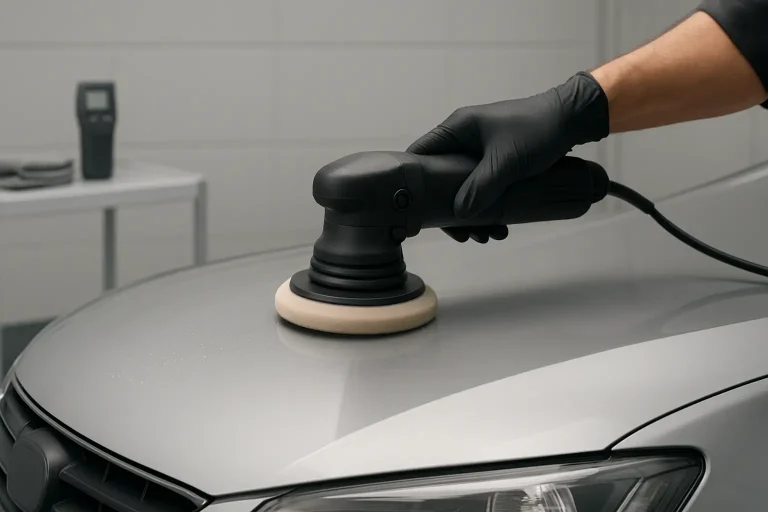
If your paint has significant swirl marks, oxidation, or scratches, a consumer ceramic spray wax seals those defects in permanently. Paint correction must happen before ceramic application, not after. For a vehicle with paint defects, the correct sequence is: machine polish with a dual-action orbital polisher first, then apply ceramic protection. Applying ceramic to defective paint traps the defects under a semi-permanent layer.
For a deeper look at how professional-grade products compare to consumer options across the full protection spectrum, the complete breakdown of professional and consumer ceramic coating brands covers the full tier structure from entry-level spray waxes through installer-exclusive coatings.
How Long Does Ceramic Spray Wax Last? Durability Factors Explained
Consumer ceramic spray wax lasts 3 to 12 months in real-world conditions. The range reflects five variables: washing frequency, wash method, UV exposure, surface preparation quality, and whether the product was applied correctly.
Washing frequency is the single biggest durability factor. Each wash cycle removes a thin layer of the ceramic film through mechanical abrasion and chemical stripping, even with pH-neutral shampoo. A vehicle washed once per week loses ceramic protection approximately 40% faster than a vehicle washed once per month, regardless of the product used.
Wash method matters almost as much as frequency. Automated tunnel washes with rotating brushes are particularly destructive to consumer ceramic coatings. The mechanical abrasion of brushes on the paint surface strips SiO2 bonding within 2 to 4 visits. If you use a tunnel wash and a ceramic spray wax, expect maximum 6 to 8 weeks of meaningful hydrophobicity. Touchless car washes and hand washing preserve the ceramic layer significantly longer.
The five main durability factors ranked by impact:
- Surface preparation quality: Skipping clay bar decontamination reduces expected durability by 30% to 50%. SiO2 not bonded to clear coat fails in weeks.
- Wash frequency and method: Weekly brush tunnel washing cuts durability to 6 to 8 weeks for most products. Monthly hand washing extends it to the maximum published rating.
- UV exposure: Vehicles parked outdoors in high-UV climates (southern US, Australia) lose ceramic protection 20% to 30% faster than garage-parked vehicles.
- Application temperature: Applying outside the 50°F to 85°F window reduces bonding quality and cuts durability by 25% to 40%.
- Layering: A second coat applied 24 hours after the first doubles film thickness and extends durability by 30% to 60% over a single coat.
For a ceramic spray wax to perform at the top of its published durability range, all five factors need to align: decontaminated surface, correct application temperature, two coats applied 24 hours apart, touchless washing, and 2 to 3 week wash intervals.
Ceramic Spray Wax for Different Surfaces: Paint, Glass, Wheels, and Trim
Not all consumer ceramic spray waxes are formulated to perform identically on every exterior surface. The clear coat on painted panels, the borosilicate glass of windshields, the high-temperature alloy of wheels, and the textured plastic of unpainted trim each require a different SiO2 bonding environment.
Applying Ceramic Spray Wax to Glass
Glass is the surface where consumer ceramic spray wax delivers the most immediate and visible performance improvement. A ceramic coat on your windshield causes rain to bead and sheet off at highway speeds without wipers, improving visibility in wet conditions.
Glass application requires a clean, contaminant-free surface. Use an alcohol-based automotive glass cleaner immediately before applying the ceramic product. Silicone residue from interior detailing sprays or contaminated glass cleaner prevents SiO2 bonding on glass more reliably than on paint. If your ceramic wax streaks on glass after buffing, the surface has silicone contamination. Clean with isopropyl alcohol at 70% concentration and reapply.
Not all ceramic spray waxes are labeled for glass use. Adam’s Ceramic Spray Coating and Chemical Guys HydroSlick are both confirmed glass-safe by their manufacturers. Check the label before applying any product to your windshield.
Applying Ceramic Spray Wax to Alloy Wheels
Wheels are the most demanding surface for ceramic spray wax. They reach temperatures of 200°F to 400°F (93°C to 204°C) during aggressive braking, accumulate brake dust at high rates, and contact road chemicals that degrade SiO2 bonding faster than any other painted surface.
A ceramic spray wax on wheels will not last as long as on painted panels. Expect 4 to 8 weeks of maximum protection on wheels driven aggressively, versus 3 to 6 months on the same product applied to door panels. The value is still significant: ceramic-coated wheels resist brake dust adhesion dramatically, making each wash faster and reducing the risk of iron contamination etching the alloy surface.
Use a dedicated iron remover wheel cleaner on wheels before applying any ceramic product. Brake dust contains iron particles that bond to alloy surfaces through a galvanic reaction. An iron remover (which turns purple on contact with iron oxide) removes these particles before you apply a ceramic coat that would otherwise lock them onto the surface permanently.
Applying Ceramic Spray Wax to Unpainted Plastic Trim
Unpainted plastic trim (door handles, bumper trim, mirror housings) is the most problematic surface for consumer ceramic spray waxes. Most SiO2 formulas are optimized for smooth, clear-coated paint surfaces. Applied to porous, textured plastic, they can leave white haze in the grain of the plastic that is very difficult to remove.
Before applying any ceramic spray wax near plastic trim, confirm the product is rated for plastic by the manufacturer. Meguiar’s Hybrid Ceramic Wax is rated safe for plastic trim. HydroSlick is not recommended for uncoated dark plastic trim. For dark plastic trim specifically, a dedicated ceramic-infused plastic trim restorer produces better results than trying to force a paint-formula ceramic spray wax onto a different substrate.
Troubleshooting Ceramic Spray Wax: Common Problems and How to Fix Them
The problems below account for the majority of negative reviews of ceramic spray waxes that are, in practice, user application errors rather than product failures. Each issue has a specific cause and a specific fix.
White Haze or Streaking After Buffing
White haze after buffing is the most reported issue with consumer ceramic spray waxes. The cause is always the same: the SiO2 carrier dried before the product was buffed off, leaving hardened SiO2 powder on the surface instead of a bonded film.
Immediate fix: Apply a light mist of isopropyl alcohol (70%) from a spray bottle directly onto the hazed area. Wait 10 seconds. The IPA re-dissolves the dried SiO2 and allows it to buff off cleanly with a fresh microfiber cloth. Do not use water. Water will not dissolve the dried SiO2 and will spread the haze rather than removing it.
Prevention: Apply the product one panel at a time in temperatures below 80°F (27°C). Buff off within 60 seconds in warm weather, 90 seconds in cool weather. Never apply in direct sunlight on a warm panel.
Product Not Beading After Full Cure
If water is not beading 24 hours after application, the SiO2 did not bond to the paint surface. The cause is almost always surface contamination at the time of application.
The fix requires starting over. Wash the vehicle, run a clay bar to remove embedded contaminants, wipe down with an IPA panel prep solution, and reapply the product at the correct temperature. There is no shortcut: contamination under the ceramic layer cannot be removed without stripping the failed coat first.
Uneven Beading Across Panels
Uneven beading (strong on the hood, absent on the doors) points to inconsistent surface preparation rather than inconsistent application. Panels exposed to more direct sun accumulate iron contamination faster and require more thorough clay bar work to reach bare clear coat.
The solution is panel-by-panel IPA wipe-down after clay bar decontamination. Apply 70% isopropyl alcohol to a microfiber cloth and wipe each panel before applying ceramic. Panels that are properly decontaminated and IPA-prepped show visually obvious differences in gloss compared to contaminated panels. If a panel does not look cleaner after the IPA wipe, it needs more clay bar work.
Ceramic Wax Causing Water Spotting
Water spotting after ceramic wax application indicates hard water mineral deposits forming on top of the hydrophobic layer. The ceramic coat is working correctly. The spots are not etched into the paint. They sit on top of the ceramic surface.
Remove water spots on a ceramic-coated surface with a 1:1 dilution of white vinegar and distilled water applied to a microfiber cloth. Wipe gently and rinse off immediately. Do not use commercial water spot removers formulated for bare paint. Many contain mild abrasives that will strip the ceramic layer rather than remove the mineral deposit sitting on top of it.
Ceramic Spray Wax Maintenance: How to Extend Protection Between Full Applications
Consumer ceramic spray wax does not require monthly full applications to maintain protection. A structured maintenance routine using a ceramic quick detailer spray between full application cycles extends the total protection window significantly without the time investment of a complete reapplication.
The recommended maintenance cycle for most consumer ceramic spray waxes:
- Every wash: Use a pH-neutral, wax-free car wash shampoo. Wax-stripping shampoos degrade SiO2 bonding with every wash cycle.
- Every 30 days: Apply a ceramic quick detailer spray after washing and drying as a topper layer. Products like Gyeon Q2M Cure or Adam’s Ceramic Spray Coating work as topper coats that replenish the SiO2 layer between full applications.
- Every 3 to 6 months: Full wash, clay bar decontamination, IPA wipe-down, and full reapplication of your primary ceramic spray wax product.
This three-tier maintenance approach extends the effective protection window of a $20 ceramic spray wax product to 9 to 12 months before a complete reapplication cycle is necessary. It reduces total product consumption and total time spent detailing over a calendar year compared to monthly full applications.
One maintenance behavior that destroys ceramic protection faster than anything else is using an all-purpose cleaner (APC) for exterior wash duties. APCs typically have a pH between 9 and 12. Consumer SiO2 coatings begin to degrade at pH above 10 with repeated contact. Use only pH-neutral automotive shampoo (pH 6 to 8) on a ceramic-coated vehicle.
Frequently Asked Questions About Ceramic Spray Wax for Cars
Can you apply ceramic spray wax over an existing carnauba paste wax?
Applying ceramic spray wax directly over carnauba paste wax produces poor bonding and dramatically reduced durability, typically 2 to 4 weeks instead of the rated 3 to 6 months. Carnauba wax creates a hydrophobic barrier between the SiO2 particles and the clear coat, preventing the cross-linking reaction that creates durable ceramic protection. Strip the existing wax with an IPA panel wipe-down (70% isopropyl alcohol on a microfiber cloth, wiped across each panel) before applying any ceramic product. The panel should look slightly duller after the IPA wipe. That is the carnauba coming off. Apply the ceramic coat within 30 minutes of the IPA wipe while the surface is chemically clean.
Is ceramic spray wax safe for matte or satin finish paint?
Standard consumer ceramic spray waxes are not safe for factory matte or satin finishes. Gloss-enhancing SiO2 formulas fill the microscopic surface texture that creates a matte appearance, converting it to a partial gloss finish that cannot be reversed without machine polishing. Matte and satin finishes require a dedicated matte-specific ceramic protectant. Products like CarPro Matte Coat or Gtechniq C4 are formulated specifically for satin clear coats and maintain the flat appearance while delivering SiO2 hydrophobic protection. Never apply Meguiar’s Hybrid Ceramic Wax, HydroSlick, or any standard consumer ceramic spray to a matte-wrapped or matte-painted vehicle.
How do you know when your ceramic spray wax protection has worn off?
The most reliable indicator is the water beading test. Spray a small amount of water on your hood from a watering can or hose at low pressure. If the water forms tight, high-contact-angle beads that roll off when you tilt the panel, the ceramic protection is active. If the water sheets across the panel in a flat film or forms low, flat beads that do not move when tilted, the hydrophobic layer has degraded and it is time for reapplication. Do this test after every wash to track protection status in real time. Do not wait until the paint looks dull. Ceramic wax does not affect gloss noticeably as it wears off. Water behavior is the only reliable indicator.
What is the difference between ceramic spray wax and a ceramic coating spray?
The terms are used interchangeably in consumer marketing but refer to products with different SiO2 concentrations and durability expectations. Consumer ceramic spray waxes (like Meguiar’s Hybrid Ceramic Wax) use 1% to 5% SiO2 in a wax or polymer carrier for 3 to 6 month protection. Ceramic coating sprays (like Adam’s Ceramic Spray Coating at 15% SiO2, or Gyeon Q2M Cure) use higher SiO2 concentrations in a dedicated carrier with little or no wax content for 6 to 12 month durability. Both are consumer-applicable. The ceramic coating spray is closer in chemistry to a professional installer coating, though still significantly diluted relative to professional products.
Can ceramic spray wax be applied to a vinyl wrap?
Most consumer ceramic spray waxes are safe for vinyl wraps, with the same matte-finish exception noted above. For gloss vinyl wraps, Turtle Wax Hybrid Solutions and Meguiar’s Hybrid Ceramic Wax are both confirmed wrap-safe by their manufacturers. Avoid products with high solvent or alcohol content in the carrier, as these can lift vinyl wrap adhesive edges over time. Test any new product on an inconspicuous area of the wrap for 24 hours before full application. Vinyl wraps benefit significantly from ceramic protection because the SiO2 layer reduces adhesive contamination from road grime that would otherwise require aggressive chemical cleaners to remove.
Does applying two coats of ceramic spray wax double the durability?
Applying a second coat of consumer ceramic spray wax 24 hours after the first extends durability by 30% to 60%, not by 100%. The second coat bonds to the partially cured first coat rather than directly to the clear coat, building film thickness but not doubling the base bond strength. For most consumer products, two coats applied 24 hours apart and followed by a 24-hour cure before water exposure represents the practical durability maximum without stepping up to a professional coating system. A third coat on top of two produces diminishing returns and is not recommended for consumer spray wax products not specifically marketed as multi-layer systems.
Will ceramic spray wax fill in scratches or swirl marks?
Ceramic spray wax does not fill in scratches or remove swirl marks. It bonds to whatever surface is present, including the inside of scratches, sealing those defects into the paint surface rather than hiding or repairing them. Minor surface swirl marks are slightly less visible under fresh ceramic due to the high-gloss SiO2 layer, but this is an optical effect that disappears as the coating wears. For any paint surface with visible swirl marks, random-orbit machine polishing with a light cutting compound before ceramic application is the correct sequence. Applying ceramic over swirl marks permanently slows your ability to correct them later, as the SiO2 layer must be stripped before polishing.
Is ceramic spray wax food-safe or safe for use on surfaces that contact food?
Consumer ceramic spray waxes for automotive use are not formulated or tested for food contact safety. They contain surfactants, carrier solvents, and SiO2 suspension agents that are not approved by the FDA for food contact surfaces. Do not apply automotive ceramic spray wax to cookware, food preparation surfaces, or any surface that contacts food or drinking water. Ceramic-coated cookware uses entirely different chemistry, a factory-applied PTFE or sol-gel ceramic coating applied at high temperatures, that is unrelated to SiO2 automotive spray products. For cookware protection and maintenance, refer to guidance specific to ceramic non-stick surfaces rather than automotive detailing products.
Can I apply ceramic spray wax in cold weather below 50°F (10°C)?
Applying consumer ceramic spray wax at temperatures below 50°F (10°C) produces poor results because the SiO2 carrier evaporates too slowly at low temperatures, preventing particles from settling and bonding to the clear coat before the product is buffed off. If you must apply in cold conditions, warm the vehicle’s panels with a heat gun or bring the vehicle into a heated garage until panel temperature reaches 60°F to 70°F (15°C to 21°C) before application. Apply one panel at a time and buff off quickly. Extend cure time to 48 hours before water exposure when applying at the lower end of the acceptable temperature range. Never apply on a frost-covered surface. Frost visible on the paint indicates surface moisture that will trap under the ceramic layer and cause bubbling as it evaporates during the cure period.
How many washes can a ceramic spray wax survive before protection drops below useful levels?
Consumer ceramic spray waxes maintain meaningful hydrophobicity for approximately 20 to 30 wash cycles when washed with pH-neutral shampoo and a two-bucket hand wash method. At weekly washing, this corresponds to 5 to 7 months. At bi-weekly washing, it corresponds to 10 to 15 months, though UV degradation limits real-world durability to the product’s rated maximum before wash count becomes the limiting factor. Automated brush tunnel washes reduce the wash cycle threshold to 6 to 10 cycles before hydrophobicity drops below the beading threshold, regardless of the product used.
Do I need to use a specific microfiber cloth for ceramic spray wax application?
The microfiber towel you use for ceramic spray wax application must be a low-pile, high-GSM (grams per square meter) detailing cloth rated at 350 GSM or higher, dedicated exclusively to wax and coating application. Standard household microfiber cloths contain synthetic fibers that shed micro-abrasive particles and contaminate the application surface. Never use a microfiber that has contacted silicone-based products, all-purpose cleaners, or fabric softener in laundry. Silicone contamination on the applicator towel transfers directly to the panel and prevents SiO2 bonding. Dedicated ceramic application towels should be washed only in hot water with no fabric softener and dried without dryer sheets.
Is ceramic spray wax worth using on a 10-year-old car with oxidized paint?
Ceramic spray wax applied to oxidized paint seals the oxidized layer rather than restoring it, producing a glossy oxidized surface that looks slightly better immediately but continues to deteriorate underneath the ceramic coat. Oxidation is a chemical breakdown of the clear coat and base coat layers that no spray wax, ceramic or otherwise, can stop or reverse. A vehicle with visible paint oxidation (chalky, faded appearance, no gloss) requires machine polishing with a cutting compound to remove the oxidized layer and expose fresh clear coat before any protective coating will produce a meaningful result. After successful paint correction, a ceramic spray wax is highly effective at extending the restored surface’s life and slowing future oxidation.
Conclusion
The best consumer ceramic spray wax for your car is the one matched to how you actually wash your vehicle, not the one with the highest price or the most aggressive marketing claims. For weekly wash-and-go drivers, Meguiar’s Hybrid Ceramic Wax spray-and-rinse formula at $18 to $22 is the most time-efficient choice. For drivers seeking maximum durability from a single application, Chemical Guys HydroSlick or Adam’s Ceramic Spray Coating deliver 6 to 12 months of genuine SiO2 protection on a properly prepared surface.
Preparation is the variable that separates a 6-week failure from a 9-month success with any of these products. Clay bar decontamination, IPA wipe-down, and correct application temperature matter more than brand choice. Choose your product, prep the surface correctly, and the SiO2 chemistry does the rest.